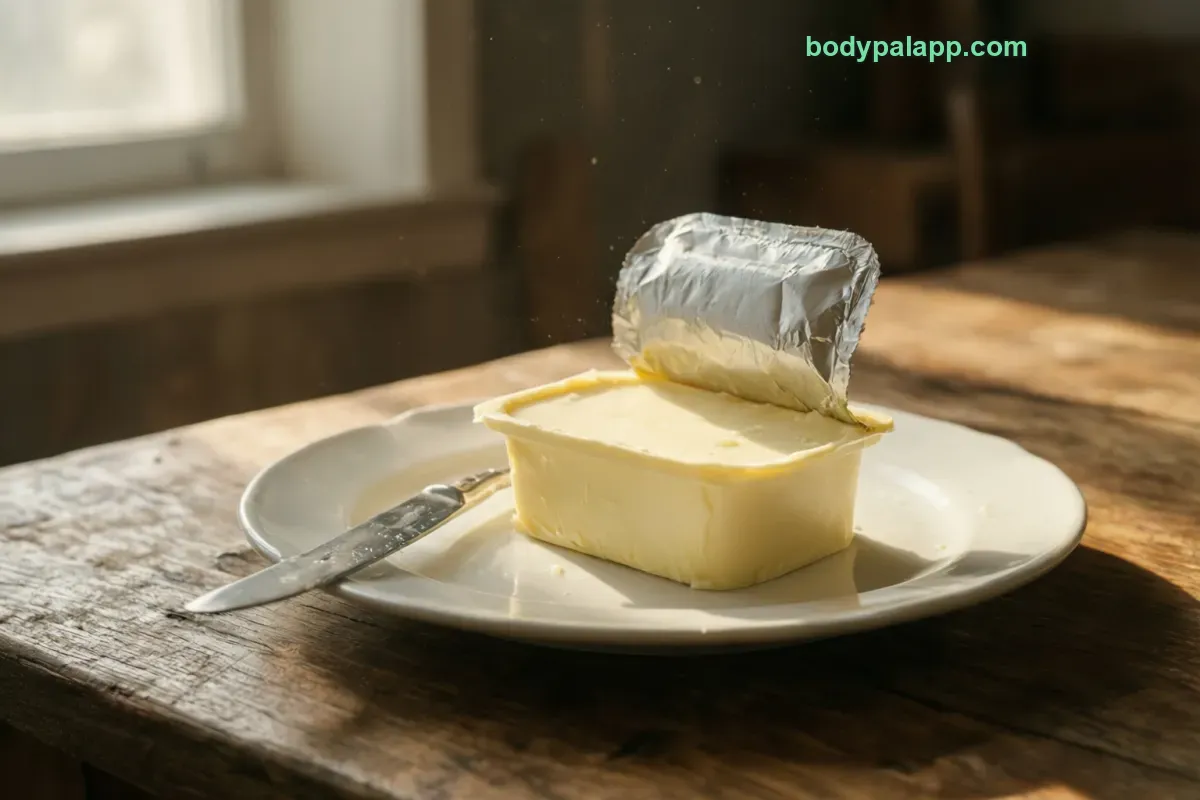
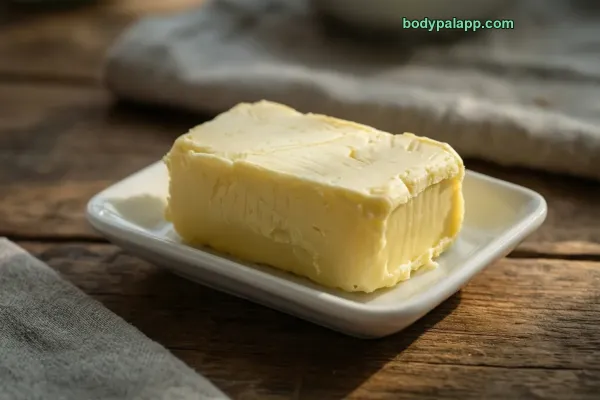
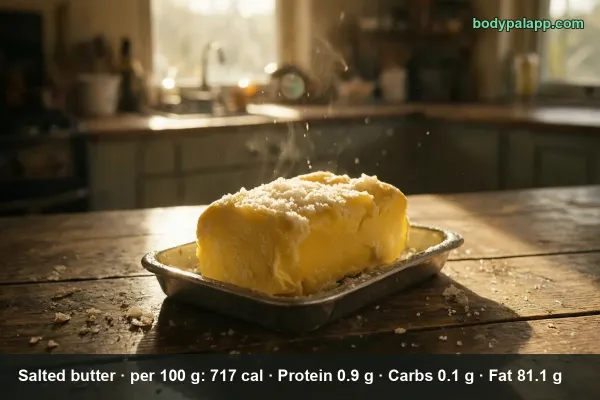
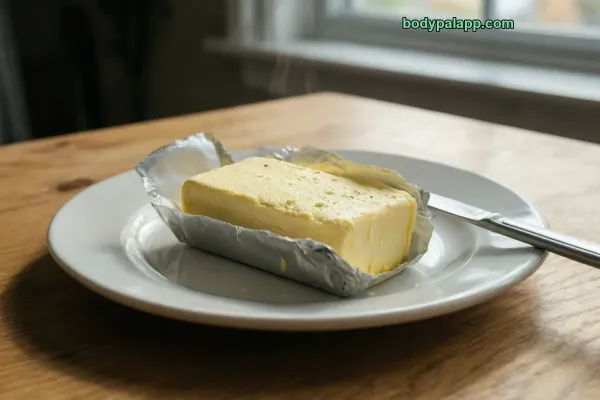
Butter packet calories come to 36 for one 5 g packet and 717 per 100 g. Almost all of that is fat: 4.1 g per packet, with protein and carbs rounding to 0. One packet is small, so what counts is how many you open, not what's inside one.
36kcal
1 packet · 5 g, salted, single-serve packet
0%protein
0 gProtein
0 gCarbs
4.1 gFat
How to burn off 36 kcal
—Walking, brisk
—Jogging
—Cycling, moderate
—Swimming
Skip the math. BodyPal counts these calories from your steps and workouts automatically.
Nutrition facts
Salted, single-serve packet · per 5 g
Calories
36 kcal
Protein
0 g
Carbohydrate
0 g
Fat
4.1 g
Saturated fat
2.6 g
Cholesterol
11 mg
Sodium
32 mg
Potassium
1 mg
Iron
0 mg
Source: USDA FoodData Central
🛡️
Verified nutrition data
Numbers on this page come from USDA FoodData Central, the U.S. Department of Agriculture’s food composition database, and from manufacturer labels where a branded product is named. Last verified September 2026. How we verify our data →
Butter packet: calories, protein and sodium by serving
Percent of daily value uses the FDA reference of 2,000 kcal a day.
Serving
kcal
Protein
Carbs
Fat
Sodium
% DV kcal
1 packet (5 g)
36
0 g
0 g
4.1 g
32 mg
2%
1 tbsp (14.2 g)
102
0.1 g
0 g
11.5 g
91 mg
5%
100 g
717
0.9 g
0.1 g
81.1 g
643 mg
36%
3 × 1 packet (5 g)
108
0.1 g
96 mg
5 × 1 packet (5 g)
179
0.2 g
161 mg
One packet is 36 calories, but packets rarely travel alone
A single 5 g packet holds 36 calories, 4.1 g of fat and 32 mg of sodium. That is 2% of the daily calorie value and 1% of the daily sodium value. On its own, it barely registers.
The trouble is that packets come in piles. Two packets bring 72 calories, three bring 108, and five reach 179 calories with 161 mg of sodium. Butter on both halves of a diner roll, then a second roll, gets you to that higher number before the main course arrives.
For scale, a level tablespoon of butter weighs 14.2 g and carries 102 calories, about what three packets add up to. If you butter at home with a knife, you are probably closer to the tablespoon than the packet. Oddly enough, the packet is the most controlled way to eat butter, because the portion is fixed and you can count the empty wrappers.
Fat supplies 100% of the calories
The calorie split for butter is 100% fat, 0% protein and 0% carbs. Per 100 g, butter carries 81.1 g of fat, 0.9 g of protein, 0.1 g of carbs and 0.1 g of sugars. Fiber is 0.
That makes a packet nearly pure energy with very little else attached. It adds no meaningful protein to a meal and no fiber to slow things down. What it does add is flavor and richness, which is why a small amount goes a long way on bread, vegetables or a baked potato.
If you track macros, log butter as a fat source and nothing else. A packet's 4.1 g of fat is a modest slice of the 78 g fat daily value used on this page. A tablespoon at 11.5 g takes a noticeably bigger bite, and a heavy hand with the knife can push past that without you noticing.
Saturated fat is the row to watch, not sodium
Of the 81.1 g of fat in 100 g of butter, 51.4 g is saturated. The daily value used here for saturated fat is 20 g, so the saturated share is the number that grows fastest as packets pile up. One packet is a small fraction; several are not.
Cholesterol sits at 215 mg per 100 g against a daily value of 300 mg. Sodium is 643 mg per 100 g, which looks high until you scale it down: 32 mg in a packet and 91 mg in a tablespoon. At normal portions, salted butter is a minor sodium source next to the bread it goes on.
If you are watching saturated fat, the practical lever is the number of packets, not the label. Clover Sonoma Salted Butter, Land O'Lakes Butter and other salted butters sit close together, and the USDA row behind this page is plain salted butter.
Make each packet earn its place
Butter works best as a finishing touch rather than a base. One packet melted over steamed vegetables, a baked potato or whole-grain toast adds richness for 36 calories. Spread thin, a packet covers more surface than you might expect.
Pairing butter with foods that bring protein or fiber, such as eggs, beans or vegetables, gives the meal staying power the butter cannot supply on its own. Butter adds calories without adding fullness, so the food underneath has to do that job.
If you are counting calories, decide in advance how many packets you will use, then leave the rest in the basket. BodyPal can log a buttered roll or plate from a photo, so the packets you do use get counted instead of forgotten.
How does butter packet compare?
Here is how a butter packet stacks up against a butter pat, salted butter and a butter stick, per 100 g and per usual serving.
Verdict: A packet and a pat are the same 5 g of butter at 36 calories each, so take whichever the restaurant hands you. The stick runs slightly richer at 743 calories per 100 g but lower in sodium at 524 mg, so it suits home cooks who watch salt and measure their own portions.
Most popular butter packet brands in the United States
Ranked by popularity in the BodyPal database
# Productkcal / 100 g
1Clover Sonoma Salted Butter1 tbsp · 14 g714 kcal
2Land O'Lakes Butter1 tbsp · 14 g714 kcal
3Land O Lakes Salted Butter1 tbsp · 14 g714 kcal
Label servings are 1 tablespoon (14 g) of salted stick butter; single-serve packets are typically 5–10 g, so per-packet calories scale down from the same per-100 g value. Source: manufacturer labels / USDA FoodData Central.
Butter packet FAQs
How many calories are in one butter packet?
A 5 g packet of salted butter has about 36 calories and 4.1 g of fat.
Is butter good for weight loss?
Butter has 717 calories per 100 g, almost all of it from fat (81.1 g). A single 5 g packet adds 36 calories.
Butter packet vs butter pat: which has more calories?
A packet and a 1-inch pat both weigh about 5 g, so each is about 36 calories. A tablespoon (14.2 g) is 102 calories.
How much sodium is in a butter packet?
A 5 g packet of salted butter has about 32 mg of sodium, with 4.1 g of fat and almost no protein or carbs.
How much butter is in a butter packet?
A standard butter packet holds 5 g of butter, which works out to 36 calories and 4.1 g of fat. That is about a third of a tablespoon, which weighs 14.2 g.
How many calories are in a pat of butter?
A pat of butter is 5 g and 36 calories, the same as a single-serve packet. Both are salted butter at 717 calories per 100 g, so you can log them the same way.
How many calories does butter have per 100 g?
Salted butter has 717 calories per 100 g, the USDA FoodData Central value for salted butter. That 100 g also holds 81.1 g of fat, 51.4 g of saturated fat and 643 mg of sodium.
How much fat is in a pat of butter?
A 5 g pat or packet of butter has 4.1 g of fat. Per 100 g, salted butter has 81.1 g of fat, of which 51.4 g is saturated, so most of a pat's fat is saturated.
How many small butter packets equal a tablespoon?
About three. A small packet is 5 g and 36 calories, while a tablespoon is 14.2 g and 102 calories. Three packets come to 108 calories, close to one tablespoon.