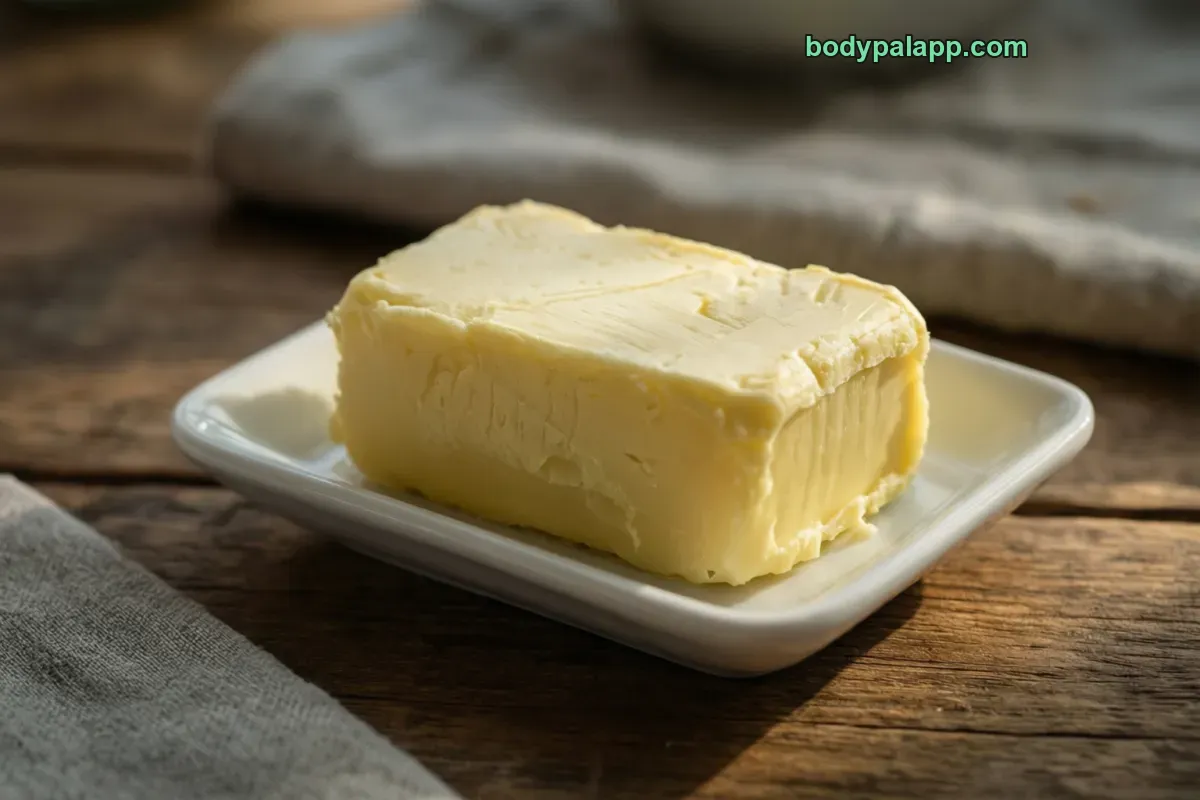
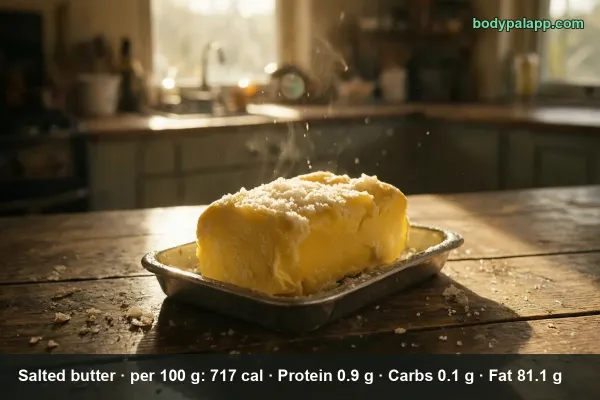
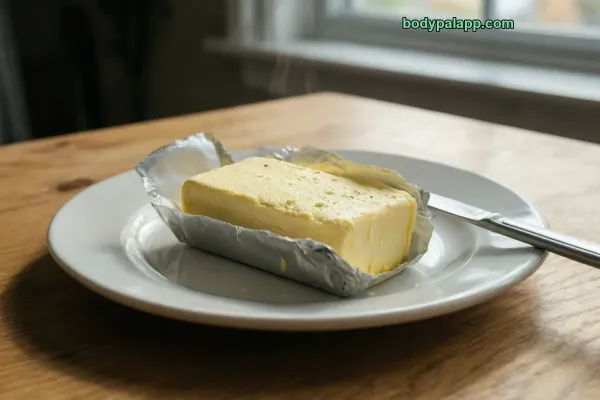
Butter pat calories come to 36 for one 5 g pat of salted butter, and 717 per 100 g. Every one of those calories comes from fat: the calorie split is 100% fat, with essentially no protein or carbs. A single pat is small. The real swing in your total is how many pats land on the plate.
36kcal
1 pat · 5 g, salted
0%protein
0 gProtein
0 gCarbs
4.1 gFat
How to burn off 36 kcal
—Walking, brisk
—Jogging
—Cycling, moderate
—Swimming
Skip the math. BodyPal counts these calories from your steps and workouts automatically.
Nutrition facts
Salted · per 5 g
Calories
36 kcal
Protein
0 g
Carbohydrate
0 g
Fat
4.1 g
Saturated fat
2.6 g
Cholesterol
11 mg
Sodium
32 mg
Potassium
1 mg
Iron
0 mg
Source: USDA FoodData Central
🛡️
Verified nutrition data
Numbers on this page come from USDA FoodData Central, the U.S. Department of Agriculture’s food composition database, and from manufacturer labels where a branded product is named. Last verified September 2026. How we verify our data →
Butter pat: calories, protein and sodium by serving
Percent of daily value uses the FDA reference of 2,000 kcal a day.
Serving
kcal
Protein
Carbs
Fat
Sodium
% DV kcal
1 pat (5 g)
36
0 g
0 g
4.1 g
32 mg
2%
1 tbsp (14.2 g)
102
0.1 g
0 g
11.5 g
91 mg
5%
100 g
717
0.9 g
0.1 g
81.1 g
643 mg
36%
3 × 1 pat (5 g)
108
0.1 g
96 mg
5 × 1 pat (5 g)
179
0.2 g
161 mg
Three pats is a 108-calorie habit
A single pat weighs 5 g and carries 36 calories, about 2% of a 2000-calorie daily value. On its own that barely registers. The catch is that pats rarely travel alone: a dinner roll, a baked potato and a side of vegetables can each pick one up at the same meal.
Two pats come to 72 calories, and three reach 108, which already edges past a level tablespoon at 102. Five pats, or 25 g, land at 179 calories. Nothing about the food changed. The total simply climbs in steady 36-calorie steps with every extra pat.
If you are counting, count pats rather than guessing at a smear. A pat is a fixed, pre-cut portion, which makes it one of the easiest fats to log accurately. BodyPal can log it from a photo of your plate, but the number that matters is still how many pats went on the food.
Every calorie in a pat comes from fat
Per 100 g, salted butter carries 81.1 g of fat, 0.9 g of protein and 0.1 g of carbs. That is why the calorie split reads 100% fat. A pat holds 4.1 g of fat and a tablespoon 11.5 g, set against a daily value of 78 g for fat.
Protein is close to nothing. The card lists 0 g for a pat and 0.1 g for a tablespoon, and even five pats add only 0.2 g. Fiber is 0 and sugars sit at 0.1 g per 100 g. Butter brings flavor and calories, not protein or bulk.
That makes butter a pure add-on. It does little to fill you up by itself, so it earns its place as a finish on foods that already bring protein or fiber. Treat it as seasoning with a calorie cost, and the cost stays easy to see.
Saturated fat is the row to watch
Of the 81.1 g of fat in 100 g of butter, 51.4 g is saturated. The daily value for saturated fat is 20 g, so 100 g of butter holds more than double a full day's worth. A pat keeps this small because the pat is small. A heavy hand does not.
Cholesterol follows the same pattern. Butter has 215 mg per 100 g, against a daily value of 300 mg. Per pat the amount is modest, but it scales with every pat you add, just like the calories do.
Sodium is milder than the word salted suggests. One pat has 32 mg, which is 1% of the 2300 mg daily value, and a tablespoon has 91 mg, or 4%. Five pats add 161 mg. If you watch sodium closely, unsalted butter is the obvious switch, though the numbers on this page are for the salted kind.
Use pats as a finish, not a base
Because a pat is a fixed 5 g, it is easy to plan around. One pat on toast or oatmeal adds 36 calories. Two on a baked potato add 72. Decide the number before the butter dish comes out, not after the potato is already glistening.
Pair butter with foods that supply what it lacks: protein from eggs, fish, poultry or beans, and fiber from vegetables, fruit and whole grains. The butter then does its real job, which is flavor. On hot steamed vegetables, one pat melts and spreads further than you would expect.
If you cook with butter, switch from pats to a measuring spoon. A tablespoon is 14.2 g and 102 calories, roughly three pats' worth, and pan cooking is where unmeasured butter quietly adds up. Brands such as Land O'Lakes and Clover Sonoma sell salted butter in sticks and tubs, so the pat is often something you cut yourself.
How does butter pat compare?
Here is how a butter pat stacks up against a butter packet, salted butter and a butter stick, both per 100 g and per usual serving.
Verdict: A pat and a packet are the same 5 g of butter at 36 calories each, so for tight portion control pick whichever your table offers. A stick is 113 g and 840 calories at 743 per 100 g, so if you cook from a stick, measure it out rather than slicing by eye.
Most popular butter pat brands in the United States
A 5 g pat of salted butter (about 1 inch square and 1/3 inch high) has 36 calories.
Is butter good for weight loss?
Butter is calorie dense at 717 calories per 100 g, almost all from fat. A single 5 g pat adds 36 calories.
Butter pat vs butter stick: how do the calories compare?
A 5 g pat has 36 calories, while a full 113 g stick of salted butter has 810.
How much fat is in a pat of butter?
A 5 g pat has 4.1 g of fat, 32 mg of sodium and almost no carbs or protein.
How many calories are in two pats of butter?
Two pats of butter come to 72 calories. That is 10 g of salted butter with 64 mg of sodium and essentially no protein. Three pats reach 108 calories, a little more than a level tablespoon at 102.
Is a pad of butter the same as a pat?
Yes. Pad is a common way of saying pat, and the numbers are the same: 36 calories for one 5 g pat of salted butter. All of those calories come from fat, 4.1 g per pat.
How much protein is in a pat of butter?
A pat of butter has 0 g of protein listed. Per 100 g, butter has only 0.9 g, and even five pats add just 0.2 g. Butter is a source of fat and flavor, not protein.
What is the nutrition breakdown of a butter pat?
One 5 g pat of salted butter has 36 calories, 4.1 g of fat, 0 g of carbs, 0 g of protein and 32 mg of sodium. That works out to 2% of daily calories and 1% of daily sodium.