
How many calories are in a cannoli?
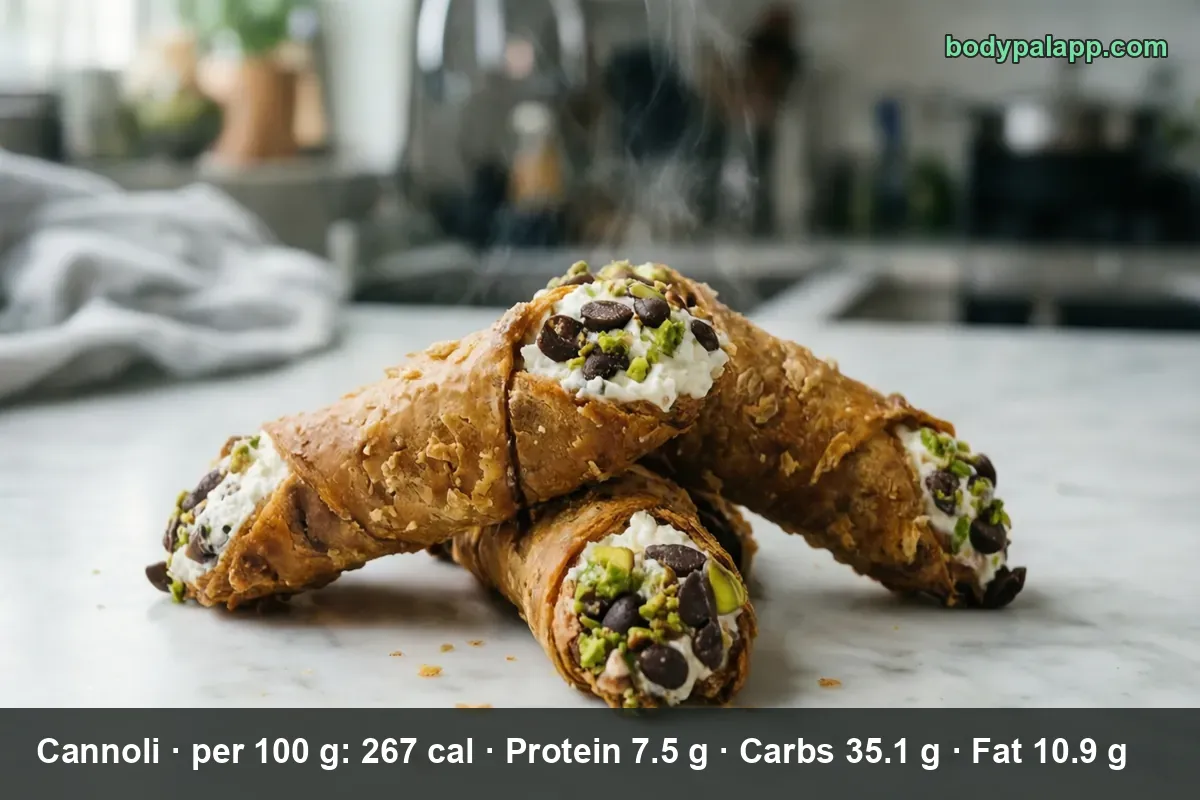
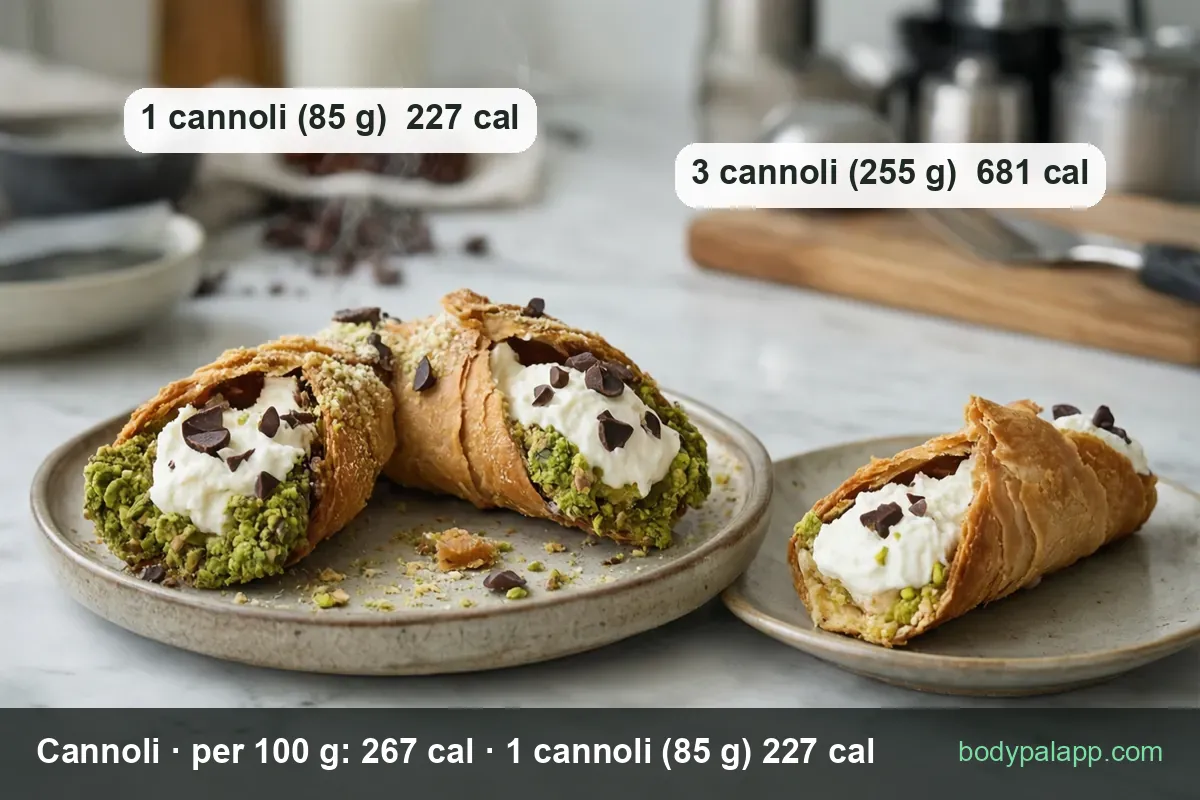
One bakery cannoli weighs 85 g and carries 227 calories. Per 100 g the pastry runs 267 calories, so the plate of three that usually comes out of the box is 681. The wet ricotta filling is what holds that number down, because the fried shell wrapped around it is close to twice as dense.
On this page
- Cannoli quick facts
- US servings, from one ounce to a box of three
- The shell is the dense part, not the filling
- Mini cannoli, shells and cream
- Cannoli cake and cannoli pie are different foods
- Saturated fat is the row to watch
- How does a cannoli compare?
- Most popular cannoli brands
- FAQ
Cannoli quick facts
No USDA record carries the word cannoli in its name. The database files the pastry as FNDDS 2708052, "Pastry, Italian, with cheese", food code 53452200, in the doughnuts, sweet rolls and pastries group. Italian dough around a cheese filling, with a listed serving of one pastry at 85 g: that is a cannoli described in survey language, and it is the only line that covers the shell and the ricotta together rather than one or the other.
| Nutrient | Per 100 g | Per 1 cannoli (85 g) | % Daily Value |
|---|---|---|---|
| Calories | 267 | 227 | — |
| Total fat | 10.94 g | 9.3 g | 12% |
| Saturated fat | 5.14 g | 4.4 g | 22% |
| Carbohydrate | 35.06 g | 29.8 g | 11% |
| Dietary fiber | 0.8 g | 0.7 g | 2% |
| Total sugars | 13.08 g | 11.1 g | — |
| Protein | 7.52 g | 6.4 g | 13% |
| Sodium | 67 mg | 57 mg | 2% |
% Daily Value is based on a 2,000-calorie diet.
Verified nutrition data
Numbers on this page come from USDA FoodData Central, the U.S. Department of Agriculture’s food composition database, and from manufacturer labels where a branded product is named. Last verified September 2026. How we verify our data →
Two rows a packaged label would print are absent, and for the same reason: this FNDDS release publishes no added sugars and no trans fat for the pastry lines. Filling them in from a bakery box would mean stitching one food's label onto another food's record, so they stay out. Total sugars carry no Daily Value on a US label at all, which is why that cell is blank rather than zero.
Two more numbers sit outside the core label but come from the same record. Cholesterol is 38 mg per 100 g, or 32 mg in one cannoli, roughly 11% of the 300 mg Daily Value published by the FDA. Potassium is 190 mg per 100 g, 162 mg in a cannoli, about 3% of the day.
The headline surprise is in the last row. Sodium is 57 mg. For a fried pastry that is almost nothing, and it is the number that separates a cannoli from every other item in the dessert case.
US servings, from one ounce to a box of three
| Serving | Weight | Calories |
|---|---|---|
| 1 oz | 28 g | 75 kcal |
| One cannoli, bakery size | 85 g | 227 kcal |
| Three cannoli, one plate or box | 255 g | 681 kcal |
| Per 100 g | 100 g | 267 kcal |
The 85 g figure is USDA's own household measure for this record, not an estimate of ours, and it matches the standard pastry-case cannoli rather than the tray of small ones. USDA also lists a second, administrative portion of 70 g for cases where the eater could not say how big it was; that works out to 187 calories, but it describes a survey answer, not a size anybody orders.
The row that decides your day is the third one. Cannoli are sold in threes and sixes because they are handed round, and the count moves the total far more than the recipe does. Three of them, 255 g, is 681 calories: a full meal's worth of energy eaten standing at a counter in about four minutes. One is a dessert. Three is lunch.
An ounce of cannoli, at 75 calories, is a useful unit only if you are cutting one in half to share. Nobody weighs a cannoli. Count them instead.
The shell is the dense part, not the filling
Buy a box of empty shells and the label reads far heavier than the finished pastry, which trips up anybody logging from the package in front of them. Alessi hand-rolled shells are 429 calories per 100 g. Cora shells are 545. The finished cannoli, with the cream inside, is 267.
Nothing has been removed to get there. Ricotta cream is mostly water and protein, so filling a shell adds grams faster than it adds calories, and the per-gram figure falls even as the object on the plate gets bigger. Density goes down; the item goes up.
Per piece the arithmetic runs the other way, because a shell is a small thing:
- One Alessi hand-rolled shell, 21 g: 90 calories
- One Cora shell, 22 g: 120 calories
- One filled cannoli, 85 g: 227 calories
Two records from two sources also happen to check each other here. Leonard Novelty cannoli cream is 250 calories per 100 g, and its own label serving of 56 g is 140 calories. An Alessi shell at 90 plus that 56 g of cream comes to about 230, which lands within three calories of USDA's 227 for a whole bakery cannoli. Different databases, same pastry, and the agreement is a good sign that 227 describes a real object rather than a rounding artifact.
The practical version: if you fill your own, log the shell and the cream separately. If somebody hands you one, log 227 and move on.
Mini cannoli, shells and cream
| Version | Per 100 g | Typical piece | Calories |
|---|---|---|---|
| Standard cannoli (USDA) | 267 kcal | 85 g | 227 kcal |
| Mini cannoli, store label | 318 kcal | 44 g | 140 kcal |
| Mini cannoli, at the USDA rate | 267 kcal | 44 g | 117 kcal |
| Mandia whole cannoli, label | 328 kcal | 95 g | 312 kcal |
| Artuso cannoli flats and cream | 333 kcal | 57 g | 190 kcal |
| Unfilled shell, Alessi | 429 kcal | 21 g | 90 kcal |
| Unfilled mini shell, Alessi | 400 kcal | 10 g | 40 kcal |
| Unfilled shell, Cora | 545 kcal | 22 g | 120 kcal |
| Cannoli cream alone, Leonard | 250 kcal | 56 g | 140 kcal |
The two mini rows are worth a second look. A mini cannolo weighs about 44 g, and the branded one comes to 140 calories while the same 44 g at USDA's density would be 117. That 23-calorie gap is a recipe difference, not a disagreement between sources: commercial minis are made with a richer cream so they hold their shape on a tray, and a heavier cream reads straight through to the per-gram figure.
Two minis, then, come to 280 calories against 227 for one full cannoli, so the tray is not the saving it looks like. One mini, at 140, is the swap that actually costs less, and it needs no willpower at all.
The whole branded cannoli at 328 calories per 100 g is a reminder that bakeries differ. Mandia's is a 95 g pastry at 312 calories, over a third more than USDA's standard piece, mostly because it is a bigger pastry with more cream in it.
Cannoli cake and cannoli pie are different foods
The word cannoli now sits on a shelf of products that are not cannoli, and logging them at 227 will understate the plate badly.
- Palermo 7-inch cannoli cake: 438 calories per 100 g. One fourteenth of the cake, 80 g, is 350 calories.
- Luigi's cannoli pie: 372 calories per 100 g. A 78 g piece is 290 calories.
Both are cakes flavored with cannoli cream, built on cake crumb rather than fried shell, and both run heavier per gram than the pastry they are named for. A slice is also cut bigger than a cannoli is rolled. If the ticket says cake or pie, use the cake or pie number.
Chocolate chip and pistachio cannoli need no separate line. The chips and the crushed nuts pressed into the exposed ends sit inside what USDA already measured, and they move the total by less than the size of the pastry does.
Saturated fat is the row to watch
Calories are why people search for cannoli. Saturated fat is the number that actually earns attention.
One cannoli holds 4.4 g of it, which is 22% of the Daily Value, against 11% for carbohydrate and 12% for total fat. A pastry that is unremarkable on calories is carrying a fifth of the day's saturated fat, because whole-milk ricotta and fried dough both contribute to the same row.
Three cannoli make that 13.1 g, about two thirds of the day, alongside 681 calories. The Dietary Guidelines for Americans put saturated fat below 10% of daily calories, which is where the three-at-a-time habit runs into trouble long before the calorie total does.
The rest of the label reads better than you would expect for a dessert:
- Protein 6.4 g per cannoli, 13% of the Daily Value. Ricotta is a cheese, and cheese brings protein that cream and custard fillings do not. Per 100 g, cannoli beat plain cheesecake at 5.29 g, tiramisu at 5.65 g and an iced éclair at 4.41 g.
- Sodium 57 mg, 2% of the day. Cheesecake carries 277 mg per 100 g and an éclair 265 mg, four times the cannoli's 67 mg per 100 g. For anyone counting sodium, this is one of the very few pastries that costs nothing.
- Fiber 0.7 g. White flour and cheese, so essentially none. That is not a fault, only a fact worth knowing if you are using MyPlate targets to fill a day.
How does a cannoli compare?
| Dessert | Per 100 g | US serving | Calories |
|---|---|---|---|
| Cannoli | 267 kcal | one pastry, 85 g | 227 kcal |
| Tiramisu | 353 kcal | one piece, 175 g | 618 kcal |
| Cheesecake, plain | 399 kcal | one slice, 175 g | 698 kcal |
| Éclair, cream filled and iced | 334 kcal | one éclair, 102 g | 341 kcal |
| Panettone | 325 kcal | one slice, 27 g | 88 kcal |
Our take: a cannoli is the lightest of the classic Italian desserts per 100 g, and the gap against cheesecake and tiramisu widens per serving. It is the only one here under 300 calories a piece apart from a thin slice of panettone, and one slice of cheesecake, at 698 calories, costs what three cannoli cost. If you want the smallest number on the dessert menu, take the panettone at 88 calories a slice and accept that it is bread. If you want the thing people came for, the cannoli is the one to order, and it brings more protein and less sodium than the cheesecake or the éclair.
The trap in the same table is the éclair. At 334 calories per 100 g it looks close to a cannoli and reads like a fair swap, but a standard éclair is 102 g against 85, so it lands 114 calories higher with a third less protein. Size does the damage, as usual.
Most popular cannoli brands in the United States
Ranked by how widely each product appears among foods sold in the United States, from the BodyPal food database of over 3.3 million products. Calories are the figures printed on each Nutrition Facts label, checked against USDA FoodData Central.
| Product | Calories (per 100 g) |
|---|---|
| Alessi Hand Rolled Cannoli Shells | 429 cal |
| Alessi Mini Cannoli Shells | 400 cal |
| Cora Cannoli Shells Pastry | 545 cal |
| Artuso Cannoli Flats and Cream | 333 cal |
| Mandia Cannoli | 328 cal |
Brand popularity: BodyPal food database. Nutrition: manufacturer labels / USDA FoodData Central.
Cannoli FAQs
How many calories are in one cannoli?
227 calories for a standard bakery cannoli of 85 g, at 267 calories per 100 g. That piece carries 6.4 g of protein, 29.8 g of carbohydrate and 9.3 g of fat. Three cannoli, the usual boxed plate at 255 g, come to 681 calories.
How many calories are in a mini cannoli?
About 140 calories for a 44 g mini cannolo, using the store label figure of 318 calories per 100 g. At the USDA density for a full-size cannoli, the same 44 g would be 117. Commercial minis use a richer cream, which is where the extra 23 calories come from.
How many calories are in a cannoli shell?
90 calories for one 21 g Alessi hand-rolled shell, and 120 for a 22 g Cora shell. Empty shells run 429 to 545 calories per 100 g, denser per gram than the finished pastry at 267, because there is no wet ricotta filling to dilute them.
What are the nutrition facts for a cannoli?
One 85 g cannoli has 227 calories, 9.3 g fat, 4.4 g saturated fat, 29.8 g carbohydrate, 11.1 g total sugars, 0.7 g fiber, 6.4 g protein and 57 mg sodium. USDA does not publish added sugars or trans fat for this record, so neither is listed here.
How much protein is in a cannoli?
6.4 g in an 85 g cannoli, which is 13% of the Daily Value and 7.52 g per 100 g. That is more than plain cheesecake at 5.29 g per 100 g, tiramisu at 5.65 g and an iced éclair at 4.41 g. The ricotta filling is the reason.
Is a cannoli healthier than cheesecake?
Yes on the numbers: a cannoli is 267 calories per 100 g against 399 for plain cheesecake, and the standard servings are 227 against 698 because a cheesecake slice is 175 g. Cannoli also carry 67 mg of sodium per 100 g where cheesecake runs 277 mg.
How many calories are in cannoli cream?
140 calories in a 56 g label serving, at 250 calories per 100 g. That is the filling on its own, sold for home assembly. A 21 g shell plus that 56 g of cream comes to about 230 calories, close to the 227 USDA gives for a whole bakery cannoli.
How many calories are in three cannoli?
681 calories for three standard cannoli, 255 g in total. That also brings 13.1 g of saturated fat, about two thirds of the Daily Value, which is the number that matters more than the calories. One cannoli is 227 and stays at 22% of the saturated fat allowance.
Similar foods
- Muffin Top — 240 cal per muffin top
- Pizza Bagel — 244 cal per pizza bagel
- Buffalo Wings — 381 cal for 4 wings
- Brownie Sundae — 440 cal per cone
- Chocolate Covered Strawberries — 120 cal per serving
- Hot Pocket — 338 cal per pocket
Count it without the math
Point the camera at the plate and BodyPal counts the cannoli for you, filling and all.


How long does it take to burn off cannoli?
One cannoli (85 g) is 227 kcal. Enter your weight and the amount you ate to see how long it takes you to burn that off:
lb
| Activity | Time to burn 227 kcal |
|---|---|
| Walking, brisk | 45 min |
| Cycling, moderate | 28 min |
| Swimming, moderate | 32 min |
| Jogging | 27 min |
| Weight training, moderate | 50 min |
Times are for a 155 lb adult at a steady pace; change the weight to see yours. The amount is set to the portion in the text (85 g); change it to what you actually ate. BodyPal works this out from your steps automatically.
Want the bigger picture? Calculate your daily calorie needs — your maintenance figure, a target for losing or gaining, and the date you get there.