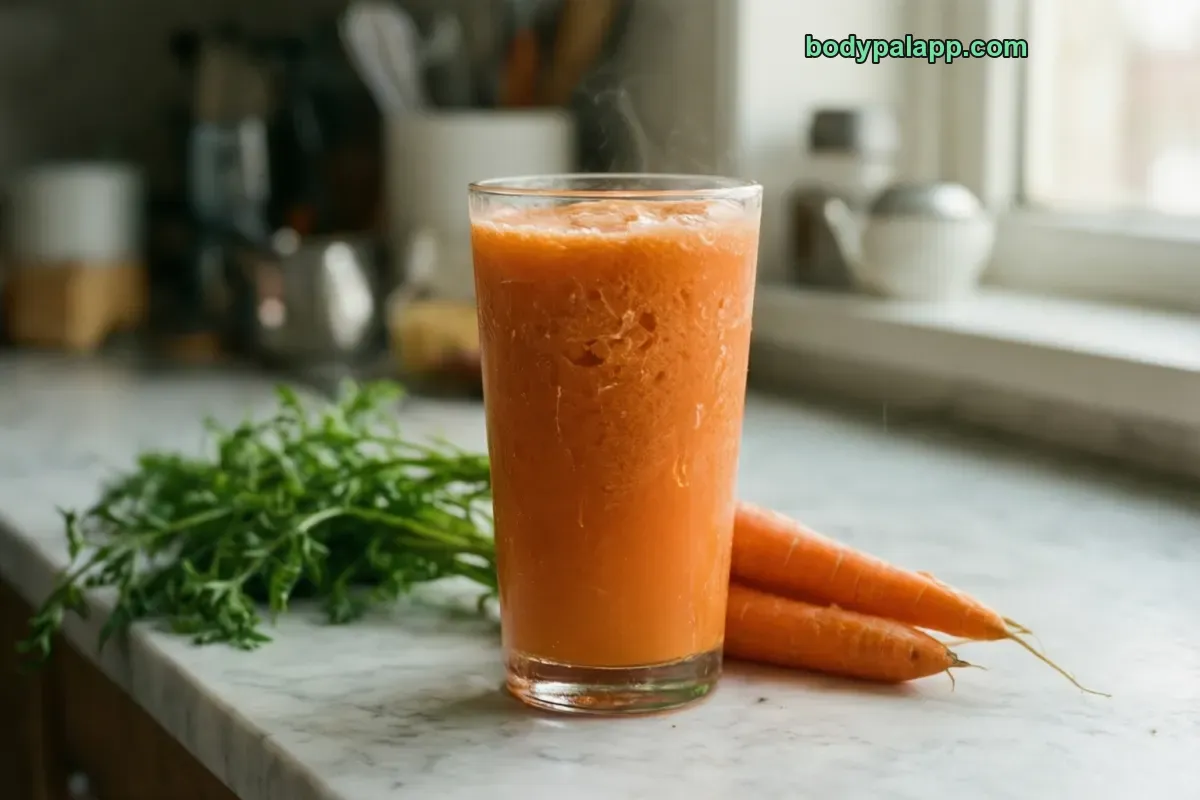
Carrot juice calories come to 94 for 1 cup (236 g) of canned, 100% juice and 40 per 100 g. Nearly all of that energy is carbohydrate: 88% of the calories come from carbs, a cup holds 9.2 g of sugars, and fat barely shows up. How much you pour moves the total far more than anything else.
94kcal
1 cup · 236 g, canned, 100% juice
9%protein
2.2 gProtein
22 gCarbs
0.4 gFat
How to burn off 94 kcal
—Walking, brisk
—Jogging
—Cycling, moderate
—Swimming
Skip the math. BodyPal counts these calories from your steps and workouts automatically.
Nutrition facts
Canned, 100% juice · per 236 g
Calories
94 kcal
Protein
2.2 g
Carbohydrate
22 g
Fat
0.4 g
Saturated fat
0.1 g
Cholesterol
0 mg
Sodium
156 mg
Potassium
689 mg
Iron
1.1 mg
Source: USDA FoodData Central
🛡️
Verified nutrition data
Numbers on this page come from USDA FoodData Central, the U.S. Department of Agriculture’s food composition database, and from manufacturer labels where a branded product is named. Last verified September 2026. How we verify our data →
Carrot juice: calories, protein and sodium by serving
Percent of daily value uses the FDA reference of 2,000 kcal a day.
Serving
kcal
Protein
Carbs
Fat
Sodium
% DV kcal
1 cup (236 g)
94
2.2 g
21.9 g
0.4 g
156 mg
5%
Glass (240 g)
96
2.3 g
22.3 g
0.4 g
158 mg
5%
100 g
40
1 g
9.3 g
0.2 g
66 mg
2%
3 × 1 cup (236 g)
283
6.7 g
467 mg
5 × 1 cup (236 g)
472
11.2 g
779 mg
One cup stays under 100 calories, a big bottle does not
One cup of canned carrot juice weighs 236 g and carries 94 calories, about 5% of the daily value. A standard 240 g glass lands at 96, so the gap between a cup and a glass is close to nothing. Either way, a single pour sits among the lighter drinks you can put next to a meal.
The total climbs quickly once you refill. Two cups (472 g) come to 189 calories, three cups (708 g) reach 283, and five cups, or 1,180 g, add up to 472. That last amount sounds like a lot of juice, yet a large bottle sipped over a day or a juice-only morning can get there without much effort. Liquid calories are easy to miss because nothing about a glass feels like a meal.
The juice itself does not change from glass to glass; only the pour does. If you track calories, measure your usual glass once at home so you know whether you drink closer to 1 cup or closer to two. That single check makes every later entry more honest.
Carbs supply 88% of every calorie
Carrot juice is almost pure carbohydrate by calories. The split runs 88% carbs, 9% protein and 3% fat. Fat barely registers at 0.2 g per 100 g, and protein stays at 1 g for the same amount.
Per 100 g you get 9.3 g of carbs, of which 3.9 g are sugars and 0.8 g is fiber. Scale that to a cup and the label reads 21.9 g of carbs, 9.2 g of sugars and 1.9 g of fiber. The fiber number is modest next to the carbs, and the sugars make up a large part of what is left. If you count carbs rather than calories, a cup of carrot juice is the line that matters, not the calorie figure.
Protein is the weak spot. A cup holds 2.2 g, only 4% of the daily value, so carrot juice adds very little protein to a meal. Treat it as a carb source in your log, the same way you would treat a piece of fruit or a slice of toast, and plan the protein elsewhere on the plate.
Sodium is the row to watch in canned juice
Canned carrot juice carries 66 mg of sodium per 100 g, which is a real number for a drink. A cup brings 156 mg, or 7% of the 2300 mg daily value, and a 240 g glass brings 158 mg. That is not salty in the way a soup or a snack is, but it is more than many people expect from a glass of vegetable juice.
On its own, one glass is a small share of the day. It adds up with refills: two cups reach 312 mg, three cups 467 mg and five cups 779 mg. If you watch sodium, count the juice alongside the rest of your meals instead of treating drinks as free.
Potassium runs higher than sodium, at 292 mg per 100 g against a 4700 mg daily value. Cholesterol and saturated fat are both 0, so those rows need no attention at all. For most readers the sodium line is the only one on the label worth a second look.
Pair a glass with protein, not more juice
Because 88% of the calories come from carbs and protein stays at 2.2 g per cup, carrot juice works best as a side to a meal rather than the meal itself. Pair it with eggs, Greek yogurt, cottage cheese or a sandwich with lean meat if you want breakfast to carry more protein. A second glass of juice adds calories and sugars without changing that picture.
Read the bottle before you log it. Products such as R.W. Knudsen Family Organic Carrot Juice Blend, Royal Montego Carrot Juice Drink and Kuji Carrot Juice Drink With Orange Pulp are blends or juice drinks, so their labels can differ from plain canned juice. Straight juices like Odwalla Organic Carrot Juice or Natalie's Carrot Juice are still worth checking against their own labels. The numbers on this page describe canned, 100% carrot juice.
Logging is quick: BodyPal can log carrot juice from a photo of your glass. Pick the cup or glass serving that matches what you actually poured, and 94 or 96 calories go straight into your day.
How does carrot juice compare?
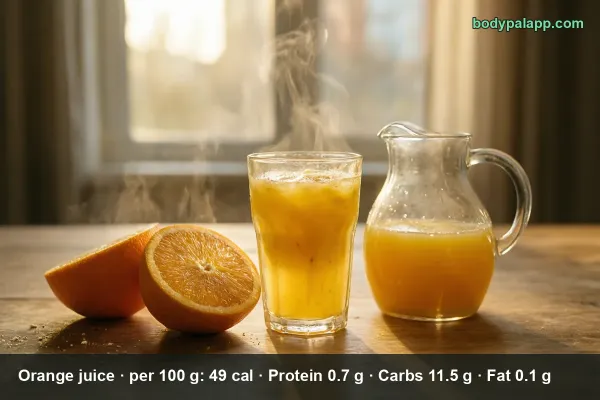
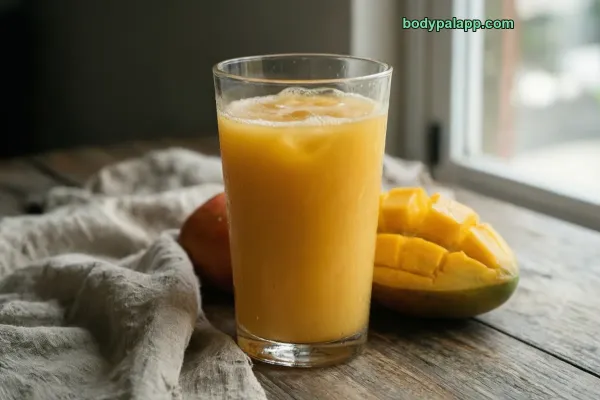
Here is carrot juice next to orange, mango and watermelon juice, shown per 100 g and per usual serving.
Verdict: For the fewest calories pick watermelon juice at 30 per 100 g, while orange and mango juice both sit at 49, about 1.2 times carrot juice. If sodium is your concern, orange juice at 2 mg and watermelon juice at 1 mg per 100 g are the cleaner picks, and carrot juice keeps only a small edge on protein.
Most popular carrot juice brands in the United States
Ranked by popularity in the BodyPal database
# Productkcal / 100 g
1R.W. Knudsen Family Organic Carrot Juice Blend8 fl oz · 240 g29 kcal
2Odwalla Organic Carrot Juice8 fl oz · 240 g29 kcal
3Natalie's Carrot Juice8 fl oz · 240 g33 kcal
4Odwalla Carrot Juice8 fl oz · 240 g29 kcal
5Royal Montego Carrot Juice Drink8 fl oz · 240 g17 kcal
6Kuji Carrot Juice Drink With Orange Pulp4.7 fl oz · 140 g43 kcal
Bottled brands are labeled at 17 to 43 calories per 100 g, because pressed juice and diluted juice drinks are lighter than the canned carrot juice used above. Source: manufacturer labels / USDA FoodData Central.
Carrot juice FAQs
How many calories are in a cup of carrot juice?
One cup (236 g) has 94 calories. A 100 g serving has 40 calories.
Is carrot juice good for weight loss?
A cup is 94 calories with 21.9 g carbs, 9.2 g sugars and 1.9 g fiber. Bottled brands run lower, from 17 to 33 calories per 100 g.
Carrot juice vs orange juice: which has fewer calories?
Carrot juice has 40 calories per 100 g and orange juice 49, so a 236 g cup is 94 calories against 116.
How much sugar is in carrot juice?
Carrot juice has 3.9 g sugars per 100 g, or 9.2 g in a cup (236 g). That cup also holds 21.9 g carbs and 2.2 g protein.
How many calories are in a glass of carrot juice?
A 240 g glass of canned carrot juice has 96 calories, about 5% of the daily value. The same glass brings 22.3 g of carbs, 9.4 g of sugars and 158 mg of sodium.
How many carbs are in carrot juice?
Carrot juice has 9.3 g of carbs per 100 g and 21.9 g per 1 cup (236 g). Of the carbs in a cup, 9.2 g are sugars and 1.9 g is fiber, with almost no fat alongside.
Is carrot juice fattening?
Carrot juice has just 0.2 g of fat per 100 g, and fat supplies only 3% of its calories. A cup is 94 calories, so the total depends on how many cups you pour: five cups reach 472.
What are the macros in carrot juice?
By calories, carrot juice is 88% carbs, 9% protein and 3% fat. One cup gives 2.2 g of protein, 21.9 g of carbs and 0.4 g of fat for 94 calories.
What are the nutrition facts for carrot juice?
Per 100 g, canned carrot juice has 40 calories, 1 g of protein, 9.3 g of carbs, 0.2 g of fat, 66 mg of sodium and 292 mg of potassium. Cholesterol is 0.