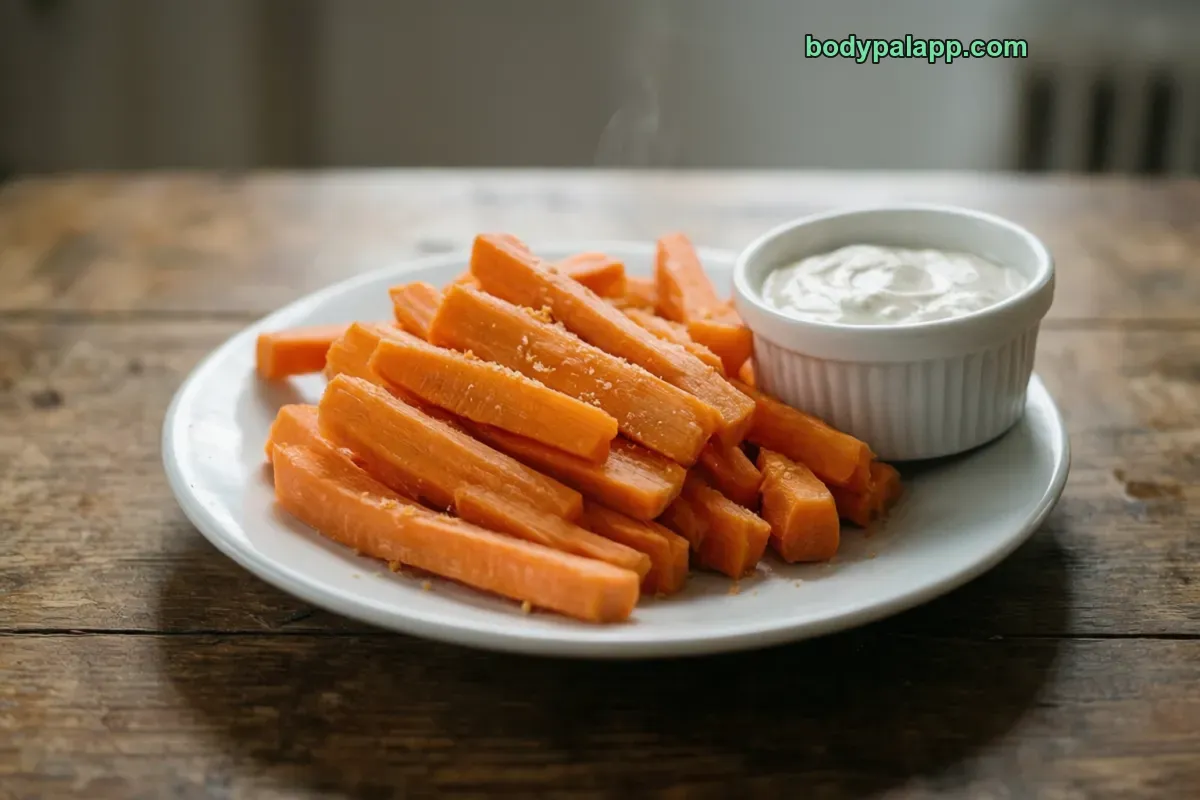
Carrot stick calories come to 50 for 1 cup (122 g) of raw sticks, and 41 per 100 g. A single 7 g stick has just 3. The thing to notice is volume: carrots are mostly water and carbohydrate, so even a heaping bowl stays small on calories while delivering real crunch and 3.4 g of fiber per cup.
50kcal
1 cup · 122 g, raw, cut into sticks
8%protein
1.1 gProtein
12 gCarbs
0.3 gFat
How to burn off 50 kcal
—Walking, brisk
—Jogging
—Cycling, moderate
—Swimming
Skip the math. BodyPal counts these calories from your steps and workouts automatically.
Nutrition facts
Raw, cut into sticks · per 122 g
Calories
50 kcal
Protein
1.1 g
Carbohydrate
11.7 g
Fat
0.3 g
Saturated fat
0 g
Cholesterol
0 mg
Sodium
84 mg
Potassium
390 mg
Iron
0.4 mg
Source: USDA FoodData Central
🛡️
Verified nutrition data
Numbers on this page come from USDA FoodData Central, the U.S. Department of Agriculture’s food composition database, and from manufacturer labels where a branded product is named. Last verified September 2026. How we verify our data →
Carrot stick: calories, protein and sodium by serving
Percent of daily value uses the FDA reference of 2,000 kcal a day.
Serving
kcal
Protein
Carbs
Fat
Sodium
% DV kcal
1 cup (122 g)
50
1.1 g
11.7 g
0.3 g
84 mg
3%
1 stick (7 g)
3
0.1 g
0.7 g
0 g
5 mg
0%
Baby-cut (85 g)
30
0.5 g
7 g
0.1 g
66 mg
1%
100 g
41
0.9 g
9.6 g
0.2 g
69 mg
2%
3 × 1 cup (122 g)
150
3.4 g
253 mg
5 × 1 cup (122 g)
250
5.7 g
421 mg
Even five cups of sticks stay at 250 calories
A single carrot stick weighs about 7 g and carries 3 calories, so counting sticks one by one is mostly pointless. A cup of sticks, about 122 g, comes to 50 calories, which is 3% of the daily value for calories. A snack pack of baby-cut carrots at 85 g lands at 30 calories.
The total climbs in a straight line, and slowly. Two cups are 100 calories, three cups are 150, and five cups, a full 610 g of raw carrot, reach 250. That last amount is more than most people chew through in one sitting. With carrots, the ceiling on calories is set by your jaw and your patience, not by the vegetable.
What really moves the number is what the sticks go into. Ranch, hummus, peanut butter or a cheese dip can easily outweigh the carrots themselves on calories, so log the dip as its own entry. BodyPal can log a plate of carrot sticks and dip from a photo, which keeps the two apart.
Carbs supply 87% of the calories
Almost every calorie in a carrot stick is carbohydrate. The calorie split is 87% carbs, 8% protein and 5% fat. Per 100 g that means 9.6 g of carbs, 0.9 g of protein and 0.2 g of fat, with saturated fat and cholesterol both at 0.
Within those carbs, sugars make up 4.7 g per 100 g and fiber 2.8 g. A cup of sticks holds 11.7 g of carbs, 5.8 g of sugars and 3.4 g of fiber. That sugar is the natural kind found in the root, and it is why raw carrots taste sweet without anything added. The fiber is part of why a cup feels like more food than 50 calories suggests.
Protein is the weak spot. A cup gives 1.1 g, only 2% of the daily value, and even five cups add up to just 5.7 g. Carrot sticks fill a crunchy-snack slot well. They do not hold you over the way a protein food does.
Baby-cut carrots run a little saltier per gram
Raw carrots are not a sodium-free vegetable. The USDA row for raw carrots lists 69 mg of sodium per 100 g, so a cup of sticks brings 84 mg, or 4% of the daily value. That is low, but it is noticeably more than onion or snap peas, which sit at 4 mg per 100 g.
Baby-cut carrots, the peeled and polished kind sold in bags by brands like Bunny-Luv and Grimmway Farms, come from a separate USDA entry. An 85 g serving has 30 calories and 66 mg of sodium, which is 3% of the daily value. Gram for gram, that is a touch higher in sodium than sticks you cut yourself, and slightly lower in calories.
Neither difference matters much on its own. If you watch sodium closely, the dip and any salted crackers alongside will move the total far more than the carrots. Potassium is the other side of the ledger here: raw carrots carry 320 mg per 100 g.
Treat carrot sticks as volume, then add protein
Carrot sticks work best as the bulk of a snack rather than the whole snack. A cup at 50 calories gives you something to crunch on while a protein or fat source does the job of keeping you full. Pairing sticks with a portion of Greek yogurt dip, a hard-boiled egg or a measured spoon of nut butter covers what the carrots lack.
They also travel well. Pre-cut bags from Cal-Organic Farms, Signature Farms or Baby Delites need no prep, and a couple of handfuls in a lunchbox replace chips with a fraction of the calories. If you are counting, weigh a cup once so you know what it looks like, then estimate from there.
For dinner sides, raw sticks and cooked carrots are close enough that preference can decide. Cooked carrots come in a bit lower per 100 g, while raw sticks keep their snap and take longer to eat.
How does carrot stick compare?
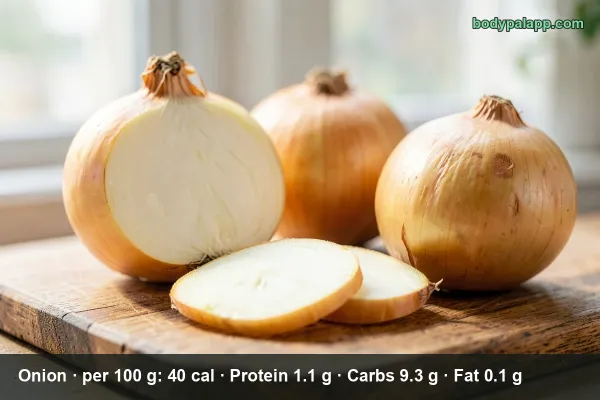
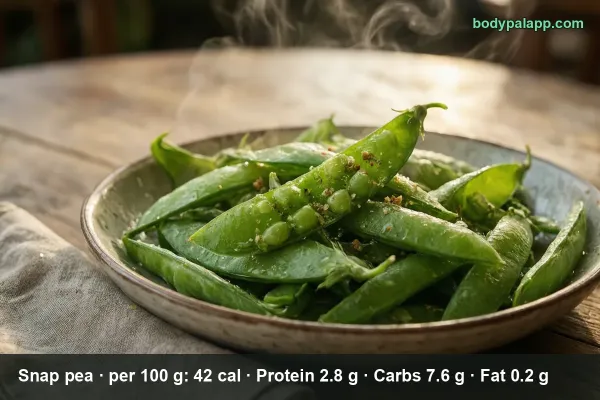
Here is how raw carrot sticks stack up against cooked carrots, onion and snap peas, per 100 g and per usual serving.
Verdict: For the fewest calories per bite, cooked carrots win at 35 per 100 g against 41 for raw sticks. For a crunchy snack with more protein at almost the same cost, pick snap peas, which carry 2.8 g per 100 g against 0.9 g at 42 calories.
Most popular carrot stick brands in the United States
7Pictsweet Farms Sliced Carrots2/3 cup · 85 g47 kcal
These packs are raw carrots like the numbers above, so the small gaps are label rounding, and baby-cut packs read slightly lower at 35 to 41 calories per 100 g. Source: manufacturer labels / USDA FoodData Central.
Carrot stick FAQs
How many calories are in carrot sticks?
A cup of carrot sticks (122 g) is about 50 calories, and one large 3-inch stick (7 g) is 3 calories.
Are carrot sticks good for weight loss?
A full cup is 50 calories with 3.4 g of fiber and only 0.3 g of fat, and a 3 oz snack portion (85 g) is 35 calories.
Carrot sticks vs cooked carrots: which has fewer calories?
Raw carrot sticks are 41 calories per 100 g and cooked carrots 35 calories per 100 g, so a cup of sticks at 50 calories is close either way.
How many carbs and how much sugar are in carrot sticks?
A cup (122 g) has 11.7 g of carbs, of which 5.8 g are sugars, plus 3.4 g of fiber and 1.1 g of protein.
How many calories are in one carrot stick?
One carrot stick of about 7 g has 3 calories, with 0.7 g of carbs and 0.2 g of fiber. You would need a full cup of sticks, about 122 g, to reach 50 calories.
How many calories are in a serving of baby carrots?
An 85 g serving of baby-cut carrots has 30 calories, 7 g of carbs, 2.5 g of fiber and 66 mg of sodium. That is 1% of the daily value for calories.
How much fiber is in a cup of carrot sticks?
A cup of carrot sticks (122 g) has 3.4 g of fiber. Per 100 g, raw carrots carry 2.8 g of fiber alongside 4.7 g of natural sugars.
How much protein do carrot sticks have?
Very little: a cup of carrot sticks has 1.1 g of protein, just 2% of the daily value. Protein supplies only 8% of the calories, so pair the sticks with a protein food.
How many calories are in two cups of carrot sticks?
Two cups of carrot sticks, about 244 g, come to 100 calories, with 168 mg of sodium and 2.3 g of protein. Three cups reach 150 calories.