
How many calories are in an onion?
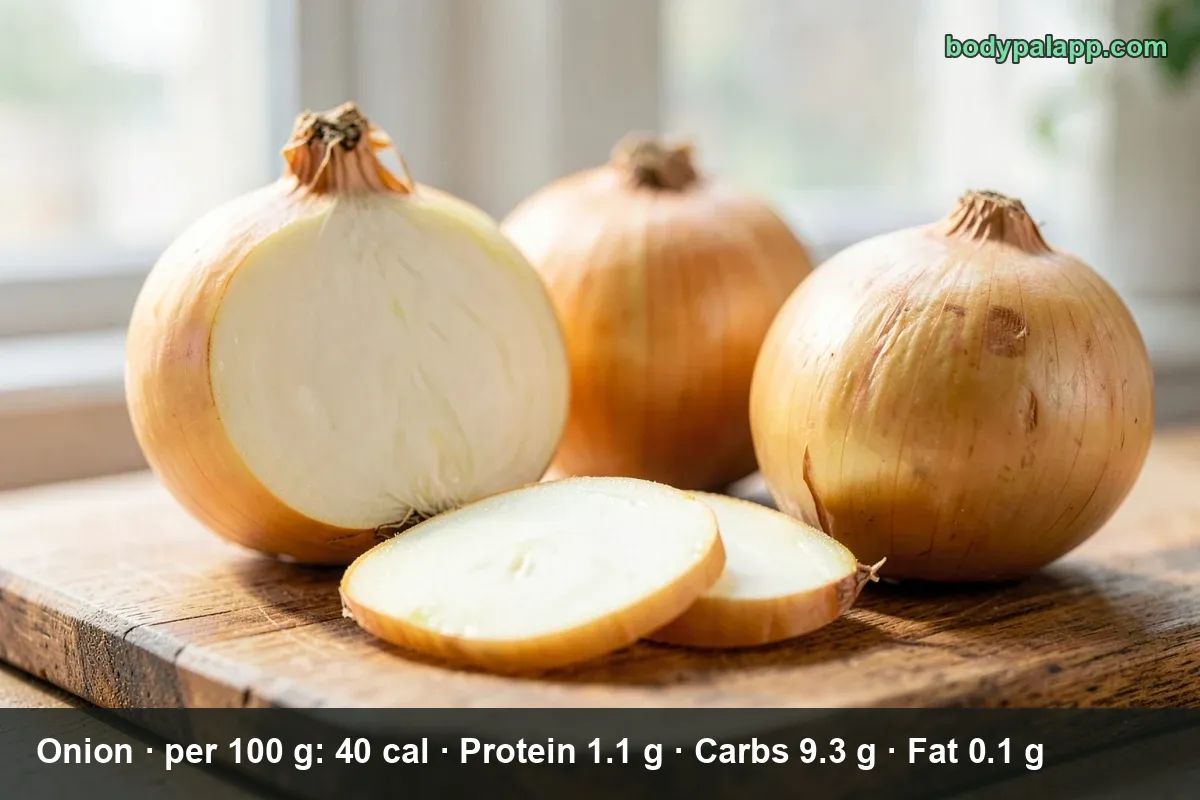
One cup of chopped raw onion weighs 160 g and carries 64 calories. Raw onion runs 40 calories per 100 g, which puts it among the lightest things you can add to a pan. A whole medium bulb is 44. The calories in onion dishes almost always come from what you cook it in.
On this page
- Onion quick facts
- US onion servings, from one ounce to a full cup
- Caramelized, boiled and battered onions
- Yellow, red, white and sweet onions
- Fiber, sugar and the sodium that shows up later
- How does an onion compare?
- Most popular onion brands
- FAQ
Onion quick facts
The record behind every number on this page is SR Legacy 170000, "Onions, raw". It is the entry to use when you are holding a bulb onion, because it is the only raw-onion record that also carries a full set of household measures: cup chopped, cup sliced, small, medium and large bulbs. Someone typing "calories in onion" is almost never asking about a dressing or a soup. They have an onion on the cutting board.
There are other raw-onion entries in FoodData Central, and they disagree by a couple of calories. That is varieties and sampling, not a different food. The variety table further down puts those side by side instead of averaging them, which would only invent a number nobody measured.
| Nutrient | Per 100 g | Per 1 cup chopped (160 g) | % Daily Value |
|---|---|---|---|
| Calories | 40 | 64 | — |
| Total fat | 0.1 g | 0.2 g | 0% |
| Saturated fat | 0.04 g | 0.1 g | 0% |
| Carbohydrate | 9.34 g | 14.9 g | 5% |
| Dietary fiber | 1.7 g | 2.7 g | 10% |
| Total sugars | 4.24 g | 6.8 g | — |
| Protein | 1.1 g | 1.8 g | 4% |
| Sodium | 4 mg | 6 mg | 0% |
| Cholesterol | 0 mg | 0 mg | 0% |
| Potassium | 146 mg | 234 mg | 5% |
% Daily Value is based on a 2,000-calorie diet.
Verified nutrition data
Numbers on this page come from USDA FoodData Central, the U.S. Department of Agriculture’s food composition database, and from manufacturer labels where a branded product is named. Last verified September 2026. How we verify our data →
There is no added-sugars row because the SR Legacy edition does not report added sugars, and a raw onion has none to report — the 4.24 g per 100 g is the sugar the plant grew. Total sugars have no Daily Value at all, so that cell stays empty rather than borrowing the 50 g limit that belongs to added sugars. Cholesterol is zero, and potassium is the quiet winner: 234 mg in a cup, 5% of the FDA Daily Value of 4,700 mg, from something you were adding for flavor anyway.
US onion servings, from one ounce to a full cup
| Serving | Weight | Calories |
|---|---|---|
| 1 oz, chopped | 28 g | 11 kcal |
| 1 medium onion, 2-1/2 in. diameter | 110 g | 44 kcal |
| 1 cup, sliced | 115 g | 46 kcal |
| 1 large onion | 150 g | 60 kcal |
| 1 cup, chopped | 160 g | 64 kcal |
| Per 100 g | 100 g | 40 kcal |
Everything except the ounce is a USDA household measure attached to record 170000. The 1 oz line is our own arithmetic from the USDA 100 g figure, not a USDA serving, and it is the one to memorize: roughly 11 calories an ounce means a fistful of onion is a rounding error next to whatever it is going into.
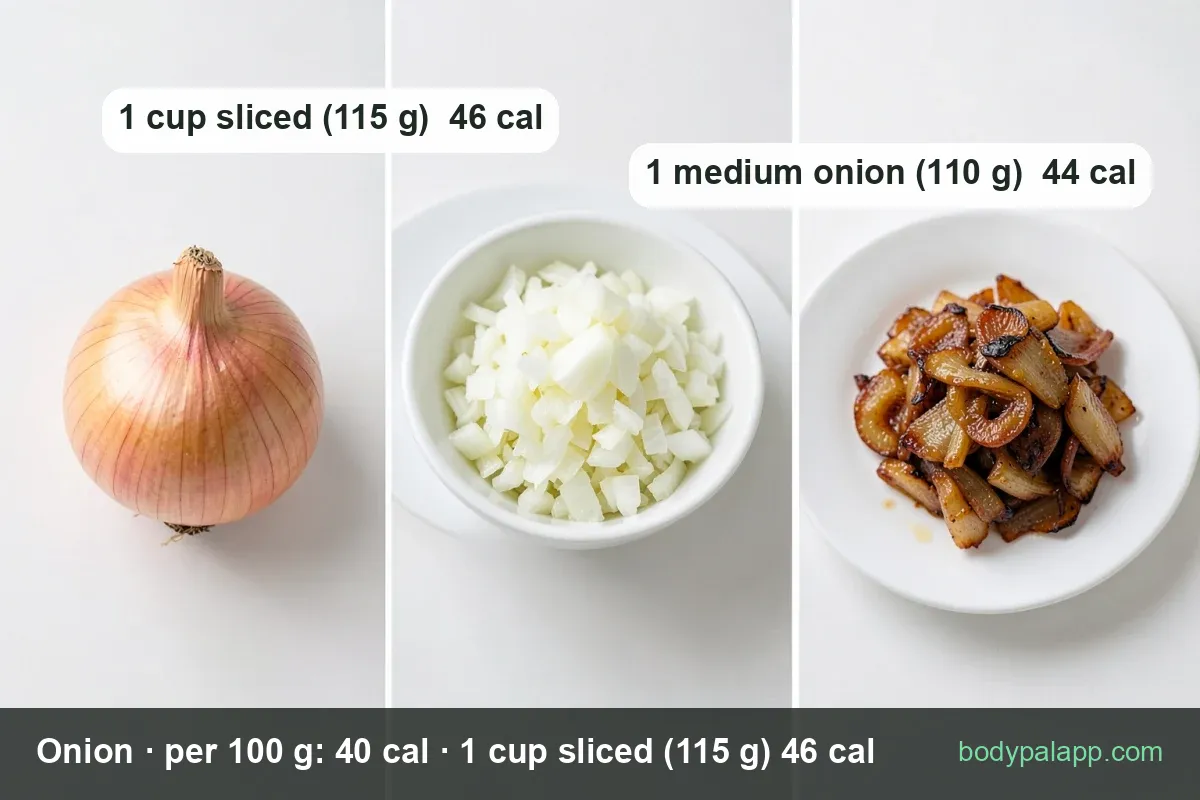
Here is the trap almost every recipe hides. A cup of chopped onion is 160 g. A cup of sliced onion is 115 g, because rings and strips leave air between them. Same cup, same word, 18 calories apart — 64 against 46. Chopped is always the heavier reading, so if a recipe just says "1 cup onion" and you are logging conservatively, use the chopped number.
One serving people ask for is not in the table above: a single slice. Slice thickness swings the gram weight enough that a single figure would mislead more than it helps, so use the ounce instead. Two thin slices off a sandwich are nowhere near 28 g, so call them a handful of calories and move on.
Caramelized, boiled and battered onions
| Version | Per 100 g | Typical serving | Calories |
|---|---|---|---|
| Raw onion | 40 kcal | 1 cup chopped, 160 g | 64 kcal |
| Boiled, drained, no salt | 44 kcal | 1 cup, 210 g | 92 kcal |
| Green onions (scallions), raw | 32 kcal | 1 cup chopped, 100 g | 32 kcal |
| Cooked with fat added | 73 kcal | 1 oz, 28 g | 20 kcal |
| Caramelized (sauteed) onions | 123 kcal | 1 oz, 28 g | 34 kcal |
| Dehydrated onion flakes | 349 kcal | 1 oz, 28 g | 98 kcal |
| Onion rings, breaded, oven-heated | 276 kcal | 10 medium rings, 60 g | 166 kcal |
Read that table top to bottom and the story is not the onion. It is the fat. Boiling changes the density barely at all — 44 against 40 per 100 g, and the cup only reads higher because a cup of soft boiled onion weighs 210 g against the 160 g in a cup of chopped raw. Caramelizing takes the same strips to 123 per 100 g. USDA's generic "cooked with fat added" record sits lower at 73, which is what a lighter hand with the oil looks like.
Put that on a real pan. The bowl of caramelized onion strips you would build from a cup of sliced raw onion starts at 46 calories and finishes near 141 — that last figure is our own arithmetic, 115 g at the sauteed density, not a USDA serving. Tripling is normal. Nothing about the vegetable changed; the butter went in.
The ounce servings for caramelized onions, cooked-with-fat onions and dried flakes are all our scaling from the USDA 100 g values. Onion flakes deserve their own warning: 349 calories per 100 g sounds alarming, but that is dehydrated weight, and you sprinkle teaspoons, not ounces.
Onion rings are a different food entirely. Batter plus par-frying plus oven finishing gives 276 calories per 100 g and 370 mg of sodium in that same 100 g. Ten medium rings, 60 g, is 166 calories — more than two and a half cups of chopped raw onion.
Yellow, red, white and sweet onions
| Variety | USDA record | Per 100 g | Carbohydrate | Fiber |
|---|---|---|---|---|
| Yellow, raw | Foundation 790646 | 38 kcal | 8.61 g | 1.9 g |
| Red, raw | Foundation 790577 | 44 kcal | 9.93 g | 2.2 g |
| White, raw | Foundation 1104962 | 35 kcal | 7.68 g | 1.2 g |
| Sweet (Vidalia type), raw | SR Legacy 170008 | 32 kcal | 7.55 g | 0.9 g |
| Generic raw onion | SR Legacy 170000 | 40 kcal | 9.34 g | 1.7 g |
The spread across yellow, red and white is 9 calories per 100 g — white at 35 against red at 44. Red onion is the densest of the four on carbohydrate at 9.93 g, and it also carries the most fiber at 2.2 g. Sweet onions are the surprise going the other way: 32 calories per 100 g, the lowest here, because a Vidalia is mostly water. Their fiber drops with it, to 0.9 g.
FNDDS also publishes a raw-onion line at 38 calories per 100 g, blending the varieties you would actually find in a supermarket bin. If you log by variety, use the row above; if you buy whatever bag is cheapest, the generic 40 is close enough that the difference over a whole onion is about two calories.
Fiber, sugar and the sodium that shows up later
Two numbers on the label do real work. A cup of chopped onion delivers 2.7 g of fiber, 10% of the 28 g Daily Value, alongside just 6 mg of sodium — a flat 0% DV. For a vegetable that goes into nearly everything savory, getting a tenth of a day's fiber for 64 calories is a good trade, and it is the reason onions count toward the vegetable group on MyPlate.
The sodium is where the plate changes. USDA's record for onions boiled with salt runs 239 mg per 100 g, so the 210 g boiled cup arrives at roughly 502 mg against the 6 mg in a raw chopped cup — 22% of the 2,300 mg Daily Value, and that is our arithmetic from the 100 g figure. Onion rings sit at 370 mg per 100 g before anyone reaches for the salt shaker. In other words, the onion contributes no sodium worth counting; the cooking water and the batter do. If you are watching sodium, boiling unsalted or roasting dry keeps that row at zero.
On sugar, resist the panic. Total sugars are 4.24 g per 100 g and 6.8 g in a cup, all of it naturally occurring, and it is not comparable to the added-sugars limit on a label. Caramelizing does not create sugar either; it concentrates what is there as water leaves, which is exactly why the calories per 100 g climb.
How does an onion compare?
| Food | Per 100 g | US serving | Calories |
|---|---|---|---|
| Onion, raw | 40 kcal | 1 cup chopped, 160 g | 64 kcal |
| Green onions (scallions), raw | 32 kcal | 1 cup chopped, 100 g | 32 kcal |
| Onions, boiled, drained, no salt | 44 kcal | 1 cup, 210 g | 92 kcal |
| Onion rings, breaded, oven-heated | 276 kcal | 10 medium rings, 60 g | 166 kcal |
Our take: scallions are the lightest thing in this table on both counts, 32 per 100 g and 32 for a full cup, so if you are trimming a bowl or a salad, that is the swap. For cooking, raw bulb onion at 40 is already so cheap that portioning it is wasted effort — the honest lever is the pan, since the same onion goes from 40 to 123 per 100 g the moment oil is involved. Log the fat by the teaspoon and log the onion by the cup. Onion rings belong in a different column of your day altogether: 166 calories for ten medium rings is a side dish, not a vegetable serving.
Most popular onion brands in the United States
Ranked by how widely each product appears among foods sold in the United States, from the BodyPal food database of over 3.3 million products. Calories are the figures printed on each Nutrition Facts label, checked against USDA FoodData Central.
| Product | Calories (per 100 g) |
|---|---|
| RealSweet Vidalia Sweet Onions | 41 cal |
| Jeff's Garden Pickled Red Onions | 71 cal |
| Five Star Red Pearl Onions | 59 cal |
| Mezzetta Cocktail Onions | 17 cal |
| Aunt Nellie's Whole Holland-Style Onions | 29 cal |
| Birds Eye White Pearl Onions | 35 cal |
Brand popularity: BodyPal food database. Nutrition: manufacturer labels / USDA FoodData Central.
Onion FAQs
How many calories are in one medium onion?
A medium onion of 110 g has 44 calories, based on the USDA raw-onion record at 40 calories per 100 g. A large one, 150 g, comes to 60. Peeling trims a few grams, so treat 44 as the ceiling for a bulb you chop whole into a pan.
How many calories in 1 cup of chopped onion?
One cup of chopped raw onion is 160 g and 64 calories. Sliced rather than chopped, a cup packs less tightly: 115 g and 46 calories. That is an 18-calorie gap for the same word on a recipe card, and chopped is always the heavier of the two.
How many calories in caramelized onions?
Caramelized onions run 123 calories per 100 g, so a 1 oz spoonful (28 g) is about 34 calories. Raw onion is 40 per 100 g, so the oil or butter roughly triples the density. The onion itself loses nothing; the pan adds everything.
How many carbs are in an onion?
Raw onion has 9.34 g of carbohydrate per 100 g, which is 14.9 g in a 1 cup chopped serving, or 5% of the Daily Value. Fiber accounts for 2.7 g of that cup. A medium bulb of 110 g lands near 10.3 g, our own arithmetic from the 100 g figure.
Do onions have a lot of sugar?
Not by weight: 4.24 g of total sugars per 100 g, or 6.8 g in a cup of chopped onion. Those sugars are naturally present in the vegetable, and the SR Legacy record does not report added sugars because raw onion has none. Total sugars carry no Daily Value.
Are onions good for weight loss?
At 40 calories per 100 g, onion is one of the cheapest ways to add flavor and volume to a plate, with 1.7 g of fiber per 100 g. The catch is the cooking fat: caramelized onions are 123 per 100 g. If you are watching calories, cook them in broth.
How many calories in green onions?
Green onions, also sold as scallions, are 32 calories per 100 g, and a cup of chopped scallions is about 100 g, so 32 calories. They are lighter than bulb onion per gram, which is 40, and they are usually used raw, so nothing is added in the pan.
How many calories in onion rings?
Ten medium frozen onion rings baked in the oven weigh about 60 g and come to 166 calories. Per 100 g that is 276 calories, almost seven times raw onion at 40. The batter and the frying oil do all of it, plus 370 mg of sodium per 100 g.
Similar foods
- Poblano Pepper — 60 cal per cup chopped
- Carrot Chips — 35 cal per 3 oz portion
- Carrot Sticks — 50 cal per cup
- Snap Peas — 26 cal per cup whole pods
- Sugar Snap Peas — 26 cal per cup whole
- Yellow Onion — 54 cal per medium onion
Count it without the math
Point the camera at the cutting board and BodyPal counts the onion for you, oil and all.


How long does it take to burn off onion?
A 1-cup chopped serving (160 g) is 64 kcal. Enter your weight and the amount you ate to see how long it takes you to burn that off:
lb
| Activity | Time to burn 64 kcal |
|---|---|
| Walking, brisk | 13 min |
| Cycling, moderate | 8 min |
| Swimming, moderate | 9 min |
| Jogging | 8 min |
| Weight training, moderate | 14 min |
Times are for a 155 lb adult at a steady pace; change the weight to see yours. The amount is set to the portion in the text (160 g); change it to what you actually ate. BodyPal works this out from your steps automatically.
Want the bigger picture? Calculate your daily calorie needs — your maintenance figure, a target for losing or gaining, and the date you get there.