
How many calories are in a poblano pepper?
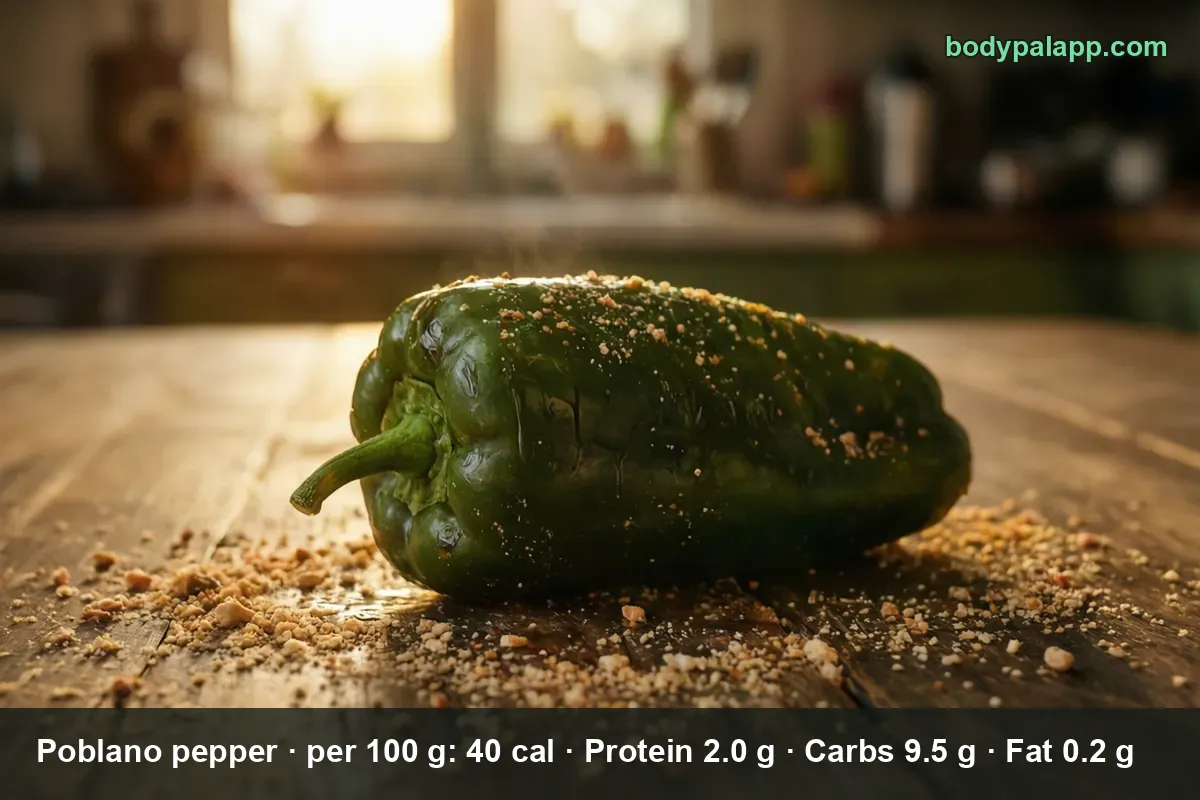
A cup of chopped poblano weighs 150 g and carries 60 calories. Per 100 g the fresh pepper runs 40 calories, and a single pod of about 45 g is only 18. Almost all of that is carbohydrate and water. The fat line is 0.2 g per 100 g, which rounds to nothing on a plate.
On this page
- Poblano pepper quick facts
- US servings, from one pod to a full cup
- Roasted, sauteed, canned and dried poblanos
- Potassium is the row that surprises people
- How does a poblano pepper compare?
- Most popular poblano pepper brands
- FAQ
Poblano pepper quick facts
USDA does not publish a stand-alone record for a raw poblano. The poblano is a fresh green chile of the species Capsicum annuum, so the generic record for fresh green chili peppers — SR Legacy 170497, "Peppers, hot chili, green, raw" — is the closest citable match for the pod you are actually holding. Every number below is that record, scaled.
Sweet green pepper records exist too, and they are the ones a lot of calorie trackers grab by mistake. They are a different cultivar with different numbers, so they stay in the comparison table further down instead of the main one.
| Nutrient | Per 100 g | Per 1 cup chopped (150 g) | % Daily Value |
|---|---|---|---|
| Calories | 40 | 60 | — |
| Total fat | 0.2 g | 0.3 g | 0% |
| Saturated fat | 0.02 g | 0.03 g | 0% |
| Carbohydrate | 9.46 g | 14.2 g | 5% |
| Dietary fiber | 1.5 g | 2.3 g | 8% |
| Total sugars | 5.1 g | 7.7 g | — |
| Protein | 2 g | 3.0 g | 6% |
| Sodium | 7 mg | 11 mg | 0% |
| Cholesterol | 0 mg | 0 mg | 0% |
| Potassium | 340 mg | 510 mg | 11% |
% Daily Value is based on a 2,000-calorie diet.
Verified nutrition data
Numbers on this page come from USDA FoodData Central, the U.S. Department of Agriculture’s food composition database, and from manufacturer labels where a branded product is named. Last verified September 2026. How we verify our data →
Two rows you will not find here: added sugars and trans fat. The SR Legacy edition of this record does not carry either, and on a fresh vegetable that nobody has processed there is no added sugar to report anyway. Total sugars have no Daily Value under the FDA label rules, so that cell stays blank; the 5.1 g per 100 g is the pepper's own sugar.
US servings, from one pod to a full cup
| Serving | Weight | Calories |
|---|---|---|
| 1 oz | 28 g | 11 kcal |
| One pepper | 45 g | 18 kcal |
| 1/2 cup chopped or diced | 75 g | 30 kcal |
| 1 cup chopped or diced | 150 g | 60 kcal |
| 4 oz raw | 113 g | 45 kcal |
| Per 100 g | 100 g | 40 kcal |
Only two of those are USDA household measures: one pepper at 45 g and a half cup chopped at 75 g. The full cup, the 4 oz weight and the ounce are our own arithmetic from the USDA 100 g figure, not USDA servings.
That half-cup measure is where people trip. USDA lists the chopped serving as 75 g for half a cup, which means a full packed cup is 150 g and 60 calories — double what the "half cup" habit puts in your head. If you dice three peppers into a skillet and call it a cup, you are within 15 g of the USDA weight. If you dice five, you are at a cup and a half.
Also worth knowing: a 45 g pod is on the small side of what most US grocery stores sell. Larger poblanos run 85 to 100 g, which puts a single big one at roughly 34 to 40 calories — again our own scaling, since USDA only publishes the 45 g pod.
Roasted, sauteed, canned and dried poblanos
| Version | Per 100 g | Typical serving | Calories |
|---|---|---|---|
| Raw poblano, fresh green chile | 40 kcal | 1 cup chopped, 150 g | 60 kcal |
| Cooked green pepper, boiled and drained | 28 kcal | 1 cup strips, 135 g | 38 kcal |
| Sauteed strips, rajas style | 116 kcal | 100 g | 116 kcal |
| Canned green chiles | 21 kcal | 100 g | 21 kcal |
| Dried pasilla or ancho-style chile | 345 kcal | 1 dried pod, 7 g | 24 kcal |
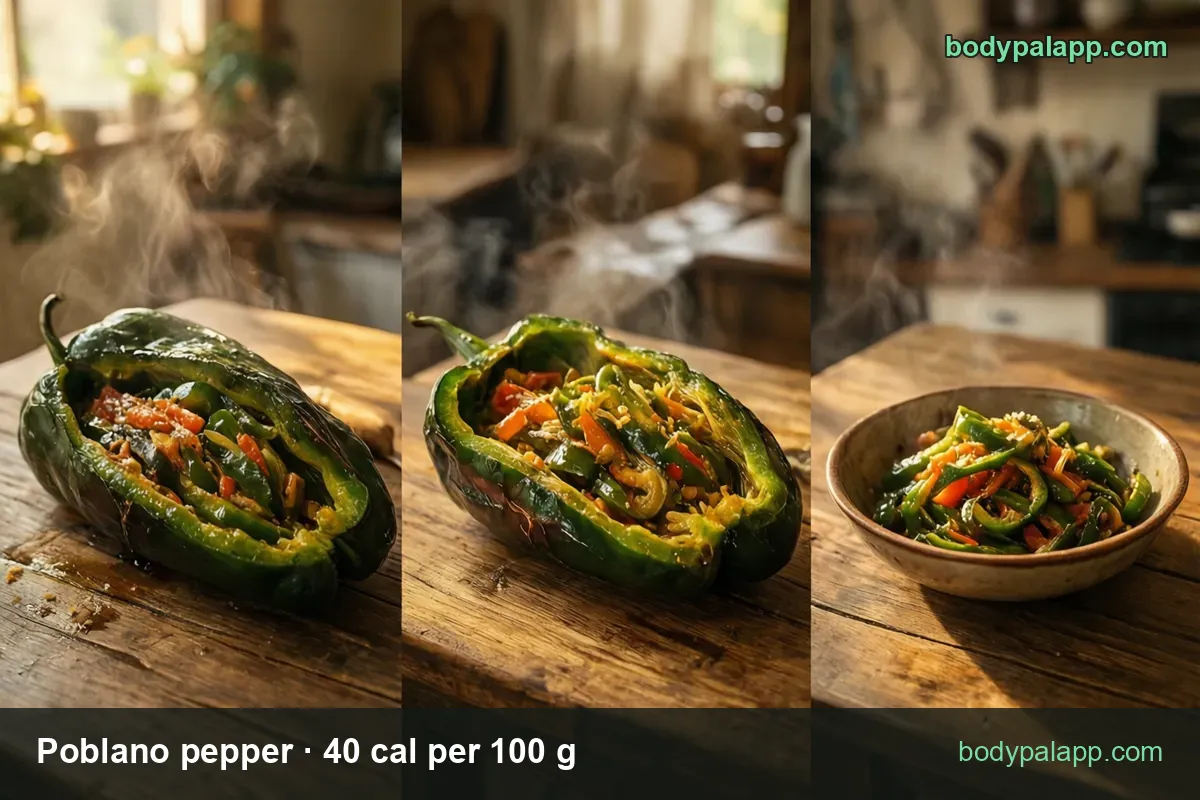
Roasting is the version most people actually eat, and it barely moves the number on its own. There is no USDA record for a roasted poblano, so the nearest cooked green pepper record sits at 28 calories per 100 g and 38 for a cup of strips. Heat drives off water and peels the skin; it does not add calories.
Rajas are a different story. Sauteed green pepper strips come in at 116 calories per 100 g against 40 raw, close to three times as much, and the gap is 11.85 g of fat per 100 g that came out of the pan. Log the oil, not the pepper. A bowl of rajas con crema is mostly a dairy-and-oil number with some chile in it.
Canned green chiles are the lightest cooked form at 21 calories per 100 g, but they arrive with 1,173 mg of sodium per 100 g — about half a teaspoon of table salt. Dried pods look alarming at 345 calories per 100 g until you weigh one: a dried pod is around 7 g, so it lands at 24 calories, less than half a cup of the fresh pepper.
Branded jars and pouches land in the same low range. Goya's sliced poblanos are 17 calories per 100 g and Wegmans fire roasted poblanos 29, both close enough to the canned chile record that the brand on the label changes almost nothing.
Potassium is the row that surprises people
A cup of chopped raw poblano supplies 510 mg of potassium, which is 11% of the 4,700 mg Daily Value, alongside 11 mg of sodium — under 1% of the 2,300 mg limit. That combination is unusual on a US plate, where most vegetables reach you already salted. MyPlate counts potassium among the nutrients Americans typically fall short on, and a fresh chile is one of the cheapest ways to move that line.
The fiber row is quieter but real: 2.3 g per cup, 8% of the 28 g Daily Value. Not a fiber food, but it costs 60 calories to get there.
If you are watching sodium, the fresh pod is the version to buy. Swapping a 100 g portion of canned green chiles for 100 g of fresh drops you from 1,173 mg of sodium to 7 mg — the largest change any preparation makes to the sodium line on this pepper.
How does a poblano pepper compare?
| Pepper | Per 100 g | US serving | Calories |
|---|---|---|---|
| Poblano, raw fresh green chile | 40 kcal | 1 cup chopped, 150 g | 60 kcal |
| Green bell pepper, raw | 20 kcal | 1 cup chopped, 149 g | 30 kcal |
| Green pepper, boiled and drained | 28 kcal | 1 cup chopped or strips, 135 g | 38 kcal |
| Pasilla chile, dried | 345 kcal | 1 dried pod, 7 g | 24 kcal |
Our take: per gram the poblano is exactly double the green bell pepper, 40 against 20, and two of the three neighbors here are lighter than it. That still leaves it trivially cheap. If you are cutting calories, the poblano is a free swap for almost anything it replaces — it is the filling that turns a stuffed poblano into a heavy plate, never the pod. If you want the food to actually keep you full, poblano alone will not do it at 3.0 g of protein per cup; pair it with beans or chicken and let the pepper carry flavor and volume. And if the recipe says rajas, budget for the oil before you budget for the chile.
Most popular poblano pepper brands in the United States
Ranked by how widely each product appears among foods sold in the United States, from the BodyPal food database of over 3.3 million products. Calories are the figures printed on each Nutrition Facts label, checked against USDA FoodData Central.
| Product | Calories (per 100 g) |
|---|---|
| Goya Sliced Poblano Peppers | 17 cal |
| Wegmans Sliced Poblano Peppers | 33 cal |
| Wegmans Fire Roasted Poblano Peppers | 29 cal |
| Macayo Diced Green Poblano Peppers | 33 cal |
Brand popularity: BodyPal food database. Nutrition: manufacturer labels / USDA FoodData Central.
Poblano pepper FAQs
How many calories are in one poblano pepper?
One pepper is 18 calories at the USDA weight of 45 g, working from 40 calories per 100 g for fresh green chile. Larger supermarket poblanos of 85 to 100 g land closer to 34 to 40 calories, which is our own scaling from the same 100 g figure.
How many calories in a roasted poblano pepper?
About 38 calories for a cup of cooked strips, 135 g, at 28 calories per 100 g. USDA publishes no roasted poblano record, so that is the nearest cooked green pepper figure. Roasting drives off water and loosens the skin; it adds no calories unless you roast in oil.
How many calories in a stuffed poblano pepper?
The pepper shell itself is 18 calories for a 45 g pod, and the filling decides everything else. USDA does not publish a record for a stuffed poblano, so no single number exists. Weigh the cheese, rice, ground beef or beans separately and add them to the 18.
Are poblano peppers good for weight loss?
At 40 calories per 100 g and 60 for a full cup chopped, poblano is one of the cheapest ways to add volume to a plate. It brings 2.3 g of fiber per cup, 8% of the Daily Value. It will not keep you full alone, though, at 3.0 g of protein per cup.
Poblano vs bell pepper: which has fewer calories?
Green bell pepper wins at 20 calories per 100 g against 40 for fresh green chile, exactly half. A cup of chopped bell pepper is 30 calories and a cup of chopped poblano is 60. Both are small numbers, so pick on flavor and heat rather than on calories.
How many carbs are in a poblano pepper?
A 45 g pod carries 4.3 g of carbohydrate, and a cup chopped at 150 g carries 14.2 g, or 5% of the Daily Value. Fiber accounts for 2.3 g of that cup and total sugars for 7.7 g, all of it the pepper's own sugar rather than anything added.
Do poblano peppers have any fat?
Essentially none: 0.2 g per 100 g, which works out to 0.3 g in a full cup chopped and 0% of the Daily Value. Saturated fat is 0.02 g per 100 g. Sauteed strips are the exception at 11.85 g of fat per 100 g, and every gram of that came from the pan.
Is a poblano the same as an ancho or pasilla chile?
A dried poblano is sold as an ancho, and dried pods run 345 calories per 100 g because the water is gone. Weigh one and it is around 7 g, so a single dried pod is roughly 24 calories. Pasilla is a different dried chile that US stores often label interchangeably.
Similar foods
- Onion — 46 cal per cup sliced
- Carrot Chips — 35 cal per 3 oz portion
- Carrot Sticks — 50 cal per cup
- Snap Peas — 26 cal per cup whole pods
- Sugar Snap Peas — 26 cal per cup whole
- Yellow Onion — 54 cal per medium onion
Count it without the math
Point the camera at the plate and BodyPal counts the poblano and whatever is stuffed inside it.


How long does it take to burn off poblano pepper?
A 1-cup chopped (150 g) serving is 60 kcal. Enter your weight and the amount you ate to see how long it takes you to burn that off:
lb
| Activity | Time to burn 60 kcal |
|---|---|
| Walking, brisk | 12 min |
| Cycling, moderate | 8 min |
| Swimming, moderate | 9 min |
| Jogging | 7 min |
| Weight training, moderate | 13 min |
Times are for a 155 lb adult at a steady pace; change the weight to see yours. The amount is set to the portion in the text (150 g); change it to what you actually ate. BodyPal works this out from your steps automatically.
This table assumes you know your daily total. If you do not, the daily calorie calculator works it out from five numbers.