
How many calories are in a glass of champagne?
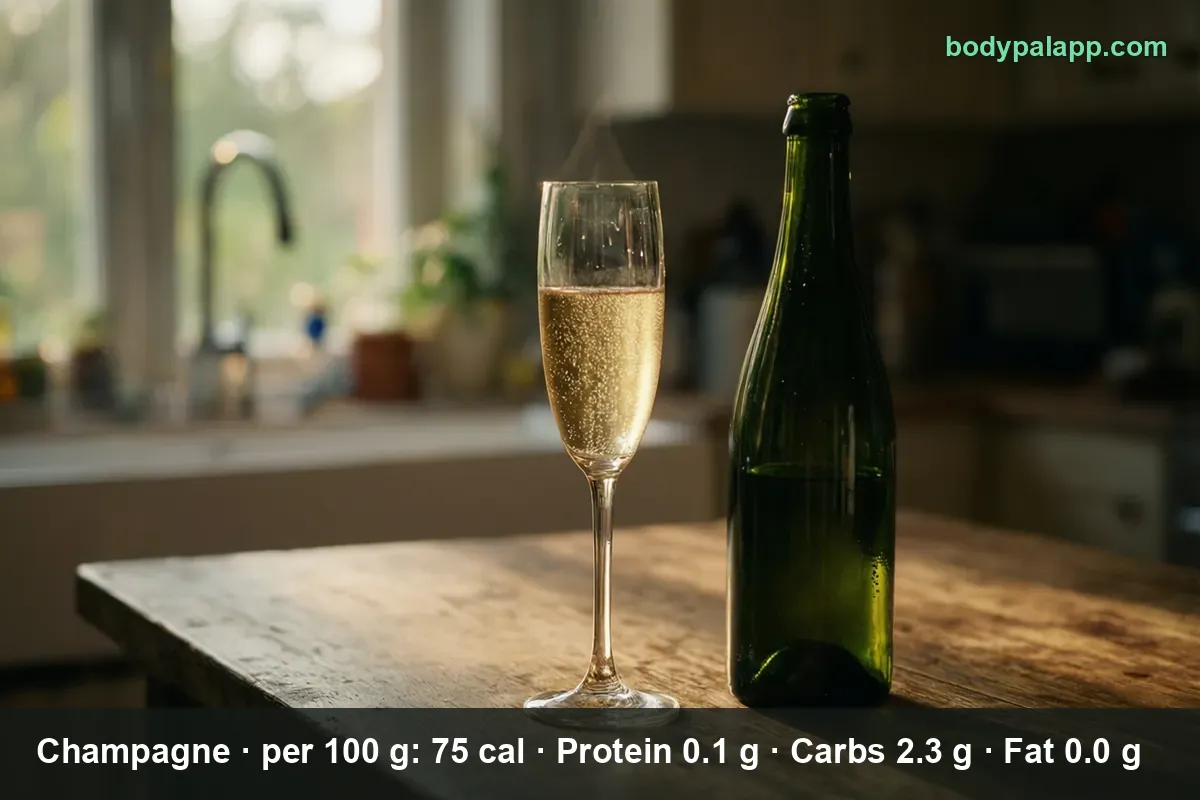
A standard glass of champagne holds 180 g and carries 135 calories. Per 100 g the wine runs 75 calories, which makes it the lightest of the everyday wines. A 5 fl oz pour, the amount public health agencies count as one standard drink, comes to 113. The whole 750 ml bottle: 563.
On this page
- Champagne quick facts
- US pours, from one ounce to a full bottle
- Calories in a glass of champagne
- Calories in a bottle of champagne
- Sweet champagne, mimosas and champagne punch
- Potassium is the only line that moves
- How does champagne compare?
- Champagne FAQs
Champagne quick facts
The record behind every number on this page is FNDDS 2710687, "Wine, sparkling", the survey entry for dry sparkling wine. That is what is in the flute at a wedding, whether the label says Champagne, cava or prosecco: the government database does not split brut from extra brut, it prices the category. The household measure attached to that record is one glass of 180 g, and that is the serving carried through the tables below.
There is a second record with champagne in its name, champagne punch, and it is a different drink entirely — sparkling wine cut with juice and sugar. It is covered further down, not here, because nobody searching for the calories in champagne is holding a punch bowl.
| Nutrient | Per 100 g | Per 1 glass (180 g) | % Daily Value |
|---|---|---|---|
| Calories | 75 | 135 | — |
| Total fat | 0 g | 0.0 g | 0% |
| Saturated fat | 0 g | 0.0 g | 0% |
| Carbohydrate | 2.31 g | 4.2 g | 2% |
| Dietary fiber | 0 g | 0.0 g | 0% |
| Total sugars | 1 g | 1.8 g | — |
| Protein | 0.07 g | 0.1 g | 0% |
| Sodium | 5 mg | 9 mg | 0% |
| Cholesterol | 0 mg | 0 mg | 0% |
| Potassium | 74 mg | 133 mg | 3% |
% Daily Value is based on a 2,000-calorie diet.
Verified nutrition data
Numbers on this page come from USDA FoodData Central, the U.S. Department of Agriculture’s food composition database, and from manufacturer labels where a branded product is named. Last verified September 2026. How we verify our data →
Two rows you would expect on a Nutrition Facts panel are missing on purpose. Added sugars and trans fat are not published for this FNDDS record, so listing them would mean inventing them. Everything else is here, and most of it is zeros: no fat, no fiber, no cholesterol, essentially no protein.
Here is the part that trips people up. Add up the macros in a glass and you get 4.2 g of carbohydrate and 0.1 g of protein — about 17 calories' worth. The label logic accounts for barely an eighth of the 135. The rest is ethanol, which carries 7 calories per gram and never appears as a macro row, because alcohol is not one. If you have ever wondered why a "zero carb, zero fat, zero sugar" drink still lands on your daily total, that gap is the answer.
US pours, from one ounce to a full bottle
| Serving | Weight | Calories |
|---|---|---|
| 1 fl oz, a tasting splash | 30 g | 23 kcal |
| 5 fl oz standard pour | 150 g | 113 kcal |
| One glass, USDA household measure | 180 g | 135 kcal |
| Half bottle, a split | 375 g | 281 kcal |
| Full bottle, 750 ml | 750 g | 563 kcal |
| Per 100 g | 100 g | 75 kcal |
Only the 180 g glass and the half bottle come straight from USDA measures. The 1 fl oz splash, the 5 fl oz pour and the full 750 ml bottle are our own arithmetic from the USDA 100 g figure, not USDA servings, and they assume sparkling wine weighs close enough to a gram per milliliter to treat 750 ml as 750 g.
That difference between 150 g and 180 g is worth 22 calories, which sounds trivial until a table of six goes through two bottles. Champagne also gets poured differently than still wine: flutes are narrow, so a "full" flute is often nearer 4 fl oz than 6, and refills happen faster than a count of glasses suggests. If you are logging a night rather than a drink, counting bottles is more honest than counting pours — divide 563 by the number of people sharing it and you will be closer than any guess at how full each flute was.
Calories in a glass of champagne
One glass is 135 calories at the USDA measure of 180 g, or 113 calories for the 5 fl oz pour used as the US standard drink. Two glasses over an evening is 270, roughly a bagel; four is 540, roughly a restaurant dessert. Nothing about the drink changes between those numbers, only the volume, which is why the pour size matters more here than any question of brut versus extra dry.
Champagne earns its reputation as the lighter choice honestly. At 75 calories per 100 g it is below white wine at 82 and red at 85, and the gap holds at every pour size: 113 against 123 and 128 for the same 5 fl oz.
Calories in a bottle of champagne
A 750 ml bottle is 563 calories — just over four glasses at the USDA 180 g measure, or five 5 fl oz pours. A half bottle, the split you get at brunch or on a plane, is 281 calories at 375 g. A quarter bottle, the single-serve 187 ml piccolo, works out to about 140.
| Format | Volume | Weight | Calories |
|---|---|---|---|
| Piccolo, single serve | 187 ml | 187 g | 140 kcal |
| Split or demi | 375 ml | 375 g | 281 kcal |
| Standard bottle | 750 ml | 750 g | 563 kcal |
Only the 375 g figure is a USDA serving; the other two are scaled from the same 75 calories per 100 g. The bottle number is the one people underestimate most. Split between two, that is 281 calories each before anything is eaten, and it arrives without the fullness signal food gives you — no fat, no fiber, no protein to slow it down.
Sweet champagne, mimosas and champagne punch
Sweetness moves the number, but far less than people expect, because the sugar in even a demi-sec is small next to the alcohol. USDA does not publish a separate record for sweet sparkling wine, so the ceiling below uses dessert wine as an upper bound — a genuinely sweet, fortified style that no brut will ever reach.
| Version | Per 100 g | Typical pour | Calories |
|---|---|---|---|
| Champagne, brut or dry sparkling | 75 kcal | 5 fl oz, 150 g | 113 kcal |
| Champagne, USDA glass | 75 kcal | 1 glass, 180 g | 135 kcal |
| Mimosa | 64 kcal | 5 fl oz, 150 g | 96 kcal |
| Champagne punch | 120 kcal | 5 fl oz, 150 g | 180 kcal |
| Sweet dessert wine, upper bound | 160 kcal | 5 fl oz, 150 g | 240 kcal |
A mimosa is the surprise: at 64 calories per 100 g it is lighter than the champagne it is made from, because orange juice replaces part of the wine and juice has less energy per gram than ethanol does. Champagne punch runs the other way — 120 calories per 100 g, and in the same 180 g glass that is 216 calories with 20.7 g of carbohydrate, against 135 calories and 4.2 g for straight champagne. The bowl, not the bottle, is what breaks a calorie budget at a party.
You will not find brand rows here, and that is not an oversight. US wine labels fall under the TTB rather than the FDA, so bottled champagne carries no Nutrition Facts panel and USDA's branded database has none of it — searching for champagne there returns vinegars, mustards and cakes. Moët, Veuve, cava and prosecco all get costed from the same generic sparkling wine record.
Potassium is the only line that moves
Run a glass of champagne against the FDA Daily Values and almost nothing registers. Fat 0%. Saturated fat 0%. Protein 0%. Sodium 9 mg, which is 0% — less than a two-hundredth of a teaspoon of table salt. Carbohydrate reaches 2%. The single line with any movement is potassium: 133 mg, or 3% of the 4,700 mg Daily Value.
That is the honest nutritional summary — champagne is calories and water with a trace of minerals. It is not a source of anything you need, and it is not a nutritional problem either, at the volumes most people drink. What it is, is 135 calories a glass that arrive without filling you up.
For how much fits into a day, the Dietary Guidelines for Americans put moderate drinking at two drinks or less a day for men and one or less for women, and note that adults who do not drink should not start. The CDC's alcohol facts define one standard drink as 5 fl oz of wine — the 113-calorie pour, not the 180 g glass. If you are counting drinks and calories at the same time, those two units are not the same size, and the glass in your hand is usually the bigger one.
How does champagne compare?
| Wine | Per 100 g | US serving | Calories |
|---|---|---|---|
| Champagne, sparkling | 75 kcal | 5 fl oz, 150 g | 113 kcal |
| White wine | 82 kcal | 5 fl oz, 150 g | 123 kcal |
| Red wine | 85 kcal | 5 fl oz, 150 g | 128 kcal |
| Mimosa | 64 kcal | 5 fl oz, 150 g | 96 kcal |
Our take: among the three wines here, champagne is the lightest, and it wins at every pour size — 113 against 123 for white and 128 for red at 5 fl oz. The margin is real but modest, 10 to 15 calories a glass, so switching from red to sparkling saves less over an evening than pouring one fewer glass. The mimosa is the only thing on the list below champagne, and it is lighter only because juice dilutes the alcohol. If the goal is the smallest number, drink the sparkling and watch the pour; if the goal is a smaller number still, the split at 281 calories is a better tool than any switch of grape.
Champagne FAQs
How many calories are in a glass of champagne?
135 calories in the USDA glass of 180 g, at 75 calories per 100 g. A 5 fl oz pour, the standard drink size, is 113 calories. Two glasses over dinner is 270. Only about 17 of those calories come from carbohydrate; the rest is alcohol.
How many calories are in a bottle of champagne?
563 calories in a full 750 ml bottle, our own arithmetic from the USDA figure of 75 calories per 100 g. That is just over four glasses at the 180 g measure. A half bottle is 281 calories and a single-serve 187 ml piccolo about 140, so sharing one bottle between two people costs 281 each.
How many calories in a flute of champagne?
Between 113 and 135 calories, depending on the pour. A flute filled to the 5 fl oz standard drink holds 150 g and 113 calories; the USDA household glass of 180 g comes to 135. Narrow flutes are often poured short, closer to 4 fl oz, which is roughly 90.
Is champagne lower in calories than wine?
Yes, slightly: sparkling wine is 75 calories per 100 g against 82 for white and 85 for red. At the same 5 fl oz pour that is 113 calories against 123 and 128. The saving is real but small, 10 to 15 calories a glass, so pour size matters more than the choice.
How many carbs are in champagne?
4.2 g of carbohydrate in a 180 g glass, or 2.31 g per 100 g, which is 2% of the Daily Value. A 5 fl oz pour has about 3.5 g and a full bottle 17.3 g. Champagne is close to a low-carb drink; the calories come from alcohol, not from carbohydrate.
Does brut champagne have fewer calories than sweet champagne?
A little, but less than most people assume: USDA prices all dry sparkling wine at 75 calories per 100 g and does not split brut from demi-sec. Even a genuinely sweet dessert wine, at 160 per 100 g, only doubles it, and no brut goes near that. Residual sugar moves the number far less than alcohol does.
How many calories are in a mimosa?
96 calories in a 5 fl oz mimosa, at 64 calories per 100 g. That is lighter than straight champagne at 113 for the same pour, because orange juice replaces some of the wine and juice carries less energy per gram than alcohol. The tradeoff is carbohydrate: 6.49 g per 100 g against 2.31 g.
Does champagne have sugar?
1 g of total sugars per 100 g, so 1.8 g in a 180 g glass and 7.5 g in a bottle. USDA does not publish added sugars for this record, so there is no figure for the dosage added at bottling. The sugar in a glass of brut is a rounding error next to its 135 calories.
Similar foods
- Cupcake Prosecco Sparkling Wine — 135 cal per glass
- Prosecco — 135 cal per glass
- Glass Of Prosecco — 135 cal per glass
- Bloody Mary — 164 cal per drink
- Sauvignon Blanc — 119 cal per glass, 5 fl oz
- Four Loko — 245 cal per can (12 fl oz)
Count it without the math
Point the camera at the glass and BodyPal counts the pour for you, bottle or flute.


How long does it take to burn off champagne?
One glass (180 g) is 135 kcal. Enter your weight and the amount you ate to see how long it takes you to burn that off:
lb
| Activity | Time to burn 135 kcal |
|---|---|
| Walking, brisk | 27 min |
| Cycling, moderate | 17 min |
| Swimming, moderate | 19 min |
| Jogging | 16 min |
| Weight training, moderate | 30 min |
Times are for a 155 lb adult at a steady pace; change the weight to see yours. The amount is set to the portion in the text (180 g); change it to what you actually ate. BodyPal works this out from your steps automatically.
Burning it off is one side of it. The other is knowing your number: work out how many calories you need a day, with macros and a goal date.