
How Many Calories in Prosecco?
A glass of prosecco is 135 calories — that is the 180 g pour USDA measures, at 75 calories per 100 g. Poured to the American standard drink of 5 fl oz, the same wine is 113. A full 750 ml bottle holds 563 calories. The calories in prosecco barely move. The glass does.
On this page
- Prosecco quick facts
- The 135 or 113 problem
- Every pour, from a taste to the whole bottle
- The calories are alcohol, not sugar
- Mimosas, spritzers and what they change
- How does prosecco compare?
- FAQ
Prosecco quick facts
The reference entry is USDA's Wine, sparkling (fdc_id 2710687), and the serving is the one USDA itself calls a glass: 180 g, or 6 fl oz.
| Nutrient | Per 100 g | Per 1 glass (180 g) | % Daily Value |
|---|---|---|---|
| Calories | 75 kcal | 135 kcal | — |
| Total fat | 0 g | 0 g | 0% |
| Saturated fat | 0 g | 0 g | 0% |
| Carbohydrate | 2.31 g | 4.16 g | 2% |
| Dietary fiber | 0 g | 0 g | 0% |
| Total sugars | 1 g | 1.8 g | — |
| Protein | 0.07 g | 0.13 g | 0% |
| Sodium | 5 mg | 9 mg | 0% |
% Daily Value is based on a 2,000-calorie diet, the reference set out in the FDA's Daily Value tables. Total sugars have no Daily Value, so that row stays blank.
Verified nutrition data
Numbers on this page come from USDA FoodData Central, the U.S. Department of Agriculture’s food composition database, and from manufacturer labels where a branded product is named. Last verified September 2026. How we verify our data →
Look down the right-hand column. Almost every figure is a zero, and the two rows an American label would normally carry — added sugars and trans fat — are not printed here at all. They are absent from the USDA entry rather than set to zero, because wine is labeled under alcohol rules, not with a Nutrition Facts panel, so those fields were never collected in the first place.
One nutrient does register. Potassium runs 74 mg per 100 g, which works out to 133 mg in a glass, or 3% of the day. That single line is the entire nutritional contribution of a glass of prosecco. Everything else on the panel is calories.
The 135 or 113 problem
Two honest sources will give you two different calorie counts for the same wine, and neither one is wrong. The difference is the glass.
USDA's household measure for wine is 1 glass = 180 g, which is 6 fl oz. The CDC defines a standard drink of wine as 5 fl oz, which comes to 150 g. Run both through the same 75 calories per 100 g and you get 135 against 113 — a 22-calorie gap created by nothing but a definition.
That gap is bigger than the difference between prosecco and red wine. So before you argue about which wine to order, settle which glass you are actually holding.
The practical fix takes thirty seconds and one kitchen scale. Fill your usual flute the way you normally fill it, weigh it, and note the number. Most flutes land somewhere between the 120 g of a small pour and the 180 g USDA glass. Once you know your own figure, the per-100 g column does the rest.
Every pour, from a taste to the whole bottle
| Pour | Weight | Calories |
|---|---|---|
| Tasting pour, 1 fl oz | 30 g | 22.5 kcal |
| Small flute, 4 fl oz | 120 g | 90 kcal |
| Standard drink, 5 fl oz | 150 g | 113 kcal |
| USDA glass, 6 fl oz | 180 g | 135 kcal |
| Half bottle | 375 g | 281 kcal |
| Full bottle, 750 ml | 750 g | 563 kcal |
Three of those rows come straight from USDA's own portion data for this entry: the 1 fl oz tasting pour of 30 g, the 180 g glass and the 375 g half bottle. The 120 g flute, the 150 g standard drink and the full bottle are our own scaling from the same USDA conversion of 1 fl oz = 30 g, cross-checked against that listed half bottle of 375 g.
The bottle row is the one worth sitting with. 563 calories is four USDA glasses plus a tasting pour, or exactly five American standard drinks. Split a bottle between two people over dinner and you have each had roughly 281 calories before the food arrives — the same as the half-bottle row, and about what a substantial side dish costs.
There is no cooked-versus-raw complication here, no draining, no absorbed oil. Prosecco is one of the few things you can log by volume and be right, provided you weigh the pour once.
The calories are alcohol, not sugar
Here is where prosecco fools a lot of careful trackers.
The carbohydrate figure is 2.31 g per 100 g. Carbohydrate carries roughly four calories a gram, so those carbs account for about 9 of the 75 calories. The remaining 66 — near enough 88% — come from the alcohol itself, which contributes energy without showing up in any macro row on the panel.
That is why a carb-counting app that only watches carbs will wave prosecco through. Per glass the carbohydrate is 4.16 g, a flat 2% of the Daily Value, while the calories sit at 135. The two numbers point in completely opposite directions, and the calorie one is the honest one.
Sugar behaves the same way. Total sugars are 1 g per 100 g, so 1.8 g in a glass — less than half a teaspoon. Prosecco is not a sugary drink by any reasonable measure. It is simply an alcoholic one, and the alcohol is doing all the work.
A note on styles, since the labels invite the question: USDA carries a single entry for sparkling wine and no separate rows for Brut, Extra Dry or Dry. Those names describe residual sugar levels that genuinely differ bottle to bottle, but there is no US government figure to attach to them, so this page does not invent one. The Dietary Guidelines for Americans treat alcohol by drink count rather than by style, which is the more useful frame anyway.
Mimosas, spritzers and what they change
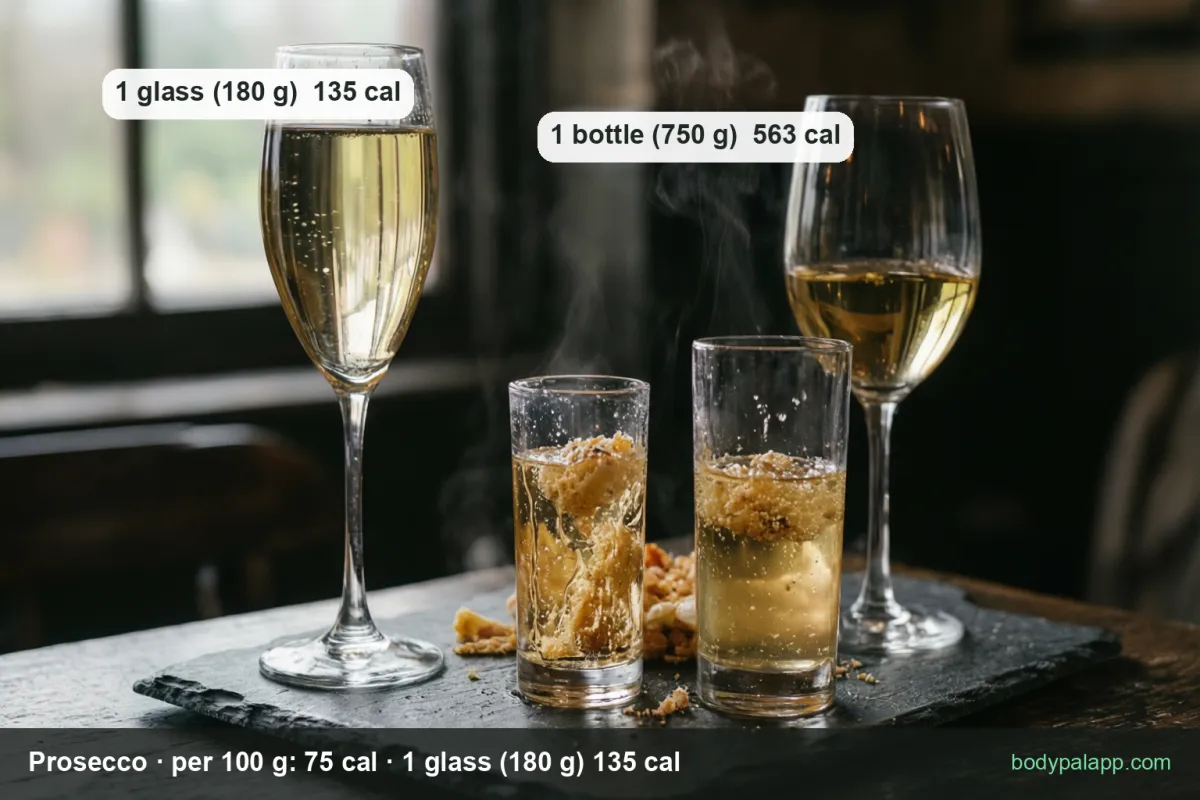
| Drink | Per 100 g | Per glass (180 g) |
|---|---|---|
| Prosecco, straight | 75 kcal | 135 kcal |
| Mimosa, with orange juice | 64 kcal | 115 kcal |
| Wine spritzer, with sparkling water | 49 kcal | 88 kcal |
Both mixed versions come in under the straight pour, and for the same reason: something with fewer calories per gram is taking up part of the glass. Orange juice is lighter than wine. Sparkling water is lighter still.
The trade is in the carbs. A mimosa runs 6.5 g of carbohydrate per 100 g against prosecco's 2.31, so a 180 g mimosa carries 11.7 g — nearly three times the carbohydrate of the wine it replaced, for 20 fewer calories. The spritzer has no such catch. At 88 calories a glass it is the cheapest way to keep a drink in your hand all evening, and it is the only variant here that meaningfully changes the arithmetic.
Not every mixed sparkling drink goes that direction. Champagne punch, USDA's entry for the party-bowl version, runs 120 calories per 100 g with 11.5 g of carbohydrate — juice and sweetener push it well past the wine it started as. The word on the label tells you nothing; what got added to the glass tells you everything.
And the question everyone asks: prosecco against champagne. USDA holds one entry for sparkling wine, so both use the same figures — 75 calories per 100 g, 135 in a glass. The price differs. The calories do not.
How does prosecco compare?
| Wine | Per 100 g | Per glass (180 g) |
|---|---|---|
| Prosecco, sparkling | 75 kcal | 135 kcal |
| White wine | 82 kcal | 148 kcal |
| Red wine | 85 kcal | 153 kcal |
| Mimosa | 64 kcal | 115 kcal |
| Light wine | 49 kcal | 88 kcal |
Prosecco is the lightest of the full-strength wines on that list, and the margin is smaller than its reputation suggests: 13 calories a glass under white, 18 under red. Bubbles are not a diet feature.
Our take: if you like prosecco, drink prosecco — swapping to it from red saves 18 calories a glass, which is a rounding error you will never feel. If you actually want a lower number, the only honest step down is light wine at 88 calories a glass, and it gets there by carrying less alcohol, not by any trick of the grape. Better still, notice that pouring 5 fl oz instead of the 6 fl oz USDA glass saves 22 calories — more than switching wines does, from a bottle you already like.
Prosecco FAQs
How many calories are in a glass of prosecco?
135 calories in the 180 g glass USDA uses, which is 6 fl oz. Poured to the American standard drink of 5 fl oz (150 g) it is 113 calories. Both come from the same figure of 75 calories per 100 g, so the only variable is how full the flute is.
How many calories in a bottle of prosecco?
563 calories in a full 750 ml bottle, and 281 in a half bottle of 375 g. That is four USDA glasses plus a tasting pour, or five 5 fl oz standard drinks. Shared between two people, a bottle costs each of you about 281 calories.
Is prosecco lower in calories than white wine?
Yes, but only just: 75 calories per 100 g against 82 for still white wine. Per glass that is 135 against 148, a difference of 13. Red wine sits at 85 per 100 g, or 153 a glass, so prosecco saves 18 there.
How many carbs are in prosecco?
2.31 g of carbohydrate per 100 g, which is 4.16 g in a 180 g glass — just 2% of the Daily Value. Those carbs account for roughly 9 of the 75 calories per 100 g. The other 66 come from alcohol, which no macro row on the panel shows.
Does prosecco have sugar?
1 g of total sugars per 100 g, so 1.8 g in a glass — under half a teaspoon. The USDA entry carries no added sugars figure at all, because wine is labeled under alcohol rules rather than with a Nutrition Facts panel, so that field was never collected.
Is prosecco keto-friendly?
A 180 g glass carries 4.16 g of carbohydrate, and a 5 fl oz pour carries 3.5 g. Those are the numbers; whether they fit your day is arithmetic only you can do. Note that the 135 calories in that glass are almost entirely alcohol, not carbohydrate.
How many calories in a mimosa?
115 calories in a 180 g glass, at 64 calories per 100 g. That is 20 fewer than straight prosecco, because orange juice is lighter than wine. The carbohydrate goes the other way: 11.7 g a glass against 4.16 g for the wine on its own.
Prosecco or champagne — which has more calories?
Neither: both log at 75 calories per 100 g and 135 in a 180 g glass, because USDA keeps a single entry for sparkling wine and prosecco and champagne share it. Any real difference between two bottles comes from residual sugar, which no US government dataset breaks out.
Similar foods
- Champagne — 135 cal per glass
- Cupcake Prosecco Sparkling Wine — 135 cal per glass
- Glass Of Prosecco — 135 cal per glass
- Bloody Mary — 164 cal per drink
- Sauvignon Blanc — 119 cal per glass, 5 fl oz
- Four Loko — 245 cal per can (12 fl oz)
Count it without the math
Point the camera at the flute and BodyPal logs the pour, the carbs and the calories before the bubbles settle.


How long does it take to burn off Prosecco?
A glass (180 g, 6 fl oz) is 135 kcal. Enter your weight and the amount you ate to see how long it takes you to burn that off:
lb
| Activity | Time to burn 135 kcal |
|---|---|
| Walking, brisk | 27 min |
| Cycling, moderate | 17 min |
| Swimming, moderate | 19 min |
| Jogging | 16 min |
| Weight training, moderate | 30 min |
Times are for a 155 lb adult at a steady pace; change the weight to see yours. The amount is set to the portion in the text (180 g); change it to what you actually ate. BodyPal works this out from your steps automatically.
This table assumes you know your daily total. If you do not, the daily calorie calculator works it out from five numbers.