
How many calories are in a cheese straw?
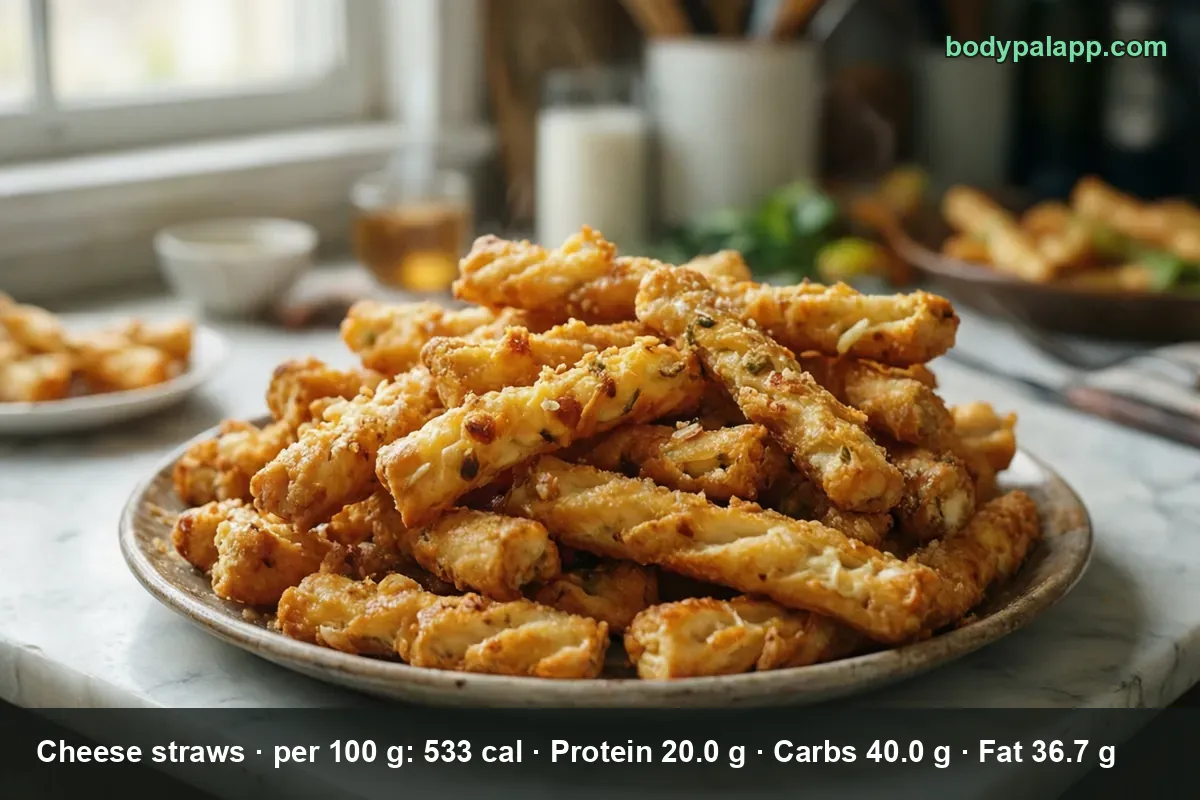
A 30 g serving of cheese straws — nine of them, straight off the label — carries 160 calories. Per 100 g the same baked cheddar dough runs 533 calories, which puts these thin twists near the top of the snack aisle for energy density. One single straw, at about 3.3 g, is only 18.
On this page
- Cheese straw quick facts
- US servings, from one straw to a 4 oz bag
- Cheddar, parmesan, gouda and jalapeno straws
- Saturated fat runs out before the calories do
- How do cheese straws compare?
- Most popular cheese straws brands
- FAQ
Cheese straw quick facts
There is no Foundation, SR Legacy or FNDDS entry for a cheese straw. The food most people are actually holding is a bag from the snack shelf or the bakery counter, so the numbers here come from a packaged label: FDC 1917232, "Cheese Straws, Classic Cheddar", a Fresh Market product with a full nutrient panel and a real household serving of nine straws.
That matters for one reason. Homemade straws — the ones piped from cheddar, butter and flour at Thanksgiving — are not standardized, and a batch rolled thicker will land heavier per piece than anything on this page. The per-100 g column is the safer number to lean on when you baked them yourself.
| Nutrient | Per 100 g | Per 9 straws (30 g) | % Daily Value |
|---|---|---|---|
| Calories | 533 | 160 | — |
| Total fat | 36.67 g | 11.0 g | 14% |
| Saturated fat | 15 g | 4.5 g | 23% |
| Carbohydrate | 40 g | 12.0 g | 4% |
| Dietary fiber | 0 g | 0.0 g | 0% |
| Total sugars | 0 g | 0.0 g | — |
| Protein | 20 g | 6.0 g | 12% |
| Sodium | 500 mg | 150 mg | 7% |
% Daily Value is based on a 2,000-calorie diet.
Verified nutrition data
Numbers on this page come from USDA FoodData Central, the U.S. Department of Agriculture’s food composition database, and from manufacturer labels where a branded product is named. Last verified September 2026. How we verify our data →
Two rows are missing on purpose. Added sugars are not declared on this label, and with total sugars at 0 g they would be zero regardless. Potassium is not declared either, so there is nothing honest to print. Cholesterol is on the panel: 83 mg per 100 g, or 25 mg in the nine-straw serving, 8% of the Daily Value.
The shape of this food is unusual for a snack. There is no fiber and no sugar anywhere in it — every calorie comes from 36.67 g of fat, 40 g of flour carbohydrate and 20 g of protein per 100 g, the protein riding along from the cheese. Nothing on the panel is soft.
US servings, from one straw to a 4 oz bag
| Serving | Weight | Calories |
|---|---|---|
| 1 straw | 3.3 g | 18 kcal |
| 5 straws, small handful | 16.7 g | 89 kcal |
| 9 straws, the label serving | 30 g | 160 kcal |
| 1 oz | 28 g | 149 kcal |
| 4 oz bag | 113 g | 602 kcal |
| Per 100 g | 100 g | 533 kcal |
Only the 30 g row is a USDA household measure. The single straw, the five-straw handful, the ounce and the bag are our own arithmetic from the USDA 100 g figure of 533, not USDA servings.
The ounce is where people slip. An ounce of cheese straws is 28 g and 149 calories, which sounds close to the 30 g label serving — and it is, within 11 calories. The gap that hurts is the bag. A small 4 oz bag is 602 calories, roughly four label servings, and cheese straws are brittle, salty and small enough that finishing one in an evening takes no effort at all. Counting straws beats counting handfuls.
Cheddar, parmesan, gouda and jalapeno straws
The cheese in the name moves the number more than the flavoring does. More cheese and less flour pushes fat and protein up; a harder, drier cheese like parmesan cuts the total.
| Version | Per 100 g | Typical serving | Calories |
|---|---|---|---|
| Cheddar cheese straws | 571 kcal | 1 oz (28 g) | 160 kcal |
| Parmesan cheese straws | 464 kcal | 1 oz (28 g) | 130 kcal |
| Gouda cheese straws | 567 kcal | 9 straws (30 g) | 170 kcal |
| Jalapeno cheddar cheese straws | 567 kcal | 10 straws (30 g) | 170 kcal |
| Asiago parmesan cheese straws | 467 kcal | 10 straws (30 g) | 140 kcal |
The two parmesan-based versions, at 464 and 467 calories per 100 g, are the lightest of the five, and the gap to cheddar or gouda is around 100 calories per 100 g — about a fifth. Jalapeno changes the heat, not the math: at 567 per 100 g it sits exactly where plain gouda does.
Brands spread wider than flavors do. Marilyn's Cheese Straws are the outlier at 393 calories per 100 g, 110 for their 1 oz serving, while HT Traders at 571 and Lowes Foods at 567 sit near the top. Straw count per serving shifts too — thinner straws mean ten in 30 g instead of nine, so a "serving" is not a fixed number of pieces across the shelf.
Saturated fat runs out before the calories do
The nine-straw serving is 160 calories, 8% of a 2,000-calorie day. Its saturated fat is 4.5 g, or 23% of the FDA Daily Value of 20 g. That is close to triple the pace. Two servings while cooking dinner — an easy 320 calories — takes you to 9 g and 45% of the day's saturated fat before the meal itself starts.
That gap comes straight from the recipe. Butter and cheese are the whole point of a cheese straw, and the Dietary Guidelines put the ceiling at less than 10% of calories from saturated fat. If you are watching that line, parmesan straws at 130 calories an ounce are the better pick, and portioning into a small bowl beats eating from the bag.
Sodium behaves more calmly than you would expect from something this savory: 150 mg per serving, 7% of the Daily Value, and 565 mg in a whole 4 oz bag — that bag figure is our own arithmetic from the 500 mg per 100 g on the label. Protein is the one row working in your favor, at 6 g per serving and 12% of the Daily Value.
How do cheese straws compare?
| Snack | Per 100 g | US serving | Calories |
|---|---|---|---|
| Cheese straws | 533 kcal | 1 oz (28 g) | 149 kcal |
| Cheese crackers, regular | 489 kcal | 1 oz (28 g) | 137 kcal |
| Cheese crackers, whole grain | 412 kcal | 1 oz (28 g) | 115 kcal |
| Cheese sandwich crackers, filled | 479 kcal | 1 oz (28 g) | 134 kcal |
Our take: ounce for ounce, cheese straws are the heaviest of the four, about 9% above regular cheese crackers and 30% above the whole grain ones. But the swap is not one-sided. Cheese crackers carry 973 mg of sodium per 100 g against 500 mg in the straws, nearly double, and only 10.93 g of protein against 20 g. If calories are the constraint, whole grain crackers win on every serving size; if sodium is what you are managing, the straws are the calmer choice and you pay about 12 calories an ounce for it.
Most popular cheese straws brands in the United States
Ranked by how widely each product appears among foods sold in the United States, from the BodyPal food database of over 3.3 million products. Calories are the figures printed on each Nutrition Facts label, checked against USDA FoodData Central.
| Product | Calories (per 100 g) |
|---|---|
| The Fresh Market Classic Cheddar Cheese Straws | 533 cal |
| HT Traders Cheddar Cheese Straws | 571 cal |
| J&M Gouda Cheese Straws | 567 cal |
| Lowes Foods Cheddar Cheese Straws | 567 cal |
| Sweet Ruby's Cheddar Cheese Straws | 536 cal |
| Marilyn's Cheese Straws | 393 cal |
Brand popularity: BodyPal food database. Nutrition: manufacturer labels / USDA FoodData Central.
Cheese straw FAQs
How many calories are in one cheese straw?
One straw is about 18 calories. The Fresh Market label counts nine straws as a 30 g serving at 160 calories, so a single twist works out to roughly 3.3 g — that is our own arithmetic from the USDA 100 g figure of 533, not a USDA serving. Handfuls add up fast.
How many calories in 9 cheese straws?
Nine cheese straws weigh 30 g and carry 160 calories, the serving printed on the package. That portion brings 11 g of fat, 4.5 g of it saturated, 12 g of carbohydrate, 6 g of protein and 150 mg of sodium. There is no fiber and no sugar in it.
How many calories in 1 oz of cheese straws?
One ounce of cheese straws is 149 calories, or about eight and a half straws. That is our own arithmetic from the USDA 100 g value of 533, not a label serving. Several brands print 1 oz as their serving instead, and those land between 110 and 160 calories.
How much saturated fat is in cheese straws?
A 30 g serving has 4.5 g of saturated fat, 23% of the Daily Value. Per 100 g the straws hold 15 g. Butter and cheese both go into the dough, so saturated fat climbs faster than calories: the serving is 8% of a 2,000-calorie day but nearly a quarter of the saturated-fat allowance.
How much sodium is in cheese straws?
Nine straws carry 150 mg of sodium, 7% of the Daily Value, and 100 g holds 500 mg. That is about a quarter teaspoon of table salt in a full 4 oz bag. Cheese crackers are saltier per gram at 973 mg per 100 g, nearly double the straws.
Do cheese straws have any fiber or sugar?
No — 0 g of fiber and 0 g of total sugars, both on the label and per 100 g. The dough is refined flour, cheese and fat, so nothing in it counts toward the 28 g fiber Daily Value. Added sugars are not listed on this label, and with zero total sugars they would be zero anyway.
How many carbs are in cheese straws?
Twelve grams of carbohydrate sit in a 30 g serving, 4% of the Daily Value, and 40 g per 100 g. All of it is starch from the flour — no fiber to subtract and no sugar. Cheese crackers run higher at 59.42 g per 100 g, since their dough carries less fat.
Cheese straws vs cheese crackers — which has fewer calories?
Per ounce the crackers are lighter: 137 calories against 149 for straws, because straws pack 533 calories per 100 g and crackers 489. The trade runs the other way on salt — crackers hold 973 mg of sodium per 100 g, the straws 500 mg. Neither is a low-calorie snack.
Similar foods
- I Can't Believe It's Not Butter — 75 cal per tbsp
- Cheese Popcorn — 74 cal per cup
- Butter Popcorn — 73 cal per cup, popped
- Milk Powder — 635 cal per cup
- Blue Cheese Dressing — 148 cal for 2 tablespoons
- Peanut Butter — 191 cal for 2 tbsp
Count it without the math
Point the camera at the bowl and BodyPal counts the straws for you, cheddar or parmesan.


How long does it take to burn off cheese straws?
A 9-straw serving (30 g) is 160 kcal. Enter your weight and the amount you ate to see how long it takes you to burn that off:
lb
| Activity | Time to burn 160 kcal |
|---|---|
| Walking, brisk | 32 min |
| Cycling, moderate | 20 min |
| Swimming, moderate | 23 min |
| Jogging | 19 min |
| Weight training, moderate | 36 min |
Times are for a 155 lb adult at a steady pace; change the weight to see yours. The amount is set to the portion in the text (30 g); change it to what you actually ate. BodyPal works this out from your steps automatically.
Burning it off is one side of it. The other is knowing your number: work out how many calories you need a day, with macros and a goal date.