
How many calories are in I Can't Believe It's Not Butter?
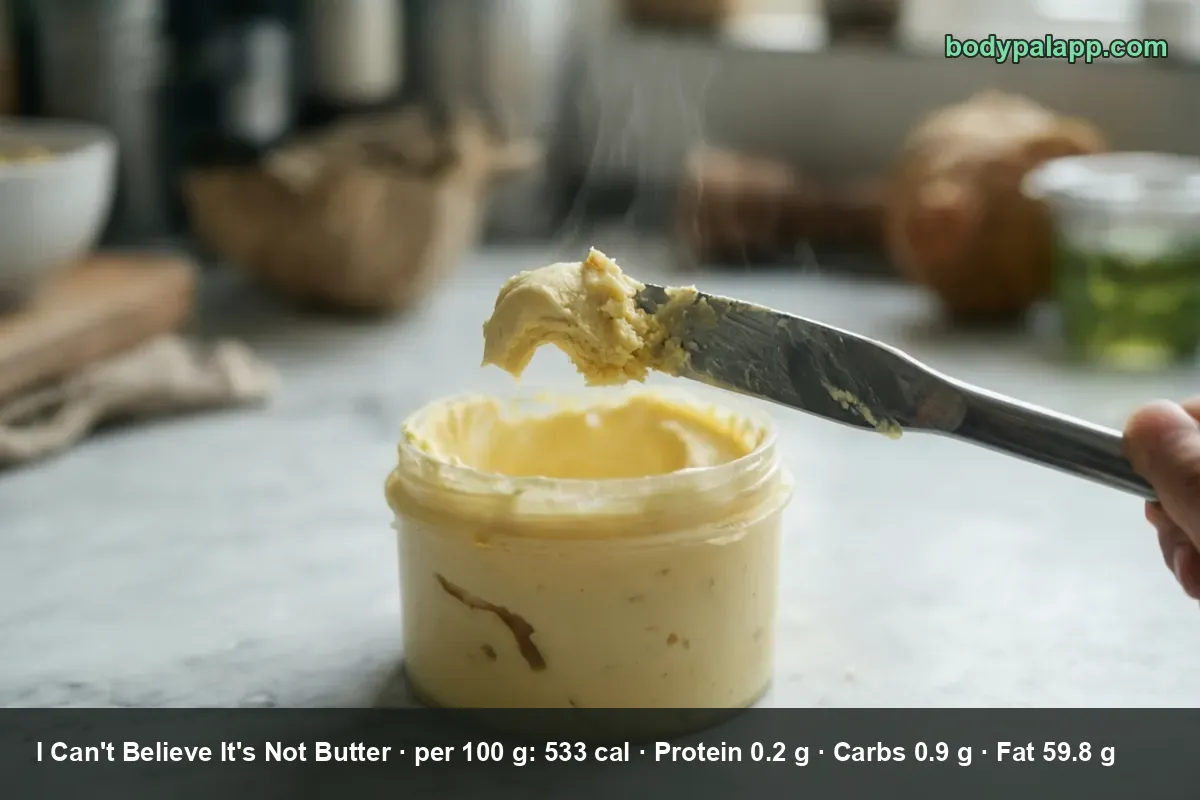
One tablespoon of the salted tub weighs 14 g and carries 75 calories. Per 100 g the spread runs 533 calories, because 60 percent of it is fat and most of the rest is water. A teaspoon scraped across toast is 26 calories, and that is the amount most people actually eat.
On this page
- Vegetable oil spread quick facts
- US servings from a teaspoon to a cup
- Sticks light spread and the fat-free tub
- Saturated fat trans fat and the sodium row
- How does the spread compare with butter
- Most popular I Can't Believe It's Not Butter! products
- FAQ
Vegetable oil spread quick facts
The product in your refrigerator door is a tub of salted vegetable oil spread at 60 percent fat, and USDA has a record for exactly that: SR Legacy 173582, "Margarine-like, vegetable oil spread, 60% fat, tub, with salt". That is the row behind the headline numbers on this page; the variant and butter tables below name their own USDA records. The stick and bottle versions of the same spread sit in separate records because their water content differs, not because the data comes from somewhere else.
The tablespoon column below is the USDA household measure of 14 g, which matches the serving printed on the tub.
| Nutrient | Per 100 g | Per 1 tbsp (14 g) | % Daily Value |
|---|---|---|---|
| Calories | 533 | 75 | — |
| Total fat | 59.81 g | 8.4 g | 11% |
| Saturated fat | 12.09 g | 1.7 g | 8% |
| Trans fat | 3.66 g | 0.5 g | — |
| Carbohydrate | 0.86 g | 0.1 g | 0% |
| Dietary fiber | 0 g | 0 g | 0% |
| Total sugars | 0 g | 0 g | — |
| Protein | 0.17 g | 0.0 g | 0% |
| Sodium | 615 mg | 86 mg | 4% |
% Daily Value is based on a 2,000-calorie diet.
Verified nutrition data
Numbers on this page come from USDA FoodData Central, the U.S. Department of Agriculture’s food composition database, and from manufacturer labels where a branded product is named. Last verified September 2026. How we verify our data →
There is no added sugars row here, because the SR Legacy edition of this record does not carry that field at all; the ingredient list of a plain salted spread has no sugar in it either. Cholesterol is 1 mg per 100 g, which rounds to 0 mg in a tablespoon, and potassium is 30 mg per 100 g, or 4 mg per tablespoon. Trans fat has no Daily Value, so that cell stays empty. See the FDA's own Daily Value reference for how those percentages are set.
US servings from a teaspoon to a cup
| Serving | Weight | Calories |
|---|---|---|
| 1 tsp | 4.8 g | 26 kcal |
| 1 tbsp | 14 g | 75 kcal |
| 2 tbsp | 28 g | 149 kcal |
| 1 oz | 28.35 g | 151 kcal |
| 1 cup | 229 g | 1221 kcal |
| Per 100 g | 100 g | 533 kcal |
The teaspoon, the tablespoon and the cup are USDA household measures for this record. The 2 tbsp and 1 oz lines are our own arithmetic from the USDA 100 g figure, not USDA servings, and they exist because recipes and food scales use them.
Two things fall out of that table. A knife-swipe on a slice of toast is closer to a teaspoon than a tablespoon, so the honest number for breakfast is often 26 calories rather than 75. And the cup is where the spread stops being a condiment: 229 g of it is 1,221 calories and 137 g of fat, which is 176 percent of a day's fat Daily Value in one measuring cup. Recipes that call for a cup of spread are asking for more fat than a whole day's reference intake, split across a whole pan of cookies.
Sticks light spread and the fat-free tub
| Version | Per 100 g | Typical piece | Calories |
|---|---|---|---|
| Salted tub, 60% fat (main record) | 533 kcal | 1 tbsp (14 g) | 75 kcal |
| Sticks for baking, 60% fat | 537 kcal | 1 tbsp (14.3 g) | 77 kcal |
| Light spread, about 37% fat | 339 kcal | 1 oz (28.35 g) | 96 kcal |
| Spread at 20% fat | 175 kcal | 1 oz (28.35 g) | 50 kcal |
| Fat-free tub | 44 kcal | 1 tbsp (14.6 g) | 6 kcal |
| Unsalted tub, 60% fat | 533 kcal | 1 oz (28.35 g) | 151 kcal |
| Tub with added vitamin D | 533 kcal | 1 tbsp (14 g) | 75 kcal |
Of those seven rows, only two come in under 200 calories per 100 g: the fat-free tub at 44 and the 20 percent spread at 175. Everything else is a fat with water whipped into it, and the calorie count tracks the fat percentage almost exactly.
The baking sticks are the trap. At 537 calories per 100 g they are four calories heavier than the tub per 100 g, which is nothing. The difference sits in the fat quality: 3.66 g of trans fat per 100 g in the tub against 12.73 g in the stick, because a firmer product needed harder fat. The tub with added vitamin D is the same food with a vitamin premix, so its calories do not move at all.
The fat-free tub is the one worth knowing about. At 6 calories a tablespoon it is genuinely close to free, but it is 4.34 g of carbohydrate per 100 g instead of fat, and it will not brown, fry or cream into a batter. It is a topping, not an ingredient.
Saturated fat trans fat and the sodium row
A tablespoon carries 1.7 g of saturated fat, which is 8 percent of the Daily Value. Three tablespoons across a day, easy enough with toast, a baked potato and a pan of vegetables, is about 5.1 g, or roughly a quarter of the day's reference amount. The Dietary Guidelines for Americans advise keeping saturated fat under 10 percent of daily calories, which is about 22 g on a 2,000-calorie day, and MyPlate frames spreads like this one as a place to swap saturated fat for unsaturated oils.
The trans fat number needs a date on it. The USDA record was sampled before FDA removed partially hydrogenated oils from the food supply in 2018, so 3.66 g per 100 g reflects an older formula. Tubs on the shelf today declare 0 g trans fat per serving. Anyone matching an old recipe database against a current label will see that gap and it is real.
Sodium is the quiet row. 86 mg a tablespoon looks small, and it is only 4 percent of the Daily Value, but the spread itself runs 615 mg per 100 g, about a quarter teaspoon of table salt in every 100 g of spread. It is entirely a recipe decision: the unsalted version of the identical 60 percent spread carries 2 mg per 100 g and the same 533 calories. If you are watching sodium rather than calories, the unsalted tub changes one number and nothing else.
How does the spread compare with butter?
| Spread | Per 100 g | US serving | Calories |
|---|---|---|---|
| Vegetable oil spread, 60% fat tub | 533 kcal | 1 oz (28.35 g) | 151 kcal |
| Butter, light, salted stick | 499 kcal | 1 oz (28.35 g) | 141 kcal |
| Smart Balance regular buttery spread with flax oil | 583 kcal | 1 oz (28.35 g) | 165 kcal |
| Vegetable oil-butter spread, reduced calorie | 465 kcal | 1 oz (28.35 g) | 132 kcal |
Our take: the spread does not win on calories. Against light butter it is 10 calories heavier per ounce and 34 heavier per 100 g, and the reduced-calorie oil-butter blend beats both at 465 per 100 g. Smart Balance, at 583, is the heaviest of the four. If the goal is fewer calories on toast, the lever is the size of the swipe, not the brand: a teaspoon of any of them lands between about 22 and 28 calories. If the goal is less saturated fat, the plant-oil spreads have the edge over dairy fat, and that is the argument this category was built on in the first place.
Most popular I Can't Believe It's Not Butter! products in the United States
Ranked by how widely each product appears among foods sold in the United States, from the BodyPal food database of over 3.3 million products. Calories are the figures printed on each Nutrition Facts label, checked against USDA FoodData Central.
| Product | Calories (per 100 g) |
|---|---|
| I Can't Believe It's Not Butter! Original 45% Vegetable Oil Spread | 429 cal |
| I Can't Believe It's Not Butter! The Light One 28% Vegetable Oil Spread | 250 cal |
| I Can't Believe It's Not Butter! It's Vegan 45% Vegetable Oil Spread | 429 cal |
| I Can't Believe It's Not Butter! Olive Oil 45% Vegetable Oil Spread | 429 cal |
| I Can't Believe It's Not Butter! Baking Sticks 79% Vegetable Oil Spread | 714 cal |
| I Can't Believe It's Not Butter! Organic Buttery Spread 79% Vegetable Oils | 727 cal |
Brand popularity: BodyPal food database. Nutrition: manufacturer labels / USDA FoodData Central.
Spread FAQs
How many calories are in 1 tablespoon of I Can't Believe It's Not Butter?
75 calories in one tablespoon, which is 14 g of a 60 percent fat salted tub at 533 calories per 100 g. That tablespoon carries 8.4 g of fat, 1.7 g of it saturated, and 86 mg of sodium. Protein and sugar are effectively zero.
How many calories are in 1 teaspoon of the spread?
26 calories for a level teaspoon, which USDA weighs at 4.8 g. That is 2.9 g of fat and 30 mg of sodium. A teaspoon is closer to what a knife actually leaves on a slice of toast than a tablespoon is, so it is the number worth logging at breakfast.
Is it lower in calories than real butter?
No. The 60 percent spread is 533 calories per 100 g, while USDA's light salted butter stick is 499. Per ounce that is 151 calories against 141. The spread wins on saturated fat, not on calories: 12.09 g per 100 g is well under the level of dairy butter fat.
How much saturated fat is in a tablespoon?
1.7 g, which is 8 percent of the Daily Value. Per 100 g the spread holds 12.09 g. Three tablespoons in a day adds up to about 5.1 g, roughly a quarter of the 20 g Daily Value that FDA uses on the Nutrition Facts label for a 2,000-calorie diet.
Does it contain trans fat?
The USDA record lists 3.66 g per 100 g, or 0.5 g per tablespoon, but that sample predates FDA's 2018 removal of partially hydrogenated oils. Current tubs declare 0 g trans fat per serving. The baking sticks in the same database are far higher at 12.73 g per 100 g.
How many calories are in the Light version?
339 calories per 100 g for the roughly 37 percent fat light spread, or 96 calories per ounce. That is about a third fewer calories than the 533 of the regular tub, and the whole difference is water replacing oil. It spreads well but behaves badly in a hot pan.
How much sodium is in one serving?
86 mg per tablespoon, 4 percent of the 2,300 mg Daily Value. Per 100 g that is 615 mg, about a quarter teaspoon of table salt. The unsalted version of the same 60 percent spread drops to 2 mg per 100 g while keeping all 533 calories, so salt is the only variable.
Is the fat-free tub actually zero calories?
Close but not zero: 44 calories per 100 g, so 6 calories in a tablespoon. Its 3.04 g of fat per 100 g comes with 4.34 g of carbohydrate, which is where the texture comes from. Use it cold on toast or potatoes, since it will not brown or cream into a batter.
Similar foods
- Cheese Straw — 160 cal for 9 straws
- Cheese Popcorn — 74 cal per cup
- Butter Popcorn — 73 cal per cup, popped
- Milk Powder — 635 cal per cup
- Blue Cheese Dressing — 148 cal for 2 tablespoons
- Peanut Butter — 191 cal for 2 tbsp
Count it without the math
Point the camera at the toast and BodyPal counts the spread with it, teaspoon or tablespoon.


How long does it take to burn off 75 kcal of vegetable oil spread?
One tablespoon (14 g) is 75 kcal. Enter your weight and the amount you ate to see how long it takes you to burn that off:
lb
| Activity | Time to burn 75 kcal |
|---|---|
| Walking, brisk | 15 min |
| Cycling, moderate | 9 min |
| Swimming, moderate | 11 min |
| Jogging | 9 min |
| Weight training, moderate | 17 min |
Times are for a 155 lb adult at a steady pace; change the weight to see yours. The amount is set to the portion in the text (14 g); change it to what you actually ate. BodyPal works this out from your steps automatically.
This table assumes you know your daily total. If you do not, the daily calorie calculator works it out from five numbers.