
How many calories are in peanut butter?
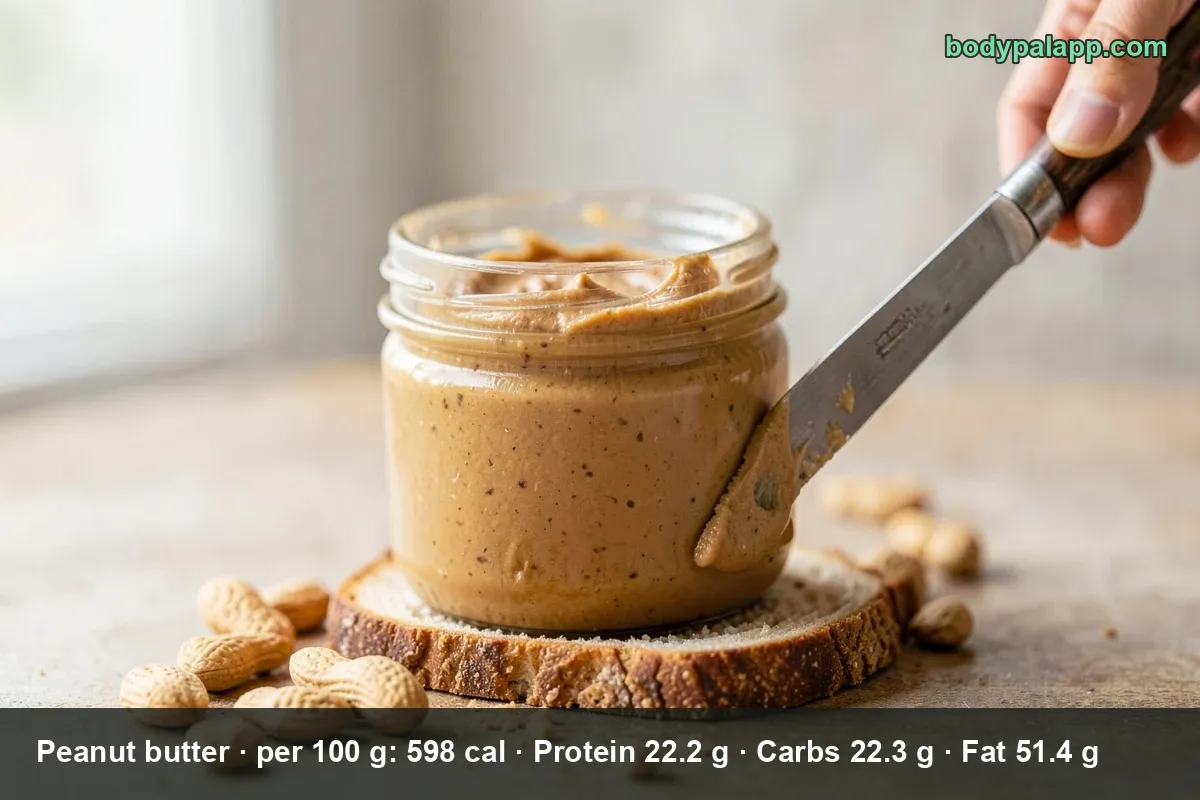
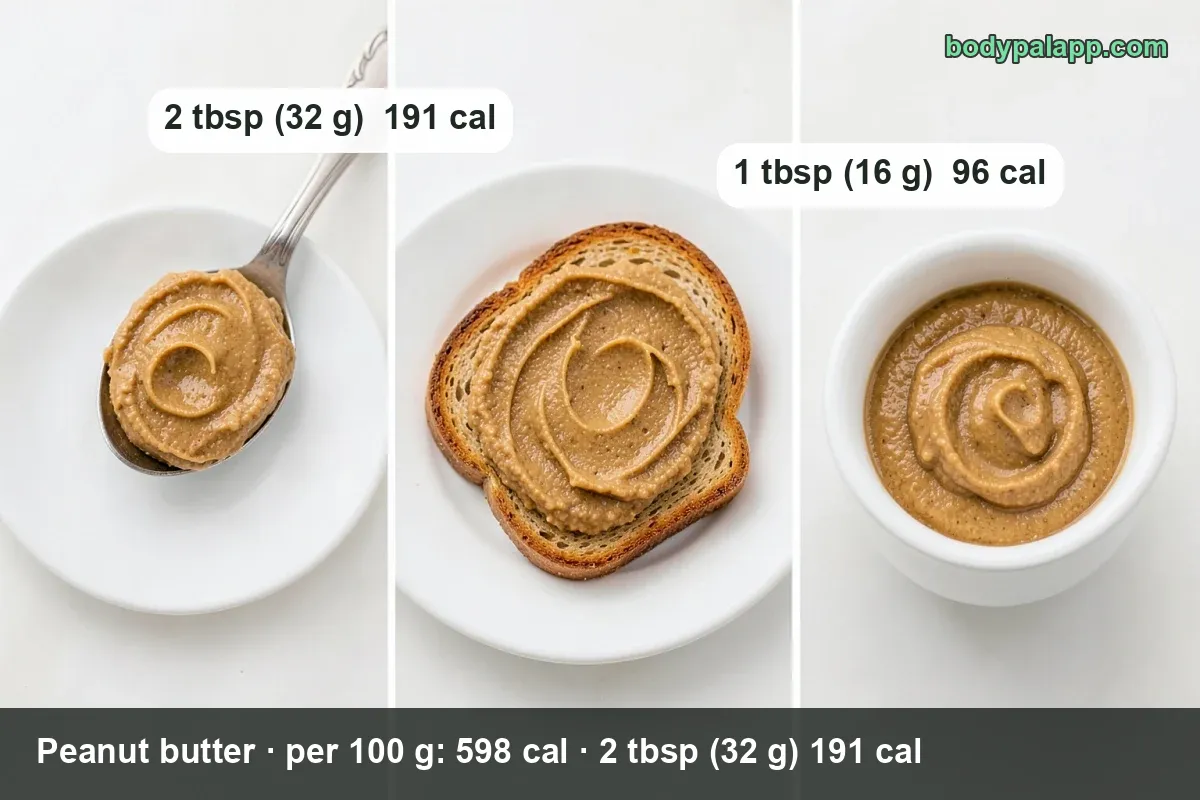
Two tablespoons of peanut butter weigh 32 g and carry 191 calories. Per 100 g the jar runs 598 calories, one of the densest foods in an ordinary kitchen. A single tablespoon is 96, and the 45 g serving USDA lists for one sitting is 269.
On this page
- Peanut butter quick facts
- US servings, from one tablespoon to a 45-gram scoop
- Crunchy, natural, reduced fat and lower sugar
- Peanut butter sandwiches, counted whole
- Protein and sodium, the two rows that matter
- How does peanut butter compare?
- Most popular peanut butter brands
- Peanut butter FAQs
Peanut butter quick facts
The record behind every number here is FNDDS 2707537, "Peanut butter". That is plain salted smooth spread out of a jar, the kind on the photo above, and it is the one USDA attaches real household amounts to: 1 tbsp at 16 g, 2 tbsp at 32 g, and a 45 g single serving.
Two other records describe the same food. Foundation 324860 is a newer lab analysis at 597 calories per 100 g, but it publishes no total sugars figure, so a full label cannot be built from it. SR Legacy 174266 gives identical values to the record used here and carries no serving sizes of its own. The differences are laboratory batches, not different jars.
| Nutrient | Per 100 g | Per 2 tbsp (32 g) | % Daily Value |
|---|---|---|---|
| Calories | 598 | 191 | — |
| Total fat | 51.36 g | 16.4 g | 21% |
| Saturated fat | 10.32 g | 3.3 g | 17% |
| Carbohydrate | 22.31 g | 7.1 g | 3% |
| Dietary fiber | 5 g | 1.6 g | 6% |
| Total sugars | 10.49 g | 3.4 g | — |
| Protein | 22.21 g | 7.1 g | 14% |
| Sodium | 426 mg | 136 mg | 6% |
% Daily Value is based on a 2,000-calorie diet.
Verified nutrition data
Numbers on this page come from USDA FoodData Central, the U.S. Department of Agriculture’s food composition database, and from manufacturer labels where a branded product is named. Last verified September 2026. How we verify our data →
There is no added sugars row above because this FNDDS edition does not publish added sugars for peanut butter, and the same applies to trans fat. Total sugars are shown instead, and they have no Daily Value of their own. Cholesterol is zero, as it is in any plant spread. Potassium comes to 558 mg per 100 g, which is 179 mg in a 2-tbsp serving, 4 percent of the Daily Value the FDA sets.
US servings, from one tablespoon to a 45-gram scoop
| Serving | Weight | Calories |
|---|---|---|
| 1 tbsp, one slice of bread | 16 g | 96 kcal |
| 2 tbsp, one sandwich | 32 g | 191 kcal |
| 1 oz | 28 g | 170 kcal |
| 1 single serving | 45 g | 269 kcal |
| Per 100 g | 100 g | 598 kcal |
The 16 g, 32 g and 45 g amounts are USDA household measures for this record. The 1 oz line is our own arithmetic from the USDA 100 g figure, scaled from 28.35 g, not a USDA serving.
This is where most peanut butter logs go wrong. The spoon lies. A tablespoon of peanut butter is not a level tablespoon of milk, and a heaped one is closer to 24 g than 16 g. Three amounts out of the same jar give 96, 191 and 269 calories, a threefold spread, and none of them is unreasonable for one piece of toast.
If you want a number that survives a bad estimate, weigh the jar before and after. Sixteen grams is about the width of a thumb of spread on one slice; 45 g is a small scoop straight from the jar, and it is what USDA treats as one sitting.
Crunchy, natural, reduced fat and lower sugar
| Version | Per 100 g | 2 tbsp (32 g) | The line that moves |
|---|---|---|---|
| Smooth, salted (main record) | 598 kcal | 191 kcal | — |
| Crunchy, chunk style | 589 kcal | 188 kcal | Fiber 8 g per 100 g |
| Smooth, without salt | 598 kcal | 191 kcal | Sodium 17 mg per 100 g |
| Reduced fat | 520 kcal | 166 kcal | Carbohydrate 35.65 g per 100 g |
| Lower sugar | 650 kcal | 208 kcal | Sugars 6.35 g per 100 g |
Every 32 g figure in that table except the main record is our own arithmetic from the USDA 100 g values, since those records carry no serving weights.
Crunchy is the free upgrade. At 589 calories per 100 g it is 3 calories lighter per serving than smooth, which is noise, but it delivers 8 g of fiber per 100 g against 5 g, so 2.6 g per serving instead of 1.6 g. That is 9 percent of the fiber Daily Value from a spoonful of spread.
Reduced fat is the one that disappoints. It saves 25 calories per serving, about 13 percent, because part of the fat is replaced with carbohydrate: 35.65 g per 100 g against 22.31 g. Sodium climbs at the same time, from 426 mg to 540 mg per 100 g, which is 173 mg in a serving instead of 136 mg. You trade a quarter of an apple's worth of calories for more salt and more starch.
Lower sugar goes the other way and lands higher. Take the sugar out and what is left is more concentrated fat: 650 calories per 100 g, 208 per serving, 17 more than the regular jar. It is a fine choice if sugar is what you are managing, but it is not a light option.
Unsalted, sometimes sold as natural smooth, is calorically identical to the salted jar. The one number that changes is sodium: 17 mg per 100 g instead of 426 mg, about 5 mg per serving.
There is no popular-brands table on this page for a reason. A search of the USDA branded database for peanut butter returns candy — Reese's cups and miniatures at 500 to 529 calories per 100 g with 55 to 61 g of carbohydrate — which is a different food from jarred spread, so those rows were left out rather than mixed in.
Peanut butter sandwiches, counted whole
| Sandwich | Weight | Per 100 g | Calories |
|---|---|---|---|
| Peanut butter sandwich | 92 g | 382 kcal | 351 kcal |
| Peanut butter and jelly sandwich | 112 g | 361 kcal | 404 kcal |
A whole peanut butter sandwich is 351 calories, which is 160 more than the 2 tbsp of spread on its own. The bread is doing more work than most people credit it for, and it is why logging "peanut butter" alone can quietly undercount lunch by nearly half.
Adding jelly costs 53 calories on top and drops the calories per 100 g from 382 to 361, because jelly is wetter and lighter than the spread it sits next to. A denser number per gram does not mean a bigger lunch; the weight is what decides.
Protein and sodium, the two rows that matter
Peanut butter earns its place on the plate through protein: 7.1 g in 2 tbsp, 14 percent of the Daily Value, and 10.0 g in the 45 g serving, which is 20 percent. MyPlate counts nut butters in the protein foods group for exactly this reason.
The row to watch is saturated fat. Per 100 g the spread carries 10.32 g, 52 percent of the daily limit, though a normal 2-tbsp serving brings that down to 3.3 g, or 17 percent. Two servings a day and you are a third of the way through the saturated fat allowance before anything else on the menu.
Sodium is the quiet one. A serving has 136 mg, roughly a sixteenth of a teaspoon of table salt, which is unremarkable on its own. It only becomes interesting next to the unsalted record at 17 mg per 100 g, and next to reduced fat at 540 mg per 100 g. If you are watching sodium, the unsalted jar is the better pick and costs you nothing in calories.
How does peanut butter compare?
| Food | Per 100 g | US serving | Calories |
|---|---|---|---|
| Peanut butter | 598 kcal | 1 oz, 28 g | 170 kcal |
| Peanuts, roasted and salted | 599 kcal | 1 oz, 28 g | 170 kcal |
| Almonds | 598 kcal | 1 oz, 28 g | 170 kcal |
| Trail mix with nuts | 604 kcal | 1 oz, 28 g | 171 kcal |
The 1 oz peanut butter line is our own scaling from the 100 g figure; the other three are USDA ounce servings.
Our take: at this end of the shelf the food you choose barely matters — all four sit inside 6 calories per 100 g of each other, with trail mix the only one above 600 and peanut butter and almonds tied at the bottom on 598. What matters is the utensil. An ounce of almonds is roughly 23 nuts you count out; an ounce of peanut butter is a spoon dipped into a jar, and the spoon has no natural stopping point. For weight loss, buy the crunchy jar and portion it with a scale, or eat the peanuts instead. For staying full through an afternoon, the 45 g serving at 269 calories and 10.0 g of protein does the job better than any snack bar at the same weight.
Most popular peanut butter brands in the United States
Ranked by how widely each product appears among foods sold in the United States, from the BodyPal food database of over 3.3 million products. Calories are the figures printed on each Nutrition Facts label, checked against USDA FoodData Central.
| Product | Calories (per 100 g) |
|---|---|
| Jif Creamy Peanut Butter | 576 cal |
| Skippy Creamy Peanut Butter | 594 cal |
| Jif Extra Crunchy Peanut Butter | 576 cal |
| Smucker's Natural Peanut Butter, Creamy | 656 cal |
| Jif Reduced Fat Creamy Peanut Butter Spread | 528 cal |
| Peter Pan Creamy Original Peanut Butter | 625 cal |
Brand popularity: BodyPal food database. Nutrition: manufacturer labels / USDA FoodData Central.
Peanut butter FAQs
How many calories are in 1 tablespoon of peanut butter?
One tablespoon weighs 16 g and carries 96 calories, since the spread runs 598 calories per 100 g. That single spoon also brings 3.6 g of protein and 8.2 g of fat. Most people who spread it on toast use closer to two spoons, which doubles the count to 191.
How many calories are in 2 tablespoons of peanut butter?
Two tablespoons, 32 g, come to 191 calories, and that is the amount USDA treats as one sandwich. It carries 16.4 g of fat, 7.1 g of protein and 136 mg of sodium. It is also the serving printed on most jar labels, so the back of the jar lines up.
How much protein is in a serving of peanut butter?
A 2-tbsp serving gives 7.1 g of protein, 14 percent of the Daily Value. Scale up to the 45 g single serving USDA lists and it reaches 10.0 g, or 20 percent. Peanut butter counts as a protein food on MyPlate, though those grams arrive alongside 16.4 g of fat.
Is crunchy peanut butter lower in calories than creamy?
Only just: chunk style is 589 calories per 100 g against 598 for smooth, so 2 tbsp is 188 instead of 191, a 3-calorie difference. The real gap is fiber, 8 g per 100 g in the crunchy jar versus 5 g in the smooth one, which is 2.6 g against 1.6 g per serving.
Does reduced fat peanut butter really save calories?
Reduced fat peanut butter is 520 calories per 100 g, so 2 tbsp is 166 against 191, a saving of 25 calories or about 13 percent. Sodium goes the other way, from 426 to 540 mg per 100 g, and carbohydrate climbs from 22.31 g to 35.65 g as starch replaces the fat.
How much sodium is in peanut butter?
A 2-tbsp serving has 136 mg of sodium, 6 percent of the Daily Value, scaled from 426 mg per 100 g. That is roughly a sixteenth of a teaspoon of table salt. Unsalted jars drop to 17 mg per 100 g, about 5 mg per serving, at no cost in calories.
Is natural peanut butter lower in calories than regular?
No: the closest USDA record, smooth peanut butter without salt, is the same 598 calories per 100 g as the salted jar, so 2 tbsp is still 191. The only line that moves is sodium, 17 mg per 100 g instead of 426 mg. Natural means less salt, not fewer calories.
How many calories are in a peanut butter sandwich?
A peanut butter sandwich weighs 92 g and comes to 351 calories, or 382 per 100 g. That is 160 more than the 2 tbsp of spread on its own, because the bread carries the rest. Add jelly and a 112 g sandwich reaches 404 calories.
Similar foods
- Cheese Straw — 160 cal for 9 straws
- I Can't Believe It's Not Butter — 75 cal per tbsp
- Cheese Popcorn — 74 cal per cup
- Butter Popcorn — 73 cal per cup, popped
- Milk Powder — 635 cal per cup
- Blue Cheese Dressing — 148 cal for 2 tablespoons
Count it without the math
Point the camera at the toast and BodyPal counts the spread for you, spoon size and all.


How long does it take to burn off peanut butter?
A 2-tbsp (32 g) serving is 191 kcal. Enter your weight and the amount you ate to see how long it takes you to burn that off:
lb
| Activity | Time to burn 191 kcal |
|---|---|
| Walking, brisk | 38 min |
| Cycling, moderate | 24 min |
| Swimming, moderate | 27 min |
| Jogging | 22 min |
| Weight training, moderate | 42 min |
Times are for a 155 lb adult at a steady pace; change the weight to see yours. The amount is set to the portion in the text (32 g); change it to what you actually ate. BodyPal works this out from your steps automatically.
One food is easy to picture; a whole day is harder. See how many calories you need a day and what a deficit actually looks like.