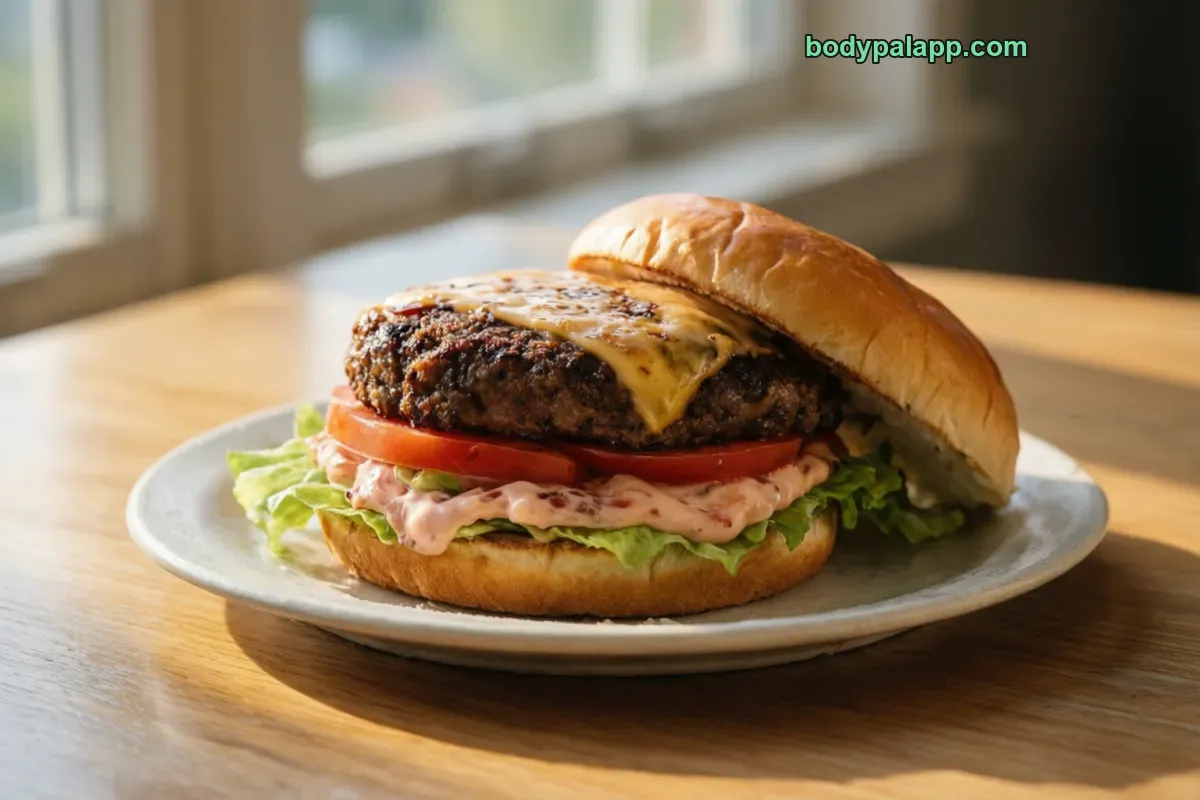
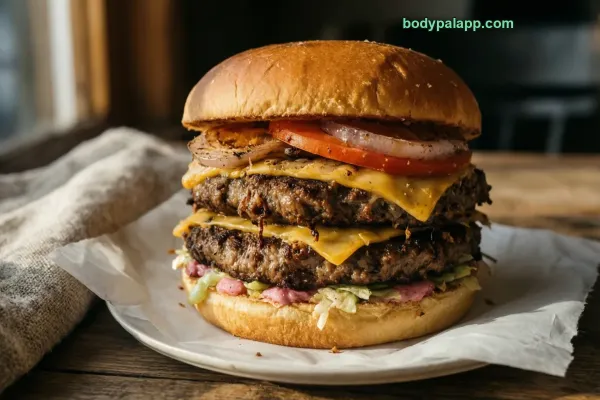
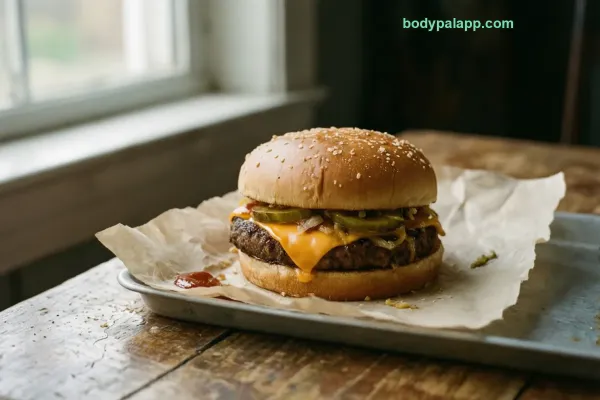
In-N-Out cheeseburger calories come to 430 for one burger (229 g), or 188 per 100 g. The figure to notice is sodium: one burger carries 1,080 mg, which is 47% of the daily value. Protein is solid at 20 g, but fat supplies the largest share of the calories at 44%.
430kcal
1 cheeseburger with onion · 229 g, as served
19%protein
20 gProtein
40 gCarbs
21 gFat
How to burn off 430 kcal
—Walking, brisk
—Jogging
—Cycling, moderate
—Swimming
Skip the math. BodyPal counts these calories from your steps and workouts automatically.
In-N-Out cheeseburger: calories, protein and sodium by serving
Percent of daily value uses the FDA reference of 2,000 kcal a day.
Serving
kcal
Protein
Carbs
Fat
Sodium
% DV kcal
1 burger (229 g)
430
20 g
40 g
21 g
1,080 mg
21%
100 g
188
8.7 g
17.5 g
9.2 g
472 mg
9%
3 × 1 burger (229 g)
1,290
60 g
3,240 mg
5 × 1 burger (229 g)
2,150
100 g
5,400 mg
A second burger takes you to 860 calories
These are In-N-Out's published nutrition values for the cheeseburger with onion, as served. One burger weighs 229 g and comes to 430 calories, about 21% of the daily value for calories. That is a full meal's worth from the sandwich alone, before anything else lands on the tray.
The total climbs quickly once you double up. Two burgers come to 860 calories and 40 g of protein. Three reach 1,290 calories, and five add up to 2,150 calories with 100 g of protein. The protein looks impressive at that scale. So does everything else.
The burger is a fixed size, so the real portion decision happens at the counter, not on the plate. Ordering one instead of two saves 430 calories outright, a bigger cut than most small swaps can deliver. If you are hungry, it is worth asking whether a second burger or something lighter on the side will do the job better.
Fat brings 44% of the calories
Per 100 g the cheeseburger has 9.2 g of fat, 17.5 g of carbs and 8.7 g of protein. Converted to calories, fat supplies 44%, carbs 37% and protein 19%. Fat is the biggest single source, which is typical for a burger built on beef and melted cheese.
Per burger that means 21 g of fat, 40 g of carbs and 20 g of protein. The 20 g of protein covers 40% of the daily value, a real contribution from one sandwich. Saturated fat sits at 3.5 g per 100 g, part of the fat total rather than a separate concern on its own here.
Fiber and sugar are small. One burger has 2 g of fiber and 9 g of sugars, so most of the carbs are starch from the bun rather than from vegetables or sweeteners. If you want fiber from this meal, it has to come from somewhere else on the plate or later in the day.
Sodium is the row to watch
One burger holds 1,080 mg of sodium, 47% of the daily value. Calories, by comparison, sit at 21% of the daily value. Put simply, the burger uses up sodium more than twice as fast as it uses up calories, and that gap is the most useful thing on this label.
Per 100 g the figure is 472 mg, which alone is 21% of the daily value. Two burgers reach 2,160 mg, close to a full day's worth in one sitting. Three come to 3,240 mg and five to 5,400 mg, both well past the daily value. Multiplying the order multiplies the sodium just as fast as the calories.
If you watch sodium, the second burger is the clearest place to hold back. One burger leaves room in the day; two leave very little. Cholesterol, by contrast, is modest at 24 mg per 100 g, so sodium is the line that deserves your attention on this page.
One burger fits a day, two take it over
At 430 calories and 20 g of protein, one cheeseburger can work as the main part of a meal. The trouble usually starts with what gets ordered next to it. A sugary drink or a large side can push the meal well past the burger's own number without adding much protein.
A plain drink like water or unsweetened tea keeps the meal close to the burger's 430 calories. Since the burger has only 2 g of fiber, fruit or vegetables at another meal help balance the day. Given the 1,080 mg of sodium, lower-salt choices for the rest of the day make sense if you track that number.
If you log what you eat, record the burger as one 229 g serving rather than guessing. BodyPal can log it from a photo of your tray, which makes it easy to see the burger and anything you added in one entry. That keeps the day's totals honest without much effort.
How does In-N-Out cheeseburger compare?
Here is how the In-N-Out cheeseburger stacks up against the Double-Double, a McDonald's cheeseburger and a cheeseburger slider, per 100 g and per usual serving.
Verdict: For the lowest calorie density pick the In-N-Out cheeseburger: 188 per 100 g against 263 to 297 for the others, in a bigger and more filling sandwich. If you just want the smallest total, the McDonald's cheeseburger at 313 calories wins, while the Double-Double at 457 calories and 16.8 g protein per 100 g suits a protein-first order.
In-N-Out cheeseburger FAQs
How many calories are in an In-N-Out cheeseburger?
One In-N-Out cheeseburger with onion (229 g) has 430 calories, which is 188 calories per 100 g.
Is an In-N-Out cheeseburger good for weight loss?
One burger has 430 calories with 20 g protein, 21 g fat and 40 g carbs. It also carries about 1080 mg of sodium.
In-N-Out cheeseburger vs Double-Double: which has more calories?
Per 100 g the cheeseburger has 188 calories and the Double-Double has 282, so the Double-Double is denser in calories.
How much protein is in an In-N-Out cheeseburger?
About 20 g of protein per burger (229 g), or 8.7 g per 100 g.
How much sodium is in an In-N-Out cheeseburger?
One In-N-Out cheeseburger has 1,080 mg of sodium, which is 47% of the daily value. That is more than twice its share of calories, at 21% of the daily value.
How many calories are in two In-N-Out cheeseburgers?
Two In-N-Out cheeseburgers come to 860 calories. They also bring 40 g of protein and 2,160 mg of sodium, which is close to a full day's daily value for sodium in one meal.
How many carbs are in an In-N-Out cheeseburger?
One In-N-Out cheeseburger has 40 g of carbs, with 9 g of sugars and 2 g of fiber. Carbs supply 37% of the burger's calories, less than fat at 44%.
How much fat is in an In-N-Out cheeseburger?
One In-N-Out cheeseburger has 21 g of fat, and fat supplies 44% of its calories. Per 100 g there are 9.2 g of fat, of which 3.5 g is saturated.
How many calories are in 100 g of an In-N-Out cheeseburger?
100 g of an In-N-Out cheeseburger has 188 calories, with 8.7 g protein, 17.5 g carbs and 9.2 g fat. That is lower than the Double-Double at 282 per 100 g.