
How many calories are in chicken adobo?
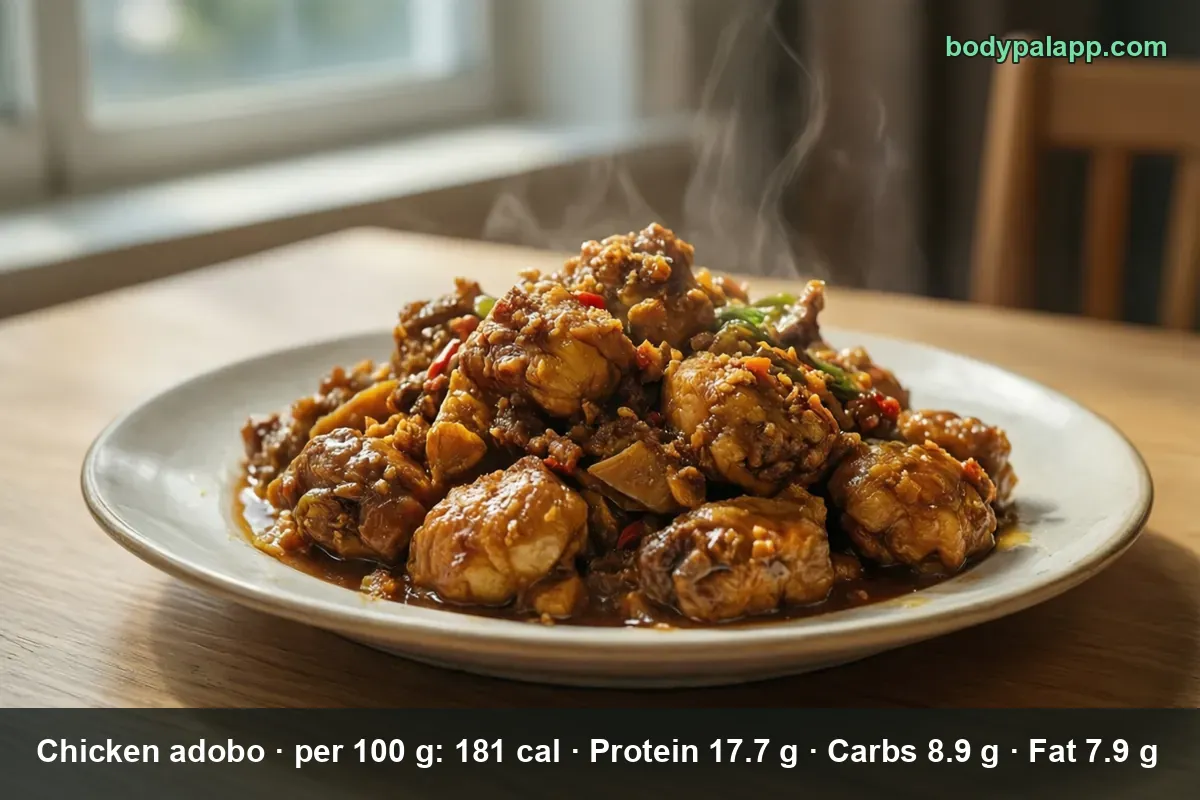
A 1-cup serving of chicken adobo with rice weighs 244 g and carries 442 calories. Per 100 g the dish runs 181 calories. That cup is the whole plate as USDA measures it: braised chicken, the soy-and-vinegar sauce it cooked down in, and the rice underneath, which is where nearly all of the carbohydrate comes from.
On this page
- Chicken adobo quick facts
- US servings from one ounce to a cup and a half
- Chicken adobo with rice and with noodles
- Sodium is the row to watch
- How does chicken adobo compare?
- Most popular chicken adobo brands
- FAQ
Chicken adobo quick facts
That figure comes from FNDDS 2708958, "Adobo, with rice", a Survey record in the poultry mixed dishes group. USDA does not publish a record for adobo on its own. The only two entries pair it with a starch, one with rice and one with noodles, and rice is how the dish is plated in almost every Filipino kitchen and turo-turo counter in the US. That record also carries its own household measure, 1 cup at 244 g, so nothing has to be invented to get a portion.
Read the table with that in mind. Every figure in the middle column is chicken, sauce and rice together, not the meat alone.
| Nutrient | Per 100 g | Per 1 cup (244 g) | % Daily Value |
|---|---|---|---|
| Calories | 181 | 442 | — |
| Total fat | 7.94 g | 19.4 g | 25% |
| Saturated fat | 2.58 g | 6.3 g | 31% |
| Carbohydrate | 8.86 g | 21.6 g | 8% |
| Dietary fiber | 0.2 g | 0.5 g | 2% |
| Total sugars | 0.03 g | 0.1 g | — |
| Protein | 17.69 g | 43.2 g | 86% |
| Sodium | 522 mg | 1274 mg | 55% |
% Daily Value is based on a 2,000-calorie diet.
Verified nutrition data
Numbers on this page come from USDA FoodData Central, the U.S. Department of Agriculture’s food composition database, and from manufacturer labels where a branded product is named. Last verified September 2026. How we verify our data →
Two rows you would see on a packaged label are missing here on purpose: added sugars and trans fat. This FNDDS edition does not measure either one for mixed dishes, so there is nothing to report rather than a zero to guess at. Cholesterol and potassium do exist in the record: a cup gives 183 mg of cholesterol, 61% of the Daily Value, and 527 mg of potassium, 11%. Total sugars have no Daily Value at all, which is why that cell stays empty.
US servings from one ounce to a cup and a half
| Serving | Weight | Calories |
|---|---|---|
| 1 oz | 28 g | 51 kcal |
| 1/2 cup, a side portion | 122 g | 221 kcal |
| 1 cup, the standard plate | 244 g | 442 kcal |
| 1 1/2 cups, a hungry plate | 366 g | 662 kcal |
| 4 oz | 113 g | 205 kcal |
| Per 100 g | 100 g | 181 kcal |
Only the 1-cup line is a USDA household measure. The half cup, the cup and a half, the 4 oz plate portion and the ounce are our own arithmetic from the USDA 100 g figure, scaled straight up or down, not USDA servings in their own right.
The half cup is worth knowing because of how adobo actually gets eaten. It rarely shows up alone. It shares the plate with more rice, sometimes with lumpia or a fried egg, and half a cup of adobo next to a cup of plain rice is a very different day of eating than one big 442-calorie scoop. Weigh the plate once and you will know which of these lines your normal portion sits on.
Chicken adobo with rice and with noodles
| Version | Per 100 g | Typical portion | Calories |
|---|---|---|---|
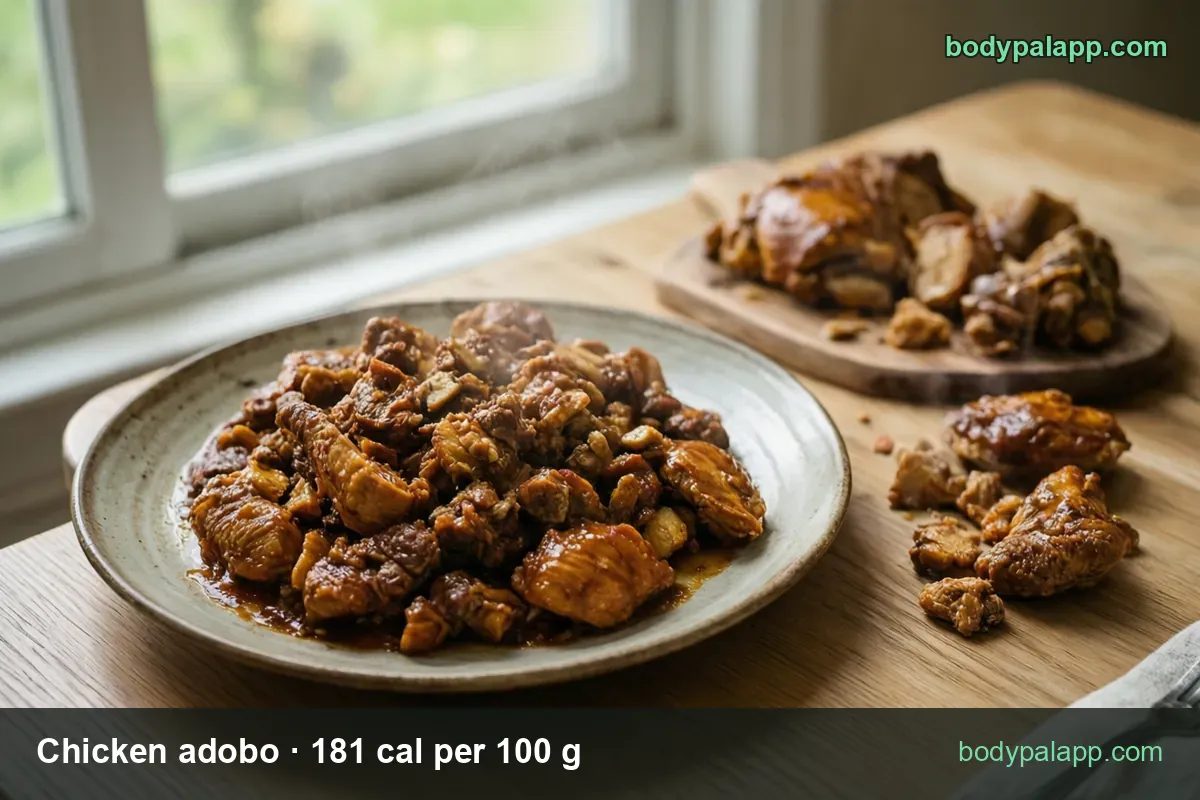
| Adobo with rice | 181 kcal | 1 cup (244 g) | 442 kcal |
| Adobo with noodles | 172 kcal | 1 cup (224 g) | 385 kcal |
| Adobo with rice, half cup | 181 kcal | 1/2 cup (122 g) | 221 kcal |
| Adobo with rice, plate portion | 181 kcal | 4 oz (113 g) | 205 kcal |
| Store adobo chicken rice bowl | 119 kcal | 1 bowl (227 g) | 270 kcal |
Here is the trap in that table. The noodle version is barely lighter as a food, 172 calories per 100 g against 181, a gap of nine. But its standard cup weighs 224 g while the rice cup weighs 244 g, so the portion lands at 385 instead of 442. The whole gap is fifty-seven calories, and most of it comes from the cup being smaller rather than from noodles beating rice. If you swap for the calories, you are mostly swapping for a smaller scoop, and you can get the same result by scooping less rice.
The refrigerated Open Nature Adobo Chicken with Rice Bowl reads lighter still at 119 calories per 100 g, and one 227 g bowl is 270 calories. Density that far below the home-style record almost always means a higher share of rice and sauce per bite and less chicken, so it is a smaller meal, not a magically leaner recipe. Home cooking pushes the other way. Thighs with the skin left on, a longer reduction, a spoon of the rendered fat poured over the rice, all of it lifts the number above 181 per 100 g, and USDA has no record that captures your grandmother's pot specifically.
Sodium is the row to watch
Adobo is a brine as much as a braise. Soy sauce and vinegar do the cooking, and the salt stays in the sauce that ends up on the rice. One cup carries 1,274 mg of sodium, which is 55% of the FDA Daily Value of 2,300 mg. That is a little over half a teaspoon of table salt in a single serving, and it lands before anything else on the tray is counted.
Protein is the other extreme, and it goes the friendly way. The same cup delivers 43.2 g, 86% of the Daily Value, which is more protein than most single servings of anything in the MyPlate protein group put on a plate at once. Saturated fat sits at 6.3 g, 31% of the Daily Value, most of it from the skin and the fat that renders into the sauce.
So the honest read is a split verdict. As a protein source per calorie, adobo is excellent. As a sodium source, one cup uses up more than half a day. If you are watching sodium, the fix is not to skip the dish but to spoon less sauce over the rice, which is where most of the salt is riding.
How does chicken adobo compare?
| Dish | Per 100 g | US serving | Calories |
|---|---|---|---|
| Chicken adobo with rice | 181 kcal | 4 oz (113 g) | 205 kcal |
| Chicken fricassee, Puerto Rican style | 183 kcal | 4 oz (113 g) | 207 kcal |
| Chicken cacciatore | 174 kcal | 4 oz (113 g) | 197 kcal |
| Chicken parmigiana | 174 kcal | 4 oz (113 g) | 197 kcal |
Our take: on calories these four braised and baked chicken dishes are within ten calories of each other per 4 oz, so picking between them on that basis is noise. Protein is where adobo pulls ahead, 17.69 g per 100 g against 16.25 for parmigiana, 14 for the fricassee and 13.19 for cacciatore. Fat runs the other way in adobo's favor too, 7.94 g per 100 g against 13.12 g in the Puerto Rican fricassee and 10.62 g in cacciatore. If you want the most protein per calorie on this list, adobo wins; if sodium is your limit for the day, it is the one to portion carefully.
Most popular chicken adobo brands in the United States
Ranked by how widely each product appears among foods sold in the United States, from the BodyPal food database of over 3.3 million products. Calories are the figures printed on each Nutrition Facts label, checked against USDA FoodData Central.
| Product | Calories (per 100 g) |
|---|---|
| Open Nature Adobo Chicken with Rice Bowl | 119 cal |
Brand popularity: BodyPal food database. Nutrition: manufacturer labels / USDA FoodData Central.
Chicken adobo FAQs
How many calories are in chicken adobo?
442 calories in a 1-cup serving with rice, which weighs 244 g, or 181 calories per 100 g. That is the USDA figure for the plate as it is served, chicken and sauce and rice together. A half-cup side portion is 221 calories and a 4 oz plate portion is 205.
How many calories in 1 cup of chicken adobo with rice?
442 calories. USDA lists 1 cup at 244 g for FNDDS record 2708958, at 181 calories per 100 g. Inside that cup are 43.2 g of protein, 21.6 g of carbohydrate and 19.4 g of fat. A cup and a half, which is closer to a big dinner plate, comes to 662.
How much protein is in chicken adobo?
43.2 g in a 1-cup serving, or 17.69 g per 100 g. That is 86% of the Daily Value in one bowl, which is why adobo works so well as the anchor of a meal. Half a cup still gives you around 21.6 g, roughly what a large chicken breast portion delivers.
How much sodium is in chicken adobo?
1,274 mg in a 1-cup serving, or 522 mg per 100 g. That is 55% of the 2,300 mg Daily Value, a little over half a teaspoon of table salt, and it comes from the soy sauce that does the braising. Most of it sits in the sauce rather than inside the meat.
Is chicken adobo healthy?
It is 442 calories a cup with 43.2 g of protein, so on protein per calorie it is one of the stronger chicken dishes USDA lists. The catch is sodium at 55% of a day and saturated fat at 31%. Eaten as one meal among three, the numbers are reasonable.
Is chicken adobo good for weight loss?
A half cup at 221 calories with about 21.6 g of protein is a genuinely useful portion when you are cutting. The full 442-calorie cup is a full meal, not a side. Keep the chicken, take less rice and less sauce, and the protein stays while the calories drop fastest.
How many calories in chicken adobo without rice?
There is no USDA number for adobo on its own: both FNDDS adobo records come with a starch, with rice at 181 calories per 100 g and with noodles at 172, so the chicken and sauce alone have no official figure. Skipping the rice mainly removes carbohydrate, 21.6 g of it in a cup.
Chicken adobo with rice or with noodles, which has fewer calories?
Noodles, at 385 calories a cup against 442, but not for the reason most people assume. Per 100 g the two are nine calories apart, 172 against 181. Most of the gap comes from the noodle cup weighing 224 g while the rice cup weighs 244 g. Portion size, not the starch.
Similar foods
- Salmon Nigiri — 430 cal per pack
- Ham Loaf — 193 cal per slice
- Pork Fried Rice — 354 cal per cup
- Salmon Avocado Roll — 433 cal per roll
- Taco Salad — 564 cal per medium taco salad
- Taco Salad With Shell — 564 cal per medium taco salad
Count it without the math
Point the camera at the plate and BodyPal counts the adobo, the sauce and the rice under it.


How long does it take to burn off chicken adobo?
A 1-cup (244 g) serving is 442 kcal. Enter your weight and the amount you ate to see how long it takes you to burn that off:
lb
| Activity | Time to burn 442 kcal |
|---|---|
| Walking, brisk | 1 hr 28 min |
| Cycling, moderate | 55 min |
| Swimming, moderate | 1 hr 3 min |
| Jogging | 52 min |
| Weight training, moderate | 1 hr 38 min |
Times are for a 155 lb adult at a steady pace; change the weight to see yours. The amount is set to the portion in the text (244 g); change it to what you actually ate. BodyPal works this out from your steps automatically.
One food is easy to picture; a whole day is harder. See how many calories you need a day and what a deficit actually looks like.