
How many calories are in a chicken chimichanga?
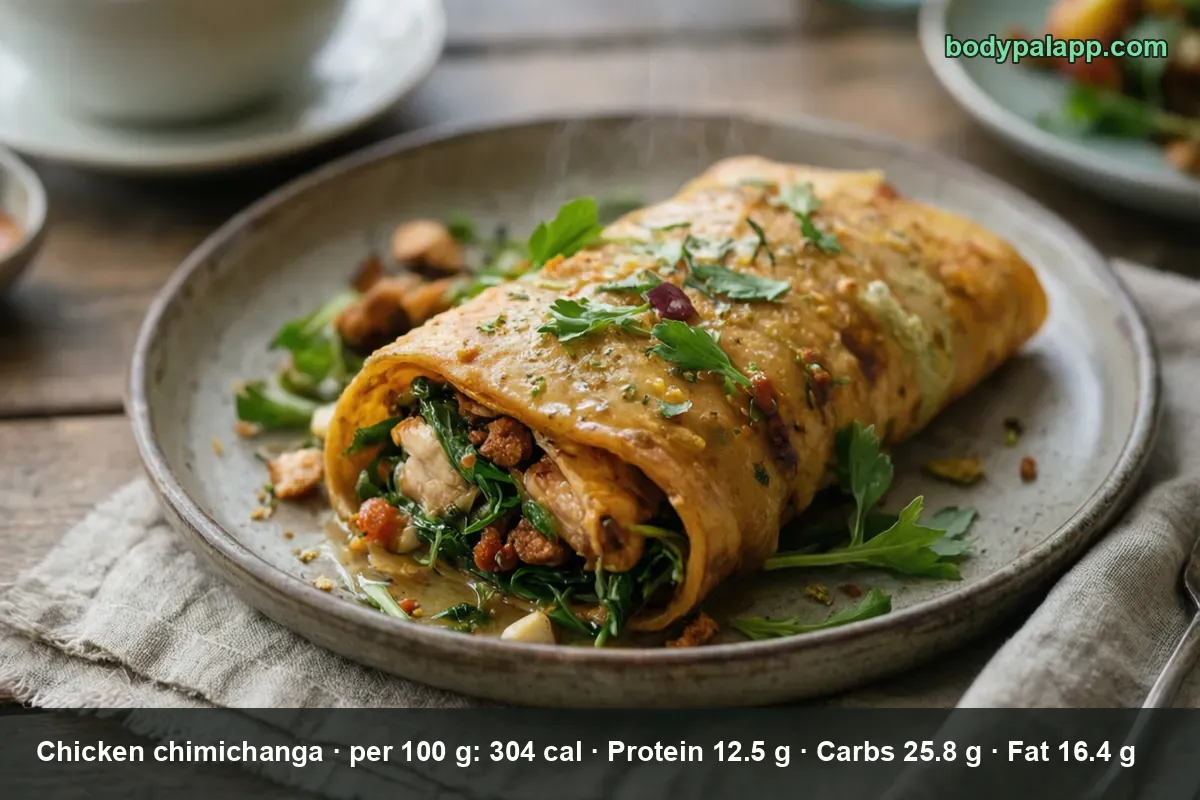
One chicken chimichanga weighs 190 g and carries 578 calories. Per 100 g that is 304 calories, which puts a single fried roll ahead of most sit-down entrees before the rice and beans arrive. The chicken filling is only part of it; the fryer and the flour tortilla do the rest.
On this page
- Chicken chimichanga quick facts
- US servings, from one ounce to a whole roll
- How frozen, beef and baked versions stack up
- Sodium and saturated fat outrun the calories
- How does a chicken chimichanga compare?
- Most popular chicken chimichanga brands
- Chicken chimichanga FAQs
Chicken chimichanga quick facts
The numbers below come from FNDDS 2708589, "Chimichanga, chicken", the survey record for a deep-fried flour tortilla with a chicken filling. It is the only USDA entry for a chicken chimichanga specifically, and it is the one that matches what a person actually orders: a hot roll off a restaurant plate, or one made the traditional way at home in oil.
That matters because most of the other chimichanga rows in the database are frozen supermarket products. Those are lighter per gram, they are baked or microwaved instead of fried, and they get their own table further down rather than being blended into the main figure.
| Nutrient | Per 100 g | Per 1 chimichanga (190 g) | % Daily Value |
|---|---|---|---|
| Calories | 304 | 578 | — |
| Total fat | 16.42 g | 31.2 g | 40% |
| Saturated fat | 4.02 g | 7.6 g | 38% |
| Carbohydrate | 25.76 g | 48.9 g | 18% |
| Dietary fiber | 1.8 g | 3.4 g | 12% |
| Total sugars | 1.96 g | 3.7 g | — |
| Protein | 12.5 g | 23.8 g | 48% |
| Sodium | 414 mg | 787 mg | 34% |
% Daily Value is based on a 2,000-calorie diet.
Verified nutrition data
Numbers on this page come from USDA FoodData Central, the U.S. Department of Agriculture’s food composition database, and from manufacturer labels where a branded product is named. Last verified September 2026. How we verify our data →
Two rows you will see on a packaged label are missing here on purpose. Added sugars and trans fat are not published in this edition of the survey database, so there is nothing honest to print for them. Cholesterol and potassium are published: 36 mg and 147 mg per 100 g, which works out to 68 mg of cholesterol (23% DV) and 279 mg of potassium (6% DV) in one roll.
The protein line is the pleasant surprise. Nearly half a day's protein target sits inside a single chimichanga, which is more than most fried entrees of the same weight manage.
US servings, from one ounce to a whole roll
| Serving | Weight | Calories |
|---|---|---|
| 1 oz | 28 g | 85 kcal |
| Half a chimichanga | 95 g | 289 kcal |
| 1 cup, chopped | 120 g | 365 kcal |
| One frozen-size roll | 142 g | 432 kcal |
| One chimichanga, any size | 190 g | 578 kcal |
| Per 100 g | 100 g | 304 kcal |
Two of those are USDA household measures: the whole chimichanga at 190 g and the 1 cup measure at 120 g. The half portion, the 142 g line and the ounce are our own arithmetic from the USDA 100 g figure, not USDA serving sizes.
The cup is where people go wrong. Logging "1 cup of chimichanga" records 365 calories, but a cup of chopped chimichanga is about two-thirds of the roll by weight, not the whole thing. If you ate the entire chimichanga and logged a cup, you are 213 calories short before you touch the sides.
The 142 g line exists for a different reason. That is the weight of a standard frozen chimichanga, and scaling the fried USDA record to it lets you see what the same roll would cost if it came out of oil instead of an oven. It comes to 432 calories against roughly 300 on a frozen package.
How frozen, beef and baked versions stack up
| Version | Per 100 g | Typical piece | Calories |
|---|---|---|---|
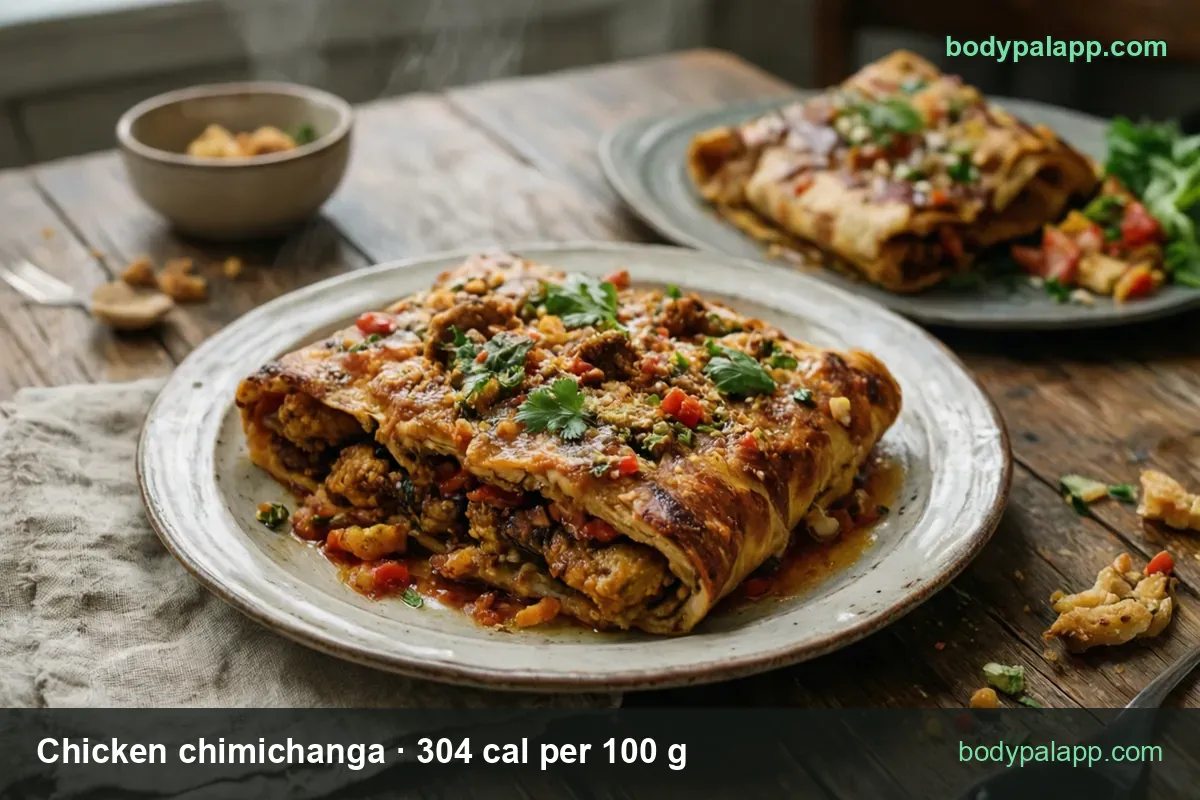
| Chicken chimichanga, fried | 304 kcal | 1 chimichanga, 190 g | 578 kcal |
| Beef chimichanga | 324 kcal | 1 item, 190 g | 616 kcal |
| Frozen chicken chimichanga, El Monterey | 211 kcal | 1 chimichanga, 142 g | 300 kcal |
| Chipotle chicken chimichanga, José Olé | 232 kcal | 1 chimichanga, 142 g | 329 kcal |
| Mini chicken chimis, El Monterey | 224 kcal | 2 chimichangas, 85 g | 190 kcal |
| Chicken quesadilla | 287 kcal | 1 full circle, 140 g | 402 kcal |
| Beef or pork taquito | 287 kcal | 1 large taquito, 105 g | 301 kcal |
The frozen aisle is the biggest single lever on this page. Six chicken chimichanga products in the USDA branded database run from 204 to 239 calories per 100 g, while the fried restaurant record sits at 304. That is a gap of up to 100 calories per 100 g, and it comes almost entirely from the deep fryer rather than from the filling.
Named packages, for reference: El Monterey Signature Chicken and Monterey Jack is 290 calories for a 142 g roll, the standard El Monterey Chicken and Monterey Jack Cheese is 300, José Olé Chicken and Cheese is 320, the José Olé Chipotle Chicken 329, Tina's Chicken and Cheddar 371 for a bigger 170 g roll, and Don Miguel Chicken and Cheese 270 for a smaller 113 g one.
Beef goes the other way. The beef chimichanga record is 324 calories per 100 g against 304 for chicken, and 616 for the same 190 g roll. The tortilla is identical; the extra 38 calories are fat, 18.8 g per 100 g versus 16.42 g.
Baked is the version people ask about most and the one USDA does not publish. There is no survey record for a chicken chimichanga finished in an oven, so no number is printed here for it. The closest non-fried stand-in in the same food group is the chicken quesadilla at 287 calories and 12.99 g of fat per 100 g, and the frozen brand labels above, which are written for oven or air-fryer instructions and land 65 to 100 calories per 100 g below the fried record.
Sodium and saturated fat outrun the calories
One chimichanga is 578 calories, which is 29% of a 2,000-calorie day. Other rows are further ahead than that. Sodium reaches 787 mg, or 34% of the 2,300 mg Daily Value the FDA sets, and saturated fat reaches 7.6 g, or 38% of the 20 g DV. If you want it in kitchen terms, 787 mg of sodium is roughly a third of a teaspoon of table salt inside a single roll.
Total fat is the same story at 40% of the day from one item. Fiber, at 3.4 g and 12% DV, is modest but not nothing, since the flour tortilla and the beans that usually ride alongside carry some.
If sodium is the number you watch, the frozen rolls are not automatically the safer pick, since salt is what carries flavor in a shelf-stable product. What reliably moves the total is portion and preparation: half a roll, or a baked one, rather than a second fried one. Rounding out the plate with a vegetable side instead of a second chimichanga is the swap MyPlate keeps pointing at, and it costs nothing in protein, since 23.8 g is already on the plate.
How does a chicken chimichanga compare?
| Food | Per 100 g | US serving | Calories |
|---|---|---|---|
| Chicken chimichanga | 304 kcal | 1 item, 190 g | 578 kcal |
| Beef chimichanga | 324 kcal | 1 item, 190 g | 616 kcal |
| Chicken quesadilla | 287 kcal | 1 full circle, 140 g | 402 kcal |
| Beef or pork taquito | 287 kcal | 1 large taquito, 105 g | 301 kcal |
Our take: the chimichanga is not the densest item in this group by much, but it is the heaviest one you get handed. Only the beef version beats it on both counts, 324 per 100 g and 616 per plate. The quesadilla and the taquito are tied at 287 calories per 100 g, so their advantage is not the recipe, it is the size: 140 g and 105 g against 190 g. For weight loss, order the quesadilla and you save 176 calories without changing what you like about the meal. For staying full through an afternoon, the chimichanga's 23.8 g of protein and 3.4 g of fiber do the job better than two taquitos would, and half a chimichanga at 289 calories is a genuinely reasonable lunch.
Most popular chicken chimichanga brands in the United States
Ranked by how widely each product appears among foods sold in the United States, from the BodyPal food database of over 3.3 million products. Calories are the figures printed on each Nutrition Facts label, checked against USDA FoodData Central.
| Product | Calories (per 100 g) |
|---|---|
| El Monterey Signature Chicken & Monterey Jack Chimichanga | 204 cal |
| El Monterey Chicken & Monterey Jack Cheese Chimichanga | 211 cal |
| Tina's Chicken & Cheddar Cheese Chimichanga | 218 cal |
| Jose Ole Chicken & Cheese Chimichanga | 225 cal |
| Jose Ole Chipotle Chicken Chimichanga | 232 cal |
| Don Miguel Chicken & Cheese Chimichangas | 239 cal |
Brand popularity: BodyPal food database. Nutrition: manufacturer labels / USDA FoodData Central.
Chicken chimichanga FAQs
How many calories are in a chicken chimichanga?
578 calories for one chimichanga of 190 g, the USDA size for a fried restaurant roll. That works out to 304 calories per 100 g. The tortilla and the deep fryer do most of that; the chicken filling itself brings 23.8 g of protein along the way.
How many calories in a frozen chicken chimichanga?
About 300 calories for a 142 g El Monterey chicken and Monterey Jack roll, and 270 to 371 across the six frozen chicken brands USDA lists. Frozen chimichangas run 204 to 239 calories per 100 g because they are baked or microwaved at home rather than deep fried.
How much protein is in a chicken chimichanga?
23.8 g of protein in one 190 g chimichanga, which is 48% of the 50 g Daily Value. Per 100 g it is 12.5 g. That is a solid number for a fried item, though the chicken quesadilla record beats it per gram at 14.45 g of protein per 100 g.
How much sodium is in a chicken chimichanga?
787 mg of sodium in one 190 g chimichanga, or 34% of the 2,300 mg Daily Value. That is roughly a third of a teaspoon of table salt in a single roll. Per 100 g the record shows 414 mg, so even half a chimichanga lands near 400 mg.
Is a chimichanga healthier than a burrito?
A chimichanga is a burrito that has been deep fried, so it lands higher in fat at 16.42 g per 100 g. USDA publishes no burrito record alongside this one, so the fair non-fried stand-in here is the chicken quesadilla, at 287 calories and 12.99 g of fat per 100 g.
How many calories in half a chicken chimichanga?
289 calories for half of a 190 g chimichanga, which is 95 g. That is our own arithmetic from the USDA 100 g figure of 304 calories, not a USDA serving size. Half also carries about 393 mg of sodium and 11.9 g of protein, which makes it a workable lunch.
Chicken vs beef chimichanga calories?
Beef is higher: 616 calories for a 190 g roll against 578 for chicken, and 324 calories per 100 g against 304. The gap is fat, 18.8 g per 100 g in the beef record versus 16.42 g in the chicken one. Protein is close, 12.08 g against 12.5 g.
How many calories in an El Monterey chicken chimichanga?
300 calories for one 142 g El Monterey Chicken and Monterey Jack Cheese chimichanga, at 211 calories per 100 g. The Signature version is 290 calories for the same 142 g. Two El Monterey mini chicken chimis, 85 g together, come to 190 calories.
Similar foods
- Bacon Egg And Cheese Biscuit — 432 cal per biscuit
- 6 Piece Chicken Mcnuggets — 287 cal per 6 piece order
- Mcdonald'S Chicken Nuggets — 287 cal per 6 pieces
- Bacon, Egg And Cheese Biscuit — 436 cal per biscuit
- Chick-Fil-A Chicken Biscuit — 460 cal per biscuit
- Wendy'S Fries — 427 cal per medium order
Count it without the math
Point the camera at the plate and BodyPal counts the chimichanga for you, filling and all.


How long does it take to burn off 578 kcal of chicken chimichanga?
One chimichanga (190 g) is 578 kcal. Enter your weight and the amount you ate to see how long it takes you to burn that off:
lb
| Activity | Time to burn 578 kcal |
|---|---|
| Walking, brisk | 1 hr 56 min |
| Cycling, moderate | 1 hr 12 min |
| Swimming, moderate | 1 hr 23 min |
| Jogging | 1 hr 8 min |
| Weight training, moderate | 2 hr 8 min |
Times are for a 155 lb adult at a steady pace; change the weight to see yours. The amount is set to the portion in the text (190 g); change it to what you actually ate. BodyPal works this out from your steps automatically.
This table assumes you know your daily total. If you do not, the daily calorie calculator works it out from five numbers.