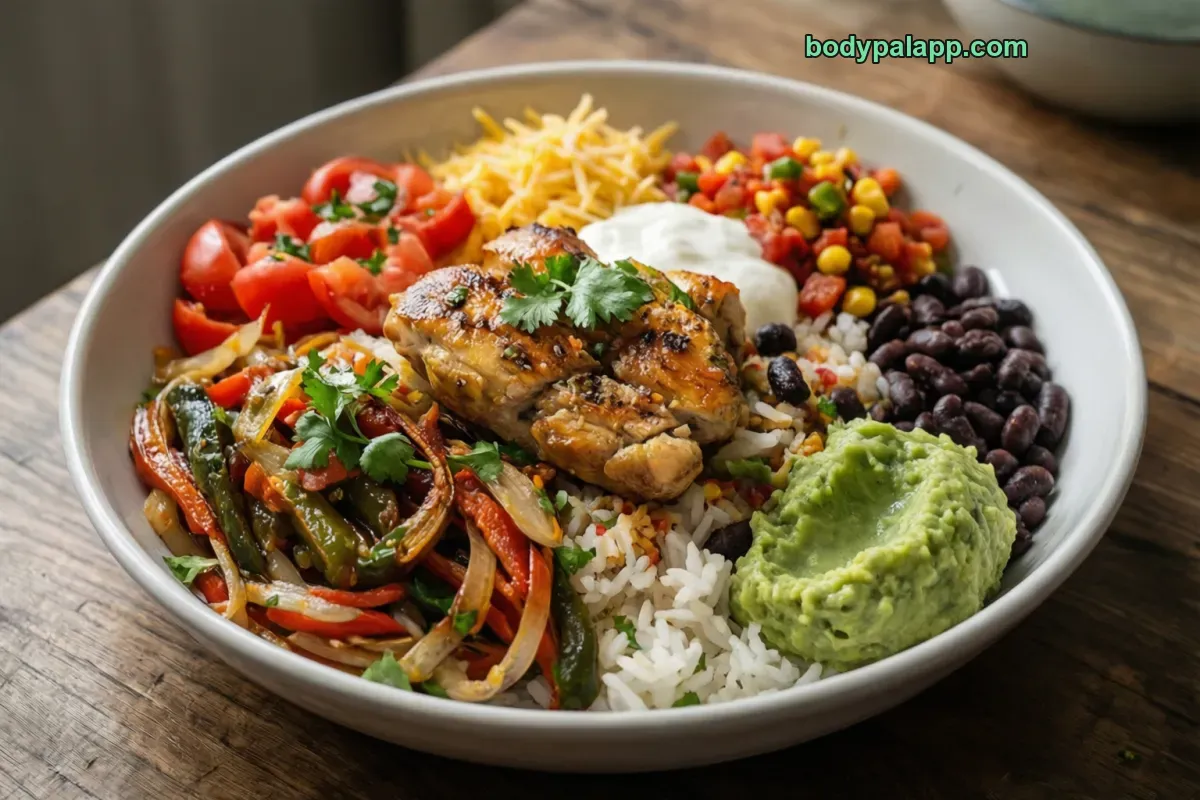
Chipotle bowl calories come to 457 for a full 315 g bowl, or 145 per 100 g. These are USDA fast-food values for a chicken burrito bowl with beans and rice. The figure to notice is protein: 41 g in one bowl, which covers 82% of the daily value. Sodium is the trade-off, at 980 mg.
457kcal
1 bowl · 315 g, restaurant serving
36%protein
41 gProtein
33 gCarbs
17.1 gFat
How to burn off 457 kcal
—Walking, brisk
—Jogging
—Cycling, moderate
—Swimming
Skip the math. BodyPal counts these calories from your steps and workouts automatically.
Nutrition facts
Restaurant serving · per 315 g
Calories
457 kcal
Protein
41 g
Carbohydrate
33 g
Fat
17.1 g
Saturated fat
7.2 g
Cholesterol
154 mg
Sodium
980 mg
Potassium
617 mg
Iron
2.9 mg
Source: USDA FoodData Central
🛡️
Verified nutrition data
Numbers on this page come from USDA FoodData Central, the U.S. Department of Agriculture’s food composition database, and from manufacturer labels where a branded product is named. Last verified September 2026. How we verify our data →
Chipotle bowl: calories, protein and sodium by serving
Percent of daily value uses the FDA reference of 2,000 kcal a day.
Serving
kcal
Protein
Carbs
Fat
Sodium
% DV kcal
Full bowl (315 g)
457
41 g
33.3 g
17.1 g
980 mg
23%
Cup (120 g)
174
15.6 g
12.7 g
6.5 g
373 mg
9%
100 g
145
13 g
10.6 g
5.4 g
311 mg
7%
3 × Full bowl (315 g)
1,370
123.1 g
2,939 mg
5 × Full bowl (315 g)
2,284
205.2 g
4,898 mg
One full bowl is a 457-calorie meal
A full 315 g bowl lands at 457 calories, which is 23% of a standard daily calorie value. That is a proper meal, not a snack, and it sits in a moderate range for a single restaurant order. The number comes from the USDA fast-food entry for a chicken bowl with beans and rice, so your own build may run higher or lower depending on what goes on top.
If you split the bowl or eat only part of it, the math gets easy. A cup, about 120 g, comes to 174 calories with 15.6 g of protein. That is roughly a third of the bowl and works as a lighter lunch or a side next to something else. Every 100 g you eat adds about 145 calories.
Portions add up quickly when bowls become a habit. Two full bowls reach 914 calories and 1,959 mg of sodium, and three bowls hit 1,370 calories. Eating one bowl a day is a very different story from ordering two in one sitting, so it pays to know which one you are logging.
Calories split almost evenly three ways
This bowl is unusually balanced. Protein supplies 36% of its calories, fat 34% and carbs 30%. Few fast-food meals give protein the largest share, and here it edges out both fat and carbs.
Per 100 g you get 13 g of protein, 10.6 g of carbs and 5.4 g of fat. Scaled to the full bowl, that is 41 g of protein, 33.3 g of carbs and 17.1 g of fat. The chicken does most of the protein work, while the rice and beans carry the carbs. Fiber is modest at 3.2 g per bowl, and sugars barely register at 0.7 g.
The fat number deserves a second look. At 17.1 g per bowl it is not extreme, but saturated fat runs 2.3 g per 100 g, and cholesterol reaches 49 mg per 100 g. If you add cheese, sour cream or guacamole, the fat share is the part of the split that grows fastest, and the calorie total follows.
Sodium is the row to watch
One full bowl carries 980 mg of sodium, which is 43% of the daily value in a single meal. Per 100 g that is 311 mg, so even a cup of it brings 373 mg, or 16% of the daily value. Seasoned meat, salted rice, beans and salsa all contribute.
The total climbs quickly with repeat orders. Two bowls reach 1,959 mg, and three bowls hit 2,939 mg, which is past the full daily value on its own. If you watch sodium, this is the number that matters more than the calorie count.
The fix is in the rest of the day rather than in the bowl. Keep breakfast and dinner lower in salt, skip salty sides like chips, and drink water instead of a soda. Potassium sits at 196 mg per 100 g, which is not much, so fruit and vegetables elsewhere in the day help balance the plate.
A bowl works best as the main meal of the day
With 457 calories and 41 g of protein, one bowl can anchor lunch or dinner without help. The protein is the strong point: it covers most of the day's protein value in one sitting, so lighter meals around it can lean on vegetables, fruit and whole grains instead.
Fiber is where the bowl falls short. At 3.2 g per bowl, adding extra fajita vegetables, lettuce or a side of fruit is an easy way to add volume for very few calories. Going light on rice also cuts carbs without touching the protein.
Toppings are the swing factor. The USDA figure covers a chicken bowl with beans and rice, so every scoop of cheese, sour cream or guacamole sits on top of that baseline. If you want an accurate log, BodyPal can record the bowl from a photo, and you can adjust the portion afterward.
How does Chipotle bowl compare?
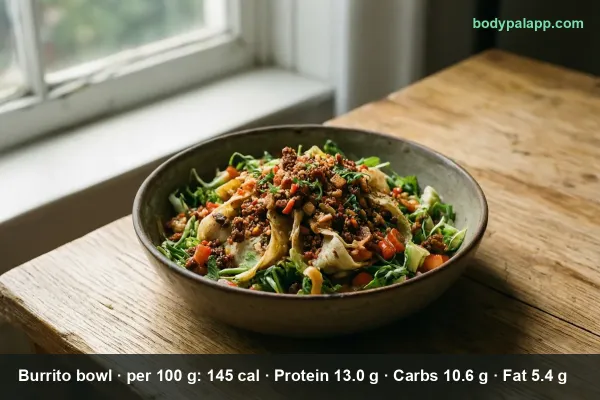
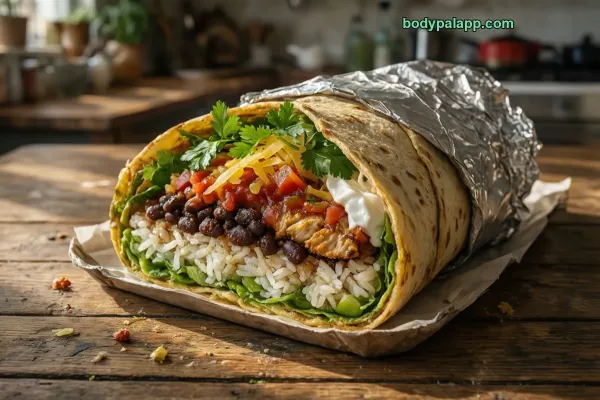
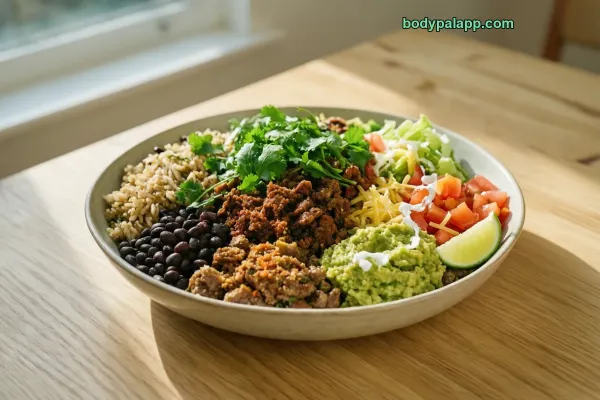
Here is how the Chipotle bowl stacks up against a generic burrito bowl, a Chipotle burrito and a taco bowl, per 100 g and per usual serving.
Verdict: For the fewest calories pick the taco bowl at 93 per 100 g, though it gives only 6.1 g of protein. For staying full on a similar calorie budget, the bowl beats the burrito: 13 g of protein per 100 g against 11.5 g, with far less sodium than the burrito's 570 mg.
Most popular Chipotle bowl brands in the United States
Ranked by popularity in the BodyPal database
# Productkcal / 100 g
1Loma Linda Chipotle Bowl With Black Beans1 1/4 Cup · 285 g91 kcal
2Chef Soraya Chipotle Bowl1 Bowl · 71 g380 kcal
3Gold Emblem Hot Chipotle Bowl With Black Beans1 Pouch · 285 g91 kcal
4Loma Linda Plant-Based Protein Chipotle Bowl With Black Beans0.5 Pouch · 142 g92 kcal
These packaged bowls lean on beans and vegetables rather than rice and meat, so most read well below the chicken, rice and bean numbers above, while the denser Chef Soraya version reads higher. Source: manufacturer labels / USDA FoodData Central.
Chipotle bowl FAQs
How many calories are in a Chipotle bowl?
A Chipotle-style bowl with chicken, rice and beans (315 g) is about 457 calories, or 145 calories per 100 g.
Is a Chipotle bowl good for weight loss?
A full 315 g bowl has about 457 calories with 41.0 g protein, 33.3 g carbs and 17.1 g fat.
Chipotle bowl vs a plain burrito bowl: are the calories different?
No. A generic burrito bowl is also 145 calories per 100 g, so both come to about 457 calories for a 315 g bowl.
How much protein is in a Chipotle bowl?
A 315 g bowl has about 41.0 g protein and 17.1 g fat, from 13.0 g protein per 100 g.
How many calories are in a cup of a Chipotle bowl?
A cup, about 120 g, has 174 calories. It also brings 15.6 g of protein, 12.7 g of carbs, 6.5 g of fat and 373 mg of sodium, roughly a third of a full bowl.
How much sodium is in a Chipotle bowl?
A full 315 g bowl has 980 mg of sodium, which is 43% of the daily value. Per 100 g it comes to 311 mg, so the total rises with every extra scoop you eat.
How many calories are in two Chipotle bowls?
Two full bowls come to 914 calories, with 82.1 g of protein and 1,959 mg of sodium. That is a lot of salt for one sitting, so sharing or saving half is worth considering.
Does a Chipotle bowl have fewer calories than a Chipotle burrito?
Slightly. A full bowl has 457 calories, while a 241 g burrito has 460. Per 100 g the gap is clearer: 145 calories for the bowl versus 191 for the burrito, which also carries more sodium.
How much fat is in a Chipotle bowl?
A full bowl has 17.1 g of fat, which supplies 34% of its calories. Saturated fat runs 2.3 g per 100 g, and toppings like cheese or sour cream push both numbers higher.