
How many calories are in a burrito bowl?
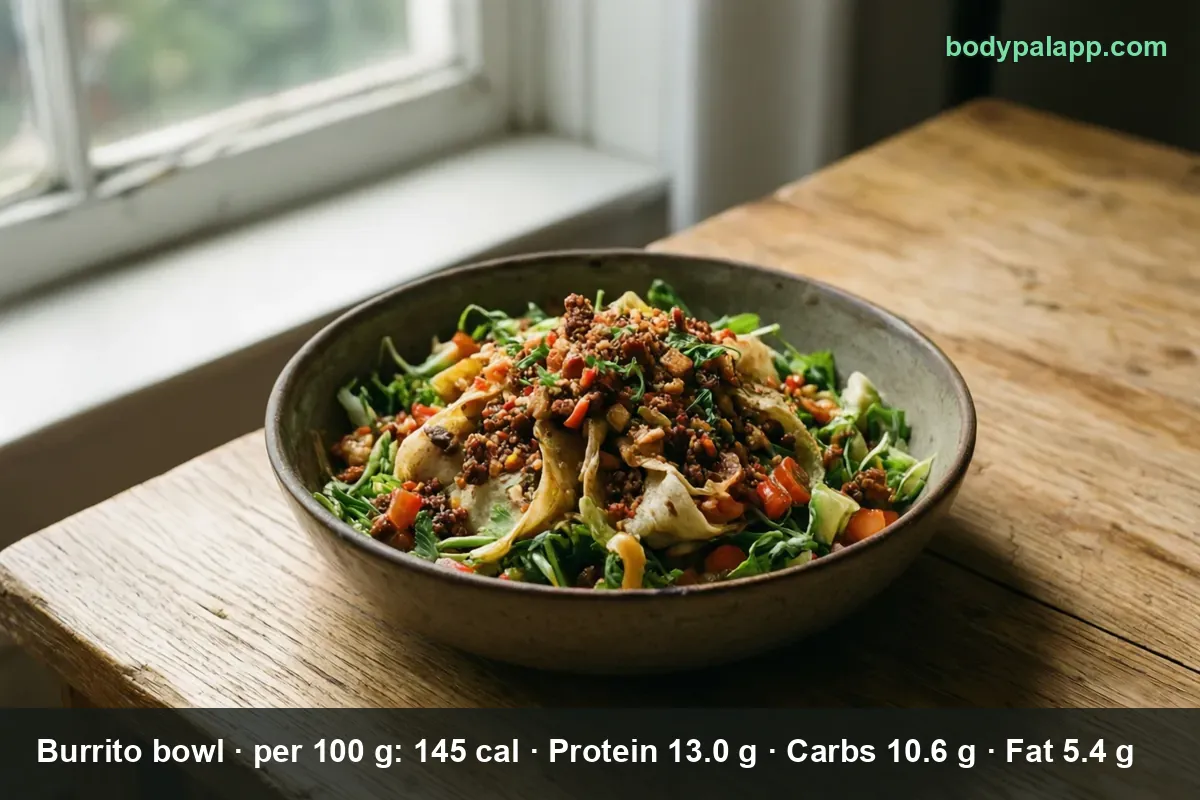
A restaurant-size burrito bowl weighs about 270 g and carries 392 calories. Per 100 g the same mix runs 145 calories, which is light for a full lunch. The meat decides the rest: chicken lands near the middle, steak or pork pushes it up, and beans pull it down.
On this page
- Burrito bowl quick facts
- US servings from one cup to a full bowl
- Chicken and steak change the number
- Rice and beans lower the calories per gram
- Sodium and saturated fat are the rows to watch
- How does a burrito bowl compare?
- Most popular burrito bowl brands
- Burrito bowl FAQs
Burrito bowl quick facts
The record behind the numbers is FNDDS 2708555, "Burrito bowl, NFS", the generic build with meat, rice, beans and toppings in one container. That is what most people are holding when they search this: not a photograph-perfect salad bowl, but the standard order off a counter line. The rice-and-beans versions and the meat-only versions each have their own USDA record, and they sit further down this page.
One thing worth knowing before the table: the survey record for a chicken bowl with beans and rice repeats these figures row for row, which tells you USDA treats the loaded chicken bowl as the default build rather than a separate recipe.
| Nutrient | Per 100 g | Per 1 bowl (270 g) | % Daily Value |
|---|---|---|---|
| Calories | 145 | 392 | — |
| Total fat | 5.44 g | 14.7 g | 19% |
| Saturated fat | 2.29 g | 6.2 g | 31% |
| Carbohydrate | 10.58 g | 28.6 g | 10% |
| Dietary fiber | 1 g | 2.7 g | 10% |
| Total sugars | 0.22 g | 0.6 g | — |
| Protein | 13.03 g | 35.2 g | 70% |
| Sodium | 311 mg | 840 mg | 37% |
% Daily Value is based on a 2,000-calorie diet.
Verified nutrition data
Numbers on this page come from USDA FoodData Central, the U.S. Department of Agriculture’s food composition database, and from manufacturer labels where a branded product is named. Last verified September 2026. How we verify our data →
Two rows you would see on a package label are missing here on purpose. USDA does not publish added sugars or trans fat for this survey record, so rather than guess at them, they stay off the table. Cholesterol and potassium are published: the 270 g bowl gives 132 mg of cholesterol, 44% of the Daily Value, and 529 mg of potassium, 11%.
US servings from one cup to a full bowl
| Serving | Weight | Calories |
|---|---|---|
| 1 oz | 28 g | 41 kcal |
| 1 cup | 120 g | 174 kcal |
| Half a bowl | 135 g | 196 kcal |
| 2 cups | 240 g | 348 kcal |
| One bowl, any size | 270 g | 392 kcal |
| Per 100 g | 100 g | 145 kcal |
USDA gives two of these as household measures: the one-cup portion at 120 g and the whole bowl at 270 g. The ounce, the half bowl and the two-cup line are our own arithmetic from the USDA 100 g figure, not USDA servings, scaled straight off the 145 calories per 100 g.
The gap between the first two is where most logs go wrong. A cup sounds like a sensible unit for something served in a bowl, but a cup of this is 174 calories and the bowl in front of you is 392. That is more than double, and it is a 218-calorie miss on a single lunch if you log the cup and eat the bowl. If you want a number you can trust without a scale, weigh the bowl once, empty and full, and reuse that weight.
Chicken and steak change the number
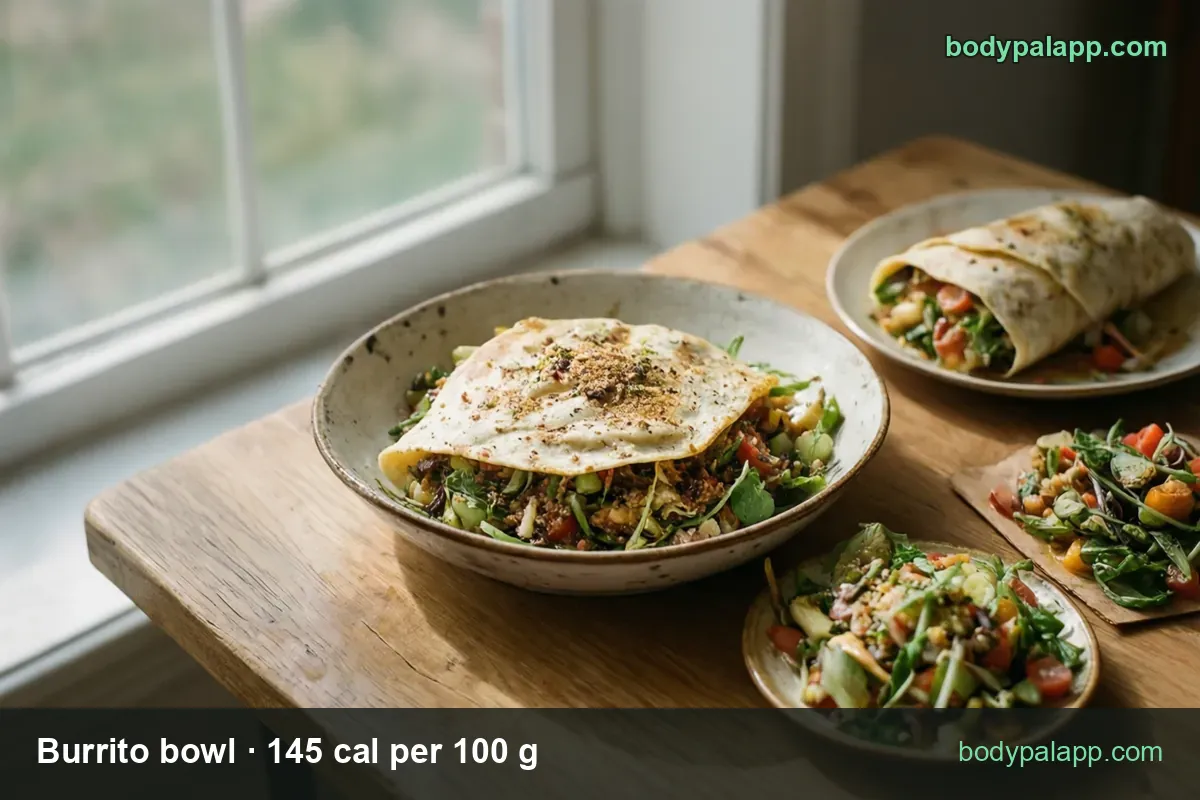
Meat is the single biggest lever, and it moves the number in the direction most people do not expect.
| Version | Per 100 g | Typical bowl | Calories |
|---|---|---|---|
| Chicken, meat and toppings only | 161 kcal | 225 g | 362 kcal |
| Steak, beef or pork, meat and toppings only | 213 kcal | 225 g | 479 kcal |
A chicken bowl with nothing but meat and toppings is 161 calories per 100 g and carries 21.04 g of protein in that same 100 g — the highest protein density of any burrito bowl record USDA publishes. Switch to steak, beef or pork and the density jumps to 213 calories per 100 g, because the fat goes from 8.11 g to 14.21 g per 100 g while the carbohydrate stays near zero.
The 225 g bowl in that table is a smaller counter-service portion, scaled by us from the USDA 100 g figures rather than taken from a USDA serving line. On retail shelves the frozen versions land in a similar band: a Healthy Choice burrito bowl is 104 calories per 100 g, a Delimex bowl 144, and a Mama Julia pork bowl 198, which covers most of the survey range.
Rice and beans lower the calories per gram
This is the part that reads backwards until you look at the math. Adding starch to a bowl does not raise the calories per gram — it lowers them, because rice and beans are wetter and leaner than the meat they sit next to.
| Version | Per 100 g | Typical bowl | Calories |
|---|---|---|---|
| With beans, no meat listed | 129 kcal | 225 g | 290 kcal |
| Chicken with beans | 135 kcal | 270 g | 365 kcal |
| Chicken with rice | 155 kcal | 270 g | 419 kcal |
| Beef or pork with beans and rice | 171 kcal | 270 g | 462 kcal |
The 225 g and 270 g bowls in that table are our own scaling from the USDA 100 g figures, not USDA serving lines. Compare the last line to the meat-only steak bowl: 213 calories per 100 g without sides, 171 with beans and rice. The garnish dilutes the fat. The catch is that it also fills the container, so the bowl you actually eat gets heavier, and the total goes up even though the density goes down.
Beans buy you something else worth having. The bean record runs 5.7 g of fiber per 100 g against 1 g in the generic bowl, and 17.3 g of carbohydrate against 10.58 g. If fiber is what you are short on — and most Americans are, against the 28 g Daily Value — the bean bowl at 290 calories for 225 g is the best value on this page.
Sodium and saturated fat are the rows to watch
Look back at the Quick Facts column and the story is not the carbohydrate. A 270 g bowl is only 28.6 g of carbohydrate, 10% of the Daily Value, which is about two slices of bread. The rows that move are the ones nobody searches for.
Sodium comes to 840 mg, or 37% of the FDA Daily Value of 2,300 mg. That is roughly a third of a teaspoon of table salt in one lunch. Saturated fat is 6.2 g, 31% of the Daily Value, most of it from the meat and cheese rather than the rice. If you are watching either one, the bean bowl is the better pick: 1.66 g of saturated fat and 296 mg of sodium per 100 g against 2.29 g and 311 mg in the generic build.
The upside is real too. At 35.2 g of protein, one bowl covers 70% of the Daily Value, which puts it ahead of most things sold as a quick lunch — the MyPlate protein guidance treats a day's worth as roughly 5 to 6 ounce-equivalents, and this bowl is a large chunk of that in one sitting. For a 350 to 450-calorie lunch target, a bean bowl or a half portion of the loaded build both fit; the full steak bowl does not.
How does a burrito bowl compare?
The obvious neighbors are the rest of the counter menu. USDA lists these three without a household portion, so the comparison runs per 100 g, which is the fair way to read them anyway.
| Dish | Per 100 g | Serving compared | Calories |
|---|---|---|---|
| Burrito bowl, NFS | 145 kcal | 100 g | 145 kcal |
| Enchilada, no meat | 165 kcal | 100 g | 165 kcal |
| Tamale, NFS | 174 kcal | 100 g | 174 kcal |
| Enchilada, NFS | 178 kcal | 100 g | 178 kcal |
Our take: gram for gram the burrito bowl is the lightest of the four, and it is not close on protein — 13.03 g per 100 g against 6.37 g in a meatless enchilada and 7.38 g in a tamale. The reason is water and vegetables, which the wrapped dishes trade away for masa and tortilla. If you are picking for weight loss, order the bowl and load it with beans; if you are picking for fullness on a long afternoon, order the bowl with chicken and skip the rice, because that is where the protein sits at its densest. The only way the bowl loses this comparison is on portion size, since nobody eats an enchilada the size of a 270 g bowl.
Federal advice on building a plate around lean protein, vegetables and whole grains is set out in the Dietary Guidelines for Americans, and a burrito bowl is one of the few counter-service meals that can be assembled to match it without much effort.
Most popular burrito bowl brands in the United States
Ranked by how widely each product appears among foods sold in the United States, from the BodyPal food database of over 3.3 million products. Calories are the figures printed on each Nutrition Facts label, checked against USDA FoodData Central.
| Product | Calories (per 100 g) |
|---|---|
| Devour Pulled Chicken Burrito Bowl | 132 cal |
| Boulder Natural Chicken Burrito Bowl | 135 cal |
| Healthy Choice Burrito Bowl | 104 cal |
| Delimex Burrito Bowls | 144 cal |
| Mama Julia Steak Burrito Bowl | 185 cal |
| Mama Julia Pork Burrito Bowl | 198 cal |
Brand popularity: BodyPal food database. Nutrition: manufacturer labels / USDA FoodData Central.
Burrito bowl FAQs
How many calories are in a burrito bowl?
A standard 270 g burrito bowl holds 392 calories, based on the USDA generic record at 145 calories per 100 g. That covers meat, rice, beans and toppings in one container. A half bowl of 135 g is 196 calories, and a single cup is 174.
How many calories in a chicken burrito bowl?
Chicken burrito bowl runs 161 calories per 100 g, so a 225 g bowl is 362 calories. Add rice and the density drops to 155 per 100 g, giving 419 calories in a 270 g bowl. Add beans instead and it is 135 per 100 g, or 365.
How many calories in a steak burrito bowl?
Steak, beef or pork burrito bowl is 213 calories per 100 g, the densest version USDA lists, so a 225 g bowl is 479 calories. Meat without rice or beans concentrates the fat: 14.21 g per 100 g against 5.44 g in the generic bowl.
How many calories in a burrito bowl without rice?
Without rice, chicken is 161 calories per 100 g and steak, beef or pork is 213, so a 225 g no-rice bowl runs 362 to 479 calories. Skipping the rice makes the bowl denser per gram, not lighter; it only saves calories if the bowl is smaller.
How much protein is in a burrito bowl?
A 270 g bowl carries 35.2 g of protein, which is 70% of the FDA Daily Value in one meal. Per 100 g that is 13.03 g. A chicken bowl with no rice or beans is denser still at 21.04 g per 100 g.
How much sodium is in a burrito bowl?
A 270 g bowl has 840 mg of sodium, 37% of the Daily Value and roughly a third of a teaspoon of table salt. That is the row to watch, not the carbohydrate, which is only 28.6 g, or 10% of the Daily Value.
How many calories in one cup of burrito bowl?
One cup weighs 120 g and holds 174 calories. That is the trap in most food logs: a real restaurant bowl is 270 g, more than double the cup, so logging by the cup can hide over 200 calories of a single lunch.
Are burrito bowls good for weight loss?
At 145 calories per 100 g the generic bowl is lighter per gram than an enchilada at 178 or a tamale at 174, and 35.2 g of protein per bowl helps with fullness. The bean version at 129 per 100 g is the lightest option USDA lists.
Similar foods
- Toor Dal — 348 cal per cup
- Shrimp Pad Thai — 294 cal per cup
- Lasagna — 286 cal per piece
- Chicken Chow Mein — 288 cal per cup
- Eye of round steak — 135 cal for 3 oz cooked
- Half And Half — 20 cal per tbsp
Count it without the math
Point the camera at the bowl and BodyPal counts it for you, rice, beans and all.


How long does it take to burn off a burrito bowl?
One bowl (270 g) is 392 kcal. Enter your weight and the amount you ate to see how long it takes you to burn that off:
lb
| Activity | Time to burn 392 kcal |
|---|---|
| Walking, brisk | 1 hr 18 min |
| Cycling, moderate | 49 min |
| Swimming, moderate | 56 min |
| Jogging | 46 min |
| Weight training, moderate | 1 hr 27 min |
Times are for a 155 lb adult at a steady pace; change the weight to see yours. The amount is set to the portion in the text (270 g); change it to what you actually ate. BodyPal works this out from your steps automatically.
This table assumes you know your daily total. If you do not, the daily calorie calculator works it out from five numbers.