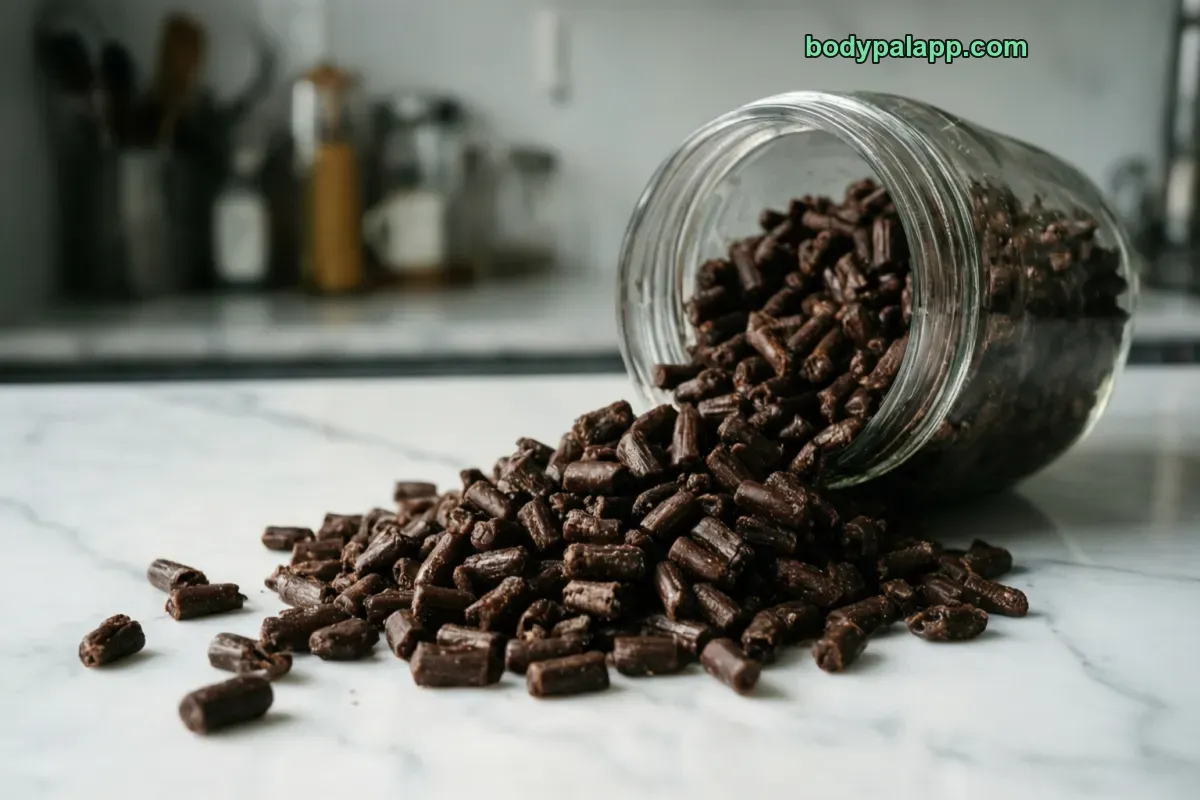
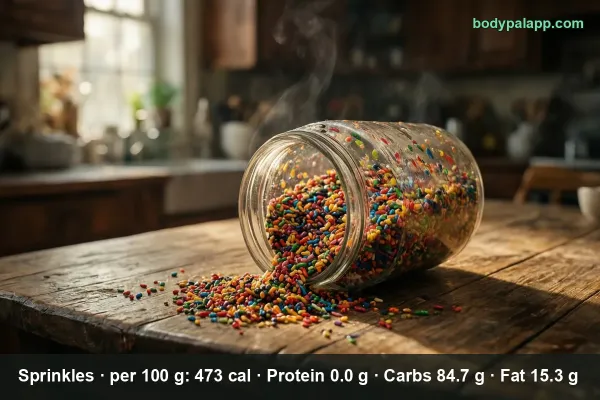
Chocolate sprinkle calories come to 95 for a 20 g serving and 473 per 100 g. Nearly all of that is sugar: 17 g per serving, with no protein and no fiber. The real question is how much you pour, because a heavy hand on a sundae can triple the serving without anyone noticing.
95kcal
1 20 g serving · 20 g, chocolate variety
0%protein
0 gProtein
17 gCarbs
3.1 gFat
How to burn off 95 kcal
—Walking, brisk
—Jogging
—Cycling, moderate
—Swimming
Skip the math. BodyPal counts these calories from your steps and workouts automatically.
Nutrition facts
Chocolate variety · per 20 g
Calories
95 kcal
Protein
0 g
Carbohydrate
16.9 g
Fat
3.1 g
Saturated fat
2.6 g
Cholesterol
0 mg
Sodium
0 mg
Potassium
0 mg
Iron
0 mg
Source: USDA FoodData Central
🛡️
Verified nutrition data
Numbers on this page come from USDA FoodData Central, the U.S. Department of Agriculture’s food composition database, and from manufacturer labels where a branded product is named. Last verified September 2026. How we verify our data →
Chocolate sprinkles: calories, protein and sodium by serving
Percent of daily value uses the FDA reference of 2,000 kcal a day.
Serving
kcal
Protein
Carbs
Fat
Sodium
% DV kcal
Serving (20 g)
95
0 g
16.9 g
3.1 g
0 mg
5%
1 oz (28 g)
132
0 g
23.7 g
4.3 g
1 mg
7%
100 g
473
0 g
84.7 g
15.3 g
2 mg
24%
1 cup (160 g)
757
0 g
135.5 g
24.4 g
3 mg
38%
3 × Serving (20 g)
284
0 g
1 mg
5 × Serving (20 g)
473
0 g
2 mg
A 20 g shake is 95 calories; a heavy pour is 284
The standard serving is 20 g, which carries 95 calories and 17 g of sugar. That is 5% of the daily value for calories, a small line item on top of a cupcake or a bowl of ice cream. An ounce, 28 g, comes to 132 calories and 23.8 g of sugar.
The trouble is that sprinkles are rarely measured. Doubling the serving to 40 g gives 189 calories, and three servings, 60 g, reach 284. Five servings equal 100 g and 473 calories, close to a quarter of the day at 24% of the daily value. Most people pour from the jar, and the jar does not stop at 20 g.
A full cup, 160 g, holds 757 calories and 135.7 g of sugar, which is 38% of the daily calorie value. Nobody eats a cup in one sitting, but a jar used across a week of baking adds up the same way. If you track, weigh your usual pour once so you know what a normal shake actually looks like.
Sugar and fat, with zero protein
Per 100 g, chocolate sprinkles carry 84.7 g of carbohydrate, 15.3 g of fat and 0 g of protein. Carbs supply 71% of the calories and fat the other 29%. Not a single calorie comes from protein, which is rare even among sweets.
Almost all of the carbohydrate is sugar, 84.8 g per 100 g. Fiber sits at 0 g, so there is nothing here to slow eating down or make you feel full. Sprinkles are flavor, color and crunch. They make a dessert look better without making it more satisfying.
The fat is what separates chocolate sprinkles from plain candy dots in taste. It gives them their soft melt on warm toast or a fresh cake. It is also why they are denser in calories than chocolate syrup by weight, even though syrup looks like the richer topping in the bowl.
Saturated fat is the row to watch
Of the 15.3 g of fat in 100 g, 13 g is saturated. The daily value for saturated fat is 20 g, so 100 g of sprinkles on its own covers most of it. At a normal 20 g serving the amount is much smaller, but it never arrives alone.
Ice cream, buttercream and doughnut glaze already bring their own saturated fat and sugar. A topping that is mostly sugar and saturated fat pushes the same rows of the label in the same direction. If you watch saturated fat, the base you sprinkle on matters more than the sprinkles, but thick coatings on cake pops or cookies still count.
Sodium is a non-issue: 2 mg per 100 g against a 2300 mg daily value, and 0% at a serving. Cholesterol is 0 mg. Potassium is just 2 mg per 100 g, so there is little nutritional return to set against the sugar.
Treat them as a garnish, not a portion
Sprinkles work best as a finishing touch. A light scatter over plain yogurt, oatmeal or sliced fruit gives the chocolate signal for well under a full serving. Spooned over a dessert that is already rich, they only add to a total that was high to begin with.
Products such as De Ruijter Milk Chocolate Sprinkles, Lieber's Chocolate Sprinkles and Mr. Sprinkles Chocolate Sprinkles all sit under this kind of listing, but recipes differ between makers. Some use more real chocolate, others more sugar and fat blends. Check the panel on the jar you actually own if you log often.
Because sprinkles bring no protein and no fiber, pair them with something that does. A topping on Greek yogurt or a protein pancake balances far better than a topping on frosting. BodyPal can log a sprinkled dessert from a photo, which helps when the topping is hard to estimate by eye.
How does chocolate sprinkles compare?
Here is how chocolate sprinkles stack up against plain sprinkles, chocolate fudge and chocolate syrup, per 100 g and per usual serving.
Verdict: If calories are the goal, chocolate syrup is the lighter chocolate hit at 279 per 100 g against 473 for sprinkles, though a 2 tbsp pour still runs 109. Fudge at least adds 2.4 g of protein per 100 g, but a 17 g piece at 70 calories is a dessert of its own, so choose sprinkles only when you can keep the pour small.
Most popular chocolate sprinkles brands in the United States
Label numbers run from 311 to 556 calories per 100 g depending on how much cocoa, sugar and fat each recipe uses, so they sit around the 473 figure above. Source: manufacturer labels / USDA FoodData Central.
Chocolate sprinkles FAQs
How many calories are in chocolate sprinkles?
A 20 g serving has about 95 calories. Per 100 g chocolate sprinkles come to 473 calories.
Are chocolate sprinkles good for weight loss?
They are mostly sugar: 100 g holds 473 calories and 84.8 g sugar, so a 20 g serving adds 95 calories and 17.0 g sugar.
Chocolate sprinkles vs chocolate fudge: which has more calories?
Chocolate sprinkles have 473 calories per 100 g against 410 for chocolate fudge, a gap of 63 calories.
How much fat is in chocolate sprinkles?
100 g has 15.3 g fat, of which 13.0 g is saturated. A 20 g serving works out to 3.1 g fat.
How much sugar is in a serving of chocolate sprinkles?
A 20 g serving has 17 g of sugar. Per 100 g the figure is 84.8 g, so nearly the whole weight of the sprinkles is sugar, with 0 g of fiber to balance it.
Do chocolate sprinkles have any protein?
No. Chocolate sprinkles list 0 g of protein per 100 g and per serving. Their calories split 71% carbs and 29% fat, so they add energy without helping you stay full.
How many calories are in a cup of chocolate sprinkles?
A cup, 160 g, holds 757 calories, which is 38% of the daily value for calories. The same cup carries 24.4 g of fat and 135.7 g of sugar.
Do chocolate sprinkles have more calories than regular sprinkles?
No. Both list 473 calories per 100 g, with the same 84.7 g of carbs and 15.3 g of fat, so the calorie count is identical for the same weight.
How many calories are in an ounce of chocolate sprinkles?
An ounce, 28 g, has 132 calories, which is 7% of the daily value. It also carries 4.3 g of fat and 23.8 g of sugar, with no protein.