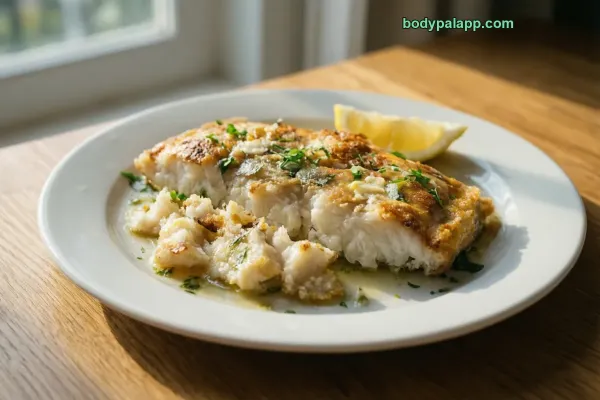
Baked cod calories come to 189 for one 180 g fillet and 105 per 100 g. What stands out is the protein: it supplies 92% of the calories, and a single fillet carries 41.1 g, or 82% of the daily value. Fat barely shows up at 0.9 g per 100 g.
189kcal
1 fillet · 180 g, Atlantic, baked (dry heat)
92%protein
41 gProtein
0 gCarbs
1.5 gFat
How to burn off 189 kcal
—Walking, brisk
—Jogging
—Cycling, moderate
—Swimming
Skip the math. BodyPal counts these calories from your steps and workouts automatically.
Nutrition facts
Atlantic, baked (dry heat) · per 180 g
Calories
189 kcal
Protein
41 g
Carbohydrate
0 g
Fat
1.5 g
Saturated fat
0.3 g
Cholesterol
99 mg
Sodium
140 mg
Potassium
439 mg
Iron
0.9 mg
Source: USDA FoodData Central
🛡️
Verified nutrition data
Numbers on this page come from USDA FoodData Central, the U.S. Department of Agriculture’s food composition database, and from manufacturer labels where a branded product is named. Last verified September 2026. How we verify our data →
Baked cod: calories, protein and sodium by serving
Percent of daily value uses the FDA reference of 2,000 kcal a day.
Serving
kcal
Protein
Carbs
Fat
Sodium
% DV kcal
1 fillet (180 g)
189
41.1 g
0 g
1.5 g
140 mg
9%
3 oz portion (85 g)
89
19.4 g
0 g
0.7 g
66 mg
4%
100 g
105
22.8 g
0 g
0.9 g
78 mg
5%
3 × 1 fillet (180 g)
567
123.3 g
421 mg
5 × 1 fillet (180 g)
945
205.5 g
702 mg
One fillet is 189 calories, a 3 oz portion is 89
The default serving here is a 180 g fillet, which lands at 189 calories, about 9% of a 2000-calorie day. That is a big piece of fish for a small number. The 3 oz portion (85 g) is roughly half of it at 89 calories, or 4% of the daily value, and still brings 19.4 g of protein.
Because cod is so lean, the total climbs slowly as you add fish. Two fillets (360 g) come to 378 calories with 82.2 g of protein. Three fillets (540 g) reach 567 calories. Even five fillets, 900 g of fish that would feed a family, total 945 calories and 205.5 g of protein.
The practical takeaway: the size of the fillet matters less than what goes on it. A second fillet adds 189 calories. A pat of butter or a creamy sauce can add more than that without adding any protein, so weigh the fish if you track closely, and log the toppings separately.
Nearly every calorie in baked cod is protein
The calorie split is about as lopsided as food gets: 92% protein, 8% fat and 0% carbs. Per 100 g you get 22.8 g of protein, 0.9 g of fat and no carbs, sugars or fiber at all. Saturated fat is just 0.2 g per 100 g.
That makes cod one of the most efficient ways to hit a protein target. At 105 calories per 100 g, you are paying very few calories for each gram of protein. A single 180 g fillet covers 82% of the 50 g daily value for protein, and the 3 oz portion covers 39%.
The flip side is that cod brings little else to the plate. There is no fiber and almost no fat, so a meal built on cod alone can feel light and may not hold you as long as you expect. Cholesterol sits at 55 mg per 100 g, and potassium at 244 mg per 100 g, both modest numbers. The fish itself is lean; the meal around it decides the final count.
Sodium stays low until you season it
Plain baked cod is low in sodium: 78 mg per 100 g, and 140 mg for a full 180 g fillet. That is only 6% of the daily value for a fillet and 3% for a 3 oz portion. Even two fillets come to 281 mg.
The numbers here are for fish baked with dry heat and nothing added, based on the USDA row for cooked Atlantic cod. Real kitchens rarely stop there. Salt, seasoning blends, soy sauce, breadcrumbs and jarred sauces can easily outweigh the sodium in the fish itself.
If you watch sodium, cod gives you plenty of room. Lemon, garlic, fresh herbs, pepper and paprika add flavor without moving the sodium row much. Frozen, pre-seasoned fillets are a different product, so check the label on those rather than relying on the plain baked numbers on this page.
Cod leaves room for everything else on the plate
With 189 calories, 0 g of carbs and 1.5 g of fat per fillet, cod is a blank base. That is useful if you want the rest of the plate to carry the fiber, carbs and fat the fish lacks. Roasted vegetables, a salad, potatoes, rice or beans all fit around it without crowding the calorie budget.
Fat is the easiest lever to pull. Cod has so little of its own that a drizzle of olive oil or a spoon of tartar sauce becomes the largest calorie source on the plate. That is fine if you want it, just count it. If you are cutting calories, a squeeze of lemon and a side of greens keeps the meal close to the fish's own numbers.
If you log meals, BodyPal can log baked cod from a photo of your plate, which helps when the sides and sauces are what actually move the total.
How does baked cod compare?
Here is how baked cod stacks up against other baked white and oily fish, per 100 g and per usual fillet.
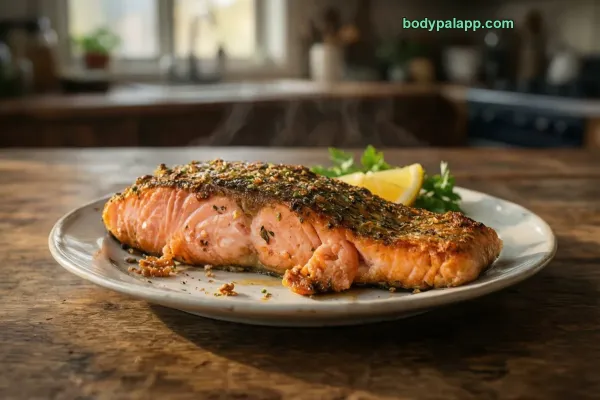
Verdict: For the fewest calories pick cod at 105 per 100 g, or tilapia if you want slightly more protein at 26.2 g per 100 g for a few more calories. Salmon runs about twice the calories at 206 per 100 g, mostly from its 12.4 g of fat, so choose it when you want that fat rather than when you are counting closely.
Most popular baked cod brands in the United States
Ranked by popularity in the BodyPal database
# Productkcal / 100 g
1Gorton's New England Baked Cod Fish Fillets1 fillet · 140 g179 kcal
Seasoned packaged fillets carry added ingredients, so their label reads higher than plain baked cod. Source: manufacturer labels / USDA FoodData Central.
Baked cod FAQs
How many calories are in a baked cod fillet?
A baked cod fillet (180 g) has about 189 calories, and a 3 oz portion (85 g) has 89.
Is baked cod good for weight loss?
Baked cod has 105 calories per 100 g with 22.8 g protein and only 0.9 g fat.
Baked cod vs baked salmon: which has fewer calories?
Per 100 g, baked cod has 105 calories and baked salmon has 274.
How much protein is in baked cod?
One baked cod fillet (180 g) has 41.1 g protein, and a 3 oz portion has 19.4 g.
How many calories are in 3 oz of baked cod?
A 3 oz portion (85 g) of baked cod has 89 calories. It also has 19.4 g of protein, 0.7 g of fat and 0 g of carbs, so it covers 39% of the daily value for protein for just 4% of the daily calories.
How many calories are in 100 grams of baked cod?
100 g of baked cod has 105 calories, with 22.8 g of protein, 0.9 g of fat and no carbs. That is 5% of a 2000-calorie day and 46% of the daily value for protein.
Does baked cod have any carbs?
No. Baked cod has 0 g of carbs, 0 g of sugars and 0 g of fiber per 100 g. Its calories come 92% from protein and 8% from fat, so any carbs in the meal come from sides, breading or sauce.
How much sodium is in baked cod?
Plain baked cod has 78 mg of sodium per 100 g and 140 mg per 180 g fillet, which is 6% of the daily value. Salt, seasoning blends and sauces added during cooking will raise that number.
How much cholesterol is in baked cod?
Baked cod has 55 mg of cholesterol per 100 g, measured against a daily value of 300 mg. Saturated fat is very low at 0.2 g per 100 g.
How many calories are in two baked cod fillets?
Two baked cod fillets (360 g) have 378 calories. They also provide 82.2 g of protein and 281 mg of sodium, so doubling the portion adds a lot of protein for relatively few calories.