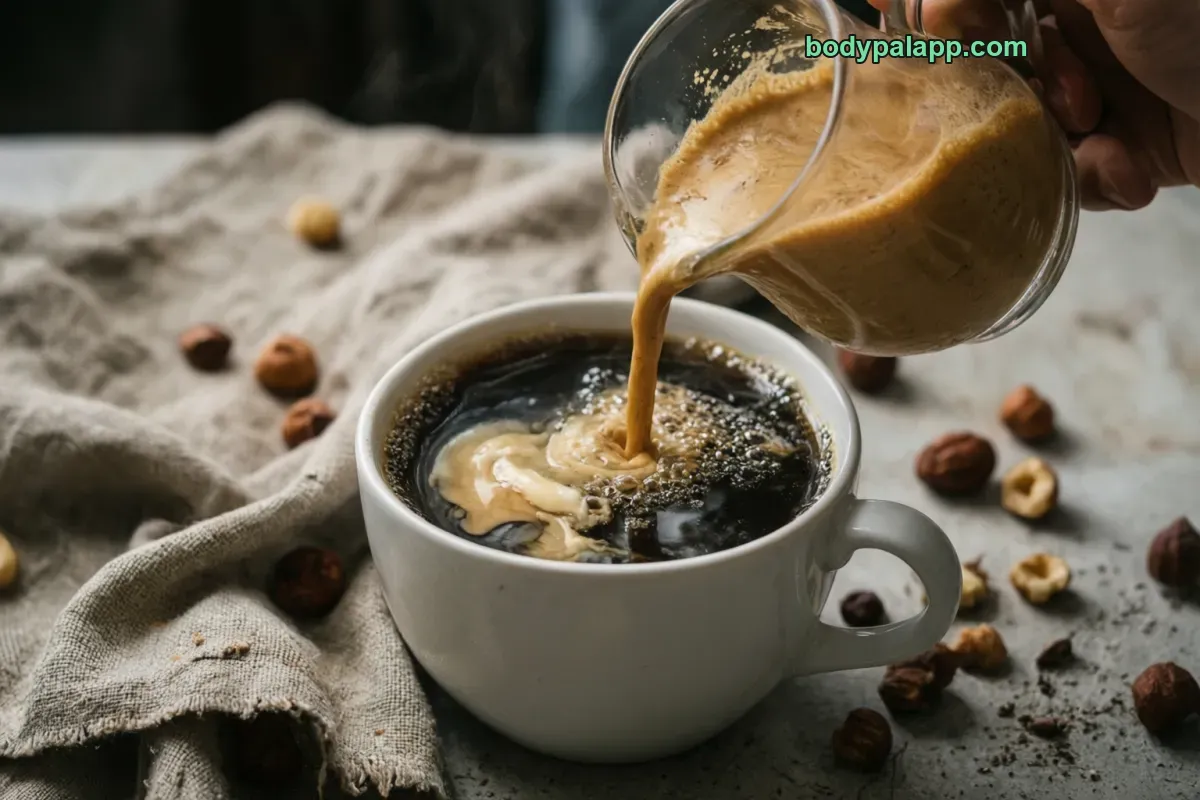
Hazelnut coffee creamer calories come to 38 for 1 tbsp (15 g) and 251 per 100 g. The number to notice is sugar: 5 g in a single tablespoon and 33 g per 100 g. Most of what you pour is sweetened fat, not dairy, and the size of your pour moves the total far more than the label suggests.
38kcal
1 tablespoon · 15 g, flavored, liquid
1%protein
0.1 gProtein
5 gCarbs
2 gFat
How to burn off 38 kcal
—Walking, brisk
—Jogging
—Cycling, moderate
—Swimming
Skip the math. BodyPal counts these calories from your steps and workouts automatically.
Nutrition facts
Flavored, liquid · per 15 g
Calories
38 kcal
Protein
0.1 g
Carbohydrate
5.3 g
Fat
2 g
Saturated fat
0.4 g
Cholesterol
0 mg
Sodium
10 mg
Potassium
14 mg
Iron
0.1 mg
Source: USDA FoodData Central
🛡️
Verified nutrition data
Numbers on this page come from USDA FoodData Central, the U.S. Department of Agriculture’s food composition database, and from manufacturer labels where a branded product is named. Last verified September 2026. How we verify our data →
Hazelnut coffee creamer: calories, protein and sodium by serving
Percent of daily value uses the FDA reference of 2,000 kcal a day.
Serving
kcal
Protein
Carbs
Fat
Sodium
% DV kcal
1 tbsp (15 g)
38
0.1 g
5.3 g
2 g
10 mg
2%
1 fl oz (30 g)
75
0.2 g
10.5 g
4.1 g
20 mg
4%
Sugar-free (15 g)
11
0.1 g
1.4 g
0.5 g
9 mg
1%
100 g
251
0.7 g
35.1 g
13.5 g
67 mg
13%
3 × 1 tbsp (15 g)
113
0.3 g
30 mg
5 × 1 tbsp (15 g)
188
0.5 g
50 mg
Three tablespoons make a 113-calorie habit
The label serving is 1 tbsp (15 g), and that comes to 38 calories, about 2% of a 2000-calorie daily reference. Few people stop there. A generous pour into a travel mug is closer to 1 fl oz (30 g), which lands at 75 calories, 10.5 g of carbs and 9.9 g of sugar.
The multiples show how quickly a habit builds. Two tablespoons give 75 calories, three give 113, and five reach 188. That last pour delivers only 0.5 g of protein and 50 mg of sodium, so almost everything you get from it is energy from sugar and fat. If you drink two or three mugs a day, the creamer can quietly become one of the larger sweet items in your day without ever looking like a treat.
Measuring once is the fix. Pour your usual amount into a tablespoon and count how many it takes. If the honest answer is three, log 113, not 38. BodyPal can log the mug from a photo, but the pour size is still the number that decides the total.
Sugar and fat split the calories almost evenly
Per 100 g, this creamer carries 35.1 g of carbs, 13.5 g of fat and 0.7 g of protein. In calorie terms that is 53% carbs, 46% fat and 1% protein. The carbs are nearly all sugar: 33 g of the 35.1 g. Fiber is a trace at 0.2 g per tablespoon.
USDA files it as "Cream substitute, flavored, liquid," which explains the rest of the label. There is no real cream in it, so cholesterol reads 0, and saturated fat stays moderate at 2.6 g per 100 g. The hazelnut is a flavor, not a meaningful amount of nuts, so do not expect anything a handful of hazelnuts would bring.
Protein is the clear gap. One tablespoon has 0.1 g, and even a five-spoon pour stops at 0.5 g. If you want your morning coffee to help keep you full until lunch, this creamer does not do that job. It adds flavor and calories, and that is the whole deal.
Sugar-free cuts a tablespoon to 11 calories
The sugar-free version in the same 15 g pour comes to 11 calories, with 1.4 g of carbs, 1.4 g of sugar and 0.5 g of fat. The regular tablespoon has 38 calories, 5.3 g of carbs and 5 g of sugar. Same spoon, less than a third of the calories.
The savings grow with the pour. If you take one tablespoon in one mug, the difference is small enough to ignore. If you take three spoons in each of several mugs, switching is one of the easiest cuts you can make without changing the habit itself. Sodium barely moves either way: 10 mg in a regular tablespoon and 9 mg in the sugar-free one, both 0% of the daily value.
Hazelnut is a common flavor across the shelf, from International Delight, Coffee-Mate and Coffee Dream to store brands such as Great Value and Shoppers Value, plus single-serve cups. Labels differ, so check whether the bottle you grab says sugar-free before you assume the lower number.
Treat it like a sweetener, not a splash of milk
Because 53% of the calories come from carbs and nearly all of those are sugar, hazelnut creamer behaves more like a flavored syrup than like dairy. Plain brewed coffee contributes close to nothing, so the creamer is the entire calorie story of the mug.
That framing helps with planning. If your breakfast already includes something sweet, a smaller pour or the sugar-free version keeps the sugar from stacking up. If your breakfast is light on protein, the creamer will not fill that hole, so pair the coffee with food that does, such as eggs or yogurt.
Sodium is not the row to worry about here. A tablespoon has 10 mg, and even 100 g holds just 67 mg, 3% of the daily value. Potassium is low too, at 96 mg per 100 g. The two numbers that matter are calories per pour and grams of sugar, and both are set by how much you pour.
How does hazelnut coffee creamer compare?
Here is how hazelnut creamer stacks up against regular coffee mate creamer, coffee syrup and plain ground coffee, per 100 g and per usual serving.
Verdict: For the fewest calories, plain coffee at 2 per cup wins easily, and regular coffee mate creamer at 20 per tablespoon costs about half of hazelnut creamer's 38. Coffee syrup is the worst swap if sugar is your concern, with 66.7 g of carbs per 100 g and 80 calories in a 2 Tbsp serving.
Most popular hazelnut coffee creamer brands in the United States
7Great Value Hazelnut Coffee Creamer1 tbsp · 15 ml233 kcal
8Shoppers Value Hazelnut Coffee Creamer4 tsp · 12 g417 kcal
Powdered creamers are labeled per gram of dry powder, so they read higher per 100 g than the liquid creamer above. Source: manufacturer labels / USDA FoodData Central.
Hazelnut coffee creamer FAQs
How many calories are in one tablespoon of hazelnut coffee creamer?
About 38 calories per tablespoon (15 g), or 75 per fluid ounce (30 g).
Is hazelnut coffee creamer good for weight loss?
One tablespoon adds 38 calories and 5.0 g of sugar. The sugar-free flavored version is 11 calories per 15 g.
Hazelnut creamer vs regular coffee creamer: which has fewer calories?
Plain liquid coffee creamer has 136 calories per 100 g against 251 for hazelnut, so a tablespoon is 20 calories versus 38.
How much sugar is in hazelnut coffee creamer?
One tablespoon has 5.0 g of sugar and 2.0 g of fat. Per 100 g it has 33.0 g of sugar.
What are the nutrition facts for hazelnut creamer per 100 g?
Per 100 g, hazelnut creamer has 251 calories, 35.1 g of carbs, 33 g of sugar, 13.5 g of fat including 2.6 g saturated, 0.7 g of protein and 67 mg of sodium.
How many calories does hazelnut creamer add to a cup of coffee?
A cup of plain coffee has only 2 calories, so the creamer supplies nearly all of it: 38 for one tablespoon, 75 for two and 113 for three.
How many calories are in a fluid ounce of hazelnut creamer?
One fl oz (30 g) of hazelnut creamer has 75 calories, with 10.5 g of carbs, 9.9 g of sugar and 4.1 g of fat. That is 4% of daily calories.
How many calories are in sugar-free hazelnut creamer?
A 15 g serving of sugar-free hazelnut creamer has 11 calories, 1.4 g of carbs, 1.4 g of sugar and 0.5 g of fat, compared with 38 calories for the regular version.
Is hazelnut creamer high in sodium?
No. One tablespoon has 10 mg of sodium, which rounds to 0% of the daily value, and even 100 g holds only 67 mg, or 3%.