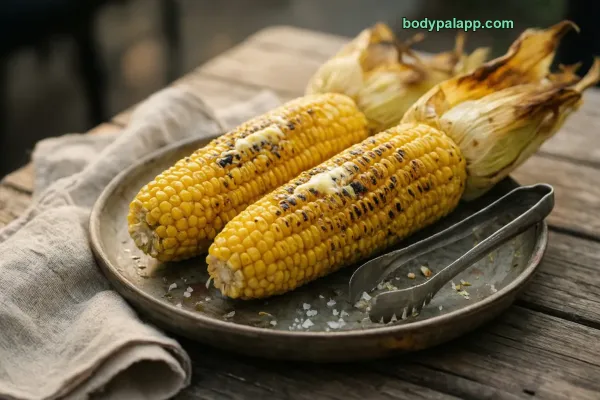
Corn on the cob without butter calories come to 99 for one medium ear (103 g), or 96 per 100 g. The number to notice is how much the ear size matters: a small ear is 85 calories and a large one 113. Plain boiled corn also carries just 1 mg of sodium per ear.
99kcal
1 medium ear · 103 g, boiled, no butter or salt
12%protein
3.5 gProtein
22 gCarbs
1.5 gFat
How to burn off 99 kcal
—Walking, brisk
—Jogging
—Cycling, moderate
—Swimming
Skip the math. BodyPal counts these calories from your steps and workouts automatically.
Nutrition facts
Boiled, no butter or salt · per 103 g
Calories
99 kcal
Protein
3.5 g
Carbohydrate
22 g
Fat
1.5 g
Saturated fat
0.2 g
Cholesterol
0 mg
Sodium
1 mg
Potassium
225 mg
Iron
0.5 mg
Source: USDA FoodData Central
🛡️
Verified nutrition data
Numbers on this page come from USDA FoodData Central, the U.S. Department of Agriculture’s food composition database, and from manufacturer labels where a branded product is named. Last verified September 2026. How we verify our data →
Corn on the cob without butter: calories, protein and sodium by serving
Percent of daily value uses the FDA reference of 2,000 kcal a day.
Serving
kcal
Protein
Carbs
Fat
Sodium
% DV kcal
1 medium ear (103 g)
99
3.5 g
21.6 g
1.5 g
1 mg
5%
1 large ear (118 g)
113
4 g
24.8 g
1.8 g
1 mg
6%
1 small ear (89 g)
85
3 g
18.7 g
1.3 g
1 mg
4%
100 g
96
3.4 g
21 g
1.5 g
1 mg
5%
3 × 1 medium ear (103 g)
297
10.5 g
3 mg
5 × 1 medium ear (103 g)
494
17.6 g
5 mg
Ear size moves the total more than butter skeptics expect
Corn is sold by the ear, not by the gram, so the size of the cob decides your count. A small ear of 89 g lands at 85 calories. A medium ear of 103 g is 99. A large ear of 118 g reaches 113. That spread is small on paper, but it adds up fast at a cookout where nobody weighs anything.
Against a 2,000-calorie reference day, a single ear sits between 4% and 6% of daily calories. That is a side dish, not a meal. Stack them and the picture changes: 2 medium ears come to 198 calories, 3 reach 297, and 5 hit 494, which is closer to a full plate of food than a side.
If you log corn, pick the size honestly. Most supermarket ears look medium, and summer farm-stand cobs often run large. When you are unsure, the medium ear at 99 calories is a fair middle estimate, and BodyPal can log the ear from a photo if you would rather not guess.
Three quarters of the calories come from carbs
Corn is a starchy vegetable, and the split shows it. Carbohydrates supply 76% of the calories, while protein and fat each supply 12%. Per 100 g that works out to 21 g of carbs, 3.4 g of protein and 1.5 g of fat.
Not all of those carbs are sugar. A medium ear holds 21.6 g of carbohydrate, of which 4.7 g is sugar and 2.5 g is fiber. The rest is mostly starch, which is why corn eats more like a grain than like a green vegetable. Its sweetness comes from that modest sugar share, not from a sugar load.
Protein is a supporting player. A medium ear gives 3.5 g, about 7% of the daily value, and a large ear gives 4 g. That is useful but not enough to make corn the anchor of a meal. Saturated fat is close to zero at 0.2 g per 100 g, and cholesterol is 0.
Plain corn has almost no sodium, so toppings decide it
Boiled without salt, corn barely registers on the sodium row: 1 mg per 100 g and 1 mg per ear, which rounds to 0% of the daily value. Even 5 medium ears total only 5 mg. That makes unsalted corn one of the easiest sides to fit into a lower-sodium day.
The catch is what goes on after cooking. Salt, seasoned butter, cheese and spice rubs add sodium that the ear itself never had. Other corn entries on BodyPal show the effect, listing well over a hundred milligrams per 100 g once preparation adds it. If you watch sodium, season with lime, pepper or fresh herbs instead of the salt shaker.
Potassium is the quieter mineral here, at 218 mg per 100 g. That is a modest share of the 4,700 mg daily value, so treat it as a small bonus rather than a reason to eat corn.
Corn works best as the starch on the plate
Because most of its calories are carbs, corn fills the role that rice, bread or potatoes usually play. Swap one for the other rather than stacking them, and the meal stays in a familiar range. A medium ear next to grilled chicken, fish or beans covers the starch and leaves protein to the main dish.
Add a leafy salad or sliced tomatoes for volume. Those bring color and bulk for few calories, and they balance corn's sweetness. The 2.5 g of fiber in a medium ear helps, but pairing it with other vegetables gets you more.
At barbecues, decide on the number of ears before you start. One ear is a side at 99 calories. Three ears at 297 is a decision worth making on purpose.
How does corn on the cob without butter compare?
Here is how plain boiled corn stacks up against other corn on the cob entries, per 100 g and per usual serving.
Verdict: For the fewest calories per serving, the plain corn on the cob entry wins at 59 per smaller 63 g ear, while corn with butter costs 111 for a regular ear and carries 3.5 g of fat per 100 g. If sodium is your concern, skip the salted versions, since grilled corn on the cob lists 253 mg per 100 g.
Corn on the cob without butter FAQs
How many calories are in one ear of corn without butter?
A medium boiled ear (103 g) has about 99 calories. A small ear (89 g) has 85 and a large ear (118 g) has 113.
Is corn on the cob good for weight loss?
A plain medium ear has 99 calories, 1.5 g of fat and 2.5 g of fiber. Per 100 g it has 96 calories.
Corn on the cob without butter vs with butter: which has fewer calories?
Plain boiled corn has 96 calories and 1.5 g fat per 100 g, while corn cooked with butter has 103 calories and 3.5 g fat. A regular buttered ear (108 g) comes to about 111 calories.
How many carbs are in an ear of corn?
A medium ear (103 g) has about 21.6 g of carbs, including 4.7 g of sugar, plus 3.5 g of protein.
How many calories are in a large ear of corn without butter?
A large ear of corn without butter (118 g) has 113 calories. It carries 24.8 g of carbs, 4 g of protein and 1.8 g of fat, which is about 6% of daily calories.
How many calories are in two ears of corn on the cob?
Two medium ears of plain corn come to 198 calories and 7 g of protein. Three ears reach 297 calories, so the count climbs quickly if you keep reaching for another cob.
How much sugar is in an ear of corn?
A medium ear of corn has 4.7 g of sugar, and 100 g has 4.5 g. Most of the remaining carbohydrate is starch, with 2.5 g of fiber in a medium ear.
How much protein is in an ear of corn without butter?
A medium ear provides 3.5 g of protein, about 7% of the daily value. A large ear gives 4 g and a small ear 3 g, so corn adds protein but should not be your main source.
Is corn on the cob high in sodium?
No. Plain boiled corn has 1 mg of sodium per ear, which is 0% of the daily value. Sodium only rises when you add salt, seasoned butter or other toppings after cooking.