
How many calories are in cotton candy grapes?
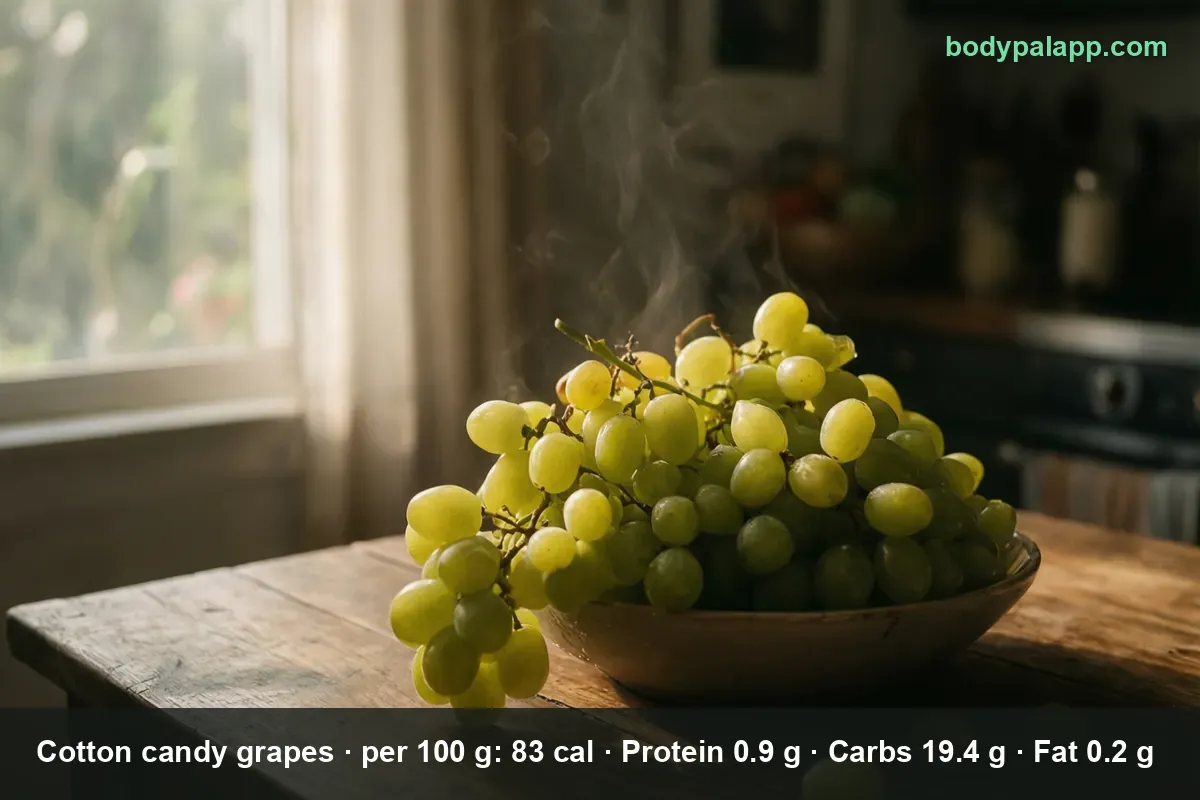
A cup of cotton candy grapes holds 150 g and 125 calories. Per 100 g the fruit runs 83 calories, so a ten-grape handful is 58. USDA does not list the Cotton Candy variety by name, so the numbers here come from its record for raw table grapes.
On this page
- Cotton candy grape quick facts
- US servings from one grape to a full cup
- Other grape types on the same scale
- The sugar looks big but the added sugar is zero
- How do cotton candy grapes compare?
- FAQ
Cotton candy grape quick facts
Cotton Candy is a trademarked green table grape, bred conventionally and sold in clamshells next to the ordinary green seedless. There is no USDA record under that name. The closest match is the survey entry FNDDS 2709237, "Grapes, raw", which is what US dietary surveys use for any fresh grape eaten out of hand. That is the record a person holding the clamshell is actually eating from, so it drives every number below.
The grower markets the variety as noticeably sweeter than a standard green grape. No public lab analysis backs a specific sugar figure for it, so this page quotes none. The older varietal records stay in the tables further down instead of being blended into one average.
| Nutrient | Per 100 g | Per 1 cup (150 g) | % Daily Value |
|---|---|---|---|
| Calories | 83 | 125 | — |
| Total fat | 0.2 g | 0.3 g | 0% |
| Saturated fat | 0.05 g | 0.1 g | 0% |
| Carbohydrate | 19.4 g | 29.1 g | 11% |
| Dietary fiber | 0.9 g | 1.4 g | 5% |
| Total sugars | 16.74 g | 25.1 g | — |
| Protein | 0.9 g | 1.4 g | 3% |
| Sodium | 5 mg | 8 mg | 0% |
% Daily Value is based on a 2,000-calorie diet.
Verified nutrition data
Numbers on this page come from USDA FoodData Central, the U.S. Department of Agriculture’s food composition database, and from manufacturer labels where a branded product is named. Last verified September 2026. How we verify our data →
Two rows you would see on a package label are missing here. FNDDS does not publish added sugars or trans fat for survey foods, and on a whole fresh grape the added-sugar line is zero by definition anyway. Cholesterol is 0 mg. Potassium is the quiet one: 224 mg per 100 g, which works out to 336 mg in a cup, or 7% of the FDA Daily Value of 4,700 mg.
US servings from one grape to a full cup
| Serving | Weight | Calories |
|---|---|---|
| 1 grape | 7 g | 6 kcal |
| 10 grapes | 70 g | 58 kcal |
| 1/2 cup | 75 g | 62 kcal |
| 1 cup | 150 g | 125 kcal |
| 1 oz | 28 g | 24 kcal |
| Per 100 g | 100 g | 83 kcal |
The cup is the USDA household measure, and it is the only line above taken straight from the record. The single grape, the ten-grape handful, the half cup and the ounce are our own arithmetic from the USDA 100 g figure, not USDA servings.
That ten-grape line is the useful one. Most people eat cotton candy grapes standing at the counter, a few at a time, and ten of them at roughly 7 g each cost 58 calories. A cup is more than double that for something that disappears in about a minute. If you log by cup out of habit, you are probably overcounting the counter grazing and undercounting the bowl in front of the TV.
Grape size is the wobble in all of this. A cup packs 150 g whether the grapes are small or oversized, so the cup number holds. The per-grape number does not: a big one can run 9 or 10 g, which pushes ten of them past 70 g. Weigh the bunch once and you will know which end of the range your store sells.
Other grape types on the same scale
USDA keeps several grape records, and they do not agree. Some are decades-old composite samples, some are recent Foundation analyses with a new calorie calculation. All of them are per 100 g of edible fruit, so the differences are real chemistry plus sampling, not a units trick.
| Grape type | Per 100 g | 1 oz (28.35 g) | Calories |
|---|---|---|---|
| Green seedless | 80 kcal | 28 g | 23 kcal |
| Red seedless | 86 kcal | 28 g | 24 kcal |
| Thompson seedless, European type | 69 kcal | 28 g | 20 kcal |
| American slip-skin, Concord type | 67 kcal | 28 g | 19 kcal |
| Muscadine | 57 kcal | 28 g | 16 kcal |
| Canned in heavy syrup | 76 kcal | 28 g | 22 kcal |
Green seedless is the closest match by type, and at 80 calories per 100 g it lands just under the survey figure of 83. Red seedless comes in highest of the six at 86. Muscadine is the lightest at 57, and it is also the one carrying real fiber at 3.9 g per 100 g against 0.9 g in the raw-grape record, because you eat the thick skin.
The canned row is the one worth staring at. Thompson seedless canned in heavy syrup is 76 calories per 100 g, barely under fresh grapes, but 19.05 g of its 19.65 g of carbohydrate is sugar, much of it poured in from the can. The same grape canned in water drops to 40 calories per 100 g. Fresh fruit and syrup-packed fruit are not interchangeable in a log, even when the calorie totals look close.
The sugar looks big but the added sugar is zero
A cup of these grapes carries 25.1 g of total sugars. Half of the 50 g added-sugar Daily Value, if you read it the wrong way. You should not: total sugars have no Daily Value on the Nutrition Facts label at all, which is why that cell stays blank in the table above, and the added-sugar line here is zero. The FDA's 50 g target is about sugar poured into food, not sugar that grew in it.
What the cup does spend is 29.1 g of carbohydrate, or 11% of the Daily Value, against 125 calories. Fiber gives 1.4 g back, 5% of the Daily Value, leaving net carbs near 27.7 g. That is a real number if you are managing carbs, and it is the honest reason to portion grapes rather than the sugar figure people panic about.
The upside is potassium. Those 336 mg per cup are 7% of the Daily Value, and they come with 8 mg of sodium, essentially nothing. MyPlate counts grapes toward the fruit group as a whole fruit rather than a juice, which is where the fiber and the chewing time come from. Fat is 0.2 g per 100 g, so the calories are carbohydrate almost end to end.
How do cotton candy grapes compare?
| Grape | Per 100 g | US serving | Calories |
|---|---|---|---|
| Cotton candy grapes (raw grapes record) | 83 kcal | 1 cup, 150 g | 125 kcal |
| Green seedless | 80 kcal | 1 oz, 28 g | 23 kcal |
| Red seedless | 86 kcal | 1 oz, 28 g | 24 kcal |
| Thompson seedless | 69 kcal | 1 oz, 28 g | 20 kcal |
Our take: on paper the Cotton Candy variety is not a splurge. Of these four records only red seedless runs higher per 100 g than the 83 used for fresh grapes, and Thompson seedless, the oldest sample of the group, is the lightest at 69. The gap between the highest and lowest row is 17 calories per 100 g, which is about 12 calories on a ten-grape handful and not worth choosing a bag over. What is worth deciding is the container. Ten grapes for 58 calories is a dessert. A cup for 125 is a snack that has to fit the day, and a second cup while the first one is still in your mouth is 250 calories of fruit you did not plan.
Cotton candy grape FAQs
How many calories are in cotton candy grapes?
A cup of cotton candy grapes weighs 150 g and carries 125 calories, or 83 calories per 100 g. USDA has no record for the Cotton Candy variety specifically, so the number comes from the FNDDS entry for raw grapes, which is what the survey uses for every fresh table grape.
How many calories in 1 cup of cotton candy grapes?
One cup is 125 calories at 150 g. That cup also brings 29.1 g of carbohydrate, 1.4 g of fiber and 1.4 g of protein. Half a cup, 75 g on our own arithmetic from the 100 g figure, lands at 62 calories.
How much sugar is in cotton candy grapes?
A cup holds 25.1 g of total sugars, from 16.74 g per 100 g. All of it is the fruit's own sugar; added sugars are 0 g, so the FDA's 50 g added-sugar Daily Value stays untouched. Total sugars carry no Daily Value of their own on the label.
Do cotton candy grapes have more sugar than regular grapes?
USDA publishes no separate sugar figure for the Cotton Candy variety, so the 16.74 g of sugar per 100 g on its raw-grape record is the only figure to compare. The older Thompson seedless entry lists 15.48 g. Nothing in the USDA data sets this variety apart from any other green table grape.
How many calories in 10 cotton candy grapes?
Ten grapes weigh about 70 g and come to 58 calories, using 7 g per grape and our own arithmetic from the USDA 100 g figure. That is under half of a full cup's 125 calories. Grape size varies, so weigh the bunch if you want the cup number to hold.
Are cotton candy grapes healthy?
A cup gives 1.4 g of fiber, 5% of the Daily Value, and 336 mg of potassium, 7% of it, for 125 calories and 8 mg of sodium. They count as fruit under MyPlate, and the fat is 0.2 g per 100 g, so the calories are almost entirely carbohydrate.
Are cotton candy grapes good for weight loss?
At 83 calories per 100 g they are light for something this sweet, and 10 grapes for 58 calories is a real dessert-sized portion. The catch is speed: a cup disappears in a minute and costs 125 calories. If you are counting, portion them into a bowl instead of eating from the bag.
How many carbs are in cotton candy grapes?
A cup carries 29.1 g of carbohydrate, 11% of the Daily Value, from 19.4 g per 100 g. Fiber is 1.4 g of that cup, so net carbs land near 27.7 g. Ten grapes come to about 13.6 g, which is why a small handful fits into most low-carb days.
Similar foods
- Popsicle — 40 cal per single stick
- Waffle cone — 556 cal per Waffle cone with 2 scoops
- Nachos — 663 cal per order
- Cannoli — 227 cal per cannoli
- Fries — 452 cal per medium fast food order
- Onion Rings — 282 cal for 8 rings
Count it without the math
Tip the clamshell into a bowl, point the camera at it, and BodyPal counts the grapes for you.


How long does it take to burn off 125 kcal of cotton candy grapes?
A 1-cup (150 g) serving is 125 kcal. Enter your weight and the amount you ate to see how long it takes you to burn that off:
lb
| Activity | Time to burn 125 kcal |
|---|---|
| Walking, brisk | 25 min |
| Cycling, moderate | 16 min |
| Swimming, moderate | 18 min |
| Jogging | 15 min |
| Weight training, moderate | 28 min |
Times are for a 155 lb adult at a steady pace; change the weight to see yours. The amount is set to the portion in the text (150 g); change it to what you actually ate. BodyPal works this out from your steps automatically.
This table assumes you know your daily total. If you do not, the daily calorie calculator works it out from five numbers.