
How Many Calories in a Popsicle?
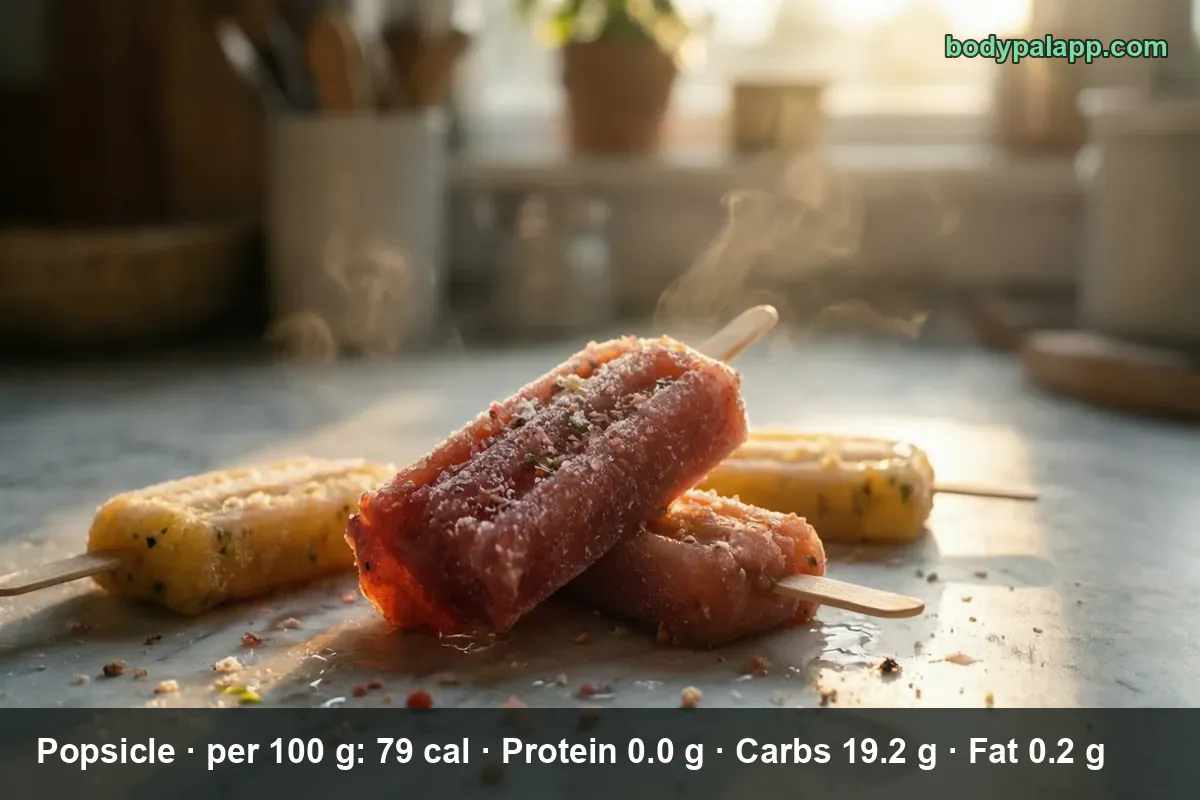
A single popsicle stick weighs 50 g and carries 40 calories. The classic double stick, the one built to snap down the middle, weighs 100 g and comes to 79 — the same number as the per-100 g figure, because a double stick is exactly 100 g of ice. A miniature is 12. A no-sugar-added pop, at the same 50 g, is also 12.
On this page
- Popsicle quick facts
- The double stick is where the count goes wrong
- Popsicle sizes, stick by stick
- Every calorie in a popsicle is sugar
- Sugar-free pops and what they really save
- Freezer pops, push ups and Scribblers
- Popsicle against the rest of the freezer
- Most popular popsicle brands
- FAQ
Popsicle quick facts
The reference here is the plain fruit-flavored ice pop on a wooden stick, the kind that comes out of a box of a dozen. USDA files it as FNDDS record 2710320, "Popsicle", in the gelatins, ices and sorbets category, and gives the single stick a weight of 50 g.
| Nutrient | Per 100 g | Per 1 single stick (50 g) | % Daily Value |
|---|---|---|---|
| Calories | 79 | 40 | — |
| Total fat | 0.24 g | 0.12 g | 0% |
| Saturated fat | 0.01 g | 0.01 g | 0% |
| Carbohydrate | 19.23 g | 9.6 g | 3% |
| Dietary fiber | 0 g | 0 g | 0% |
| Total sugars | 13.66 g | 6.8 g | — |
| Protein | 0 g | 0 g | 0% |
| Sodium | 7 mg | 4 mg | 0% |
% Daily Value is based on a 2,000-calorie diet.
Verified nutrition data
Numbers on this page come from USDA FoodData Central, the U.S. Department of Agriculture’s food composition database, and from manufacturer labels where a branded product is named. Last verified September 2026. How we verify our data →
Two rows that appear on a packaged box are absent, on purpose. The 2021–2023 FNDDS release publishes no added-sugars value and no trans fat value for frozen ices, so neither is listed here rather than borrowed from a similar product. Total sugars sit without a percentage because the FDA sets no Daily Value for total sugars — only added sugars carry one.
What is left is a strikingly empty label. Fat, saturated fat, protein and sodium all round to 0% of the day in one stick. The only line that moves at all is carbohydrate, at 3%. A popsicle is one of the few foods where the Nutrition Facts panel is honest by being almost blank.
The double stick is where the count goes wrong
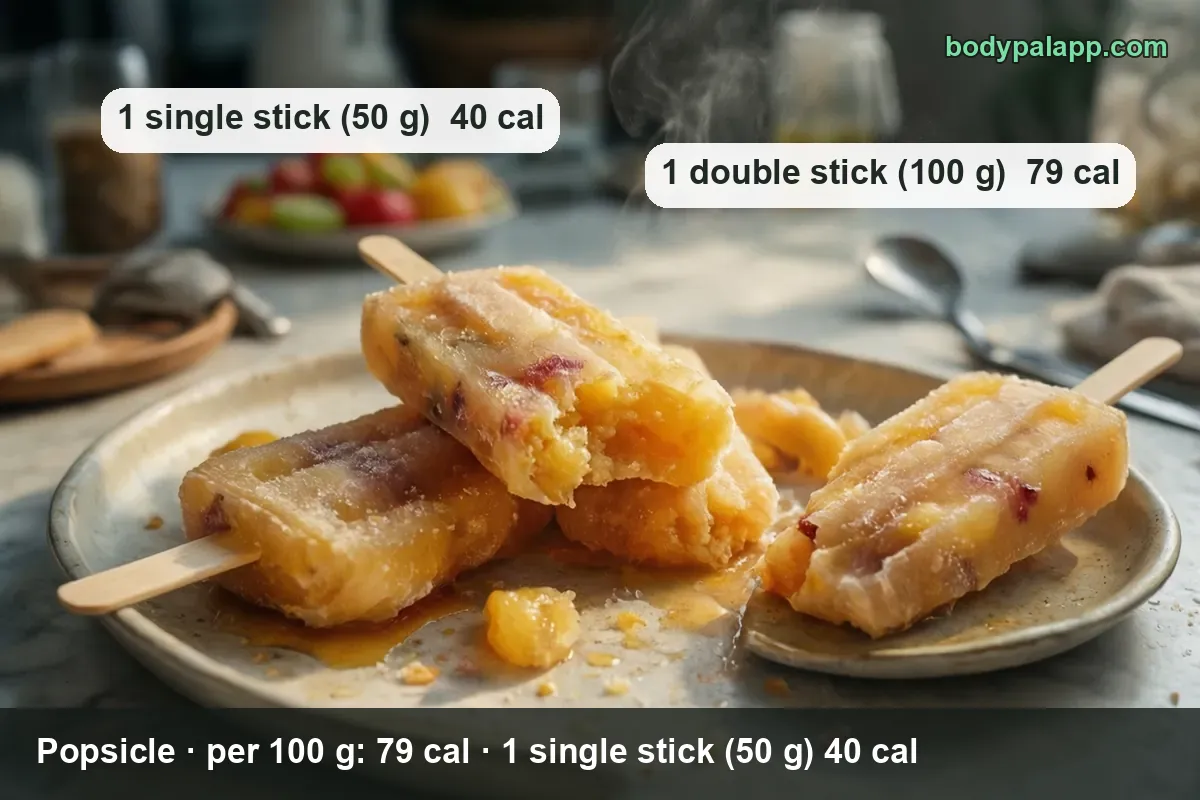
USDA measures two everyday sizes, and the gap between them is the whole trap. A single stick is 50 g and 40 calories. A double stick — two joined slabs on two sticks, scored down the middle so it can be snapped and shared — is 100 g and 79 calories.
Almost nobody snaps it and shares it. The pop goes in one hand, both sticks stay together, and the count that gets logged is 40 because 40 is the number the internet gives for "a popsicle."
So the honest rule is short. If your pop has one stick, log 40. If it has two, log 79, and do it even if you told yourself the other half was for later.
That doubling has a second effect that is easy to like. Because the double stick weighs exactly 100 g, its calorie count and the per-100 g figure are the same 79, which makes it the rare food where the two most-quoted numbers cannot be confused with each other.
Popsicle sizes, stick by stick
| Serving | Weight | Calories |
|---|---|---|
| 1 miniature popsicle | 15 g | 12 |
| 1 oz | 28 g | 22 |
| 1 fl oz | 30 g | 24 |
| 1 single stick | 50 g | 40 |
| 1 push up | 50 g | 40 |
| 1 double stick | 100 g | 79 |
| 100 g | 100 g | 79 |
Four of those rows are USDA's own measured portions for record 2710320: the miniature, the single stick, the push up and the double stick. The ounce rows are arithmetic on the same 79 figure, and they are worth having because freezer-aisle boxes are labeled in fluid ounces rather than grams.
The push up is the row people expect to be different. A cardboard tube with a plastic plunger looks like more dessert than a flat stick does, but USDA weighs it at the same 50 g, so it lands on the same 40 calories. The packaging changes; the ice does not.
The miniature is the opposite case. At 15 g it is 12 calories, which reads like nothing — and it is nothing, until the box of minis is open on a hot afternoon. Three of them equal about one single stick. Five equal 60 calories, more than a full-size pop, and they get eaten in a way a full-size pop never does, standing at the freezer door.
Every calorie in a popsicle is sugar
Run the macros for 100 g and the food explains itself in one line.
- Carbohydrate: 19.23 g × 4 = 77 calories, 97% of the total
- Fat: 0.24 g × 9 = 2 calories, 3%
- Protein: 0 g × 4 = 0 calories
There is no third contributor. A popsicle is flavored, colored, frozen sugar water, and the 13.66 g of total sugars per 100 g is essentially the whole food. In one single stick that is 6.8 g of sugars, roughly a teaspoon and a half, alongside 0 g of protein, 0 g of fiber and 0.12 g of fat.
That composition cuts both ways, and it is worth being straight about both.
The upside is that 40 calories buys a real dessert with a real ritual — something cold that takes ten minutes to finish. Very little in the freezer aisle does that for under 50 calories. The sodium is a rounding error too: 4 mg in a stick, against the 2,300 mg the FDA uses as the daily reference, which is 0% of the day and one of the few frozen desserts you can say that about.
The downside is that nothing comes with those calories. No protein to hold you, no fiber, no fat to slow the sugar down. The Dietary Guidelines for Americans cap added sugars at 10% of daily calories — 50 g on a 2,000-calorie day — and while USDA publishes no added-sugars figure for this record, a food whose energy is 97% carbohydrate from syrup is spending against that budget rather than a nutrition one. MyPlate's guidance on added sugars treats frozen desserts as exactly that kind of spend.
Treat a popsicle as what it is: a cheap, cold, low-calorie sweet. Not a fruit serving, and not a snack that will get you to dinner.
Sugar-free pops and what they really save
| Version | Per 100 g | Serving | Calories | Total sugars per 100 g |
|---|---|---|---|---|
| Popsicle, standard | 79 | 1 single stick (50 g) | 40 | 13.66 g |
| Popsicle, no sugar added | 24 | 1 single stick (50 g) | 12 | 1.52 g |
| POPSICLE sugar-free pops, orange, cherry, grape | 21 | 1 pop, 1.75 fl oz (55 g) | 12 | 1.52 g |
Sugar-free is one of those label claims that usually saves less than it promises. Here it saves almost everything.
The no-sugar-added pop, USDA record 2710321, runs 24 calories per 100 g against 79 — a 70% cut, and the largest proportional saving on this page. Sugars fall from 13.66 g per 100 g to 1.52 g. On a 50 g stick that is 12 calories instead of 40, so three sugar-free pops cost less than one standard one.
The branded sugar-free line, SR Legacy record 170259, reads 21 calories per 100 g on a slightly larger 55 g pop, which lands on the same 12 calories. Two different USDA files, two recipes, one answer.
Sodium goes the other way, from 7 mg per 100 g to 10 mg, which is the sweetener system doing its job. At 10 mg it is still 0% of the day, so this is a curiosity rather than a trade-off.
Our take: on a food this small, the sugar-free version is one of the few swaps where the arithmetic is genuinely worth it. Twelve calories against forty is not a diet-food compromise, it is under a third of the count — and the pop still takes ten minutes to eat.
Freezer pops, push ups and Scribblers
Three neighbors get searched as if they were popsicles, and two of them essentially are.
Freezer pops, the ones sold as unfrozen plastic tubes you cut open at the top, are USDA record 2710322 at 79 calories per 100 g — an exact match for a popsicle in every macro. A 50 g freezer pop is 40 calories; 1 fl oz of one is 24. If you froze a box of tubes yourself, log them as sticks and move on.
Push ups share the record with the popsicle itself, at 50 g and 40 calories, as the size table shows.
POPSICLE Scribblers, SR Legacy record 170255, are the juice-type variety rather than a water ice, and they come in slightly higher at 81 calories per 100 g with 14.57 g of sugars. The pops themselves are small, 1.2 fl oz at 33 g, which puts one at 27 calories. Saturated fat, cholesterol and added sugars are not published in SR Legacy for that product, so those lines are left out rather than guessed.
The pattern across all four is that the recipe barely matters and the weight decides everything. Water ice, juice ice, tube or stick, the frozen-sugar family sits within a couple of calories per 100 g of itself. What separates a 12-calorie pop from a 79-calorie one is either the size of the thing or the removal of the sugar — nothing in between.
Popsicle against the rest of the freezer
| Item | Per 100 g | US serving | Calories |
|---|---|---|---|
| Popsicle | 79 | 1 single stick (50 g) | 40 |
| Freezer pop | 79 | 1 freezer pop (50 g) | 40 |
| Frozen fruit juice bar | 106 | 1 bar (80 g) | 85 |
| Sorbet | 110 | 1 cup (200 g) | 220 |
| Italian ice | 128 | 1 cup (130 g) | 166 |
Per 100 g the popsicle is the lightest thing in the case, and the spread is real: 79 against 106 for a frozen juice bar, 110 for sorbet and 128 for Italian ice. Water content is the reason. The heavier items carry more fruit solids and more syrup per gram, and the juice bar even brings 0.81 g of protein per 100 g, which no popsicle does.
Per serving the ranking holds but the distances explode, because the popsicle is served on a stick and its rivals are served in a cup. A 200 g cup of sorbet is 220 calories — five and a half single sticks. A cup of Italian ice at 130 g is 166, more than four. A frozen juice bar at 85 calories is the closest competitor and still costs two pops.
Our take: if the point is a cold sweet for the fewest calories, the popsicle wins twice, once on density and once on the fact that nobody eats a cup of it. If you want a frozen dessert that carries anything at all — a little protein, actual fruit — the juice bar at 85 calories is the honest upgrade, and it costs about the same as two sticks. Sorbet only looks close to a popsicle on the per-100 g line; the cup it arrives in makes it a different decision entirely.
Most popular popsicle brands in the United States
Ranked by how widely each product appears among foods sold in the United States, from the BodyPal food database of over 3.3 million products. Calories are the figures printed on each Nutrition Facts label, checked against USDA FoodData Central.
| Product | Calories (per 100 g) |
|---|---|
| Popsicle Orange Cherry Grape Ice Pops | 81 cal |
| Popsicle Rainbow Frozen Dessert Ice Pops | 81 cal |
| Popsicle Disney Frozen Minis Ice Pops | 79 cal |
| Popsicle Jolly Rancher Ice Pops | 74 cal |
| Popsicle Tropicals Ice Pops | 32 cal |
| Popsicle Peach, Raspberry & Vanilla Swirl Fruit Twister Dessert Pops | 97 cal |
Brand popularity: BodyPal food database. Nutrition: manufacturer labels / USDA FoodData Central.
Popsicle FAQs
How many calories in a popsicle?
40 calories for one single stick of 50 g, at 79 calories per 100 g. A double stick weighs 100 g and is 79 calories, and a miniature at 15 g is 12. The stick carries 9.6 g of carbohydrate, 6.8 g of total sugars and no protein or fiber.
How many calories in a sugar-free popsicle?
12 calories for a 50 g no-sugar-added pop, from 24 calories per 100 g against 79 for the standard version — a 70% cut. The branded POPSICLE sugar-free pops run 21 calories per 100 g, which also lands on 12 for one 55 g pop. Sugars drop from 13.66 g to 1.52 g per 100 g.
How many carbs are in a popsicle?
9.6 g in one 50 g stick, which is 3% of the Daily Value, from 19.23 g per 100 g. Carbohydrate supplies 97% of the calories in this food. A no-sugar-added pop of the same size holds about 3.0 g instead, from 5.92 g per 100 g.
How much sugar is in a popsicle?
6.8 g of total sugars in one 50 g stick, roughly a teaspoon and a half, from 13.66 g per 100 g. No % Daily Value appears beside it because the FDA sets one only for added sugars, and USDA does not publish an added-sugars figure for this record.
Are popsicles healthy?
They are the lightest frozen dessert in the case at 79 calories per 100 g, with 4 mg of sodium and no saturated fat worth counting. They also carry no protein, no fiber and nothing but sugar, so a popsicle is best treated as a low-calorie sweet rather than a fruit serving.
How many calories in a freezer pop?
40 calories for a 50 g freezer pop, from 79 calories per 100 g — an exact match for a popsicle on every macro. One fluid ounce of one is 24 calories. The plastic tube changes nothing except how you open it.
Do popsicles have any protein or fat?
No protein at all and 0.24 g of fat per 100 g, which is 0.12 g in a single stick and 0% of the Daily Value. Saturated fat is 0.01 g per 100 g. Nearly all 40 calories in a stick come from carbohydrate, which is why a popsicle does not hold off hunger the way a dairy dessert does.
Popsicle or sorbet — which is lighter?
The popsicle, twice over. Per 100 g it is 79 calories against 110 for sorbet, and per serving a single stick is 40 while a 1-cup serving of sorbet (200 g) is 220 — five and a half sticks. Italian ice sits between them at 128 per 100 g, or 166 for a 130 g cup.
Similar foods
- Waffle cone — 556 cal per Waffle cone with 2 scoops
- Nachos — 663 cal per order
- Cannoli — 227 cal per cannoli
- Fries — 452 cal per medium fast food order
- Onion Rings — 282 cal for 8 rings
- Funnel cake — 318 cal per cake, 6-inch
Count it without the math
Point the camera at the stick and BodyPal knows whether it was the single or the double.


How long does it take to burn off a popsicle?
A single stick (50 g) is 40 kcal. Enter your weight and the amount you ate to see how long it takes you to burn that off:
lb
| Activity | Time to burn 40 kcal |
|---|---|
| Walking, brisk | 8 min |
| Cycling, moderate | 5 min |
| Swimming, moderate | 6 min |
| Jogging | 5 min |
| Weight training, moderate | 9 min |
Times are for a 155 lb adult at a steady pace; change the weight to see yours. The amount is set to the portion in the text (50 g); change it to what you actually ate. BodyPal works this out from your steps automatically.
One food is easy to picture; a whole day is harder. See how many calories you need a day and what a deficit actually looks like.