
How Many Calories Are in Fries?
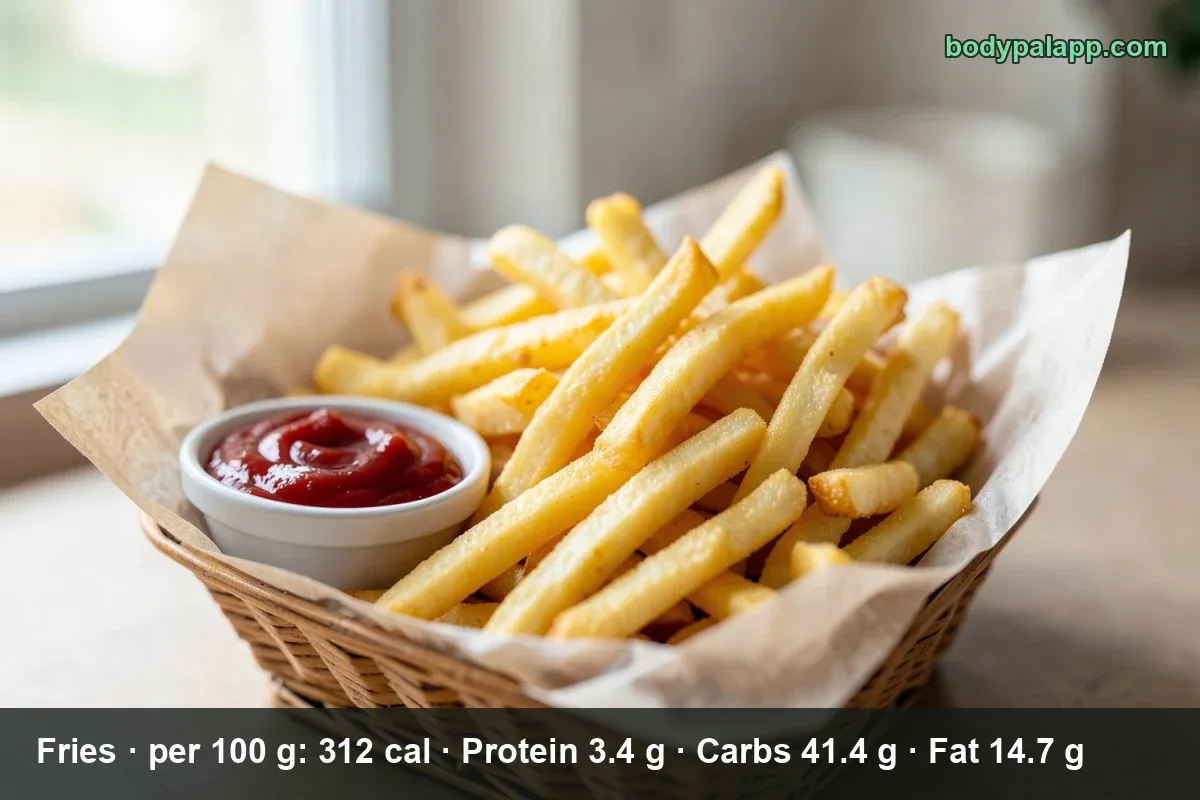
A medium fast food order of fries weighs 145 g and carries 452 calories. Per 100 g they run 312 calories, the highest of the USDA french-fry records in the tables below. A small order is 343, a large 562, and one cup — a much smaller thing than the carton — is 187.
On this page
- Fries quick facts
- US serving sizes, from one ounce to a large order
- Fast food, restaurant, homemade: six versions of the same potato
- Fat and sodium are the rows to watch
- How do fries compare?
- Most popular fries brands
- FAQ
Fries quick facts
When an American types "calories in fries," they are almost always holding a cardboard carton from a counter, not a bowl of something baked at home. So the headline number comes from the USDA record that describes exactly that: FNDDS 2709461, "Potato, french fries, fast food", scaled to a medium order of 145 g. Home versions and frozen bags get their own rows further down, because they are genuinely different foods once the oil is involved.
Two label rows are missing here on purpose. This FNDDS edition does not publish added sugars or trans fat for the record, so rather than guess, those lines are left out. Cholesterol is 0 mg — fries are fried in vegetable oil, not animal fat — and potassium is unusually high for a side dish at 579 mg per 100 g, or 840 mg in the medium order, which is 18% of the Daily Value.
| Nutrient | Per 100 g | Per 1 medium order (145 g) | % Daily Value |
|---|---|---|---|
| Calories | 312 | 452 | — |
| Total fat | 14.73 g | 21.4 g | 27% |
| Saturated fat | 2.34 g | 3.4 g | 17% |
| Carbohydrate | 41.44 g | 60.1 g | 22% |
| Dietary fiber | 3.8 g | 5.5 g | 20% |
| Total sugars | 0.3 g | 0.4 g | — |
| Protein | 3.43 g | 5.0 g | 10% |
| Sodium | 210 mg | 305 mg | 13% |
| Cholesterol | 0 mg | 0 mg | 0% |
| Potassium | 579 mg | 840 mg | 18% |
% Daily Value is based on a 2,000-calorie diet.
Verified nutrition data
Numbers on this page come from USDA FoodData Central, the U.S. Department of Agriculture’s food composition database, and from manufacturer labels where a branded product is named. Last verified September 2026. How we verify our data →
US serving sizes, from one ounce to a large order
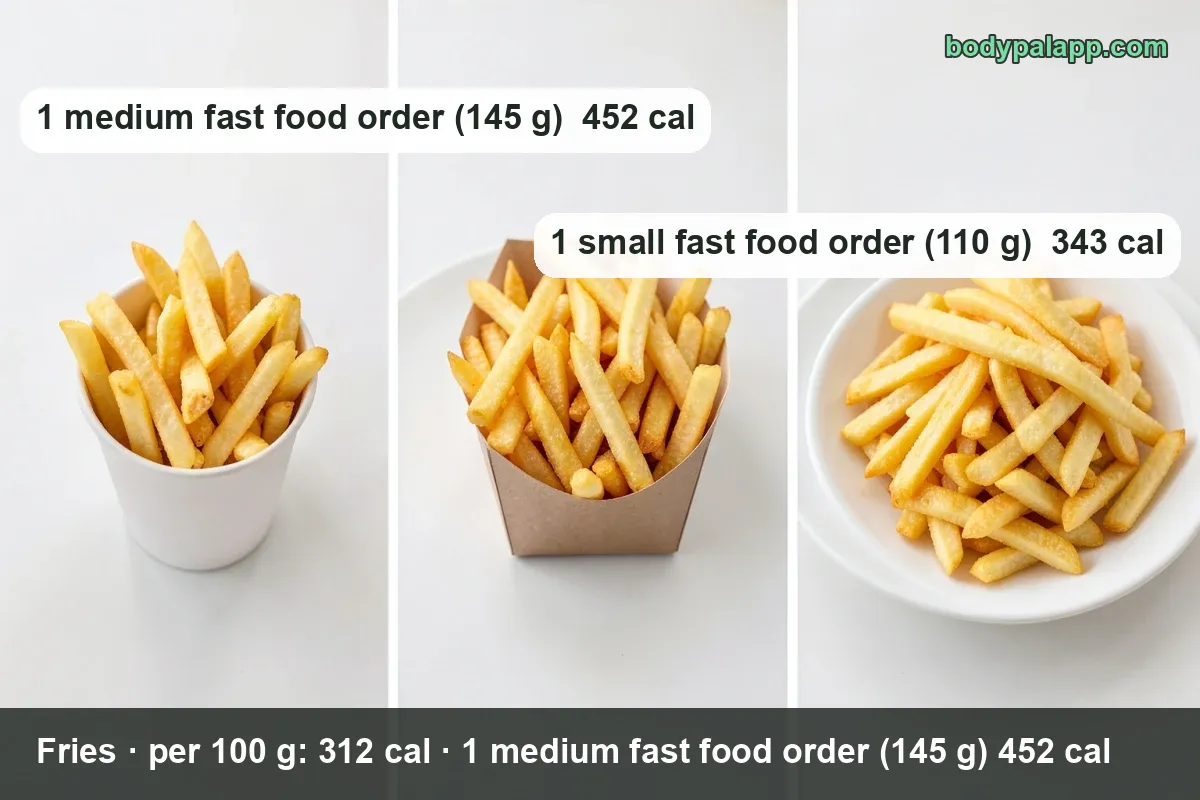
The single most useful thing to know about fries is that the sizes people say out loud and the sizes people actually eat rarely match. A cup sounds like a lot of fries. It is 60 g. A medium carton is 145 g, so it holds about two and a half cups' worth, and it costs 2.4 times as many calories.
| Serving | Weight | Calories |
|---|---|---|
| 1 oz | 28 g | 87 kcal |
| 1 cup | 60 g | 187 kcal |
| 1 kids meal order | 70 g | 218 kcal |
| 1 small fast food order | 110 g | 343 kcal |
| 1 medium fast food order | 145 g | 452 kcal |
| 1 large fast food order | 180 g | 562 kcal |
| Per 100 g | 100 g | 312 kcal |
The kids, small, medium and large orders and the 1-cup measure are USDA household portions for this record. The 1 oz line is our own arithmetic from the USDA 100 g figure, not a USDA serving — it is there because bagged and weighed fries get logged in ounces.
Going from small to medium adds 109 calories. Going from medium to large adds another 110. That is the whole upsize question in one sentence: each step up the menu is worth roughly a slice of bread and a pat of butter, and the fries taste identical either way.
Fast food, restaurant, homemade: six versions of the same potato
USDA keeps separate records for fries by where they were cooked, and the spread is wide. Counter fries at 312 calories per 100 g sit at the top. Homemade oven fries from fresh potatoes sit at 166, roughly half.
| Version | Per 100 g | Typical serving | Calories |
|---|---|---|---|
| Fast food fries | 312 kcal | 1 medium order (145 g) | 452 kcal |
| Kids meal fries | 312 kcal | 1 kids order (70 g) | 218 kcal |
| Restaurant fries | 289 kcal | 1 medium order (145 g) | 419 kcal |
| Fries, not further specified | 225 kcal | 1 cup (60 g) | 135 kcal |
| Homemade, deep-fried | 198 kcal | 1 cup (60 g) | 119 kcal |
| Homemade, oven-baked | 166 kcal | 1 cup (60 g) | 100 kcal |
The per-cup numbers for the last three rows are our own arithmetic from the USDA 100 g figures, scaled to the same 60 g cup, so the versions can be read side by side.
Two of these deserve a comment. Restaurant fries — sit-down places, not drive-thru windows — come in 23 calories per 100 g under the fast food record, but they are noticeably saltier, and that trade shows up in the next section. And the homemade pair is the cleanest before-and-after in the whole set: same potato, same kitchen, oven instead of fryer, and a cup drops from 119 to 100 calories because fat falls from 13.1 g to 9.16 g per 100 g.
Frozen retail bags are a fourth category again. Package labels for the most-logged US frozen potato fries run from 107 to 179 calories per 100 g, or 90 to 150 calories for a 3 oz serving — Ore-Ida Golden Steak Fries at the low end, Wild Harvest Organic Shoestring at the high end. Those figures describe the fries in the bag; whatever oil or spray you add on the sheet pan is yours to count.
Fat and sodium are the rows to watch
Calories are the headline, but the medium order's most striking line is fat: 21.4 g, or 27% of the FDA Daily Value of 78 g. Saturated fat is milder at 3.4 g, 17% of the 20 g DV, because the frying medium is vegetable oil. If you are watching saturated fat specifically, fries are not the problem on the tray; the burger next to them usually is.
Sodium is where fries reverse expectations. The fast food record carries 305 mg in a medium order, a modest 13% DV. But the restaurant record runs 357 mg per 100 g, which works out to 518 mg for the same 145 g — 23% DV, scaled by us from the USDA 100 g figure. Sit-down fries are lighter in calories and heavier in salt at the same time.
The rows nobody expects are fiber and potassium. A medium order has 5.5 g of fiber, 20% DV, and 840 mg of potassium, 18% DV. Potatoes are a vegetable, and the MyPlate vegetable group counts starchy ones. That does not make a fried side a health food, and the Dietary Guidelines put most starchy vegetables in a smaller weekly slot than the leafy ones. It does mean fries are not nutritionally empty, which is the story most calorie pages tell.
How do fries compare?
| Version | Per 100 g | US serving | Calories |
|---|---|---|---|
| Fast food fries | 312 kcal | 1 medium order (145 g) | 452 kcal |
| Restaurant fries | 289 kcal | 1 medium order (145 g) | 419 kcal |
| Homemade, deep-fried | 198 kcal | 1 cup (60 g) | 119 kcal |
| Homemade, oven-baked | 166 kcal | 1 cup (60 g) | 100 kcal |
Our take: if you are counting calories, the portion decides this, not the recipe. Ordering a small instead of a medium saves 109 calories on the spot, which is more than switching a whole cup of homemade fries from the fryer to the oven saves you (19). Cook them at home in the oven and you get the best rate per gram in the table — 166 calories per 100 g against 312 — but only if the portion stays honest, because three cups of oven fries land at 300 calories, two-thirds of a medium fast food order. For satiety per calorie, the homemade oven version wins easily. For a night out, order the small and stop negotiating with yourself about the large.
Most popular fries brands in the United States
Ranked by how widely each product appears among foods sold in the United States, from the BodyPal food database of over 3.3 million products. Calories are the figures printed on each Nutrition Facts label, checked against USDA FoodData Central.
| Product | Calories (per 100 g) |
|---|---|
| Wild Harvest Crinkle Cut Fries | 155 cal |
| McCain Crinkle Cut Fries | 129 cal |
| McCain Extra Crispy Crinkle Cut Fries | 141 cal |
| Ore-Ida Golden Steak Fries | 107 cal |
| Wild Harvest Organic Shoestring French Fries | 179 cal |
Brand popularity: BodyPal food database. Nutrition: manufacturer labels / USDA FoodData Central.
Fries FAQs
How many calories are in a medium order of fries?
452 calories for a medium fast food order of 145 g, at 312 calories per 100 g. That is the carton most counter orders hand you, and it brings 21.4 g of fat and 305 mg of sodium along with the calories. The USDA record behind it is FNDDS 2709461, fast food french fries.
How many calories are in a large order of fries?
562 calories for a large fast food order of 180 g. That is 110 calories more than a medium and 219 more than a small, from the same USDA record at 312 calories per 100 g. The fries themselves are identical; only the weight in the carton changes, which is what makes upsizing so easy to underestimate.
How many calories are in a small order of fries?
343 calories for a small fast food order of 110 g. A kids meal order is smaller again at 70 g and 218 calories. If you want fries without spending most of a lunch on them, the small is the honest choice: it saves 109 calories against the medium and 219 against the large.
How many calories are in 1 cup of fries?
187 calories in 1 cup, because a cup of fries weighs only 60 g. That is the trap in this food: a cup sounds generous but holds far less than the carton, and a medium order at 145 g is 2.4 times as many calories. If you log fries by the cup, weigh one carton once.
How many calories are in one french fry?
A single fry has no USDA weight, so the honest unit is 1 oz (28 g) at 87 calories, our own arithmetic from the USDA 100 g figure. USDA does not publish a per-piece figure, so any per-fry number would be invented rather than measured. For scale, 100 g is 312 calories and a medium order is 452.
Are baked fries lower in calories than fried?
Yes, by about a sixth: homemade fries from fresh potatoes are 198 calories per 100 g deep-fried and 166 oven-baked. A 60 g cup falls from 119 to 100 calories. The difference is fat: 13.1 g per 100 g fried against 9.16 g baked. Both still sit well under the 312 of fast food fries.
How much sodium is in a serving of fries?
305 mg in a medium fast food order of 145 g, which is 13% of the FDA Daily Value of 2,300 mg. Restaurant fries are saltier: 357 mg per 100 g works out to 518 mg for the same 145 g, or 23% DV. If sodium is what you are watching, the counter version is the lighter one.
Do fries have any fiber or potassium?
Yes — 5.5 g of fiber and 840 mg of potassium in a medium 145 g order, which is 20% and 18% of the Daily Value. Potatoes keep both through frying, so fries are not the nutritional blank they are often described as. They also carry 0 mg of cholesterol, since the frying medium is vegetable oil.
Similar foods
- Bacon Cheeseburger — 564 cal per burger
- Beef Hot Dog — 177 cal per hot dog
- Pig In A Blanket — 264 cal per pig in a blanket
- Croissant Sandwich — 417 cal per sandwich
- Bacon Egg And Cheese Biscuit — 432 cal per biscuit
- Chicken Chimichanga — 578 cal per chimichanga
Count it without the math
Point the camera at the carton and BodyPal counts the fries for you, small, medium or large.


How long does it take to burn off fries?
One medium fast food order (145 g) is 452 kcal. Enter your weight and the amount you ate to see how long it takes you to burn that off:
lb
| Activity | Time to burn 452 kcal |
|---|---|
| Walking, brisk | 1 hr 30 min |
| Cycling, moderate | 56 min |
| Swimming, moderate | 1 hr 5 min |
| Jogging | 53 min |
| Weight training, moderate | 1 hr 40 min |
Times are for a 155 lb adult at a steady pace; change the weight to see yours. The amount is set to the portion in the text (145 g); change it to what you actually ate. BodyPal works this out from your steps automatically.
Burning it off is one side of it. The other is knowing your number: work out how many calories you need a day, with macros and a goal date.