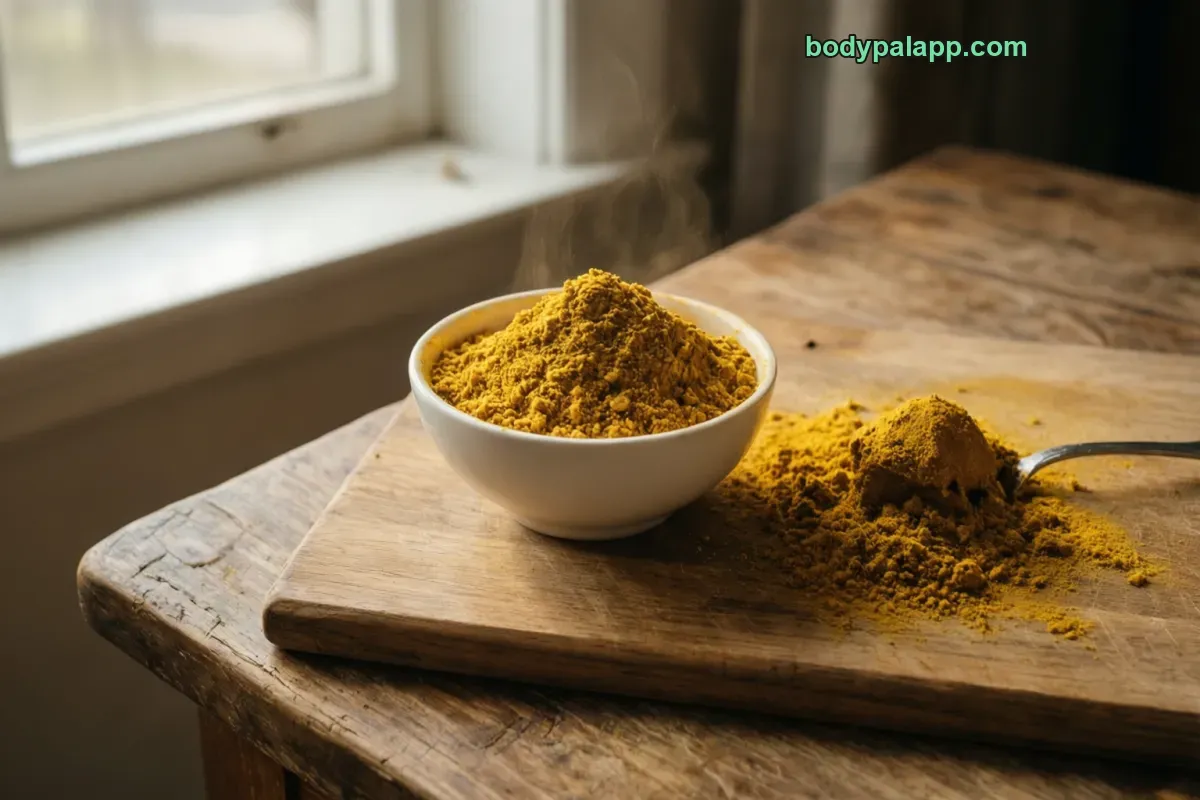
Curry powder calories come to 7 for 1 tsp (2 g) and 325 per 100 g. The number to notice is fiber. Per 100 g the blend carries 53.2 g of it, so in a single teaspoon the carbs and the fiber both read 1.1 g. At normal cooking doses, the calories barely register.
7kcal
1 teaspoon · 2 g, ground spice blend
14%protein
0.3 gProtein
1 gCarbs
0.3 gFat
How to burn off 7 kcal
—Walking, brisk
—Jogging
—Cycling, moderate
—Swimming
Skip the math. BodyPal counts these calories from your steps and workouts automatically.
Nutrition facts
Ground spice blend · per 2 g
Calories
7 kcal
Protein
0.3 g
Carbohydrate
1.1 g
Fat
0.3 g
Saturated fat
0 g
Cholesterol
0 mg
Sodium
1 mg
Potassium
23 mg
Iron
0.4 mg
Source: USDA FoodData Central
🛡️
Verified nutrition data
Numbers on this page come from USDA FoodData Central, the U.S. Department of Agriculture’s food composition database, and from manufacturer labels where a branded product is named. Last verified September 2026. How we verify our data →
Curry powder: calories, protein and sodium by serving
Percent of daily value uses the FDA reference of 2,000 kcal a day.
Serving
kcal
Protein
Carbs
Fat
Sodium
% DV kcal
1 tsp (2 g)
7
0.3 g
1.1 g
0.3 g
1 mg
0%
1 tbsp (6.3 g)
20
0.9 g
3.5 g
0.9 g
3 mg
1%
100 g
325
14.3 g
55.8 g
14 g
52 mg
16%
3 × 1 tsp (2 g)
20
0.9 g
3 mg
5 × 1 tsp (2 g)
33
1.4 g
5 mg
A tablespoon of curry powder is 20 calories
Most recipes measure curry powder by the teaspoon, and at that scale the calories hardly move. One teaspoon (2 g) is 7 calories, 2 teaspoons are 13, and 3 teaspoons come to 20, the same as a level tablespoon of 6.3 g. Even a heavy hand of 5 teaspoons, about 10 g, adds only 33 calories to the pot.
Measured against the daily value, a teaspoon rounds to 0% of calories and a tablespoon to 1%. Split across a pot that feeds several people, each plate gets a fraction of that. If you track food closely, log the spice when you use it by the tablespoon or more. Below that it disappears into rounding.
The per-100 g figure, 325 calories, looks high next to a teaspoon's 7. That number is useful for comparing jars, not for planning dinner. Nobody eats 100 g of a spice blend in one sitting, and the dose you actually use is the one that counts.
Most of the carbs in curry powder are fiber
By calories, curry powder splits 55% carbs, 31% fat and 14% protein. Per 100 g that works out to 55.8 g carbs, 14 g fat and 14.3 g protein. The interesting part sits inside the carb line.
Fiber accounts for 53.2 g of those 55.8 g, and sugars for only 2.8 g. In a single teaspoon, carbs and fiber both read 1.1 g, with 0.1 g sugar. A tablespoon brings 3.5 g carbs alongside 3.4 g fiber. So the carb count on paper overstates how much of it behaves like starch or sugar.
The fat, 14 g per 100 g, includes only 1.6 g saturated, and cholesterol is 0. Protein reaches 29% of the daily value per 100 g, but a teaspoon delivers just 0.3 g, or 1%. Treat curry powder as flavor with a small fiber bonus, not as a source of protein or fat.
Plain curry powder is nearly sodium-free
The USDA row behind these numbers, Spices, curry powder, lists 52 mg sodium per 100 g, which is 2% of the daily value. A teaspoon has 1 mg and a tablespoon 3 mg, both 0% of the daily value. Even 5 teaspoons only reach 5 mg.
That makes the blend one of the easier ways to add flavor if you watch sodium. In a finished curry, the salt usually comes from everything else: stock, added salt, soy sauce, canned tomatoes. Store blends are not all the same, so read the label on jars such as Badia Madras Style Curry Powder or Rani Curry Powder if you want to know whether salt is in the mix.
Potassium shows up in a bigger way, at 1,170 mg per 100 g. At teaspoon doses that is still a small amount. The takeaway holds: curry powder adds a lot of taste while leaving the sodium row almost untouched.
A curry's calories come from everything else
At 7 calories a teaspoon, curry powder is rarely the reason a curry runs high. The total is set by the oil or ghee used to bloom the spices, the coconut milk or cream, the protein, and the rice or bread on the side. If a dish feels heavy, look there first.
That makes curry powder useful for lighter cooking. It seasons lentils, roasted vegetables, eggs, chicken and yogurt dressings without adding much, so a simple dish tastes finished without extra fat. Blooming the spice in a little oil still works. Measure the oil, not the spice.
If you log meals, weigh the main ingredients and add curry powder only at tablespoon scale. BodyPal can log a curry from a photo, and the spice line will barely shift the total.
How does curry powder compare?
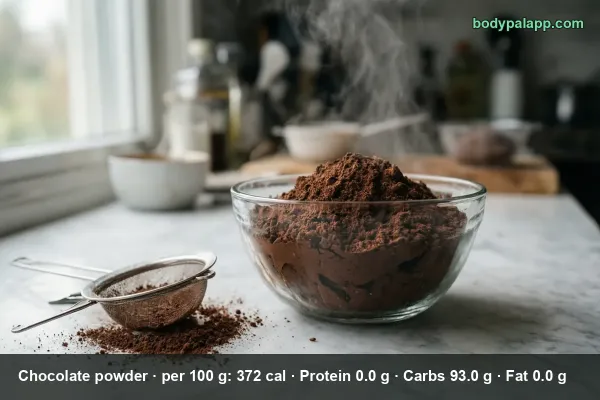
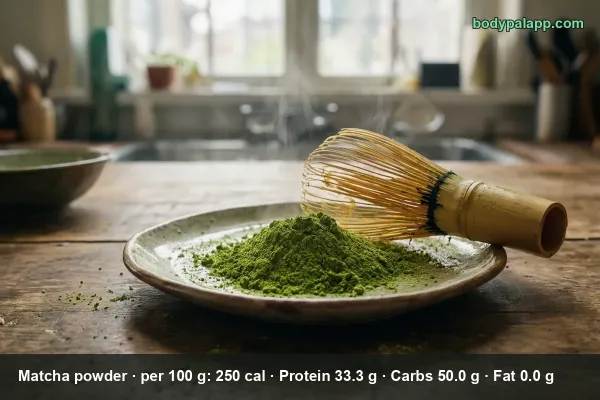
Here is curry powder next to onion powder, chocolate powder and matcha powder, per 100 g and per usual serving.
Verdict: For everyday seasoning, curry powder and onion powder are a wash at 7 and 8 calories per teaspoon, though curry powder brings more protein (14.3 g vs 10.4 g per 100 g) and less sodium (52 mg vs 73 mg). Chocolate powder is the one to measure, with 372 calories and 636 mg sodium per 100 g.
Most popular curry powder brands in the United States
Ranked by popularity in the BodyPal database
# Productkcal / 100 g
1Badia Madras Style Curry Powder1/4 tsp · 0.8 g625 kcal
2Rani Curry Powder1 Tbsp · 6 g333 kcal
Brand curry powders vary widely by blend and added oils, from about 333 to 625 calories per 100 g, above the 325 for the plain spice blend used above. Source: manufacturer labels / USDA FoodData Central.
Curry powder FAQs
How many calories are in a teaspoon of curry powder?
About 7 calories for a level teaspoon (2 g). A tablespoon (6.3 g) is about 20 calories.
Is curry powder good for weight loss?
A teaspoon of curry powder is only about 7 calories, with 0.3 g of fat and 0.3 g of protein, so the amount used to season a dish adds very little to a day's calorie total.
Curry powder vs onion powder: which has fewer calories?
Curry powder has 325 calories per 100 g and onion powder has 341, so curry powder is about 16 calories per 100 g lower.
How many carbs are in curry powder?
One teaspoon of curry powder (2 g) has about 1.1 g of carbs, most of it fiber. Per 100 g that is 55.8 g of carbs, including 53.2 g of fiber.
How much fiber is in curry powder?
A teaspoon of curry powder has 1.1 g fiber, and a tablespoon has 3.4 g. Per 100 g it reaches 53.2 g, which is almost all of the 55.8 g of carbs.
Does curry powder have sodium?
Very little: 1 mg per teaspoon and 3 mg per tablespoon, both 0% of the daily value. Per 100 g it is 52 mg, or 2%. Blends with added salt will read higher on their labels.
How much fat is in curry powder?
A teaspoon of curry powder has 0.3 g fat and a tablespoon has 0.9 g. Per 100 g it is 14 g, of which 1.6 g is saturated, and cholesterol is 0.
Is curry powder a source of protein?
Not at normal doses. A teaspoon gives 0.3 g protein and a tablespoon 0.9 g. Per 100 g it has 14.3 g, which is 29% of the daily value, but nobody eats that much.
Does curry powder contain sugar?
Barely. A teaspoon has 0.1 g sugars and a tablespoon 0.2 g. Per 100 g the total is 2.8 g, small next to the 53.2 g of fiber.