
How many calories are in chocolate powder?
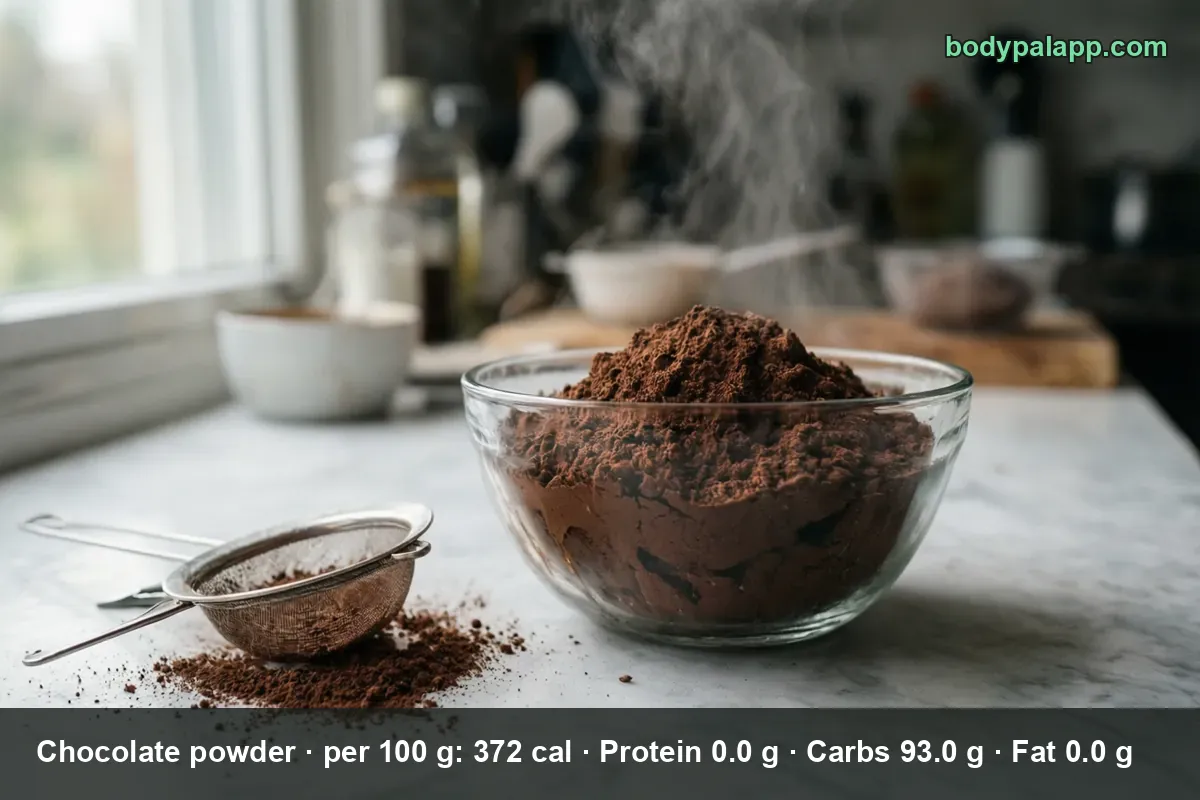
Two level tablespoons of chocolate drink powder — the scoop that goes into a glass of milk — weigh 11 g and carry 41 calories. Straight from the tub the powder runs 372 calories per 100 g, because it is mostly sugar with cocoa stirred through it: 92.96 g of carbohydrate per 100 g, no fat and no protein at all.
On this page
- Chocolate powder quick facts
- US servings, from one tablespoon to a full ounce
- No sugar added, malted, and already mixed with milk
- Sugar and sodium are the rows to watch
- How does chocolate powder compare?
- Most popular chocolate powder brands
- Chocolate powder FAQs
Chocolate powder quick facts
The record used here is USDA SR Legacy 173182, "Beverages, rich chocolate, powder". That is the dry mix sold in a tub or a canister, meant to be spooned into milk or water — the thing in your hand when you go looking for this number, not a ready-made chocolate milk and not a baking cocoa. Its USDA household measure is 2 tablespoons, 11 g, which is why that scoop is the anchor for every figure below.
The nutrient profile is unusually simple. No fat, no fiber, no protein, and almost the entire weight is carbohydrate. Branded chocolate powders confirm the shape of it: they land between 300 and 400 calories per 100 g, so the generic record is not an outlier.
| Nutrient | Per 100 g | Per 2 tbsp (11 g) | % Daily Value |
|---|---|---|---|
| Calories | 372 | 41 | — |
| Total fat | 0 g | 0 g | 0% |
| Saturated fat | 0 g | 0 g | 0% |
| Carbohydrate | 92.96 g | 10.2 g | 4% |
| Dietary fiber | 0 g | 0 g | 0% |
| Total sugars | 81.82 g | 9.0 g | — |
| Protein | 0 g | 0 g | 0% |
| Sodium | 636 mg | 70 mg | 3% |
% Daily Value is based on a 2,000-calorie diet.
Verified nutrition data
Numbers on this page come from USDA FoodData Central, the U.S. Department of Agriculture’s food composition database, and from manufacturer labels where a branded product is named. Last verified September 2026. How we verify our data →
There is no added-sugars row on this page, and that is deliberate: the SR Legacy edition of this food does not publish an added-sugars figure, so any percentage against the 50 g Daily Value would be invented. Cholesterol and potassium are listed as zero in the same record, which in SR Legacy usually means "not measured" rather than "none present", so they are left out too. Daily Values throughout come from the FDA's Daily Value reference.
US servings, from one tablespoon to a full ounce
| Serving | Weight | Calories |
|---|---|---|
| 1 tbsp | 5.5 g | 20 kcal |
| 2 tbsp, the standard scoop | 11 g | 41 kcal |
| 4 tbsp, a heavy pour | 22 g | 82 kcal |
| 1 oz | 28.35 g | 105 kcal |
| Per 100 g | 100 g | 372 kcal |
Only the 2 tablespoon line is a USDA household measure. The single tablespoon, the four-tablespoon pour and the ounce are our own arithmetic from the USDA 100 g figure, not USDA servings, scaled straight off 372 calories per 100 g.
The tablespoon is where people get tripped up. A level tablespoon of this powder is about 5.5 g, but nobody levels a scoop of chocolate mix — a heaped one is closer to double that, and two heaped tablespoons behave like the four-tablespoon row, 82 calories rather than 41. Brand labels make the gap official: Nesquik's chocolate powder calls 2 tablespoons 15 g and 60 calories, four grams more per scoop than the generic USDA measure. If you log by tablespoon and never weigh, you are probably under-counting by a third to a half.
An ounce of dry powder is 105 calories, which is a useful reference point for anyone measuring a canister by weight rather than by spoon. Nobody drinks an ounce of it in one glass, though — that would be nearly three standard scoops.
No sugar added, malted, and already mixed with milk
| Version | Per 100 g | Typical serving | Calories |
|---|---|---|---|
| Rich chocolate powder (the main record) | 372 kcal | 2 tbsp (11 g) | 41 kcal |
| No sugar added chocolate powder | 350 kcal | 2 tbsp (11 g) | 39 kcal |
| Malted chocolate drink powder | 411 kcal | 3 heaping tsp (21 g) | 86 kcal |
| Malted chocolate powder prepared with whole milk | 85 kcal | 1 cup / 8 fl oz (265 g) | 225 kcal |
| Ovaltine chocolate malt powder | 372 kcal | 2 tbsp (11 g, our arithmetic) | 41 kcal |
| Cocoa mix, no sugar added | 377 kcal | 2 tbsp (11 g, our arithmetic) | 41 kcal |
| Carob-flavor beverage mix | 372 kcal | 1 tbsp (5.5 g, our arithmetic) | 20 kcal |
The "no sugar added" version is the one that surprises people. It saves 22 calories per 100 g — 350 against 372 — which comes out at a grand total of 2 calories on a 2 tablespoon scoop. What actually changes is the composition: sugars drop from 81.82 g to 27.27 g per 100 g, while protein climbs to 9.09 g, fat to 4.5 g and fiber to 9.1 g. It is a better glass of chocolate milk on almost every axis except the calorie count, which barely moves.
Malted powder runs the other way. At 411 calories per 100 g it is the densest dry mix on this page, and its USDA serving is bigger too — 3 heaping teaspoons, 21 g, for 86 calories. That is double the standard chocolate scoop before a drop of milk goes in.
The prepared row is the one to read carefully. The 85 calories per 100 g belongs to the finished drink, not the powder, and a full 8 fl oz cup of malted chocolate made with whole milk is 225 calories. The powder contributes well under half of that; the rest is the milk. Any time you see a chocolate-drink number under 100 calories per 100 g, you are looking at a beverage, not a mix.
Branded packets follow the same logic in a different package. Carnation Breakfast Essentials rich milk chocolate mix is 361 calories per 100 g, but the packet is 36 g, so one sachet is 130 calories — three times a plain scoop, because a breakfast mix is built to carry protein and vitamins, not just flavor. The Light Start version cuts the packet to 20 g and 60 calories.
Sugar and sodium are the rows to watch
Roughly four fifths of this powder is sugar by weight: 81.82 g per 100 g, or 9.0 g in a 2 tablespoon scoop. Because SR Legacy does not break out added sugars for this food, there is no honest %DV to place against the FDA's 50 g added-sugars value — but the raw split is informative on its own. Of the 10.2 g of carbohydrate in a scoop, 9.0 g is sugar. There is essentially nothing else in there.
The carbohydrate row reads as a mild 4% of the Daily Value, which is exactly why the sugar line matters more than the percentage. A single scoop is small. Two scoops in a tall glass is 18 g of sugars from the powder alone before the milk's own lactose is counted, and the Dietary Guidelines for Americans put added sugars at under 10% of daily calories.
Sodium is the genuinely unexpected row. This powder carries 636 mg per 100 g — about a quarter teaspoon of table salt in a full 100 g — which delivers 70 mg, or 3% of the Daily Value, in one 2 tablespoon scoop. That is more sodium per gram than most sweet groceries, and a four-tablespoon pour puts it at 140 mg. The salt is there to sharpen the cocoa flavor; it just does not announce itself when the product tastes like candy.
The last thing worth saying is what is not in the powder. Zero protein, zero fat, zero fiber. Every gram of protein in a glass of chocolate milk comes from the milk, so switching to water turns the drink into sugar with cocoa in it and nothing else. That is the strongest argument for the no-sugar-added mix or a breakfast-essentials packet if the drink is meant to be doing any nutritional work.
How does chocolate powder compare?
| Dry mix | Per 100 g | US serving | Calories |
|---|---|---|---|
| Rich chocolate powder | 372 kcal | 2 tbsp, 11 g | 41 kcal |
| No sugar added chocolate powder | 350 kcal | 2 tbsp, 11 g | 39 kcal |
| Malted chocolate drink mix | 411 kcal | 3 heaping tsp, 21 g | 86 kcal |
| Cocoa mix, no sugar added | 377 kcal | 2 tbsp, 11 g (our arithmetic) | 41 kcal |
Our take: of these four, only the no-sugar-added chocolate powder is lighter per 100 g than the plain rich powder, and the margin is 22 calories — nothing you would feel. Malted mix is the densest of the group at 411 per 100 g and it also gets the biggest official serving, so it is the one that quietly doubles a drink. For counting purposes the powder is close to irrelevant at 41 calories a scoop; the milk under it decides the total. For a drink you have every day, take the no-sugar-added mix — same calories, a third of the sugar, and it brings protein and fiber that the standard powder does not have at all.
Most popular chocolate powder brands in the United States
Ranked by how widely each product appears among foods sold in the United States, from the BodyPal food database of over 3.3 million products. Calories are the figures printed on each Nutrition Facts label, checked against USDA FoodData Central.
| Product | Calories (per 100 g) |
|---|---|
| Nesquik Chocolate Powder | 400 cal |
| Navitas Organics Cacao Chocolate Powder | 400 cal |
| Nestle Carnation Breakfast Essentials Rich Milk Chocolate Powder Drink Mix | 361 cal |
| Choco Listo Instant Chocolate Drink Mix | 400 cal |
| Baru Fluffy Marshmallow Chocolate Powder | 367 cal |
| Carnation Breakfast Essentials Light Start Rich Milk Chocolate | 300 cal |
Brand popularity: BodyPal food database. Nutrition: manufacturer labels / USDA FoodData Central.
Chocolate powder FAQs
How many calories are in 2 tbsp of chocolate powder?
41 calories for 2 level tablespoons, or 11 g, of USDA's rich chocolate drink powder. That is the standard scoop most people stir into a glass of milk. Double it to a heavy four-tablespoon pour and you are at 82 calories, 20.5 g of carbohydrate and 140 mg of sodium.
How many calories in chocolate powder with milk?
About 225 calories for an 8 fl oz cup, 265 g, of malted chocolate powder already prepared with whole milk, which USDA lists at 85 calories per 100 g. Most of that comes from the milk, not the mix: the 11 g scoop of powder itself is only 41 calories.
Is chocolate powder the same as cocoa powder?
No: the chocolate drink powder on this page is 81.82 g of sugars per 100 g and 372 calories, built to dissolve in cold milk. Plain unsweetened cocoa is a separate USDA food with its own record and far less sugar. The closest mix here, cocoa mix with no sugar added, runs 377 calories per 100 g.
How much sugar is in chocolate drink powder?
9.0 g of total sugars in a 2 tablespoon scoop, from 81.82 g per 100 g — roughly four fifths of the powder by weight. USDA's SR Legacy record does not split out added sugars for this food, so there is no % Daily Value to quote against the FDA's 50 g added-sugars value.
Is no sugar added chocolate powder lower in calories?
Barely: 350 calories per 100 g against 372, so a 2 tablespoon scoop is 39 instead of 41. The sugars fall hard, from 81.82 g to 27.27 g per 100 g, but protein climbs to 9.09 g, fat to 4.5 g and fiber to 9.1 g. The energy moves rather than disappears.
How many calories in Nesquik chocolate powder?
60 calories on the label for its 2 tablespoon serving, which the brand weighs at 15 g — heavier than the 11 g USDA uses for generic powder. Per 100 g the branded figure is 400 calories against 372 for the USDA record, so compare these mixes per gram, never per tablespoon.
Does chocolate powder have protein?
None: USDA lists 0 g of protein per 100 g for rich chocolate powder, so the scoop adds nothing — the protein in a glass of chocolate milk comes entirely from the milk. Two related mixes do carry some: the no-sugar-added powder at 9.09 g per 100 g and the cocoa mix at 15.49 g.
How much sodium is in chocolate powder?
70 mg in a 2 tablespoon scoop, 3% of the Daily Value, from 636 mg per 100 g — about a quarter teaspoon of table salt in a full 100 g of powder. That is more sodium per gram than most sweet groceries carry, and four tablespoons push the scoop total to 140 mg.
Similar foods
- Pop Tart — 193 cal per tart
- Fruit By The Foot — 78 cal per roll
- Carrot Cake — 748 cal per slice
- Cheese Danish — 266 cal per danish
- Twinkie — 157 cal per cake
- Blow Pop — 60 cal per pop
Count it without the math
Point the camera at the glass and BodyPal counts the powder and the milk together.


How long does it take to burn off chocolate powder?
Two tablespoons (11 g) is 41 kcal. Enter your weight and the amount you ate to see how long it takes you to burn that off:
lb
| Activity | Time to burn 41 kcal |
|---|---|
| Walking, brisk | 8 min |
| Cycling, moderate | 5 min |
| Swimming, moderate | 6 min |
| Jogging | 5 min |
| Weight training, moderate | 9 min |
Times are for a 155 lb adult at a steady pace; change the weight to see yours. The amount is set to the portion in the text (11 g); change it to what you actually ate. BodyPal works this out from your steps automatically.
Want the bigger picture? Calculate your daily calorie needs — your maintenance figure, a target for losing or gaining, and the date you get there.