
How many calories are in Fruit by the Foot?
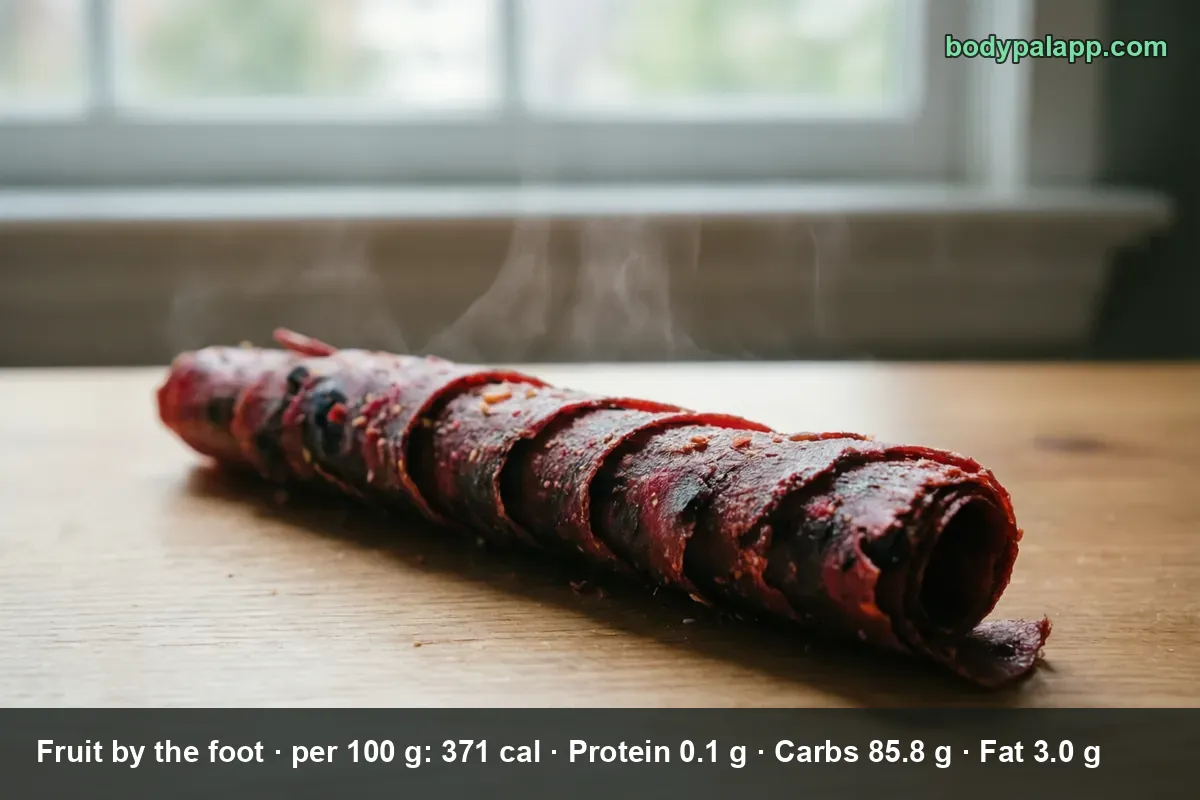
One large roll of fruit leather weighs 21 g and carries 78 calories. Per 100 g the same sheet runs 371 calories, because 85.8 g of every 100 g is carbohydrate. The roll stays a small number only because it is a small amount of food. Two rolls come to 156.
On this page
- Fruit by the Foot quick facts
- US servings, from one roll to a full ounce
- Rolls, pieces and pouches
- The sodium row nobody checks
- How does fruit leather compare?
- Most popular fruit by the foot brands
- FAQ
Fruit by the Foot quick facts
There is no USDA record filed under the brand name. What there is, and what matches the product exactly, is SR Legacy 167541, "Snacks, fruit leather, rolls" — a fruit sheet rolled into a strip rather than cut into shapes. Its household measure, "1 roll, large," weighs 21 g, which is the same weight as the 0.75 oz packs sold in American grocery aisles. That is the row this page is built on, and it is the one that describes what is actually unrolled at a kitchen table.
The distinction matters more than it sounds. USDA keeps a separate record for fruit leather pieces, and the two profiles are not interchangeable: different sugar, very different sodium, different package weight. Mixing them is the easiest way to log this snack wrong.
| Nutrient | Per 100 g | Per 1 roll, large (21 g) | % Daily Value |
|---|---|---|---|
| Calories | 371 | 78 | — |
| Total fat | 3 g | 0.6 g | 1% |
| Saturated fat | 0.67 g | 0.1 g | 1% |
| Carbohydrate | 85.8 g | 18.0 g | 7% |
| Dietary fiber | 0 g | 0.0 g | 0% |
| Total sugars | 49.16 g | 10.3 g | — |
| Protein | 0.1 g | 0.0 g | 0% |
| Sodium | 317 mg | 67 mg | 3% |
% Daily Value is based on a 2,000-calorie diet.
Verified nutrition data
Numbers on this page come from USDA FoodData Central, the U.S. Department of Agriculture’s food composition database, and from manufacturer labels where a branded product is named. Last verified September 2026. How we verify our data →
Two rows you would expect on a package label are missing here on purpose: added sugars and trans fat. USDA does not publish either value for this SR Legacy record, so rather than guess at a split between fruit sugar and syrup, the page leaves them out. Cholesterol is 0 mg per 100 g and stays 0 mg in a roll. Potassium runs 294 mg per 100 g, which is 62 mg in one roll — about 1% of the Daily Value, and the closest thing to a redeeming micronutrient in the record. The FDA's Daily Value reference is what those percentages are measured against.
US servings, from one roll to a full ounce
| Serving | Weight | Calories |
|---|---|---|
| 1 roll, small | 14 g | 52 kcal |
| 1 roll, large | 21 g | 78 kcal |
| 2 rolls | 42 g | 156 kcal |
| 1 oz | 28.35 g | 105 kcal |
| Per 100 g | 100 g | 371 kcal |
The small and large rolls are USDA's own household measures, so those two lines are as close to an official serving as this food gets. The two-roll line and the ounce line are our own arithmetic from the USDA 100 g figure, not USDA servings — but they are the two that actually get used. Kids' lunchboxes rarely stop at one strip, and an ounce is what a scale reads if you weigh a couple of unwrapped rolls together.
Notice what the ounce does. At 105 calories, one ounce of fruit leather costs more than a full roll and a third, which is the trap of any dehydrated food: the water is gone, so a very light-looking amount is dense. Weighing this snack is more reliable than counting it, because roll thickness varies between products while grams do not.
Rolls, pieces and pouches
Four USDA records cover this shelf, and they split along shape and fortification rather than fruit type. Every number below comes from the record named in its row.
| Version | Per 100 g | Typical serving | Calories |
|---|---|---|---|
| Fruit leather rolls, the classic strip | 371 kcal | 1 roll, large (21 g) | 78 kcal |
| Two rolls in one pack | 371 kcal | 2 rolls (42 g) | 156 kcal |
| Fruit leather pieces | 359 kcal | 1 package (27 g) | 97 kcal |
| Fruit leather pieces with vitamin C | 373 kcal | 1 serving (21 g) | 78 kcal |
| Fruit leather pouch, FNDDS entry | 371 kcal | 1 pouch, regular (15 g) | 56 kcal |
The classic strip is the baseline: 78 calories, 18.0 g of carbohydrate, 10.3 g of it sugar. Two rolls is the realistic unit for anyone over the age of ten — 156 calories and 20.6 g of sugar, which is where this snack stops being a rounding error in a day's log.
Fruit leather pieces are the interesting one. Per 100 g they are the lightest of the four at 359 calories, yet a package comes out heaviest at 97 calories, because the package holds 27 g instead of 21 g. Per gram they are gentler; per pack they are not. They also carry the most sugar of the group at 57.58 g per 100 g, and the least sodium at 199 mg.
Pieces with vitamin C are the only record in the set with fiber in them: 3.5 g per 100 g, or about 0.7 g in a 21 g serving, roughly 3% of the Daily Value. USDA does not publish a total sugars figure for this fortified record, so that row simply does not exist for it. Calories land at 373 per 100 g, statistically the same as the plain rolls.
The pouch entry is the smallest calorie hit at 56, but only because a regular pouch weighs 15 g. Same density, less product.
Store brands land close to all of this. Stretch Island's raspberry, strawberry and cherry leathers run 357 calories per 100 g, or 50 calories for a 14 g strip, while the apple and grape versions come in at 321 per 100 g and 45 per strip. A handmade key lime leather from You Love Fruit matches that lower band at 321 per 100 g. The spread between the lightest branded strip and the heaviest generic sheet is about 50 calories per 100 g — real, but small next to how many strips get eaten.
The sodium row nobody checks
The number that surprises people in this record is not the sugar. It is the salt. One roll carries 67 mg of sodium, 3% of the Daily Value, and 100 g of the sheet carries 317 mg — 14% of a day's allowance, in a food that tastes entirely of fruit punch. The pieces record shows how much of that is a formulation choice rather than something inherent: 199 mg per 100 g, about 37% less, for a product made from the same idea.
Set that against the rest of the profile. Fiber is 0 g. Protein is 0.1 g per 100 g, which rounds to 0.0 g in a roll. There is nothing in the strip that slows absorption or does anything for fullness — 18.0 g of carbohydrate arrives with no brake on it. That is the honest read of this record: it is candy in a fruit-shaped wrapper, and USDA files it under Snacks accordingly.
None of that makes a roll a problem. At 78 calories it is one of the cheapest sweet things a lunchbox can hold, and MyPlate's fruit group — fresh, frozen, canned, dried fruit — is a separate line item that this snack does not fill. If you are watching sodium, the cut pieces are the better pick of the two. If you are watching calories, the roll wins on portion control alone, because it comes pre-measured at 21 g.
How does fruit leather compare?
| Product | Per 100 g | US serving | Calories |
|---|---|---|---|
| Fruit leather rolls | 371 kcal | one large roll, 21 g | 78 kcal |
| Fruit leather pieces | 359 kcal | one package, 27 g | 97 kcal |
| Pieces with vitamin C | 373 kcal | one serving, 21 g | 78 kcal |
| Candy, fruit leather pouch | 371 kcal | one regular pouch, 15 g | 56 kcal |
Our take: all four records sit within 14 calories of each other per 100 g, so the shape on the wrapper barely moves the density — the package weight is doing all the work. The pieces are the lowest per 100 g at 359 and still the highest per pack at 97, which is the single most useful thing on this page. If you want the smallest number, take the roll at 78 or the pouch at 56 and stop there. If sodium is the thing you track, the pieces at 199 mg per 100 g beat the rolls at 317 mg by a wide margin, a bigger gap than anything in the calorie rows.
Most popular fruit by the foot brands in the United States
Ranked by how widely each product appears among foods sold in the United States, from the BodyPal food database of over 3.3 million products. Calories are the figures printed on each Nutrition Facts label, checked against USDA FoodData Central.
| Product | Calories (per 100 g) |
|---|---|
| Stretch Island Raspberry Fruit Leather | 357 cal |
| Stretch Island Strawberry Original Fruit Leather | 357 cal |
| Stretch Island Cherry Original Fruit Leather | 357 cal |
| Stretch Island Apple Original Fruit Leather | 321 cal |
| Stretch Island Grape Original Fruit Leather | 321 cal |
| You Love Fruit Handmade Fruit Leather Key Lime | 321 cal |
Brand popularity: BodyPal food database. Nutrition: manufacturer labels / USDA FoodData Central.
Fruit by the Foot FAQs
How many calories are in one Fruit by the Foot roll?
78 calories for one large roll of 21 g, based on the USDA record for fruit leather rolls at 371 calories per 100 g. A smaller 14 g roll comes to 52. Two rolls, which is how a lot of packs get eaten, add up to 156 calories.
How much sugar is in a fruit leather roll?
10.3 g of total sugars in one 21 g roll, and 49.16 g per 100 g, just under half the sheet by weight. USDA does not publish added sugars for this record, so there is no split between fruit sugar and what the factory pours in.
Is Fruit by the Foot a serving of fruit?
By the numbers, it behaves nothing like fruit: 0 g of fiber per 100 g and 0.1 g of protein, against 85.8 g of carbohydrate. USDA files the record under Snacks, not fruit. MyPlate's fruit group is built around fresh, frozen, canned and dried fruit instead.
Fruit by the Foot vs Fruit Roll-Up: which has fewer calories?
USDA has no branded record for either name, so the honest comparison is generic: rolls run 371 calories per 100 g and cut pieces 359. Per package the pieces are higher at 97 calories for 27 g, against 78 for a 21 g roll. Package weight decides it.
How many calories are in 100 g of fruit leather?
371 calories per 100 g for the rolled sheets, which is roughly five rolls at 21 g each. Cut pieces sit slightly lower at 359 and the vitamin C version slightly higher at 373. Nobody eats 100 g in one sitting; it is the yardstick, not a serving.
Does fruit leather have any fiber?
Zero — the USDA record for fruit leather rolls lists 0 g of fiber per 100 g, so a roll delivers 0.0 g. The one exception is the fortified pieces with vitamin C, which carry 3.5 g per 100 g, about 0.7 g in a 21 g serving, or 3% of the Daily Value.
How much sodium is in a fruit snack roll?
67 mg in one 21 g roll, 3% of the Daily Value, and 317 mg per 100 g, which is 14%. That is more salt than the sweetness suggests. The cut pieces are lighter here at 199 mg per 100 g, about 54 mg in a 27 g package.
How many rolls make 200 calories?
Two rolls give 156 calories and three give 234, so 200 sits between them. Exactly 200 calories works out to 54 g of sheet, a little over two and a half rolls. Those are our own arithmetic from the USDA 371 per 100 g figure, not USDA servings.
Similar foods
- Chocolate Powder — 41 cal for 2 tbsp
- Pop Tart — 193 cal per tart
- Carrot Cake — 748 cal per slice
- Cheese Danish — 266 cal per danish
- Twinkie — 157 cal per cake
- Blow Pop — 60 cal per pop
Count it without the math
Unroll it, point the camera at it, and BodyPal logs the strip for you.


How long does it take to burn off fruit by the Foot?
One large roll (21 g) is 78 kcal. Enter your weight and the amount you ate to see how long it takes you to burn that off:
lb
| Activity | Time to burn 78 kcal |
|---|---|
| Walking, brisk | 16 min |
| Cycling, moderate | 10 min |
| Swimming, moderate | 11 min |
| Jogging | 9 min |
| Weight training, moderate | 17 min |
Times are for a 155 lb adult at a steady pace; change the weight to see yours. The amount is set to the portion in the text (21 g); change it to what you actually ate. BodyPal works this out from your steps automatically.
Burning it off is one side of it. The other is knowing your number: work out how many calories you need a day, with macros and a goal date.