
How many calories are in matcha powder?
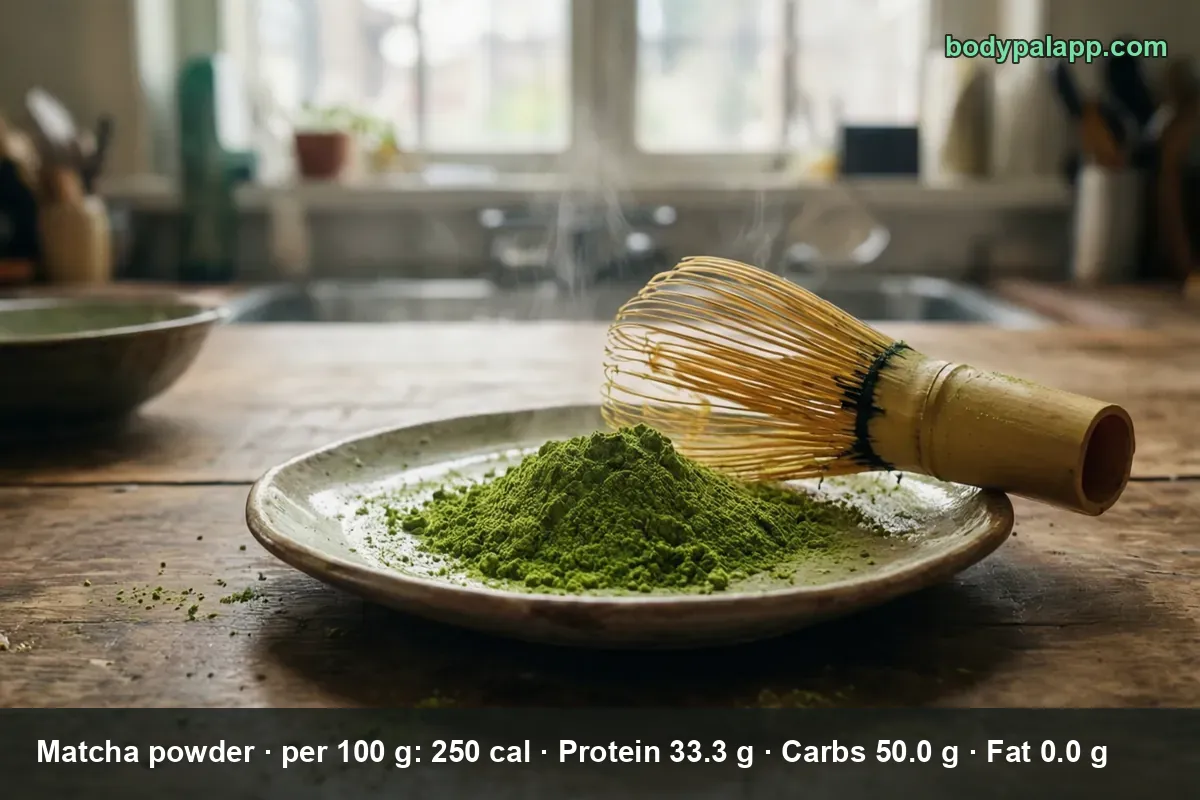
A tablespoon of matcha powder, the 6 g serving printed on the GreenWise label, is 15 calories, and the powder itself runs 250 calories per 100 g. A teaspoon is 5. Matcha is one of the few things in an American kitchen where the size of the spoon, not the ingredient, decides whether the entry is worth typing at all.
On this page
- Matcha powder quick facts
- US servings, from one teaspoon to one ounce
- Culinary, ceremonial and latte mixes
- Fiber and potassium are the rows to watch
- Why matcha labels disagree
- How does matcha powder compare?
- Most popular matcha powder brands
- FAQ
Matcha powder quick facts
There is no Foundation, SR Legacy or FNDDS entry for matcha in FoodData Central, so this page is built on a Branded label. The one used here is ORGANIC MATCHA POWDER, GreenWise / Publix, fdc_id 2398187. It was chosen for a dull but decisive reason: its label serving is 1 tablespoon, 6 g, three times the 2 g serving most matcha brands print. Label values are rounded at the serving, so the bigger the serving, the less that rounding distorts the per-100-g math.
It is also the only plain-matcha record in this group that reports protein, fiber and potassium together at levels consistent with ground whole green tea leaf. The ingredient list is one item long: organic matcha powder.
| Nutrient | Per 100 g | Per 1 tbsp (6 g) | % Daily Value |
|---|---|---|---|
| Calories | 250 | 15 | — |
| Total fat | 0 g | 0 g | 0% |
| Saturated fat | 0 g | 0 g | 0% |
| Carbohydrate | 50 g | 3.0 g | 1% |
| Dietary fiber | 33.3 g | 2.0 g | 7% |
| Total sugars | 0 g | 0 g | — |
| Protein | 33.33 g | 2.0 g | 4% |
| Sodium | 0 mg | 0 mg | 0% |
% Daily Value is based on a 2,000-calorie diet.
Verified nutrition data
Numbers on this page come from USDA FoodData Central, the U.S. Department of Agriculture’s food composition database, and from manufacturer labels where a branded product is named. Last verified September 2026. How we verify our data →
Three rows are missing on purpose. There is no added sugars line because the label does not declare one, and with a single-ingredient powder there is nothing to add sugar to — total sugars are 0 g either way. Cholesterol is 0 mg, as you would expect from a leaf. Potassium is the row people miss: 2,667 mg per 100 g, or 160 mg in a tablespoon, which is 3% of the Daily Value.
US servings, from one teaspoon to one ounce
| Serving | Weight | Calories |
|---|---|---|
| 1 tsp | 2 g | 5 kcal |
| 2 tsp, one bowl of usucha | 4 g | 10 kcal |
| 1 tbsp, the label serving | 6 g | 15 kcal |
| 1 oz | 28.4 g | 71 kcal |
| Per 100 g | 100 g | 250 kcal |
Only the 6 g tablespoon is a USDA household measure. The teaspoon, the two-teaspoon bowl, the ounce and the 100 g line are our own arithmetic from the USDA per-100-g figure, not USDA servings.
The ounce row is there for a reason, and it is not because anyone drinks it. Matcha is sold by the ounce — a 1 oz tin is a common size — and 71 calories is the whole tin. That is the entire calorie content of two weeks of daily bowls, sitting on the shelf. It reframes the ingredient better than any per-serving figure does.
The teaspoon is the measure that matters in practice. Traditional usucha is one to two teaspoons whisked into hot water, which is 5 to 10 calories. If you build a latte at home, that spoonful is the smallest line in the entry by a wide margin.
Culinary, ceremonial and latte mixes
Grade is a flavor and texture distinction, not a calorie one. What actually moves the number is whether sugar is in the jar.
| Version | Per 100 g | Typical serving | Calories |
|---|---|---|---|
| Culinary matcha, unsweetened | 250 kcal | 1 tsp (2 g) | 5 kcal |
| Ceremonial-style single-origin powder | 333 kcal | 1/2 tsp (1.5 g) | 5 kcal |
| Matcha to-go stick | 250 kcal | 1 stick (4 g) | 10 kcal |
| Flavored matcha packet | 167 kcal | 1 packet (3 g) | 5 kcal |
| Matcha latte mix, sweetened | 400 kcal | 2 tsp (10 g) | 40 kcal |
| Sweet matcha latte mix | 385 kcal | 1 tbsp (13 g) | 50 kcal |
Read the first four rows and the last two as two different foods. Every unsweetened powder lands at 5 or 10 calories a serving whatever its per-100-g figure says, because the servings are tiny. The two latte mixes are mostly sugar: 90 g and 92.31 g of carbohydrate per 100 g against 50 g for plain matcha, and their label servings are heavier too. Two teaspoons of Jade Leaf mix weigh 10 g and cost 40 calories; two teaspoons of plain powder weigh 4 g and cost 10. Four times the number for the same two spoons.
Among plain powders the US shelf is remarkably uniform. GreenWise, Matcha Love, Maeda-En, Simply Super and Tiesta Tea all declare 250 calories per 100 g; Sencha Naturals declares 333. All six come to 5 calories per label serving except the GreenWise tablespoon at 15, and that is only because the spoon is bigger.
Fiber and potassium are the rows to watch
Steeped green tea gives you water and whatever dissolves into it. The leaf goes in the strainer. Matcha is the leaf, stone-ground, whisked and swallowed, which is why a nutrition panel exists for it in the first place.
A tablespoon carries 2.0 g of fiber. Against the FDA Daily Value of 28 g on the Nutrition Facts label, that is 7% from something that costs 15 calories — a ratio almost nothing else in a drink can match. The same tablespoon brings 160 mg of potassium, 3% of the Daily Value, and 2.0 g of protein at 4%.
None of that makes matcha a meaningful source of anything at real-world doses, and it should not be logged as one. A teaspoon is 0.7 g of fiber. The Dietary Guidelines for Americans put the fiber target in the tens of grams a day, so a bowl of tea is a rounding contribution. The honest framing is the one MyPlate uses for drinks: what you add to the cup matters more than the cup.
Fat and sodium are both flat zero, which is unusual for a powdered drink product and worth noticing if you are watching either.
Why matcha labels disagree
Pull up eight Branded matcha records and you will see 250, 333, 350 and 375 calories per 100 g for what is functionally the same powder. Seven of those records list something other than the GreenWise numbers, and none of them is wrong.
The cause is arithmetic, not the leaf. FDA rules let a label round calories to the nearest 5 at the serving. When the serving is 1.5 g or 2 g, a single rounded calorie becomes an enormous swing once you scale it up: 5 calories on a 1.5 g serving projects to 333 per 100 g, the same 5 calories on a 2 g serving projects to 250. Protein does the same thing. One record shows 0 g of protein per 100 g and another shows 50 g, purely because 0.7 g rounded down to zero on one label and 1 g rounded up on another.
This is the single most useful thing to know about logging matcha, and it is why the 6 g serving was chosen here. It is also why chasing the "right" per-100-g figure for matcha is a waste of effort. At one to two teaspoons a bowl, every one of those labels gives you 5 to 10 calories.
How does matcha powder compare?
| Powder | Per 100 g | US serving | Calories |
|---|---|---|---|
| Plain matcha powder | 250 kcal | 1 tbsp, 6 g | 15 kcal |
| Matcha latte mix, Jade Leaf | 400 kcal | 2 tsp, 10 g | 40 kcal |
| Sweet matcha latte mix, Rishi | 385 kcal | 1 tbsp, 13 g | 50 kcal |
| Flavored matcha packet, Jade Monk | 167 kcal | 1 packet, 3 g | 5 kcal |
Our take: plain matcha powder is not worth a food entry on its own, and treating it as one is the mistake most people make. Log the milk. A whisked bowl in hot water is 5 to 15 calories depending on your spoon, while the sweetened mixes are 40 to 50 calories a serving before a drop of milk goes in, because they are sugar with matcha in it. If you buy one tin for both jobs, buy the unsweetened one and sweeten to taste — you control a variable that the mix decides for you. The flavored packet at 167 calories per 100 g looks like the light option and is only light because the packet is small.
Most popular matcha powder brands in the United States
Ranked by how widely each product appears among foods sold in the United States, from the BodyPal food database of over 3.3 million products. Calories are the figures printed on each Nutrition Facts label, checked against USDA FoodData Central.
| Product | Calories (per 100 g) |
|---|---|
| Sencha Naturals 100% Japanese Organic Matcha Powder | 333 cal |
| Matcha Love Japanese Culinary Matcha | 250 cal |
| Maeda-En Green Tea Powder Matcha | 250 cal |
| GreenWise Organic Matcha Powder | 250 cal |
| Simply Super Organic Matcha Powder | 250 cal |
| Tiesta Tea Matcha Japanese Green Tea Powder | 250 cal |
Brand popularity: BodyPal food database. Nutrition: manufacturer labels / USDA FoodData Central.
Matcha powder FAQs
How many calories are in a teaspoon of matcha powder?
A level teaspoon weighs about 2 g and comes to 5 calories, scaled from the USDA figure of 250 calories per 100 g. That is a quarter of one percent of a 2,000-calorie day. The bowl of usucha most people whisk, two teaspoons, is 10 calories.
How many calories are in matcha powder per 100 g?
250 calories per 100 g on the GreenWise Branded record. Nobody consumes 100 g of it, which is roughly seventeen tablespoons of tea powder. The figure matters mainly as the base for scaling servings, and because rival matcha labels declare 333 or 350 for the same kind of product.
Does matcha powder have carbs?
Yes, 50 g per 100 g, which works out to 3.0 g in a tablespoon and 1 g in a teaspoon, or 1% of the Daily Value per tablespoon. Two thirds of those carbohydrates are fiber, at 33.3 g per 100 g, so the digestible share is very small indeed.
How much protein is in matcha powder?
33.33 g per 100 g, which is 2.0 g in a tablespoon and 4% of the Daily Value. Matcha is ground whole leaf, so you swallow the leaf protein instead of steeping it out. Treat it as context rather than a protein source: a teaspoon gives well under a gram.
Does matcha powder have fiber?
A tablespoon carries 2.0 g of fiber, 7% of the 28 g Daily Value, from 33.3 g per 100 g. Steeped green tea leaves the leaf in the strainer, while matcha does not, which is the only reason fiber appears on the panel. A teaspoon is about 0.7 g.
Is matcha powder zero calorie?
No, though at 5 calories a teaspoon it is close in practice. A tablespoon is 15, so a whisked bowl with nothing added sits near the bottom of anything worth logging. Zero-calorie claims come from brewed tea, where the leaf is strained out and thrown away.
How many calories does a matcha latte mix add compared with plain matcha?
Two teaspoons of sweetened matcha latte mix are 40 calories against 10 for two teaspoons of plain powder, four times as much, and that is before any milk. In a cafe latte the milk and the syrup carry most of the total, and the matcha itself barely registers.
Ceremonial vs culinary matcha: do the calories differ?
Barely: culinary matcha is declared at 250 calories per 100 g and one ceremonial-style powder at 333, yet both come to 5 calories at their label servings of 1 teaspoon and half a teaspoon. The gap is label rounding on tiny servings, not a real difference in the leaf.
Similar foods
- Steak — 368 cal per regular steak
- Eggnog — 112 cal for 1/2 cup
- Protein Shake — 156 cal per cup
- Bubble Tea — 239 cal per drink
- Apple cider — 114 cal per cup
- Root beer — 152 cal for 12 fl oz glass
Count it without the math
Point the camera at the cup and BodyPal counts the matcha, the milk and the syrup for you.

