
How many calories are in maple syrup?
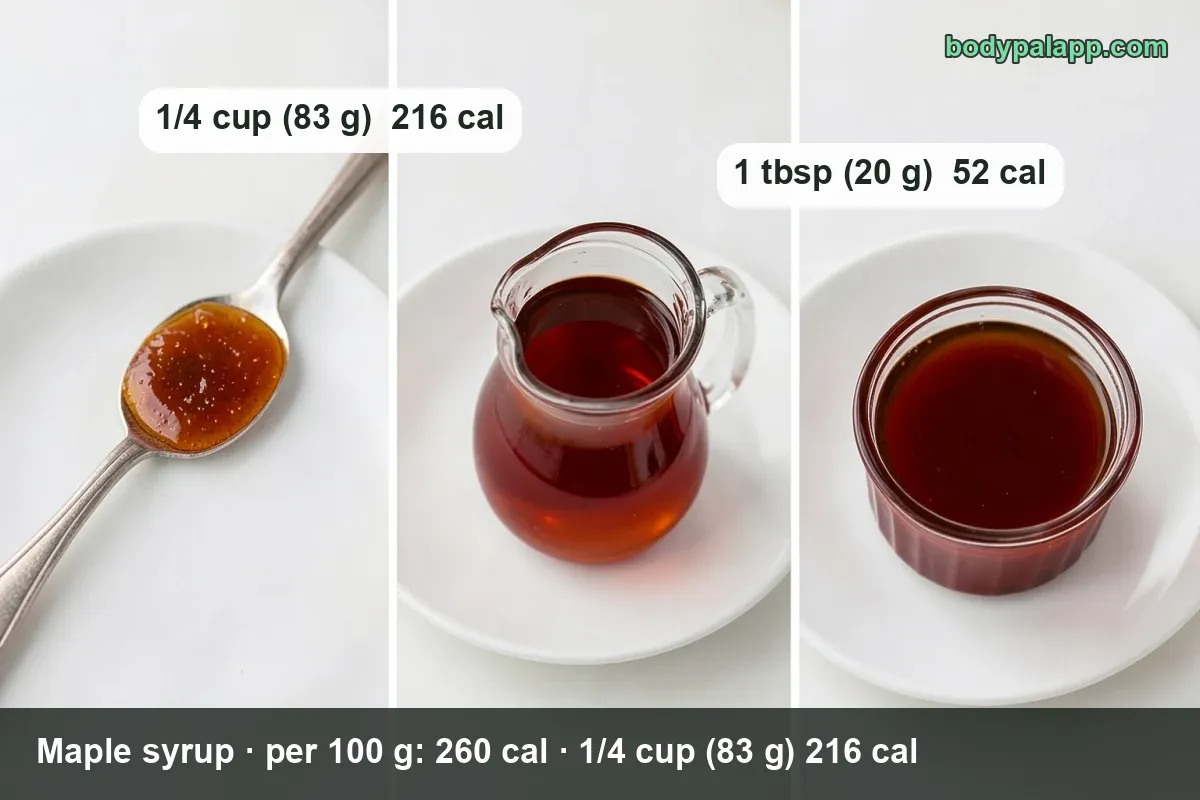
A 1/4-cup pour of pure maple syrup weighs 83 g and carries 216 calories. Per 100 g the syrup runs 260 calories, and a single tablespoon is 52. The gap between those two numbers is the whole story of this page: the serving on the bottle is four tablespoons, and almost nobody pours by the spoon.
On this page
- Maple syrup quick facts
- US servings, from one tablespoon to a full cup
- Pancake syrup, Canadian syrup and the other bottles
- Carbohydrate is the only row that moves
- How does maple syrup compare?
- Most popular maple syrup brands
- Maple syrup FAQs
Maple syrup quick facts
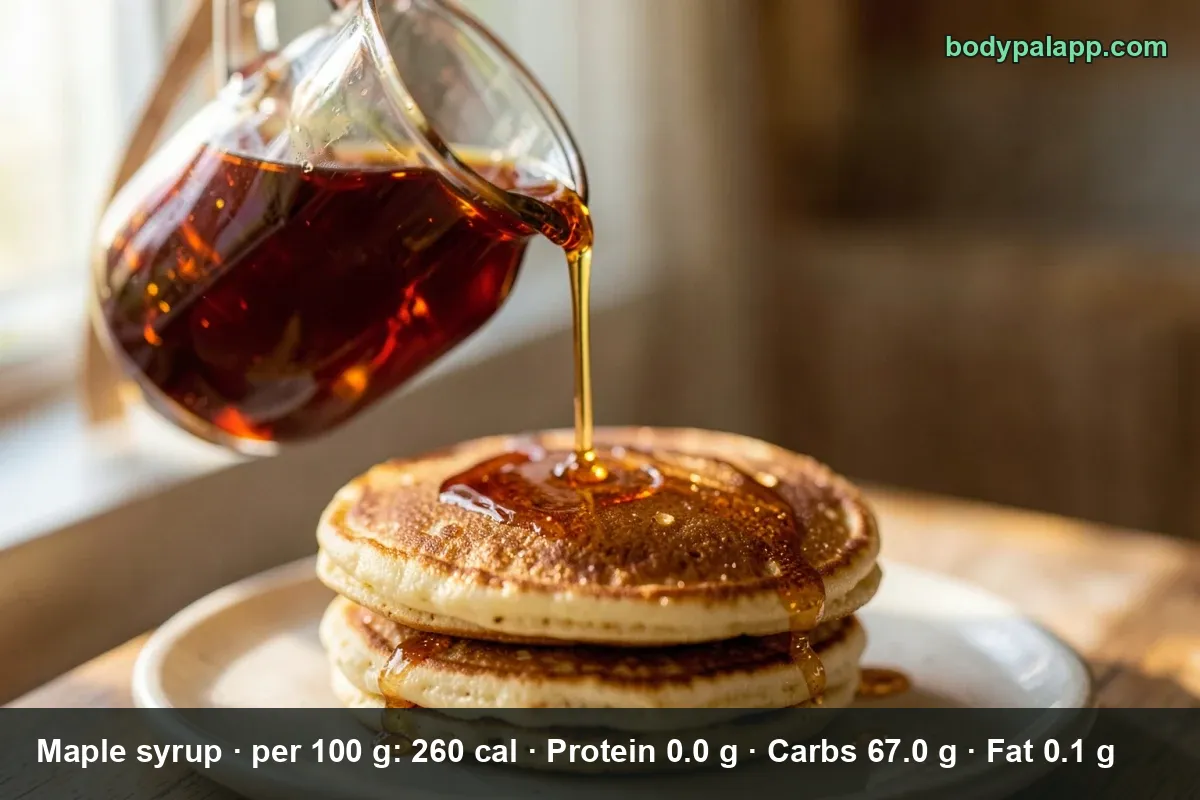
The record behind every number here is SR Legacy 169661, "Syrups, maple" — plain, pure maple syrup, the amber kind that comes out of a jug. That is the product in the picture, and 1/4 cup (83 g) is the serving printed on US bottles as 60 ml, so it is the column that matters when you are logging breakfast rather than reading a lab sheet.
Canadian maple syrup and the two pancake table blends have their own USDA records. They are different products, not different measurements of the same one, so they get their own section further down instead of being averaged into this table.
| Nutrient | Per 100 g | Per 1/4 cup (83 g) | % Daily Value |
|---|---|---|---|
| Calories | 260 | 216 | — |
| Total fat | 0.06 g | 0.0 g | 0% |
| Saturated fat | 0.01 g | 0.0 g | 0% |
| Carbohydrate | 67.04 g | 55.6 g | 20% |
| Dietary fiber | 0 g | 0 g | 0% |
| Total sugars | 60.46 g | 50.2 g | — |
| Protein | 0.04 g | 0.0 g | 0% |
| Sodium | 12 mg | 10 mg | 0% |
% Daily Value is based on a 2,000-calorie diet.
Verified nutrition data
Numbers on this page come from USDA FoodData Central, the U.S. Department of Agriculture’s food composition database, and from manufacturer labels where a branded product is named. Last verified September 2026. How we verify our data →
Two rows you would see on a supermarket label are missing on purpose. USDA's SR Legacy edition does not publish an added sugars figure for this record, and it does not publish trans fat either, so neither row appears rather than being guessed at. Cholesterol is zero. Potassium is the one mineral with a real number: 212 mg per 100 g, which is 176 mg in a 1/4-cup pour and 4% of the Daily Value.
US servings, from one tablespoon to a full cup
| Serving | Weight | Calories |
|---|---|---|
| 1 tbsp | 20 g | 52 kcal |
| 2 tbsp | 40 g | 104 kcal |
| 1 oz | 28 g | 73 kcal |
| 1/4 cup, the label serving | 83 g | 216 kcal |
| 1 cup | 315 g | 819 kcal |
| Per 100 g | 100 g | 260 kcal |
The tablespoon, the 1/4 cup and the full cup are USDA household measures, weighed as syrup rather than converted from volume. The 2 tbsp and 1 oz lines are our own arithmetic from the USDA 100 g figure, not USDA servings — useful because 2 tbsp is what a careful pour over pancakes actually looks like, and because ounces are how a lot of people measure into coffee or oatmeal.
Notice how fast the cup column climbs. A cup of maple syrup is 315 g and 819 calories, which is why syrup in a recipe deserves the same attention as the butter. A tablespoon in a marinade or a vinaigrette, by contrast, is 52 calories and rarely worth agonizing over.
The other trap is the difference between the spoon and the jug. Free-pouring from the little glass pitcher on the table is very close to the 1/4 cup, not the tablespoon, so the honest log for a plate of pancakes is usually 104 to 216 calories, not 52.
Pancake syrup, Canadian syrup and the other bottles
| Version | Per 100 g | Typical serving | Calories |
|---|---|---|---|
| Pure maple syrup (169661) | 260 kcal | 1/4 cup (83 g) | 216 kcal |
| Canadian maple syrup (170276) | 270 kcal | 60 ml (80 g) | 216 kcal |
| Pancake table syrup, 2% maple (168838) | 265 kcal | 1/4 cup (83 g) | 220 kcal |
| Pancake table syrup, 2% maple, added potassium (170646) | 265 kcal | 1 tbsp (20 g) | 53 kcal |
| Cane syrup (167743) | 269 kcal | 1 tbsp (20 g, our arithmetic) | 54 kcal |
| Chocolate syrup, NESTLE (170681) | 269 kcal | 1 tbsp (20 g, our arithmetic) | 54 kcal |
Canadian maple syrup is the densest of the maple records at 270 calories per 100 g, a little less water in the same bottle. Because the 60 ml serving weighs 80 g rather than 83 g, it lands on exactly the same 216 calories as the US pour. Different syrup, same breakfast.
Pancake table syrup with 2% maple is the one that surprises people. It is corn syrup with a splash of maple, it costs a fraction as much, and it is heavier: 265 calories per 100 g against maple's 260, and 220 calories in the same 1/4 cup instead of 216. It also carries 61 mg of sodium per 100 g against maple's 12 mg, five times as much, because the flavor has to be built rather than boiled down.
The sugar column tells the rest of that story. The blend lists 42 g of sugars per 100 g while pure maple lists 60.46 g, yet the blend has more total carbohydrate — 69.6 g against 67.04 g. The difference is corn syrup solids that are carbohydrate without being sugar. The version with added potassium is the same blend at 265 calories per 100 g, 53 calories a tablespoon; USDA did not measure its sugars, so that figure is not shown.
USDA's Branded Foods entries for pure maple syrup — Shady Maple Farms and Maple Grove Farms of Vermont at 350, Crown Maple at 360, and Parker's, Bissell Maple Farm and Great River Maple at 333 — are printed per 100 ml rather than per 100 g, which is why they read higher than the 260 above. Their label servings land close to ours: 60 ml (1/4 cup) is 210 calories on the Maple Grove and Shady Maple bottles, and Crown Maple's smaller 30 ml serving is 108.
Carbohydrate is the only row that moves
Maple syrup is a one-nutrient food. Fat is 0.06 g per 100 g and protein 0.04 g, both of which round to 0.0 g in a 1/4-cup serving and to 0% of their Daily Values. Fiber is a flat zero. Sodium is 10 mg in that pour, less than half a percent of the day. Everything the syrup does to your total, it does through carbohydrate: 55.6 g, or 20% of the Daily Value, in one 1/4 cup.
That makes it easy to place. If you are watching sodium or saturated fat, syrup is a non-event. If you are counting carbohydrate — for a plan, for a workout window, for anything — a quarter cup is a fifth of a standard day in something you finish in ninety seconds.
The Dietary Guidelines for Americans put added sugars below 10% of daily calories, which is 200 calories on a 2,000-calorie day. USDA does not publish an added sugars value for this record, so we are not going to score maple's 50.2 g of total sugars against that ceiling. The calorie side needs no interpretation, though: the 1/4-cup pour is 216 calories, arriving with no protein, no fiber and nothing else to slow it down. MyPlate files syrup where you would expect, alongside the sweetened drinks and desserts.
The one genuinely nice number is potassium. At 212 mg per 100 g, a 1/4 cup gives 176 mg and 4% of the Daily Value — modest, but it is the only mineral in maple syrup that registers at all, and it is real potassium from the tree rather than something added at the plant.
How does maple syrup compare?
| Syrup | Per 100 g | US serving | Calories |
|---|---|---|---|
| Maple syrup | 260 kcal | 1 tbsp (20 g) | 52 kcal |
| Pancake table syrup, 2% maple | 265 kcal | 1 tbsp (20 g) | 53 kcal |
| Cane syrup | 269 kcal | 1 tbsp (20 g, our arithmetic) | 54 kcal |
| Chocolate syrup, NESTLE | 269 kcal | 1 tbsp (20 g, our arithmetic) | 54 kcal |
Our take: pure maple is the lightest of the four per 100 g, but only just — two calories separate the lightest and heaviest tablespoon on this table. Anyone switching syrups to save calories is doing arithmetic that rounds to nothing. Switch for the sodium (12 mg per 100 g against the table blend's 61 mg) or for the taste, and switch the amount if you want the number to change: going from a free pour to two measured tablespoons cuts a pancake breakfast by 112 calories, which is more than choosing between all four bottles ever could.
Most popular maple syrup brands in the United States
Ranked by how widely each product appears among foods sold in the United States, from the BodyPal food database of over 3.3 million products. Calories are the figures printed on each Nutrition Facts label, checked against USDA FoodData Central.
| Product | Calories (per 100 g) |
|---|---|
| Shady Maple Farms Maple Syrup | 350 cal |
| Maple Grove Farms of Vermont Maple Syrup | 350 cal |
| Crown Maple Maple Syrup | 360 cal |
| Parker's Maple Syrup | 333 cal |
| Bissell Maple Farm Maple Syrup | 333 cal |
| Great River Maple Maple Syrup | 333 cal |
Brand popularity: BodyPal food database. Nutrition: manufacturer labels / USDA FoodData Central.
Maple syrup FAQs
How many calories are in 1 tablespoon of maple syrup?
One tablespoon of pure maple syrup is 52 calories, from 13.4 g of carbohydrate and 12.1 g of sugars. That is the USDA household measure at 20 g per tablespoon, scaled from 260 calories per 100 g. Two tablespoons, the more realistic pour over pancakes, come to 104 calories.
How many calories are in 1/4 cup of maple syrup?
A 1/4 cup of maple syrup weighs 83 g and holds 216 calories, and that is the serving printed on most US bottles as 60 ml. It brings 55.6 g of carbohydrate, 20% of the Daily Value, plus 50.2 g of sugars, with no fat and no protein worth counting.
Is maple syrup healthier than pancake syrup?
Pancake table syrup with 2% maple is 265 calories per 100 g, slightly above pure maple syrup at 260. The blend carries 61 mg of sodium per 100 g against 12 mg, and 69.6 g of carbohydrate against 67.04 g. On calories the two are a wash; the cheaper bottle is not the lighter one.
How much sugar is in maple syrup?
Maple syrup is 60.46 g of total sugars per 100 g, so a tablespoon holds 12.1 g and a 1/4 cup holds 50.2 g. USDA does not publish an added sugars figure for this record, so the page shows total sugars only and leaves the added sugars row off the table entirely.
Does maple syrup have any protein or fat?
Essentially none: maple syrup carries 0.04 g of protein and 0.06 g of fat per 100 g, both of which round to 0.0 g in a 1/4-cup serving and to 0% of their Daily Values. Saturated fat is 0.01 g per 100 g, fiber is zero and cholesterol is zero.
How many carbs are in maple syrup?
A tablespoon of maple syrup has 13.4 g of carbohydrate and a 1/4 cup has 55.6 g, which is 20% of the Daily Value. Fiber is zero, so all of it is available carbohydrate. Pancake table syrup is slightly higher at 69.6 g per 100 g against maple's 67.04 g.
How many calories does maple syrup add to pancakes?
Two measured tablespoons add 104 calories to a plate of pancakes, and a generous 1/4-cup pour adds 216. Those come from our own arithmetic and from the USDA household measure respectively, both scaled from 260 calories per 100 g. Pour from a jug rather than a spoon and you are closer to the larger number.
Does maple syrup have potassium?
Yes, 212 mg per 100 g, which works out to 176 mg in a 1/4-cup serving, or 4% of the Daily Value, and about 42 mg per tablespoon. Potassium is the only mineral in maple syrup that reaches a meaningful share of a Daily Value. Sodium, by comparison, is 12 mg per 100 g.
Similar foods
- Burger Meat (Raw Ground Beef Patties) — 287 cal per patty
- Chicken Bouillon — 11 cal per cube
- Coffee Syrup — 80 cal per 2 Tbsp
- Miracle Whip — 40 cal per tbsp
- Hazelnut Coffee Creamer — 38 cal per tablespoon
- Matcha Powder — 5 cal per tsp
Count it without the math
Point the camera at the plate and BodyPal counts the syrup along with the pancakes.


How long does it take to burn off maple syrup?
A 1/4 cup (83 g) serving is 216 kcal. Enter your weight and the amount you ate to see how long it takes you to burn that off:
lb
| Activity | Time to burn 216 kcal |
|---|---|
| Walking, brisk | 43 min |
| Cycling, moderate | 27 min |
| Swimming, moderate | 31 min |
| Jogging | 25 min |
| Weight training, moderate | 48 min |
Times are for a 155 lb adult at a steady pace; change the weight to see yours. The amount is set to the portion in the text (83 g); change it to what you actually ate. BodyPal works this out from your steps automatically.
Burning it off is one side of it. The other is knowing your number: work out how many calories you need a day, with macros and a goal date.