
How many calories are in enoki mushrooms?
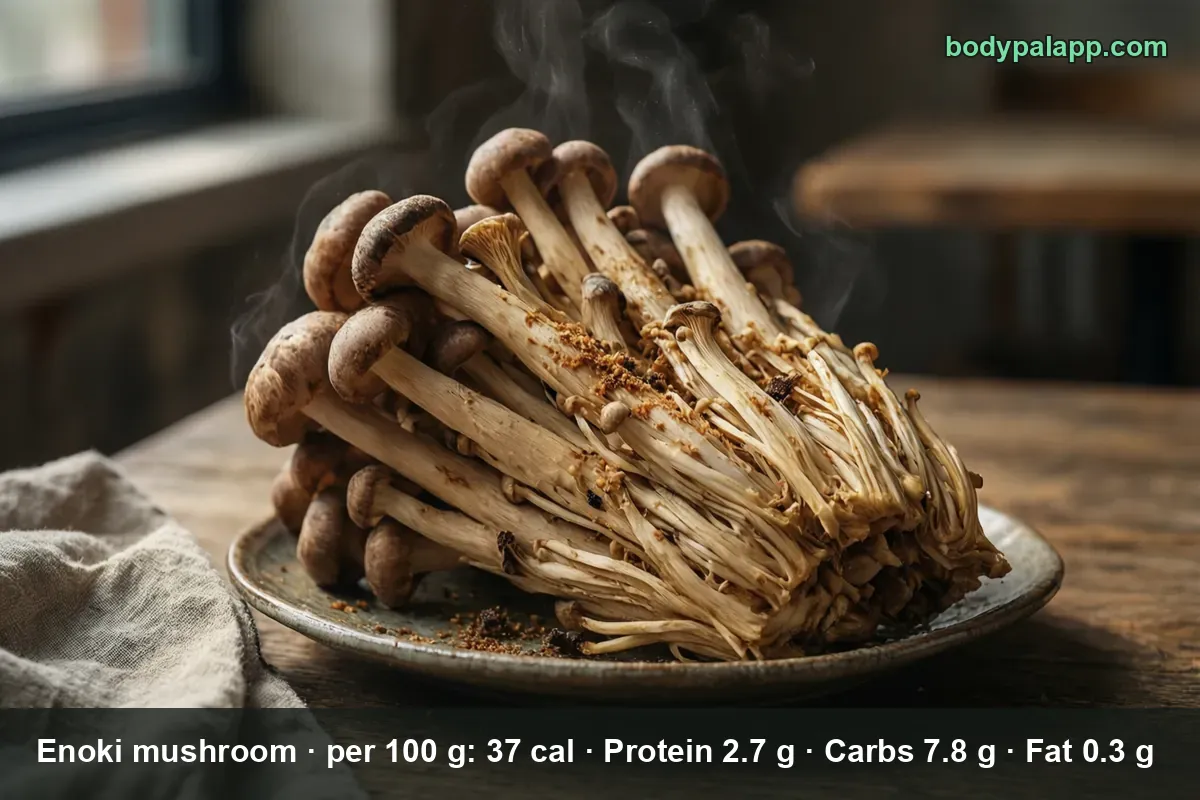
One cup of whole enoki mushrooms weighs 64 g and carries 24 calories. Raw enoki runs 37 calories per 100 g, which puts it among the lightest things you can pile on a plate. Those long white stems are mostly water and fiber, so a handful that looks like a lot barely moves your daily total.
On this page
- Enoki mushroom quick facts
- US servings, from one mushroom to a full cup
- Whole, sliced, and packaged enoki
- The two USDA enoki records and why they differ
- Fiber and potassium for 24 calories
- How do enoki mushrooms compare?
- Most popular enoki mushroom brands
- FAQ
Enoki mushroom quick facts
The numbers below come from SR Legacy 169382, "Mushrooms, enoki, raw". That is the record that matches what you actually bring home: a shrink-wrapped bundle of raw enoki from the produce case or the Asian grocery. It is also the only enoki entry with household measures attached, so the cup figures below are USDA's own, not something scaled by hand.
Enoki is sold raw and cooked in seconds, so the raw row is the honest starting point. Cooking does not add calories on its own; the oil, butter, or broth you cook it in does.
| Nutrient | Per 100 g | Per 1 cup whole (64 g) | % Daily Value |
|---|---|---|---|
| Calories | 37 | 24 | — |
| Total fat | 0.29 g | 0.2 g | 0% |
| Saturated fat | 0.03 g | 0.0 g | 0% |
| Carbohydrate | 7.81 g | 5.0 g | 2% |
| Dietary fiber | 2.7 g | 1.7 g | 6% |
| Total sugars | 0.22 g | 0.1 g | — |
| Protein | 2.66 g | 1.7 g | 3% |
| Sodium | 3 mg | 2 mg | 0% |
% Daily Value is based on a 2,000-calorie diet.
Verified nutrition data
Numbers on this page come from USDA FoodData Central, the U.S. Department of Agriculture’s food composition database, and from manufacturer labels where a branded product is named. Last verified September 2026. How we verify our data →
There is no added sugars row and no trans fat row here, because the SR Legacy edition does not publish either for this record — and a raw mushroom has no added sugar in it to publish. Cholesterol is 0 mg, as it is for every plant food. Potassium is the quiet standout: 359 mg per 100 g, or 230 mg in a cup, which is 5% of the 4,700 mg Daily Value.
US servings, from one mushroom to a full cup
Enoki is bought by the package and eaten by the handful, so the useful question is what a real portion weighs. A standard retail bundle is about 200 g, which works out to roughly three cups.
| Serving | Weight | Calories |
|---|---|---|
| 1 medium mushroom | 3 g | 1 kcal |
| 1 large mushroom | 5 g | 2 kcal |
| 1 oz | 28 g | 10 kcal |
| 1 cup whole | 64 g | 24 kcal |
| 1 cup sliced | 65 g | 24 kcal |
| Per 100 g | 100 g | 37 kcal |
The cup and mushroom figures are USDA household measures on record 169382. The 1 oz line is our own arithmetic from the USDA 100 g figure, not a USDA serving — it is there because packaged mushrooms are priced and weighed in ounces in most US stores.
Here is the part that trips people up in a food log. One cup whole is 64 g. One cup sliced is 65 g. That is a one-gram difference, and both land on 24 calories. With most vegetables, chopping packs the cup tighter and the calories climb; enoki stems are so thin and so springy that slicing them changes almost nothing. If your app asks "whole or sliced," the answer does not matter here.
Whole, sliced, and packaged enoki
| Version | Per 100 g | Typical portion | Calories |
|---|---|---|---|
| Raw enoki, whole | 37 kcal | 1 cup whole (64 g) | 24 kcal |
| Raw enoki, sliced | 37 kcal | 1 cup sliced (65 g) | 24 kcal |
| Enoki, Foundation lab sample | 44 kcal | 100 g | 44 kcal |
| Packaged enoki, Guan's | 45 kcal | 100 g (3.5 oz) | 45 kcal |
Two branded packages sit in the USDA Branded database, and they bracket the range: Xuerong lists 38 calories per 100 g and Guan's lists 45. Both print the same label serving, 100 g or 3.5 oz, which is unusual and convenient — most US produce labels dodge a serving size entirely. If the bag in your kitchen shows one of those numbers instead of 37, log the bag. It is the same mushroom measured by a different lab.
USDA publishes no cooked enoki record, so there is no "cooked" line to give you. That absence is worth understanding rather than working around. Enoki wilts in a hot pan in under a minute and loses water, which means 100 g raw shrinks to something noticeably smaller and slightly more calorie-dense per gram — the calories did not go anywhere, the water did. The practical move is to weigh or measure the mushrooms before they hit the pan, then count the fat separately. A teaspoon of oil adds about 40 calories, which is more than the cup of enoki it coats.
The two USDA enoki records and why they differ
Search FoodData Central for enoki and you get two answers: 37 calories per 100 g from SR Legacy, and 44 from the newer Foundation Foods sample. Neither is wrong, and averaging them would be worse than picking one.
The gap is method, not mushroom. The Foundation record is a more recent laboratory analysis whose energy value is calculated with general Atwater factors applied to its own protein, carbohydrate, and fat readings, which run a little higher than the older sample's. It also does not report sugars or saturated fat at all, so a page built on it would have blank rows where the label expects numbers. SR Legacy carries the full profile plus the cup measures, which is why it is the main row here.
Seven calories per 100 g is the whole argument. On a cup of enoki that is a difference of four calories, by our own arithmetic from the two 100 g figures. Pick one source, stay with it, and stop worrying about it.
Fiber and potassium for 24 calories
A cup of enoki delivers 1.7 g of fiber, which is 6% of the 28 g Daily Value the FDA uses on the Nutrition Facts label, for 24 calories. Against the rest of the mushroom case, that is the cheapest fiber on the shelf. It is one of the cheapest ways to add bulk to a bowl.
Sodium is where enoki gets misjudged. Raw, it carries 3 mg per 100 g — 0% of the 2,300 mg Daily Value, and about a thousandth of the sodium in a teaspoon of table salt. Two milligrams in a cup. Every bit of sodium in a bowl of enoki soup or a plate of enoki wrapped in bacon comes from the broth, the soy sauce, or the pork, never from the mushroom. If you are watching sodium, the mushroom is not the problem; the liquid it is sitting in is.
Protein is real but modest: 2.66 g per 100 g, 1.7 g per cup, 3% DV. Treat enoki as a vegetable that adds texture and volume to a meal, the way MyPlate counts vegetables, not as a protein source. Carbohydrate is 5.0 g per cup, and a third of that is fiber.
How do enoki mushrooms compare?
| Food | Per 100 g | US serving | Calories |
|---|---|---|---|
| Enoki mushrooms, raw | 37 kcal | 1 cup whole, 64 g | 24 kcal |
| Rutabaga, raw | 37 kcal | 1 cup cubes, 140 g | 52 kcal |
| Drumstick pods, raw | 37 kcal | 1 cup slices, 100 g | 37 kcal |
| Winter squash, baked | 37 kcal | 1 cup cubes, 205 g | 76 kcal |
Our take: all four of these foods are identical on paper at 37 calories per 100 g, and they are nowhere near identical on a plate. What separates them is how much a cup weighs. Enoki fills a cup with 64 g of air and thin stems; baked winter squash packs 205 g of dense flesh into the same cup and lands at 76 calories, more than three times the enoki. If you are eating by volume and trying to keep calories down, enoki is the best of the four by a wide margin — the lightest cup on the list. If you want a side that actually holds you over, the squash is doing more work per bite.
Most popular enoki mushroom brands in the United States
Ranked by how widely each product appears among foods sold in the United States, from the BodyPal food database of over 3.3 million products. Calories are the figures printed on each Nutrition Facts label, checked against USDA FoodData Central.
| Product | Calories (per 100 g) |
|---|---|
| Xuerong Enoki Mushroom | 38 cal |
| Guan's Enoki Mushrooms | 45 cal |
Brand popularity: BodyPal food database. Nutrition: manufacturer labels / USDA FoodData Central.
Enoki mushroom FAQs
How many calories are in enoki mushrooms?
Raw enoki mushrooms have 37 calories per 100 g, and a cup of whole mushrooms weighing 64 g comes to 24 calories. A single medium mushroom is about 1 calorie. Packaged brands list 38 to 45 calories per 100 g, so check your bag if it prints a number.
How many calories in 1 cup of enoki mushrooms?
24 calories for one cup of whole enoki, which USDA weighs at 64 g. A cup of sliced enoki weighs 65 g and also comes to 24 calories, because the thin stems do not pack tighter when you cut them. Three cups, roughly a full retail bundle, is about 72 calories.
How many carbs do enoki mushrooms have?
Enoki has 7.81 g of carbohydrate per 100 g, or 5.0 g in a 64 g cup. Fiber accounts for 2.7 g per 100 g and 1.7 g per cup, so a third of the carbohydrate is fiber. Total sugars are just 0.22 g per 100 g, essentially nothing.
How much protein is in enoki mushrooms?
2.66 g of protein per 100 g, which works out to 1.7 g in a cup of whole mushrooms, or 3% of the Daily Value. That is decent for a vegetable but it is not a protein food. Enoki earns its place in a bowl on texture, fiber, and volume instead.
Do enoki mushrooms have fiber?
Yes, 2.7 g per 100 g and 1.7 g in a 64 g cup, which is 6% of the 28 g Daily Value for just 24 calories. That ratio of fiber to calories is hard to beat anywhere in the produce aisle, and it is the main reason enoki adds bulk to a meal so cheaply.
Are enoki mushrooms keto friendly?
A cup of enoki has 5.0 g of carbohydrate and 1.7 g of fiber, leaving about 3.3 g of net carbs by our own arithmetic from the USDA figures. That is low enough to fit most keto targets easily. Watch what goes with it, since sauces and broths carry more carbs than the mushroom does.
Do cooked enoki mushrooms have more calories than raw?
Not by themselves — 100 g of raw enoki still holds 37 calories after it wilts. USDA publishes no cooked enoki record, and cooking only drives off water, not calories. What changes the number is the pan: a teaspoon of oil adds roughly 40 calories, more than the mushrooms.
How much potassium is in enoki mushrooms?
359 mg of potassium per 100 g, or 230 mg in a 64 g cup, which is 5% of the 4,700 mg Daily Value. Sodium runs the other way at only 3 mg per 100 g, 0% DV, so raw enoki is a genuinely high-potassium, near-zero-sodium food before anything else joins it.
Similar foods
- Delicata Squash — 76 cal per cup
- Squash — 83 cal per cup cooked
- Broccoli Sprouts — 10 cal per half cup
- Brussels Sprouts — 28 cal per half cup
- Yellow Onion — 54 cal per medium onion
- Broccoli — 55 cal per cup chopped
Count it without the math
Point the camera at the bowl and BodyPal counts the enoki for you, stems and all.


One food is easy to picture; a whole day is harder. See how many calories you need a day and what a deficit actually looks like.