
How many calories are in squash?
A 1-cup serving of cooked winter squash, 225 g on the scale, is 83 calories, and squash runs 37 calories per 100 g. Raw squash is lighter per gram, 26 calories per 100 g, and the only reason is water. Cook it, some of that water leaves, and the number per gram goes up.
On this page
- Squash quick facts
- US servings, from one ounce to a full cup
- Raw, cooked, and cooked with fat
- Butternut, acorn, spaghetti and summer squash
- Fiber and potassium, not protein
- How does squash compare?
- Most popular squash brands
- Squash FAQs
Squash quick facts
The row behind every number on this page is FNDDS 2709694, "Winter squash, cooked, no added fat". It is the orange, seedy, hard-skinned kind you halve and roast, cooked plainly, and it is the only squash record that comes with a real household measure of 1 cup for the cooked vegetable. That is what somebody scooping mash out of a bowl actually has in front of them.
One detail in that row deserves a note: sodium sits at 117 mg per 100 g, because the record reflects the way American kitchens cook squash, with salt in the pan. The baked, unsalted SR Legacy row 170490 has the same 37 calories per 100 g and just 1 mg of sodium. Calories do not move; sodium does.
| Nutrient | Per 100 g | Per 1 cup (225 g) | % Daily Value |
|---|---|---|---|
| Calories | 37 | 83 | — |
| Total fat | 0.35 g | 0.8 g | 1% |
| Saturated fat | 0.07 g | 0.2 g | 1% |
| Carbohydrate | 8.82 g | 19.8 g | 7% |
| Dietary fiber | 2.8 g | 6.3 g | 22% |
| Total sugars | 3.29 g | 7.4 g | — |
| Protein | 0.89 g | 2.0 g | 4% |
| Sodium | 117 mg | 263 mg | 11% |
% Daily Value is based on a 2,000-calorie diet.
Verified nutrition data
Numbers on this page come from USDA FoodData Central, the U.S. Department of Agriculture’s food composition database, and from manufacturer labels where a branded product is named. Last verified September 2026. How we verify our data →
There is no added sugars row here, and no trans fat row, because this FNDDS edition does not publish either for the record; plain cooked squash with nothing stirred in has no added sugar to report anyway. Cholesterol is 0 mg, as it is for any vegetable. Potassium is the quiet one: 240 mg per 100 g, 540 mg in the cup, which is 11% of the Daily Value.
The sodium figure is worth putting in kitchen terms. The 263 mg in a cooked cup is roughly what an eighth of a teaspoon of table salt would give you, which is about what a cook shakes over a tray of squash without thinking about it.
US servings, from one ounce to a full cup
| Serving | Weight | Calories |
|---|---|---|
| 1 oz cooked | 28 g | 10 kcal |
| 1/2 cup cooked | 113 g | 42 kcal |
| 4 oz cooked | 113 g | 42 kcal |
| 1 cup cooked | 225 g | 83 kcal |
| Per 100 g | 100 g | 37 kcal |
The 1-cup and half-cup lines are USDA household measures for this record. The 4 oz line is the same 113 g under a different name, which is handy if you weigh food in ounces rather than scooping it, and the 1 oz line is our own arithmetic from the USDA 100 g figure rather than a USDA serving.
Squash is one of the foods where the measuring cup lies to you in a useful direction. Mashed squash packs; cubed roasted squash does not. A cup of loose cubes can weigh roughly 40 g less than a cup of mash — our own estimate, not a USDA measure — which at 37 calories per 100 g is a swing of about 15 calories. That is small enough to ignore, and it is the reason a scale is not worth dragging out for this vegetable specifically. Save the scale for the oil.
Raw, cooked, and cooked with fat
Two things move squash calories, and only one of them is the squash.
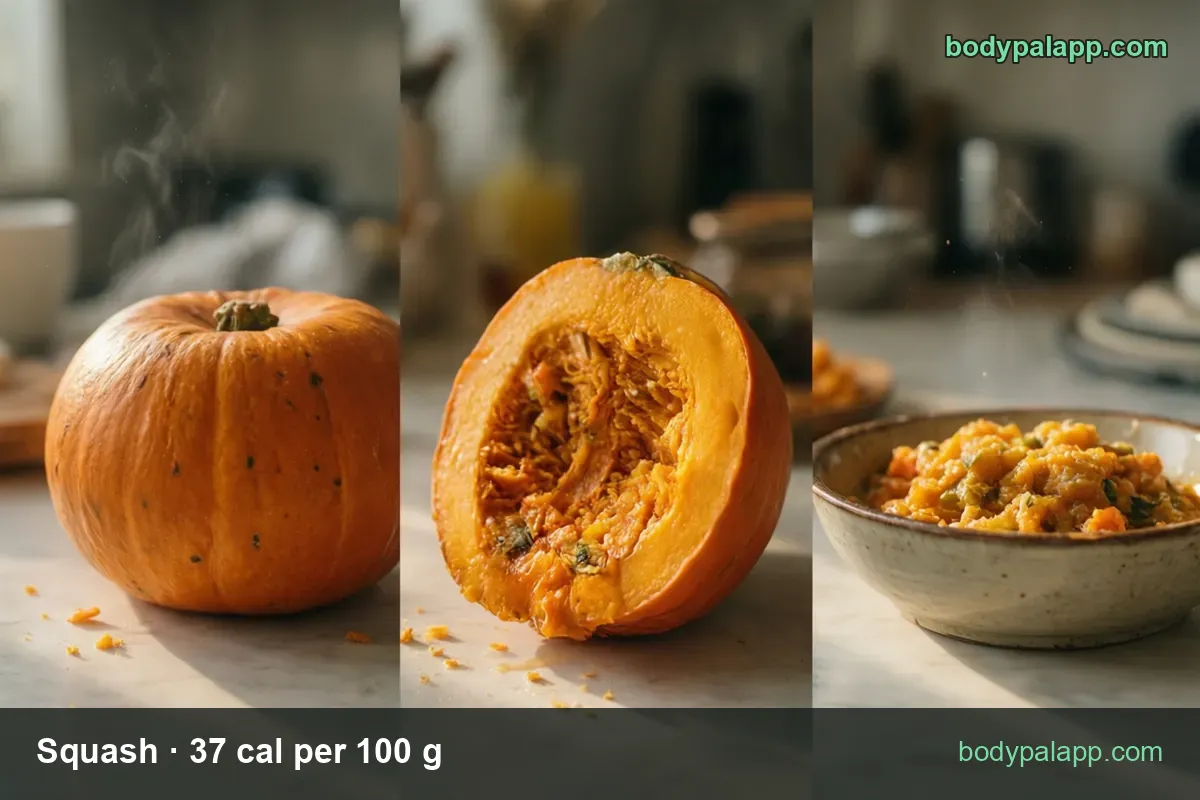
The first is cooking, and it moves the number the opposite way from what people expect. Raw winter squash is 26 calories per 100 g against 37 cooked. Nothing was added; water was lost. A cup of raw cubes weighs only 140 g and comes to 36 calories, so raw looks lighter both per gram and per cup, but that is a weight illusion. The same squash, before and after, holds the same energy.
The second is fat, and it moves the number hard. Cooked with fat added, squash is 59 calories per 100 g, and the 230 g cup that USDA measures for it is 136 calories. Against the plain cup at 83, the oil or butter adds 53 calories, more than half again as much as the vegetable itself.
| Version | Per 100 g | Typical portion | Calories |
|---|---|---|---|
| Cooked, no added fat | 37 kcal | 1 cup (225 g) | 83 kcal |
| Cooked with fat added | 59 kcal | 1 cup (230 g) | 136 kcal |
| Raw | 26 kcal | 1 cup cubes (140 g) | 36 kcal |
| Baked, no salt | 37 kcal | 100 g | 37 kcal |
Packaged squash follows the same rule. Plain frozen and fresh butternut from the produce aisle sits between 47 and 59 calories per 100 g, close to the raw and lightly cooked rows above. A mashed butternut product sweetened with brown sugar runs 88 calories per 100 g, which is more than double the plain cooked figure and comes entirely from what the manufacturer stirred in.
Butternut, acorn, spaghetti and summer squash
Variety matters less than most recipe blogs suggest, but it is not nothing. These are all raw except where noted, so compare them with the 26 raw figure above rather than the 37 cooked one.
| Variety | Per 100 g | Typical portion | Calories |
|---|---|---|---|
| Butternut, raw | 45 kcal | 100 g | 45 kcal |
| Acorn, raw | 40 kcal | 1 cup cubes (140 g) | 56 kcal |
| Spaghetti, raw | 31 kcal | 100 g | 31 kcal |
| Spaghetti, cooked | 49 kcal | 100 g | 49 kcal |
| Summer squash, raw | 16 kcal | 1 cup sliced (113 g) | 18 kcal |
Butternut is the starchiest of the group at 11.69 g of carbohydrate per 100 g, which is why it roasts sweet and why it is the variety brands package. Acorn is a step down at 10.42 g and 40 calories; USDA does not publish sugars for that record, so there is no sugar figure to quote for acorn.
Spaghetti squash is the odd one. Raw, it is the lightest winter type here at 31 calories, well under butternut. Cooked, it is 49 per 100 g against 37 for plain cooked winter squash, so the strands are not the low-calorie trick they are sold as once they are on the plate. Summer squash and zucchini are a different vegetable entirely at 16 calories per 100 g raw, less than half of raw butternut or acorn, and a full sliced cup is 18 calories.
Fiber and potassium, not protein
Squash gets talked about as a health food in vague terms. The Daily Values make it specific. One cooked cup delivers 6.3 g of fiber, which is 22% of the FDA Daily Value of 28 g, and 540 mg of potassium, 11% of the 4,700 mg value. Protein is 2.0 g, just 4%.
So the cup is doing a fifth of a day's fiber for 83 calories. That is the strongest thing on the label, and it explains why squash sits well as a side in a meal that already has a protein source rather than as the protein itself. The MyPlate vegetable guidance counts a cup of cooked squash as a full cup toward the vegetable group, and the Dietary Guidelines put most adults at 2 to 3 cups of vegetables a day.
If you are watching sodium, cook it yourself and leave the salt out. The unsalted baked row is 1 mg per 100 g against 117 mg, and the calories are identical at 37.
How does squash compare?
| Vegetable | Per 100 g | US serving | Calories |
|---|---|---|---|
| Winter squash, cooked | 37 kcal | 1 cup (225 g) | 83 kcal |
| Zucchini, raw with skin | 17 kcal | 1 cup sliced (113 g) | 19 kcal |
| Crookneck squash, canned, drained | 13 kcal | 1 cup diced (210 g) | 27 kcal |
| Butternut squash, frozen | 57 kcal | 1/3 package (113 g) | 64 kcal |
Our take: if the goal is bulk for the fewest calories, the summer squashes win outright, and canned crookneck at 13 calories per 100 g is the lightest thing in this table by a wide margin. But winter squash earns its extra calories. It carries 2.8 g of fiber per 100 g against far less in watery summer squash, it holds 240 mg of potassium, and it actually tastes like something when roasted, which matters if a vegetable side has to survive being eaten on a Tuesday. For weight loss, treat winter squash as the starch on the plate rather than the vegetable, and let zucchini fill the space that would otherwise go to rice or potato. The mistake is not the squash; it is the two tablespoons of oil on the sheet pan, which cost more than the vegetable does.
Most popular squash brands in the United States
Ranked by how widely each product appears among foods sold in the United States, from the BodyPal food database of over 3.3 million products. Calories are the figures printed on each Nutrition Facts label, checked against USDA FoodData Central.
| Product | Calories (per 100 g) |
|---|---|
| Earthbound Farm Kabocha Squash | 35 cal |
| Green Giant Butternut Squash Riced Veggies | 59 cal |
| Alexia Mashed Butternut Squash with Brown Sugar | 88 cal |
| Pictsweet Farms Butternut Squash | 58 cal |
| Green Giant Fresh Butternut Squash | 47 cal |
| Archer Farms Butternut Squash | 47 cal |
Brand popularity: BodyPal food database. Nutrition: manufacturer labels / USDA FoodData Central.
Squash FAQs
How many calories are in 1 cup of cooked squash?
A 1-cup serving of cooked winter squash, 225 g, is 83 calories, which works out to 37 per 100 g. Half a cup, 113 g, is 42 calories. That figure assumes no added fat in the pan, which is how the USDA record is defined, so butter or oil sits on top of it.
How many calories in raw squash?
Raw winter squash is 26 calories per 100 g, and a 1-cup measure of raw cubes at 140 g comes to 36 calories. Raw looks lighter per gram only because it still holds its water. Cooking drives some of that off, which is why the cooked figure climbs to 37 per 100 g.
Is squash good for weight loss?
At 37 calories per 100 g with 2.8 g of fiber, cooked squash is one of the cheaper ways to fill a plate. A full cup is 83 calories and carries 6.3 g of fiber, 22% of the Daily Value. Leave the added fat out and the cup stays under a hundred calories.
How many carbs are in squash?
A cooked cup carries 19.8 g of carbohydrate, 7% of the Daily Value, of which 6.3 g is fiber and 7.4 g is sugar. Per 100 g that is 8.82 g. Butternut is the starchiest common variety, at 11.69 g of carbohydrate per 100 g raw against 10.42 g for acorn.
Butternut vs acorn squash: which has fewer calories?
Acorn is lighter, at 40 calories per 100 g raw against 45 for butternut. A cup of raw acorn cubes, 140 g, is 56 calories. Butternut carries more carbohydrate too, 11.69 g per 100 g versus 10.42 g for acorn, and that difference is where nearly all of the calorie gap comes from.
Does roasting squash add calories?
Roasting adds none on its own: baked winter squash without salt is 37 calories per 100 g, the same as squash cooked with no added fat. Oil is what moves the number. Cooked with fat added, squash is 59 calories per 100 g, and the 230 g cup comes to 136 calories.
How much fiber is in a cup of squash?
One cup of cooked squash, 225 g, has 6.3 g of fiber, which is 22% of the 28 g Daily Value, or 2.8 g per 100 g. The same cup brings 540 mg of potassium, 11% of the Daily Value. Protein is only 2.0 g, so this is a fiber vegetable, not a protein one.
Is spaghetti squash lower in calories than winter squash?
Raw spaghetti squash is 31 calories per 100 g, lighter than raw butternut at 45 and raw acorn at 40. Cooked, that edge is gone: spaghetti squash is 49 per 100 g against 37 for winter squash cooked with no added fat, so the strands are not automatically the lighter choice.
Similar foods
- Delicata Squash — 76 cal per cup
- Enoki Mushrooms — 24 cal per cup whole
- Broccoli Sprouts — 10 cal per half cup
- Brussels Sprouts — 28 cal per half cup
- Yellow Onion — 54 cal per medium onion
- Broccoli — 55 cal per cup chopped
Count it without the math
Point the camera at the plate and BodyPal counts the squash for you, oil and all.


How long does it take to burn off squash?
A 1-cup (225 g) cooked serving is 83 kcal. Enter your weight and the amount you ate to see how long it takes you to burn that off:
lb
| Activity | Time to burn 83 kcal |
|---|---|
| Walking, brisk | 17 min |
| Cycling, moderate | 10 min |
| Swimming, moderate | 12 min |
| Jogging | 10 min |
| Weight training, moderate | 18 min |
Times are for a 155 lb adult at a steady pace; change the weight to see yours. The amount is set to the portion in the text (225 g); change it to what you actually ate. BodyPal works this out from your steps automatically.
Want the bigger picture? Calculate your daily calorie needs — your maintenance figure, a target for losing or gaining, and the date you get there.