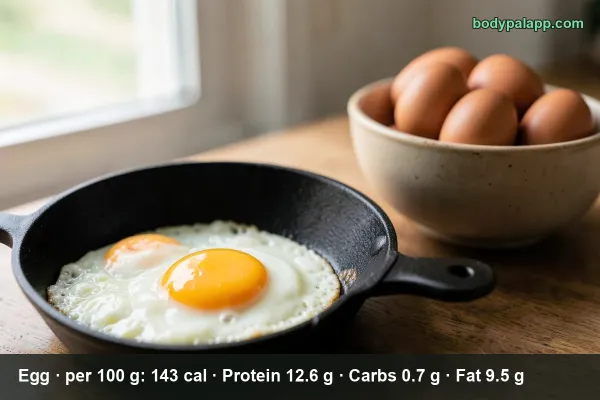
Extra large egg calories come to 80 for one 56 g egg and 143 per 100 g. The split is the thing to notice: fat supplies 62% of those calories and protein 36%, while carbs barely register at 0.4 g per egg. Size moves the total too, with a large egg at 72 and a jumbo at 90.
80kcal
1 extra large egg · 56 g, whole, raw
36%protein
7 gProtein
0 gCarbs
5.3 gFat
How to burn off 80 kcal
—Walking, brisk
—Jogging
—Cycling, moderate
—Swimming
Skip the math. BodyPal counts these calories from your steps and workouts automatically.
Nutrition facts
Whole, raw · per 56 g
Calories
80 kcal
Protein
7 g
Carbohydrate
0.4 g
Fat
5.3 g
Saturated fat
1.8 g
Cholesterol
208 mg
Sodium
80 mg
Potassium
77 mg
Iron
1 mg
Source: USDA FoodData Central
🛡️
Verified nutrition data
Numbers on this page come from USDA FoodData Central, the U.S. Department of Agriculture’s food composition database, and from manufacturer labels where a branded product is named. Last verified September 2026. How we verify our data →
Extra large egg: calories, protein and sodium by serving
Percent of daily value uses the FDA reference of 2,000 kcal a day.
Serving
kcal
Protein
Carbs
Fat
Sodium
% DV kcal
1 extra large (56 g)
80
7 g
0.4 g
5.3 g
80 mg
4%
1 large (50 g)
72
6.3 g
0.4 g
4.8 g
71 mg
4%
1 jumbo (63 g)
90
7.9 g
0.5 g
6 g
89 mg
5%
100 g
143
12.6 g
0.7 g
9.5 g
142 mg
7%
3 × 1 extra large (56 g)
240
21.1 g
239 mg
5 × 1 extra large (56 g)
400
35.2 g
398 mg
Two extra large eggs make a 160-calorie breakfast
One extra large egg weighs 56 g and carries 80 calories, 7 g of protein and 5.3 g of fat. That is 4% of the daily calorie value and 14% of the 50 g protein value. Small numbers on their own, which is why the count of eggs on the plate matters far more than anything else about them.
Scale it up and the math stays tidy. Two eggs come to 160 calories with 14.1 g of protein. Three reach 240 calories and 21.1 g of protein, a solid omelet. Five, the kind of batch some people scramble after a workout, land at 400 calories, 35.2 g of protein and 398 mg of sodium.
Egg size is the quieter variable. Swap extra large for large and each egg drops to 72 calories; go jumbo and it climbs to 90 with 7.9 g of protein. Across a three-egg plate those gaps add up, so check the size printed on the carton before you log, because the label on the box is the only reliable clue.
Fat supplies 62% of the calories
Per 100 g, an extra large egg has 9.5 g of fat, 12.6 g of protein and only 0.7 g of carbohydrate. There is less fat than protein by weight, yet gram for gram fat carries more energy, so it ends up supplying 62% of the calories while protein supplies 36%. Carbs account for just 2%.
That makes the egg a protein food with a fat-heavy calorie profile. Still, 7 g of protein for 80 calories is a strong trade, and a single egg covers 14% of the protein daily value. Sugar is a rounding error at 0.2 g per egg, and fiber is 0.
These figures describe the whole egg, raw, as the USDA row "Egg, whole, raw, fresh" lists it. Cooking in butter or oil adds calories the egg itself does not have, so log the cooking fat as its own line. A dry nonstick pan or a pot of boiling water keeps the plate close to the numbers above.
Cholesterol is the row to watch
Most rows on this label are modest. Sodium is 80 mg per egg, just 3% of the 2300 mg daily value, and saturated fat is 3.1 g per 100 g against a daily value of 20 g. Cholesterol is the outlier: 372 mg per 100 g, which is above the entire 300 mg daily value used on this page.
An extra large egg weighs 56 g, so a single egg holds less than that 100 g figure, but cholesterol remains the most striking number in the nutrition table. If you track cholesterol, eggs are the item to count with care, and how many you eat matters more than which size you buy.
The other rows stay quiet. Potassium is 138 mg per 100 g against a 4700 mg daily value, so eggs are not a meaningful source. Sodium stays low even in bulk: five extra large eggs add up to 398 mg before any salt goes on, which leaves the salt shaker as the bigger sodium decision.
Eggs need a fiber partner on the plate
With 0.4 g of carbs and 0 g of fiber per egg, eggs bring protein and fat and very little else. Pairing them with vegetables, beans, fruit or whole-grain toast fills the gap the egg leaves at zero. Spinach, peppers and tomatoes fold into a scramble without adding much to the calorie count.
For calorie counting, the egg is the easy part. Two extra large eggs at 160 calories leave room for toast and fruit in a modest breakfast; cheese, bacon and cooking fat are what push the total up. BodyPal can log the whole plate from a photo, which helps when the eggs share space with several other foods.
Brand cartons such as Kroger Extra Large Eggs, Lucerne Farms Grade AA Extra Large Eggs and Hickman's Family Farms Extra Large Eggs appear in the brand table on this page. When you do not know the brand, the generic numbers here are a fair stand-in for a plain extra large egg.
How does extra large egg compare?
Here is how an extra large egg stacks up against our generic egg and soft egg pages, per 100 g and per usual serving.
Verdict: On calories it is a dead heat: all three land at 143 per 100 g, so choose by how you like your eggs, not by the count. For the most protein pick the extra large or plain egg at 12.6 g, and if you watch sodium the soft egg edges ahead at 129 mg versus 142 mg.
Most popular extra large egg brands in the United States
Ranked by popularity in the BodyPal database
# Productkcal / 100 g
1Rocky Mountain Eggs Grade AA Extra Large Eggs1 egg · 56 g143 kcal
2Kroger Extra Large Eggs1 egg · 56 g143 kcal
3Checkerbloom Farms Extra Large Eggs1 egg · 56 g143 kcal
4Gravel Ridge Farms Extra Large Eggs1 egg · 56 g143 kcal
5Target Fresh Extra Large Eggs1 egg · 56 g143 kcal
6Lucerne Farms Grade AA Extra Large Eggs56 g143 kcal
7Hickman's Family Farms Extra Large Eggs1 egg · 56 g143 kcal
About 80 calories for a 56 g extra large egg, with 7.0 g protein and 5.3 g fat.
Is an extra large egg good for weight loss?
One extra large egg has 80 calories, 7.0 g protein and 0.4 g carbs.
Extra large egg vs large egg calories?
Both have 143 calories per 100 g; an extra large egg weighs 56 g for 80 calories, a large egg 50 g for about 72.
How much protein is in an extra large egg?
An extra large egg has 7.0 g protein, which is 12.6 g per 100 g.
How many calories are in 5 extra large eggs?
Five extra large eggs contain 400 calories. They also bring 35.2 g of protein and 398 mg of sodium, and weigh 280 g in total. Any butter, oil or cheese used in cooking comes on top of that.
What are the nutrition facts for an extra large egg?
One extra large egg (56 g) has 80 calories, 7 g of protein, 5.3 g of fat, 0.4 g of carbs, 0.2 g of sugar and 80 mg of sodium. Per 100 g it carries 372 mg of cholesterol.
What are the macros of an extra large egg?
By calories, an extra large egg is 62% fat, 36% protein and 2% carbs. Per 100 g that works out to 9.5 g of fat, 12.6 g of protein and 0.7 g of carbohydrate.
How many calories are in a very large or jumbo egg?
A jumbo egg (63 g) has 90 calories, compared with 80 for an extra large egg. It also carries 7.9 g of protein, 6 g of fat and 89 mg of sodium, or 16% of the protein daily value.