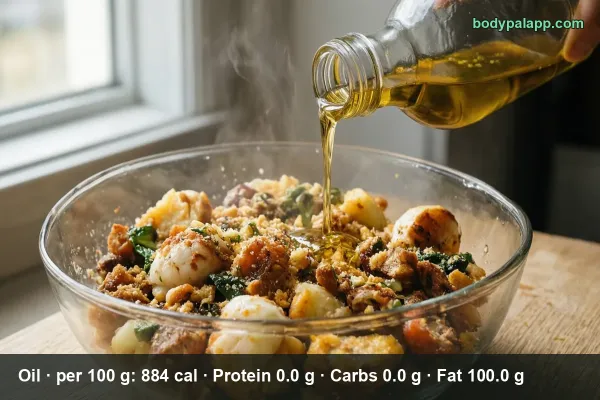
Extra virgin olive oil calories come to 119 for 1 tablespoon (13.5 g) and 884 per 100 g. All of that energy is fat: 100% of the calories, with 0 g protein, 0 g carbs and 0 g sugar. The label is simple. The real variable is how much leaves the bottle, because an unmeasured pour climbs fast.
119kcal
1 tablespoon · 13 g, extra virgin, as bottled
0%protein
0 gProtein
0 gCarbs
13.5 gFat
How to burn off 119 kcal
—Walking, brisk
—Jogging
—Cycling, moderate
—Swimming
Skip the math. BodyPal counts these calories from your steps and workouts automatically.
Nutrition facts
Extra virgin, as bottled · per 13 g
Calories
119 kcal
Protein
0 g
Carbohydrate
0 g
Fat
13.5 g
Saturated fat
1.9 g
Cholesterol
0 mg
Sodium
0 mg
Potassium
0 mg
Iron
0.1 mg
Source: USDA FoodData Central
🛡️
Verified nutrition data
Numbers on this page come from USDA FoodData Central, the U.S. Department of Agriculture’s food composition database, and from manufacturer labels where a branded product is named. Last verified September 2026. How we verify our data →
Extra virgin olive oil: calories, protein and sodium by serving
Percent of daily value uses the FDA reference of 2,000 kcal a day.
Serving
kcal
Protein
Carbs
Fat
Sodium
% DV kcal
1 tablespoon (13.5 g)
119
0 g
0 g
13.5 g
0 mg
6%
1 teaspoon (4.5 g)
40
0 g
0 g
4.5 g
0 mg
2%
1 cup (216 g)
1,909
0 g
0 g
216 g
4 mg
95%
100 g
884
0 g
0 g
100 g
2 mg
44%
3 × 1 tablespoon (13.5 g)
358
0 g
1 mg
5 × 1 tablespoon (13.5 g)
597
0 g
1 mg
A teaspoon is 40 calories, a cup is 1,909
A measured tablespoon weighs 13.5 g and carries 119 calories, about 6% of the daily calorie value used on this page. A teaspoon (4.5 g) drops that to 40. That gap matters more than it looks, because most recipes that say "a drizzle" could be done with a teaspoon, and most people pour closer to a tablespoon or more.
Free pouring is where the total runs away. Two tablespoons (27 g) come to 239 calories. Three tablespoons (41 g) reach 358. Five tablespoons (68 g), a realistic amount for a pan of roasted vegetables or a big homemade dressing, add up to 597. None of these amounts look large in a pan, and that is exactly the problem.
At the extreme, a full cup (216 g) is 1,909 calories, or 95% of the daily calorie value. Nobody eats a cup at once, but a cup spread across a week of cooking for one person shows how a bottle quietly becomes a meaningful part of the diet. The fix is boring and effective: use a measuring spoon for a week, and you will learn what your usual pour actually is.
Every calorie in the bottle is fat
The calorie split is 100% fat, 0% protein and 0% carbs. Per 100 g there are 100 g of fat, 0 g of protein, 0 g of carbs, 0 g of fiber and 0 g of sugar. A tablespoon holds 13.5 g of fat and a teaspoon holds 4.5 g, against a daily value for fat of 78 g.
That makes olive oil one of the most calorie-dense foods in any kitchen. It adds flavor and helps food brown, but it adds nothing that fills a plate or a stomach on its own. Calories from oil arrive without volume, so they are easy to eat without noticing.
Saturated fat is 13.8 g per 100 g, measured against a daily value of 20 g. The rest of the fat is not saturated, which is the main way olive oil differs from butter or lard. Branded bottles such as Filippo Berio Extra Virgin Olive Oil and De Cecco Extra Virgin Olive Oil appear in the brand table on this page if you want to check a specific label.
Sodium, cholesterol and sugar are near zero
If you watch sodium, oil is not where it comes from. There are 2 mg per 100 g, 0 mg in a tablespoon and 4 mg in a full cup, which rounds to 0% of the 2300 mg daily value. Cholesterol is 0 mg and potassium is 1 mg per 100 g.
That clean label is the flip side of the macros. Olive oil brings almost no minerals, no fiber and no protein to the table. Its job is fat and flavor, and the numbers say exactly that.
So when a dish built with olive oil turns out salty or sugary, look elsewhere: the dressing base, the cheese, the bread, the cured meat. The oil itself only adds calories. That makes it easy to account for, as long as the amount is known.
Measure the oil, then build around it
The best use of olive oil is as a carrier for foods that bring the volume. A teaspoon at 40 calories is enough to coat a tray of vegetables or season a pot of beans, and those foods add the fiber and protein the oil lacks. A tablespoon at 119 dresses a large salad.
Where it gets expensive is in combination. A salad with 3 tablespoons of oil already sits at 358 calories before any cheese, nuts or croutons. If you are counting, decide the oil amount first and fit the rest of the plate around it, rather than adding oil to taste at the end.
Cooking habits matter too. Pans soak up oil, and a splash that feels small can be 2 tablespoons. If tracking by hand feels tedious, BodyPal can log a dish from a photo, but a measuring spoon next to the stove remains the most reliable tool for this particular food.
How does extra virgin olive oil compare?
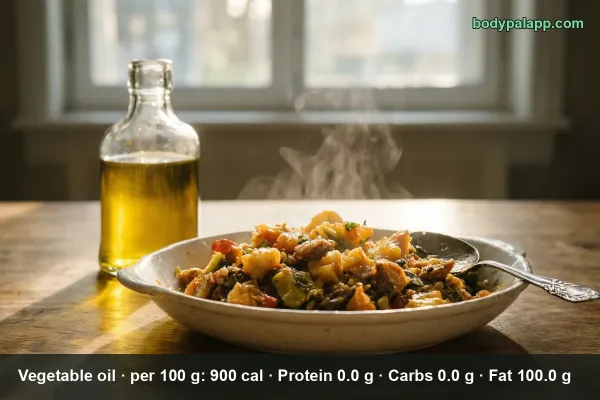
Here is extra virgin olive oil next to avocado oil, generic oil and vegetable oil, per 100 g and per usual serving.
Verdict: Per 100 g, extra virgin olive oil, avocado oil and generic oil all sit at 884 calories and vegetable oil at 900, so swapping oils saves nothing worth counting. Choose by flavor and cooking use, and cut calories by measuring: a teaspoon at 40 beats any swap.
Most popular extra virgin olive oil brands in the United States
Labels state calories per 15 ml tablespoon and round them, so their per-100 figures differ slightly from the number above. Source: manufacturer labels / USDA FoodData Central.
Extra virgin olive oil FAQs
How many calories are in a tablespoon of extra virgin olive oil?
About 119 calories in one tablespoon (13.5 g), and 40 in one teaspoon (4.5 g).
Is extra virgin olive oil good for weight loss?
It is calorie dense at 884 calories per 100 g, so one tablespoon adds 119 calories. All of it comes from 13.5 g of fat, with 0 g of carbs and protein.
Extra virgin olive oil vs avocado oil: which has fewer calories?
They are the same: both list 884 calories per 100 g.
How much fat is in extra virgin olive oil?
It is 100 g of fat per 100 g, so one tablespoon (13.5 g) has 13.5 g of fat and 0 g of carbs.
How many calories are in a teaspoon of extra virgin olive oil?
A teaspoon (4.5 g) of extra virgin olive oil has 40 calories, all from 4.5 g of fat. Using a teaspoon instead of a tablespoon saves a lot, since a tablespoon is 119.
How many calories are in 2 tablespoons of olive oil?
Two tablespoons (27 g) of extra virgin olive oil come to 239 calories. Three tablespoons (41 g) reach 358, which is common in a homemade dressing or a pan of roasted vegetables.
How many calories are in a cup of extra virgin olive oil?
A cup (216 g) of extra virgin olive oil contains 1,909 calories and 216 g of fat. That is 95% of the daily calorie value used on this page.
Does extra virgin olive oil have carbs or sugar?
No. Extra virgin olive oil has 0 g of carbs, 0 g of sugar and 0 g of fiber per 100 g. It also has 0 g of protein, so 100% of its calories come from fat.
How much saturated fat is in extra virgin olive oil?
Extra virgin olive oil has 13.8 g of saturated fat per 100 g, against a daily value of 20 g. The remaining fat in the 100 g total is not saturated.