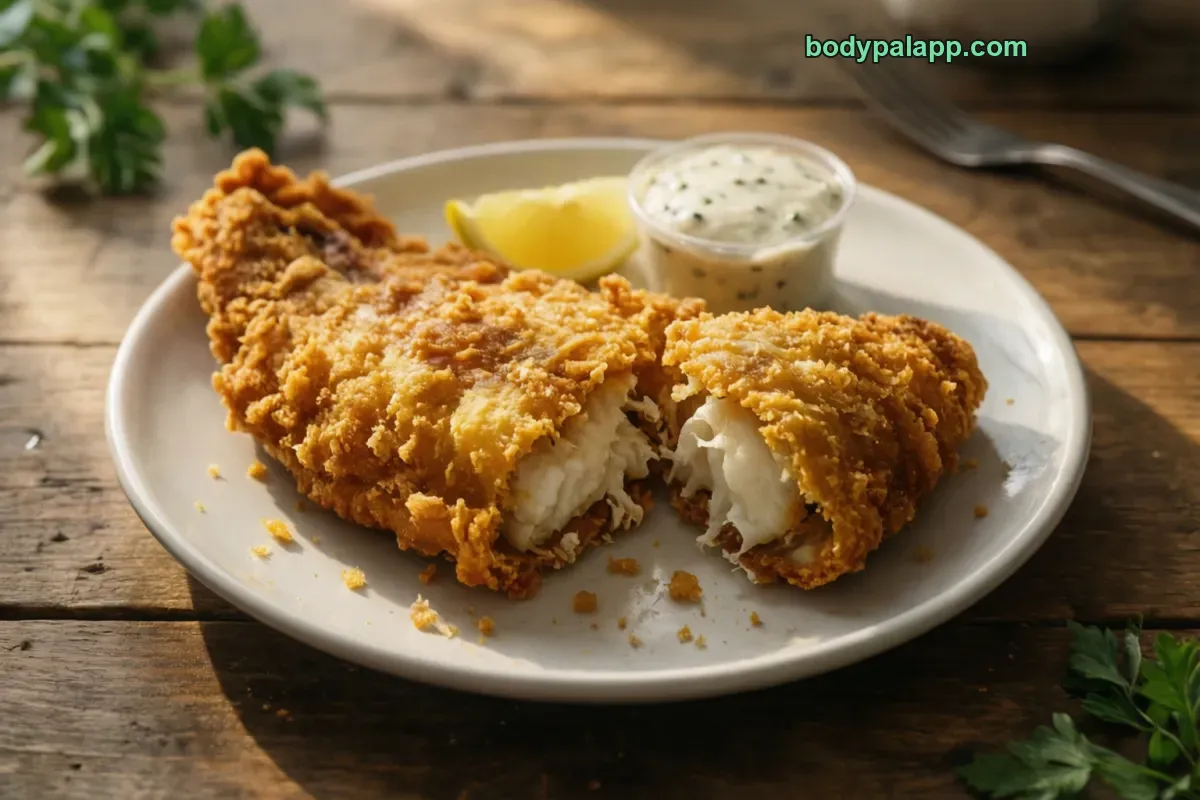
Fried fish fillet calories come to 495 for one 226 g restaurant serving and 219 per 100 g. Sodium is the number that stands out. That single plate carries 1,268 mg, or 55% of the daily value, which is more than half a day's salt before you add tartar sauce or fries.
495kcal
1 restaurant serving · 226 g, battered or breaded, fried
25%protein
30 gProtein
38 gCarbs
24 gFat
How to burn off 495 kcal
—Walking, brisk
—Jogging
—Cycling, moderate
—Swimming
Skip the math. BodyPal counts these calories from your steps and workouts automatically.
Nutrition facts
Battered or breaded, fried · per 226 g
Calories
495 kcal
Protein
30 g
Carbohydrate
38 g
Fat
24 g
Saturated fat
4.2 g
Cholesterol
81 mg
Sodium
1268 mg
Potassium
567 mg
Iron
0.9 mg
Source: USDA FoodData Central
🛡️
Verified nutrition data
Numbers on this page come from USDA FoodData Central, the U.S. Department of Agriculture’s food composition database, and from manufacturer labels where a branded product is named. Last verified September 2026. How we verify our data →
Fried fish fillet: calories, protein and sodium by serving
Percent of daily value uses the FDA reference of 2,000 kcal a day.
Serving
kcal
Protein
Carbs
Fat
Sodium
% DV kcal
1 serving (226 g)
495
30.5 g
38.2 g
24.4 g
1,268 mg
25%
Cod fillet (140 g)
304
18.9 g
16.4 g
17.5 g
596 mg
15%
3 oz portion (85 g)
186
11.5 g
14.4 g
9.2 g
477 mg
9%
100 g
219
13.5 g
16.9 g
10.8 g
561 mg
11%
3 × 1 serving (226 g)
1,485
91.5 g
3,804 mg
5 × 1 serving (226 g)
2,475
152.4 g
6,339 mg
A restaurant plate is a 495-calorie meal
The default serving here is the family-restaurant plate of 226 g. It lands at 495 calories with 30.5 g of protein, which is 25% of the daily calorie value in one go. A single cod fillet of 140 g comes in at 304 calories, and a 3 oz portion of 85 g is 186 calories. It's the same food with three very different totals.
Plate size moves the number, not the fish. A second serving doubles everything: 452 g brings 990 calories and 2,536 mg of sodium. Three servings, the kind of total a shared platter can reach, add up to 1,485 calories and 3,804 mg of sodium.
If you want fried fish without a full-meal total, the 3 oz portion is the practical choice. It keeps calories at 186 and sodium at 477 mg, which is 21% of the daily value. It still gives you 11.5 g of protein. Add vegetables to the plate rather than a second piece.
Fat supplies 44% of the calories
Batter and fryer oil change what fish delivers. In this fried fillet, fat supplies 44% of the calories, carbs 31% and protein only 25%. Per 100 g that works out to 10.8 g of fat, 16.9 g of carbs and 13.5 g of protein.
The carbs come almost entirely from the coating. There are just 0.5 g of sugars and 0.9 g of fiber per 100 g, so this is refined starch from the breading, not anything sweet. Saturated fat stays modest at 1.9 g per 100 g, and cholesterol is 36 mg.
The protein is still respectable. The full serving delivers 30.5 g, or 61% of the daily value, and even the 3 oz portion gives 11.5 g. You pay for that protein with more fat and starch than the fish alone would bring. That is the trade-off with any battered seafood.
Sodium is the row to watch
At 561 mg per 100 g, sodium is the standout on this label. The full 226 g serving holds 1,268 mg, which is 55% of the daily value. Calories take up only 25% of their daily value, so salt fills the day much faster. Seasoned batter and restaurant prep both add to it.
Smaller cuts bring the sodium down with them. A cod fillet of 140 g carries 596 mg, or 26% of the daily value, and the 3 oz portion has 477 mg, or 21%. If you watch sodium, portion size is the lever you control most directly.
Sides count too. Tartar sauce, fries and coleslaw are usually seasoned as well, so a fried fish plate can push the day's sodium up quickly. Squeezing lemon on the fish instead of using sauce and choosing a plain vegetable side keep the plate close to what the fish alone contributes.
Build the rest of the plate around fiber
Fried fish brings protein and fat but very little fiber: 2 g in the full serving and 0.9 g per 100 g. That leaves room for vegetables, beans or a whole-grain side. They fill the gap and add volume without many extra calories.
Treat a full serving as the main event of a meal, not a snack. At 495 calories it already covers 25% of the daily calorie value, so lighter sides make sense. A green salad, steamed broccoli or a slaw with vinegar dressing balances the fried coating better than fries do.
Packaged options such as Gorton's Air Fried Fish Fillets are another route at home, but check their own label, since the figures here describe the restaurant version. If you want to track the whole plate, BodyPal can log it from a photo.
How does fried fish fillet compare?
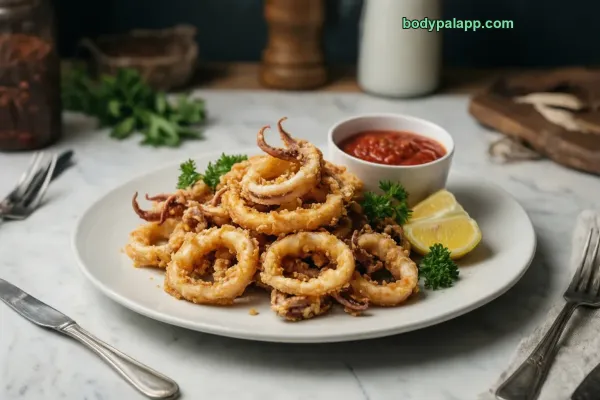
Here is how fried fish fillet compares with fried tilapia, fried calamari and a fried pork chop, per 100 g and per usual serving.
Verdict: For the fewest calories per 100 g, fried fish fillet wins at 219, while tilapia, calamari and pork chop all come in about 1.1 times higher, though a 90 g tilapia fillet at 213 calories is the smallest serving. For staying full, pick the fried pork chop, which has 27.6 g of protein per 100 g and just 94 mg of sodium, compared with 561 mg here.
Most popular fried fish fillet brands in the United States
Ranked by popularity in the BodyPal database
# Productkcal / 100 g
1Gorton's Air Fried Fish Fillets2 fillets · 110 g173 kcal
Packaged air-fried fillets carry a lighter coating than restaurant battered fish, so their label reads lower than the main number. Source: manufacturer labels / USDA FoodData Central.
Fried fish fillet FAQs
How many calories are in a fried fish fillet?
A restaurant serving of battered or breaded fried fish fillet (226 g) has about 495 calories. A single fried cod fillet (140 g) has about 304.
Is fried fish good for weight loss?
Fried fish fillet has 219 calories and 10.8 g of fat per 100 g. A 3 oz portion (85 g) comes to about 186 calories.
Fried fish fillet vs fried tilapia: which has fewer calories?
Battered fried fish fillet has 219 calories per 100 g and fried tilapia has 237, so the two are close.
How much protein is in a fried fish fillet?
A 226 g serving has about 30.5 g of protein and 38.2 g of carbs, much of the carbs from the batter. Per 100 g: 13.5 g of protein.
How many calories are in a 3 oz piece of fried fish?
A 3 oz portion (85 g) of fried fish fillet has 186 calories. It also carries 11.5 g of protein, 9.2 g of fat and 14.4 g of carbs, which makes it the lightest serving listed here.
How many calories are in a fried cod fillet?
A fried cod fillet of 140 g has 304 calories, or 15% of the daily value. It brings 18.9 g of protein, 17.5 g of fat and 596 mg of sodium, well below the full restaurant plate.
How much sodium is in fried fish?
Fried fish fillet has 561 mg of sodium per 100 g. A full 226 g restaurant serving reaches 1,268 mg, which is 55% of the daily value, so sodium is the first row to check.
How many carbs are in a fried fish fillet?
A full 226 g serving of fried fish fillet has 38.2 g of carbs, nearly all from the batter or breading. Per 100 g it is 16.9 g, with only 0.5 g of sugars and 0.9 g of fiber.
How many calories are in two fried fish fillets?
Two full servings of fried fish fillet, 452 g in total, come to 990 calories. The pair also carries 2,536 mg of sodium and 61 g of protein, so a double order adds up quickly.