
How many calories are in fish roe?
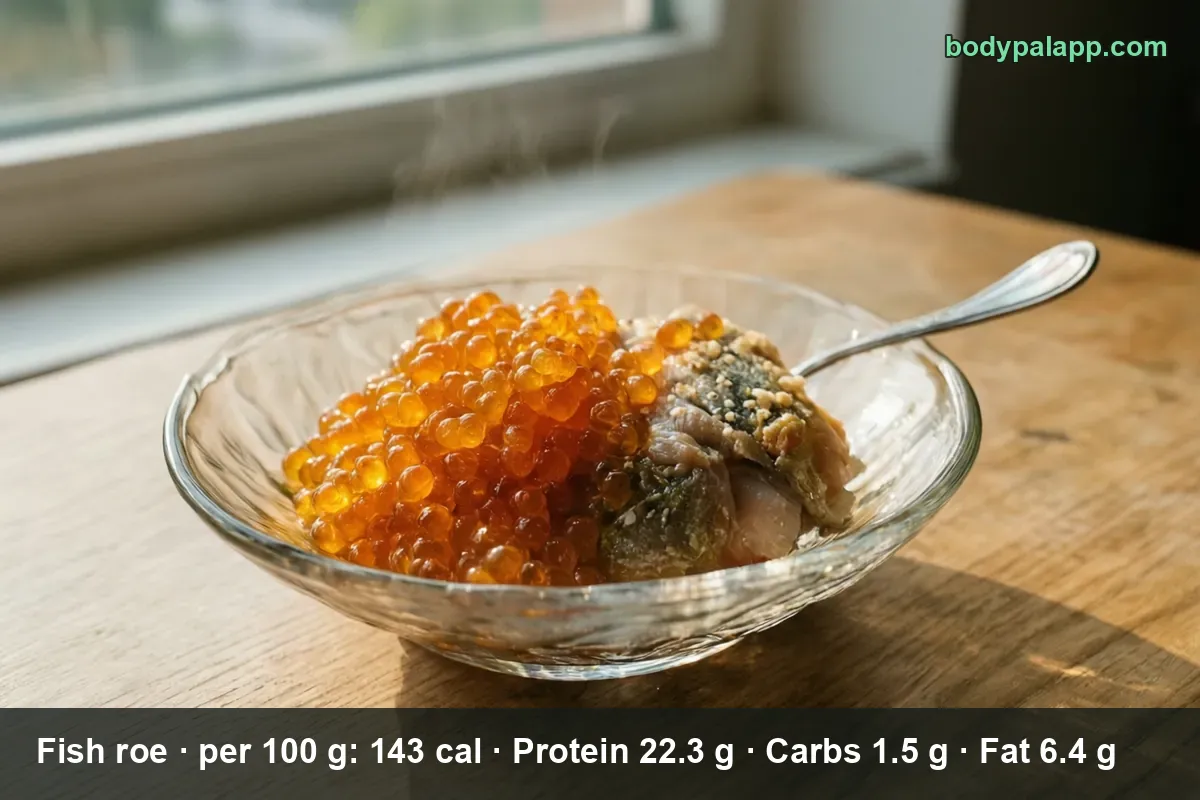
A tablespoon of fish roe is 20 calories. Raw roe runs 143 calories per 100 g, so the orange beads you spoon over rice, toast or a bowl of noodles cost far less than most people guess. A 3-ounce portion, the size a sushi bar plates, is 122 calories with 19.0 g of protein.
On this page
- Fish roe quick facts
- US servings from one tablespoon to an 8 oz can
- Cooked roe runs 204 calories per 100 g
- Cholesterol is the row to watch
- How does fish roe compare to salmon and tuna?
- Most popular fish roe brands
- Fish roe FAQs
Fish roe quick facts
The number here comes from the USDA record 175132, "Fish, roe, mixed species, raw", an SR Legacy entry that averages the roe of the species sold in US markets. Raw is the right line for almost everyone searching this. Roe reaches the plate cold: spooned onto a hand roll, dropped on a blini, stirred through pasta at the last second. Heat is the exception, not the rule, so the cooked record lives further down the page as a variant rather than as the headline.
One level tablespoon of roe weighs 14 g. That is the unit people actually use, and every %DV below is calculated for that spoon against the FDA's Daily Values for a 2,000-calorie diet.
| Nutrient | Per 100 g | Per 1 tbsp (14 g) | % Daily Value |
|---|---|---|---|
| Calories | 143 | 20 | — |
| Total fat | 6.42 g | 0.9 g | 1% |
| Saturated fat | 1.46 g | 0.2 g | 1% |
| Carbohydrate | 1.5 g | 0.2 g | 0% |
| Dietary fiber | 0 g | 0 g | 0% |
| Total sugars | 0 g | 0 g | — |
| Protein | 22.32 g | 3.1 g | 6% |
| Sodium | 91 mg | 13 mg | 1% |
| Cholesterol | 374 mg | 52 mg | 17% |
| Potassium | 221 mg | 31 mg | 1% |
% Daily Value is based on a 2,000-calorie diet.
Verified nutrition data
Numbers on this page come from USDA FoodData Central, the U.S. Department of Agriculture’s food composition database, and from manufacturer labels where a branded product is named. Last verified September 2026. How we verify our data →
Two rows you would see on a packaged label are missing here on purpose. USDA does not publish added sugars or trans fat for this raw roe record, so writing either as zero would be a guess rather than a measurement. Everything else is measured, including the two rows most fish pages skip: cholesterol at 374 mg per 100 g and potassium at 221 mg.
Read the table sideways for a second and the shape of the food appears. Roe is protein and fat sitting in water, with 1.5 g of carbohydrate per 100 g and no fiber at all. That is why the calorie count stays low while the protein count does not.
US servings from one tablespoon to an 8 oz can
| Serving | Weight | Calories |
|---|---|---|
| 1 tbsp | 14 g | 20 kcal |
| 2 tbsp, a sushi topping | 28 g | 40 kcal |
| 1 oz | 28.35 g | 41 kcal |
| 3 oz | 85 g | 122 kcal |
| 1 can (8 oz), solids and liquid | 227 g | 325 kcal |
| Per 100 g | 100 g | 143 kcal |
The tablespoon and the 8-ounce can are USDA household measures on this record. The 1-ounce, 2-tablespoon and 3-ounce lines are our own arithmetic from the USDA 100 g figure, not USDA servings, but they are the two portions people log most: a spoonful on a roll and a proper appetizer helping.
Notice how little distance there is between a tablespoon and an ounce. Fourteen grams against 28.35 g means the ounce is almost exactly two spoons, so 20 calories becomes 41. That is unusual. With most garnishes, doubling the spoon quietly doubles a number that was already worth watching. Here five tablespoons still add up to only 100 calories.
The can is the outlier and the one worth reading twice. At 227 g of solids and liquid, an 8-ounce can is 325 calories, which is a meal rather than a topping. Very few people eat one alone, but it is the number to have if you are folding a whole can into a pasta sauce for two.
Cooked roe runs 204 calories per 100 g
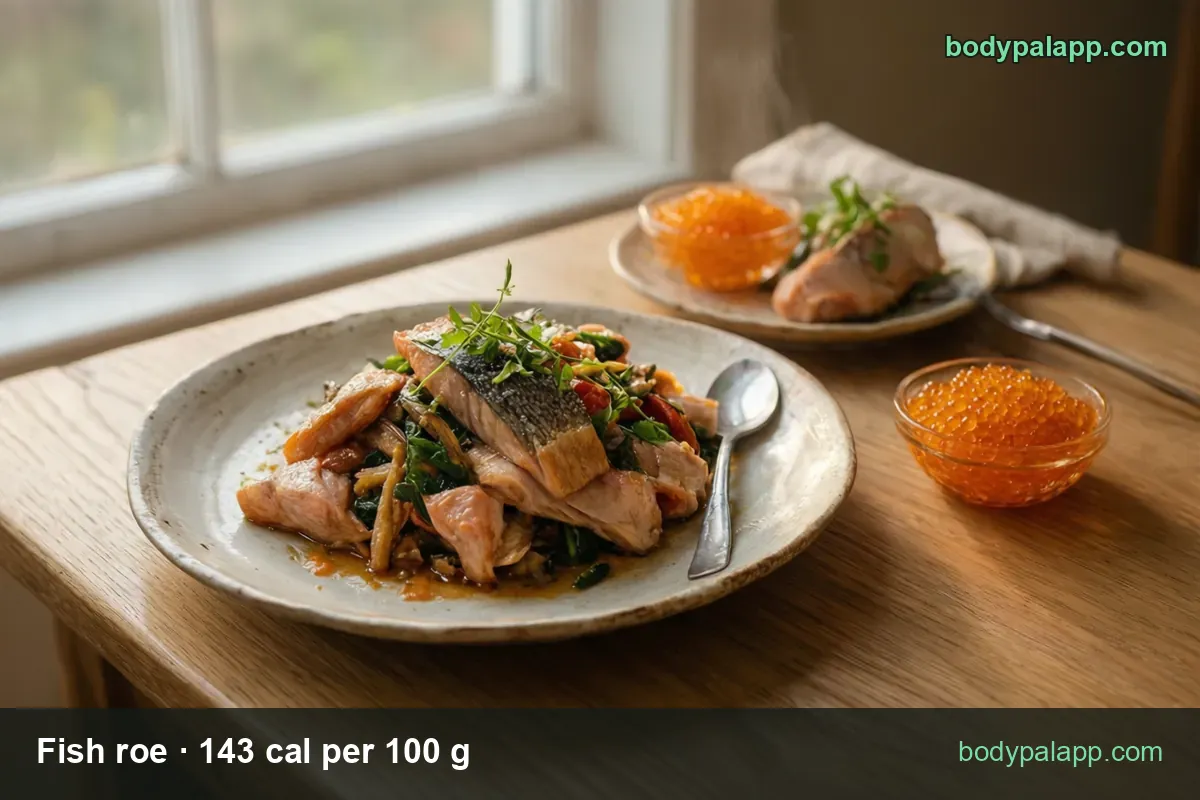
Roe fried in a pan or baked in a shallow dish is a different entry in the database, 174239, "Fish, roe, mixed species, cooked, dry heat".
| Version | Per 100 g | Typical piece | Calories |
|---|---|---|---|
| Raw roe, mixed species | 143 kcal | 1 tbsp (14 g) | 20 kcal |
| Raw roe, mixed species | 143 kcal | 3 oz (85 g) | 122 kcal |
| Cooked roe, dry heat | 204 kcal | 1 oz (28.35 g) | 58 kcal |
| Cooked roe, dry heat | 204 kcal | 3 oz (85 g) | 173 kcal |
Cooking lifts the per-100-g figure from 143 to 204, a jump of 43%, and nothing was added to the pan to do it. Water left. The same eggs, drier, weigh less, so every gram that remains carries more of everything: protein rises from 22.32 g to 28.62 g per 100 g, fat from 6.42 g to 8.23 g, sodium from 91 mg to 117 mg. On a 3-ounce plate that is 173 calories cooked against 122 raw, and about 24.3 g of protein instead of 19.0 g, both scaled by us from the USDA 100 g figures.
The practical version: weigh roe before it hits the heat and you can use the raw line. Weigh it after and you need the cooked line, or you will undercount by roughly a third.
Salmon roe, sold as ikura, gets no separate USDA record, so it is counted on the mixed-species line here. A restaurant portion of two tablespoons on a hand roll is 40 calories and 6.2 g of protein. Cured, jarred and salted products are the one place this page stops being reliable, because packers add salt by the spoonful and the label on the jar will say so.
Cholesterol is the row to watch
Calories are not the interesting number in fish roe. Cholesterol is. Raw roe carries 374 mg per 100 g, which makes a single tablespoon 52 mg, or 17% of the FDA Daily Value of 300 mg. Stack three spoons on a bagel and you are at half a day's worth for 60 calories.
A 3-ounce serving takes it further: 318 mg, or 106% of the Daily Value, from a portion that costs 122 calories. Few common protein foods clear the whole Daily Value in one appetizer portion while staying under 130 calories. If your doctor has asked you to keep an eye on dietary cholesterol, roe is a food to use by the spoon.
Sodium runs the opposite way and surprises people. Raw roe is 91 mg per 100 g, so an ounce carries 26 mg, barely 1% of the 2,300 mg Daily Value. Salted roe tastes salty because of the cure, not because the eggs themselves are a sodium food. The salt is added on the way to the jar.
The protein side is the reason to keep roe in the rotation at all. At 22.32 g per 100 g, roe holds its own among the seafood MyPlate counts in the protein group, and 3 ounces delivers 19.0 g of it, 38% of the 50 g Daily Value, for the calories of a small apple and a half.
How does fish roe compare to salmon and tuna?
| Food | Per 100 g | US serving | Calories |
|---|---|---|---|
| Fish roe, raw | 143 kcal | 3 oz (85 g) | 122 kcal |
| Salmon, Atlantic, wild, raw | 142 kcal | 3 oz (85 g) | 121 kcal |
| Tuna, bluefin, fresh, raw | 144 kcal | 3 oz (85 g) | 122 kcal |
| Salmon, chum, canned, drained | 141 kcal | 3 oz (85 g) | 120 kcal |
Four foods, three calories apart per 100 g. That is the finding here: as raw seafood goes, roe is ordinary on calories and only bluefin tuna beats it on protein, 23.33 g per 100 g against 22.32 g. Wild Atlantic salmon is the lowest of the four at 19.84 g, and canned chum salmon sits between them at 21.43 g.
Our take: treat roe as a protein food that happens to be served in spoonfuls, not as a luxury item with hidden calories. Per gram it is roughly a salmon fillet, and per tablespoon it is cheaper than almost anything else you would put on a cracker. The reason to cap the portion is the cholesterol column, not the calorie column. For volume and satiety at a meal, plate the fillet; for flavor and protein at 20 calories a spoon, use the roe.
Most popular fish roe brands in the United States
Ranked by how widely each product appears among foods sold in the United States, from the BodyPal food database of over 3.3 million products. Calories are the figures printed on each Nutrition Facts label, checked against USDA FoodData Central.
| Product | Calories (per 100 g) |
|---|---|
| Roland Whole Grain Lumpfish Red Caviar | 94 cal |
| Romanoff Red Whitefish Caviar | 133 cal |
| Romanoff Black Lumpfish Caviar | 143 cal |
| Season Red Salmon Caviar | 167 cal |
| Tsar Nicoulai Premium American White Sturgeon Caviar | 267 cal |
| Tsar's Salmon Caviar | 286 cal |
Brand popularity: BodyPal food database. Nutrition: manufacturer labels / USDA FoodData Central.
Fish roe FAQs
How many calories are in fish roe?
Raw fish roe is 143 calories per 100 g, and a 1-tablespoon (14 g) spoonful is 20 calories. That is the USDA figure for mixed-species roe eaten raw, the way roe usually reaches the plate. A 3-ounce (85 g) portion, closer to a sushi-bar serving, works out to 122 calories.
How many calories are in a tablespoon of fish roe?
One tablespoon of raw roe weighs 14 g and carries 20 calories, with 3.1 g of protein and 0.9 g of fat. It also brings 52 mg of cholesterol, 17% of the FDA Daily Value, which is the number that climbs fastest as you add spoons to a cracker or a roll.
How many calories are in salmon roe (ikura)?
USDA does not publish a separate record for salmon roe, so ikura is counted on the mixed-species line: 143 calories per 100 g, or 20 calories a tablespoon. A restaurant ikura topping of about 2 tablespoons (28 g) is 40 calories and 6.2 g of protein, by our own scaling.
Does cooking fish roe change the calories?
Yes, cooked with dry heat roe rises from 143 to 204 calories per 100 g, a jump of 43%. Nothing is added; water leaves. A 3-ounce serving goes from 122 calories raw to 173 cooked, and the protein in that serving climbs from 19.0 g to about 24.3 g in the same way.
Is fish roe high in protein?
Very, at 22.32 g of protein per 100 g, which puts it beside bluefin tuna at 23.33 g and above wild Atlantic salmon at 19.84 g. A 3-ounce serving carries 19.0 g, or 38% of the 50 g Daily Value, for 122 calories. Per calorie, few foods do better.
How much cholesterol is in fish roe?
374 mg per 100 g, the fastest-moving row on the label. One tablespoon is 52 mg, or 17% of the Daily Value; a 3-ounce serving is 318 mg, which is 106% of the FDA's 300 mg Daily Value. If you are tracking cholesterol, roe works better as a garnish than as a main course.
Is fish roe high in sodium?
Raw roe is not: 91 mg of sodium per 100 g, 13 mg in a tablespoon, about 1% of the 2,300 mg Daily Value. Cured or jarred roe is effectively a different food, because salt goes in during packing, and the jar's own label will read far higher than this USDA record for raw eggs.
Is fish roe good for weight loss?
At 20 calories a tablespoon, roe is one of the cheapest ways to put protein and flavor on a plate. Three ounces gives 19.0 g of protein for 122 calories and almost no carbohydrate, 1.5 g per 100 g. Cholesterol, not calories, is the reason to keep the portion modest.
Similar foods
- Fish — 129 cal per fillet
- Salmon Roe — 20 cal per tablespoon
- Shrimp And Grits — 300 cal per cup
- Shrimp In Lobster Sauce — 279 cal per cup
- Grilled Calamari — 209 cal per cup
- Calamari Steak — 175 cal per steak
Count it without the math
Point the camera at the plate and BodyPal counts the roe, the rice and the fish underneath it for you.


One food is easy to picture; a whole day is harder. See how many calories you need a day and what a deficit actually looks like.