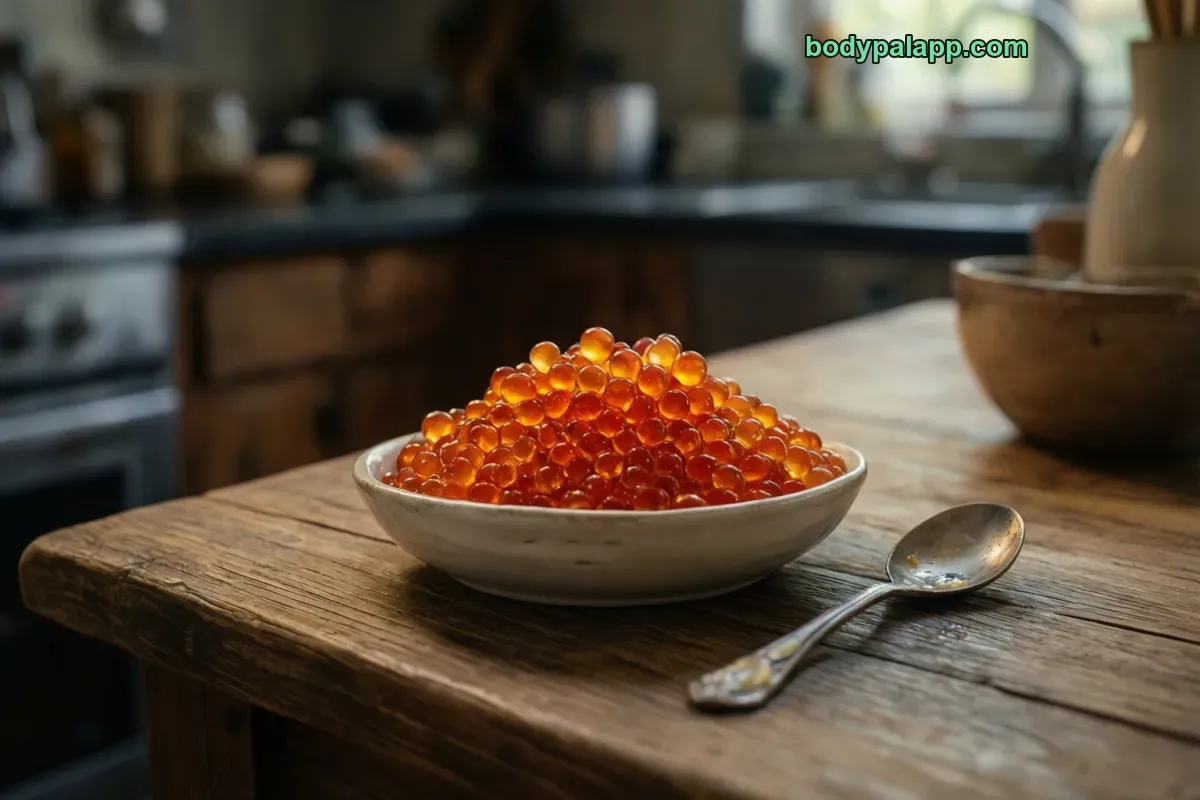
Salmon roe calories come to 20 for a 1 Tbsp (14 g) spoonful and 143 per 100 g. Protein drives most of that, at 58% of the calories, so a 3 oz portion brings 19 g of protein for 122 calories. The number to notice is not calories at all. It is cholesterol, at 374 mg per 100 g.
20kcal
1 tablespoon · 14 g, raw, salmon variety
58%protein
3.1 gProtein
0 gCarbs
0.9 gFat
How to burn off 20 kcal
—Walking, brisk
—Jogging
—Cycling, moderate
—Swimming
Skip the math. BodyPal counts these calories from your steps and workouts automatically.
Nutrition facts
Raw, salmon variety · per 14 g
Calories
20 kcal
Protein
3.1 g
Carbohydrate
0.2 g
Fat
0.9 g
Saturated fat
0.2 g
Cholesterol
52 mg
Sodium
13 mg
Potassium
31 mg
Iron
0.1 mg
Source: USDA FoodData Central
🛡️
Verified nutrition data
Numbers on this page come from USDA FoodData Central, the U.S. Department of Agriculture’s food composition database, and from manufacturer labels where a branded product is named. Last verified September 2026. How we verify our data →
Salmon roe: calories, protein and sodium by serving
Percent of daily value uses the FDA reference of 2,000 kcal a day.
Serving
kcal
Protein
Carbs
Fat
Sodium
% DV kcal
1 Tbsp (14 g)
20
3.1 g
0.2 g
0.9 g
13 mg
1%
1 oz (28 g)
40
6.2 g
0.4 g
1.8 g
25 mg
2%
3 oz portion (85 g)
122
19 g
1.3 g
5.5 g
77 mg
6%
100 g
143
22.3 g
1.5 g
6.4 g
91 mg
7%
3 × 1 Tbsp (14 g)
60
9.4 g
38 mg
5 × 1 Tbsp (14 g)
100
15.6 g
64 mg
One tablespoon is 20 calories, five is 100
Salmon roe is usually served by the spoon, and the math is friendly. One 1 Tbsp (14 g) spoonful is 20 calories, 3.1 g of protein and 0.9 g of fat. Two spoonfuls, or 1 oz (28 g), land at 40 calories. Even a generous pile of five tablespoons, 70 g of roe, stays at 100 calories.
The total moves in a straight line with the spoon. Three tablespoons (42 g) bring 60 calories and 9.4 g of protein, while five bring 15.6 g of protein. A full 3 oz portion (85 g), the size you might find heaped over a rice bowl, is 122 calories. That is just 6% of a 2000-calorie day.
The roe itself is rarely the big number on the plate. The rice, blini, crackers or cream cheese underneath deserve their own entries in your log. BodyPal can log the whole plate from a photo if you would rather not weigh each part.
Protein supplies 58% of the calories
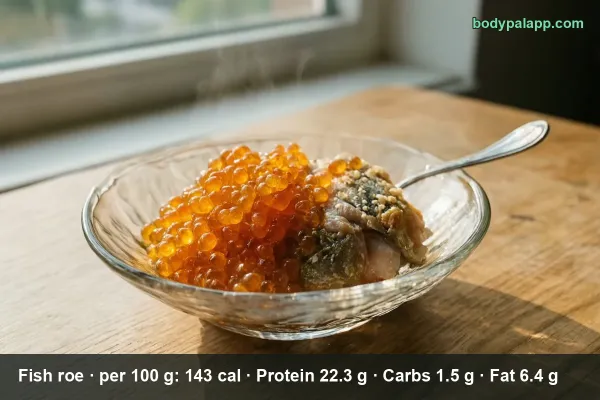
Per 100 g, salmon roe carries 22.3 g of protein, 6.4 g of fat and 1.5 g of carbs. That works out to a calorie split of 58% protein, 38% fat and 4% carbs. For something eaten by the spoonful as a garnish, that is a lean, protein-led profile.
The protein adds up quickly against the daily value of 50 g. One tablespoon covers 6%, an ounce covers 12%, and a 3 oz portion covers 38%. A full 100 g reaches 45% of the daily value for 143 calories, a ratio few toppings can match.
Fat makes up the rest, at 6.4 g per 100 g with 1.5 g of it saturated. That is roughly half the fat of a raw salmon fillet, which carries 13.4 g per 100 g. There is no sugar and no fiber, so the roe adds protein and some fat to a meal and very little else.
Cholesterol is the row to watch
The number that stands out on the nutrition table is cholesterol: 374 mg per 100 g. The daily value used on this page is 300 mg, so a 100 g serving goes past it on its own. This is the one row where salmon roe is anything but light.
Most people eat far less than 100 g at a sitting. A tablespoon or two on sushi or toast is a small slice of that figure, while a heaped bowl of roe over rice is where the row starts to matter. If you track cholesterol, weigh the portion rather than eyeball it.
Sodium, by contrast, is modest in the raw product: 91 mg per 100 g, or 4% of the 2300 mg daily value. A tablespoon holds 13 mg. These are raw values from the USDA row, and jarred roe such as Caviar Russe Salmon Roe is usually cured, so read the sodium line on the package you actually buy.
Use it as a topping, not the main event
At 20 calories a spoonful, salmon roe works best as a finishing touch. It brings briny flavor, a pop of texture and a few grams of protein without moving your daily total much. Spoon it over rice, scrambled eggs, avocado toast or a baked potato.
If you want a fish meal that actually fills you up, a fillet is the better base. A 6 oz raw salmon fillet (170 g) is 354 calories, and a tablespoon of roe on top adds only 20 more. Pairing the two gives you the fillet's bulk and the roe's texture in one plate.
For a lighter plate, set the roe on cucumber slices, radish or a leafy salad rather than buttered blini and crackers. The roe's 143 calories per 100 g stay the same either way. What changes the total is everything you put around it.
How does salmon roe compare?
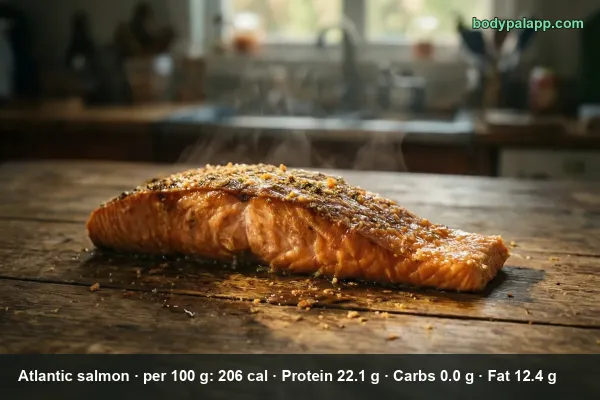
Here salmon roe sits next to generic fish roe, Atlantic salmon and a raw salmon fillet, compared per 100 g and per usual serving.
Verdict: For the most protein per calorie, pick salmon roe: 143 calories per 100 g against 206 for Atlantic salmon and 208 for raw salmon, with 22.3 g of protein, identical to generic fish roe. For a filling main course, choose the fillet, since a 6 oz raw salmon fillet (170 g) at 354 calories is a meal, while roe is best kept as a topping.
Most popular salmon roe brands in the United States
Ranked by popularity in the BodyPal database
# Productkcal / 100 g
1Caviar Russe Salmon Roe1 Tbsp · 15 g267 kcal
This label is cured and salted for retail, so it reads higher in calories than the plain raw roe data used above. Source: manufacturer labels / USDA FoodData Central.
Salmon roe FAQs
How many calories are in salmon roe?
A tablespoon (14 g) of salmon roe has about 20 calories, and an ounce is 40. Per 100 g the figure is 143 calories.
Is salmon roe good for weight loss?
A tablespoon of salmon roe is about 20 calories with 3.1 g of protein, so a typical serving is small and low in calories.
Salmon roe vs fish roe: are the calories different?
No. Salmon roe is counted using the same generic fish roe data, so both are 143 calories per 100 g and about 20 calories per tablespoon (14 g).
How much protein and cholesterol is in salmon roe?
A tablespoon (14 g) has about 3.1 g of protein and 52 mg of cholesterol. Per 100 g that is 22.3 g protein and 374 mg cholesterol.
What are the nutrition facts for salmon roe per 100g?
Per 100 g, salmon roe has 143 calories, 22.3 g of protein, 6.4 g of fat and 1.5 g of carbs. It also lists 91 mg of sodium, 221 mg of potassium and 374 mg of cholesterol, with no sugar or fiber.
What are the macros for ikura?
Ikura, the Japanese name for salmon roe, splits its calories 58% protein, 38% fat and 4% carbs. In grams, one tablespoon gives 3.1 g of protein, 0.9 g of fat and 0.2 g of carbs.
Is salmon roe high in protein?
Yes: a 3 oz portion (85 g) has 19 g of protein, 38% of the daily value, for only 122 calories. Even a single tablespoon brings 3.1 g, or 6% of the daily value.
What is the nutrition of salmon eggs per tablespoon?
One tablespoon (14 g) of salmon eggs has 20 calories, 3.1 g of protein, 0.9 g of fat and 13 mg of sodium. Two tablespoons, or 1 oz, come to 40 calories and 6.2 g of protein.
Are these numbers for raw roe?
Yes. The 143 calories per 100 g come from the USDA row for raw roe of mixed fish species, used here for salmon roe. Cured or salted jars can list a different sodium figure, so check the package label.