Frozen mango calories come to 90 for 1 cup (150 g) of unsweetened chunks and 60 per 100 g. What stands out is the source: 90% of those calories are carbohydrate, and most of that carbohydrate is sugar, 20.5 g per cup. Fat and sodium barely register, and protein stays low at 1.2 g.
90kcal
1 cup · 150 g, frozen, unsweetened chunks
5%protein
1.2 gProtein
22 gCarbs
0.6 gFat
How to burn off 90 kcal
—Walking, brisk
—Jogging
—Cycling, moderate
—Swimming
Skip the math. BodyPal counts these calories from your steps and workouts automatically.
Nutrition facts
Frozen, unsweetened chunks · per 150 g
Calories
90 kcal
Protein
1.2 g
Carbohydrate
22 g
Fat
0.6 g
Saturated fat
0.1 g
Cholesterol
0 mg
Sodium
2 mg
Potassium
252 mg
Iron
0.2 mg
Source: USDA FoodData Central
🛡️
Verified nutrition data
Numbers on this page come from USDA FoodData Central, the U.S. Department of Agriculture’s food composition database, and from manufacturer labels where a branded product is named. Last verified October 2026. How we verify our data →
Frozen mango: calories, protein and sodium by serving
Percent of daily value uses the FDA reference of 2,000 kcal a day.
Serving
kcal
Protein
Carbs
Fat
Sodium
% DV kcal
1 cup (150 g)
90
1.2 g
22.5 g
0.6 g
2 mg
5%
1 chunk (25 g)
15
0.2 g
3.7 g
0.1 g
0 mg
1%
100 g
60
0.8 g
15 g
0.4 g
1 mg
3%
3 × 1 cup (150 g)
270
3.7 g
5 mg
5 × 1 cup (150 g)
450
6.2 g
8 mg
One cup is a 90-calorie snack, and refills add up fast
The standard serving is 1 cup (150 g), which lands at 90 calories, or 5% of a 2,000-calorie day. A single chunk weighs about 25 g and carries 15 calories, so counting pieces is a workable way to track a handful straight from the bag. On a 100 g basis you get 60 calories, which makes frozen mango one of the lighter sweet foods in the freezer.
The catch is that frozen fruit is easy to eat by the bowl. Two cups (300 g) bring you to 180 calories, and three cups (450 g) reach 270. Blend a big batch for the week, say 5 cups or 750 g, and the total sits at 450 calories with 6.2 g of protein. Nothing alarming, but it shows how quickly a light food becomes a meal-sized number when the measuring cup stays in the drawer.
If you log by weight, use the 100 g row: 60 calories, 15 g of carbs, 0.8 g of protein. A kitchen scale beats guessing, because frozen chunks vary in size and a heaping cup can hold noticeably more than 150 g.
Nine in ten calories are carbs, mostly sugar
The calorie split is lopsided: 90% carbohydrate, 5% protein and 5% fat. Per 100 g that means 15 g of carbs against 0.8 g of protein and 0.4 g of fat. Saturated fat is just 0.1 g and cholesterol is 0. This is a fruit that delivers quick energy and very little else in macro terms.
Of those 15 g of carbs per 100 g, 13.7 g are sugars. In a 1-cup serving that becomes 20.5 g of sugar out of 22.5 g of total carbs. Since the chunks are unsweetened, this is the fruit's own sugar, not syrup, but your body still counts it as carbohydrate. If you track carbs closely, the cup is the number to watch, not the single chunk.
Fiber softens the picture a little. A cup supplies 2.4 g, and 100 g gives 1.6 g, against a 28 g daily value. It is a modest contribution, enough to make frozen mango more filling than juice, but not enough to call it a high-fiber food.
Sugar is the row to watch; sodium is a non-issue
Sodium is close to zero: 1 mg per 100 g and 2 mg per cup, which rounds to 0% of the 2,300 mg daily value. Even 750 g of fruit adds only 8 mg. If you watch salt, frozen mango simply does not move your total.
Sugar is the opposite story. At 20.5 g per cup, a single serving holds more sugar than any other row on the label holds in grams. People who count total sugars, rather than only added sugars, should log it honestly, especially in smoothies where two or three cups can disappear into one glass.
Potassium is the quiet plus. You get 168 mg per 100 g against a 4,700 mg daily value. It is not a standout source, but it is one more reason the calories here come with some useful nutrients rather than none.
Pair it with protein to turn sugar into a meal
With only 1.2 g of protein per cup, frozen mango will not keep you full on its own for long. It works better as the sweet part of a combination: blended with Greek yogurt or milk, spooned over cottage cheese, or added to a protein shake. The fruit brings flavor and carbs; the dairy or protein powder brings the staying power.
Because fat is only 0.4 g per 100 g, a small amount of nuts, seeds or nut butter adds texture without crowding out the mango. If your goal is a lighter dessert, a cup of frozen chunks eaten slowly, half-thawed, is a 90-calorie option that feels like sorbet.
Store brands such as Dole, Wyman's and Simple Truth all sell plain frozen chunks; check that the bag says unsweetened, since added syrup or sugar changes every number on this page. If you'd rather not weigh, BodyPal can log your bowl from a photo.
How does frozen mango compare?
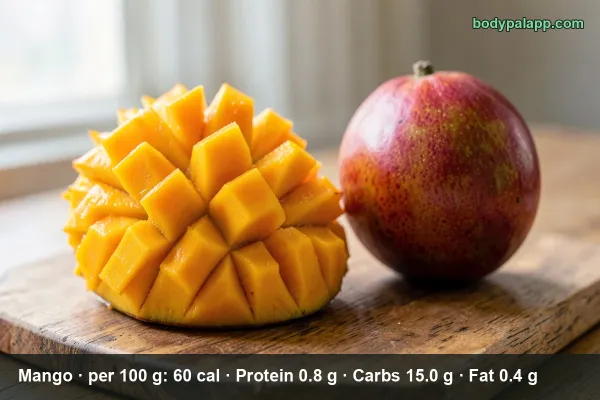
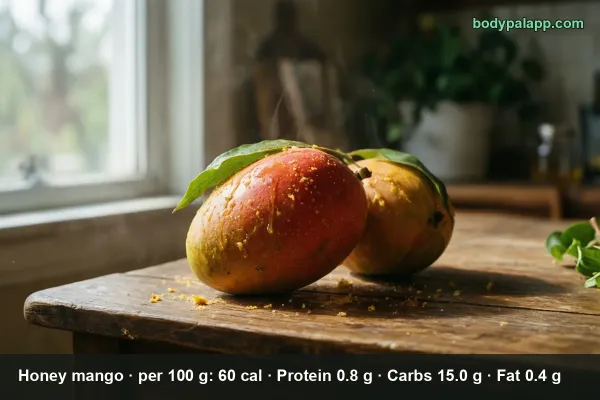
Here is frozen mango next to fresh mango and honey mango, per 100 g and per usual serving.
Verdict: On the numbers they are identical: all three come to 60 calories, 15 g of carbs and 0.8 g of protein per 100 g, so pick whichever is cheapest or most convenient. For weight loss, frozen wins on practicality, because pre-cut chunks make it easy to measure a 1-cup portion instead of eating a whole fruit.
Most popular frozen mango brands in the United States
Ranked by popularity in the BodyPal database
# Productkcal / 100 g
1Our Family Fresh Frozen Mango Chunks1 cup · 165 g61 kcal
One cup of frozen mango chunks (150 g) has about 90 calories, and a single chunk (25 g) has about 15.
Is frozen mango good for weight loss?
Frozen mango has 60 calories and 0.4 g of fat per 100 g, so a 150 g cup comes to 90 calories with 2.4 g of fiber.
Does frozen mango have fewer calories than fresh mango?
No, both have 60 calories per 100 g. A cup of fresh mango pieces weighs more (165 g), so it comes to about 99 calories versus 90 for a cup of frozen chunks.
How much sugar is in frozen mango?
Frozen mango has 13.7 g of natural sugar per 100 g, or about 20.5 g in a 150 g cup, out of 22.5 g total carbs.
What are the nutrition facts for frozen mango?
Per 100 g, frozen mango has 60 calories, 15 g of carbs, 13.7 g of sugars, 1.6 g of fiber, 0.8 g of protein, 0.4 g of fat, 1 mg of sodium and 168 mg of potassium.
How many calories are in half a cup of frozen mango?
Half a cup is half of the 90 calories in a full 1-cup (150 g) serving, so it lands at roughly two thirds of the 60 calories in 100 g. Weighing it is the most accurate way to log it.
How many calories are in one frozen mango chunk?
One chunk of about 25 g has 15 calories, with 3.7 g of carbs and 3.4 g of sugars. Counting chunks works well for snacking straight from the bag.
How much protein is in frozen mango?
Very little: 1.2 g per 1-cup (150 g) serving and 0.8 g per 100 g. Protein makes up only 5% of the calories, so pair it with yogurt or milk if you want a filling snack.
How many carbs are in a cup of frozen mango?
A 1-cup (150 g) serving has 22.5 g of carbs, of which 20.5 g are sugars and 2.4 g are fiber. Carbohydrate supplies 90% of its calories.