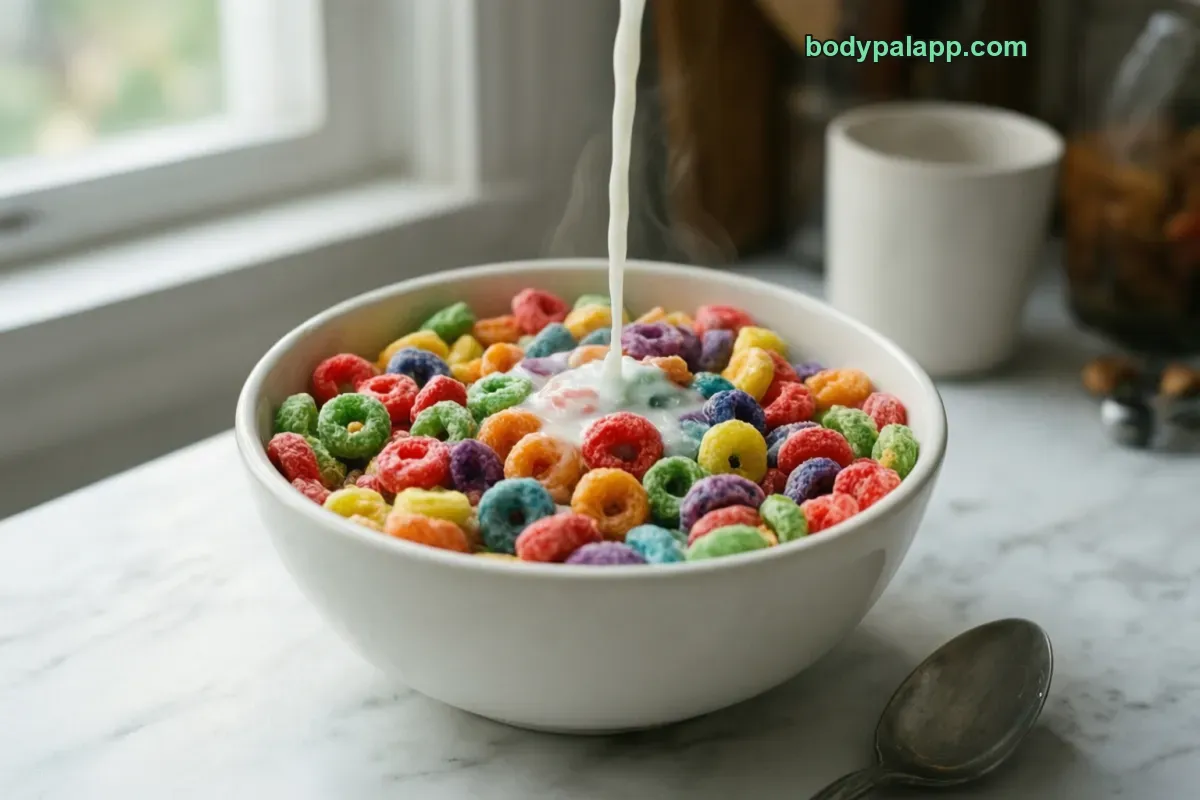
Fruit Loops calories come to 150 for a 1 1/3 cup bowl (39 g) and 385 per 100 g. Nearly all of that energy is carbohydrate: 86% of the calories come from carbs, and a standard bowl carries 12 g of sugar against only 2 g of protein. The size of your pour decides the total more than anything else.
150kcal
1 1 1/3 cup · 39 g, packaged, per label
5%protein
2 gProtein
34 gCarbs
1.5 gFat
How to burn off 150 kcal
—Walking, brisk
—Jogging
—Cycling, moderate
—Swimming
Skip the math. BodyPal counts these calories from your steps and workouts automatically.
Nutrition facts
Packaged, per label · per 39 g
Calories
150 kcal
Protein
2 g
Carbohydrate
34 g
Fat
1.5 g
Saturated fat
0.5 g
Cholesterol
0 mg
Sodium
210 mg
Potassium
60 mg
Source: USDA FoodData Central
🛡️
Verified nutrition data
Numbers on this page come from USDA FoodData Central, the U.S. Department of Agriculture’s food composition database, and from manufacturer labels where a branded product is named. Last verified September 2026. How we verify our data →
Fruit Loops: calories, protein and sodium by serving
Percent of daily value uses the FDA reference of 2,000 kcal a day.
Serving
kcal
Protein
Carbs
Fat
Sodium
% DV kcal
1 1/3 Cup (39 g)
150
2 g
34 g
1.5 g
210 mg
8%
Snack Pouch (13 g)
50
1 g
12 g
0 g
60 mg
3%
100 g
385
5.1 g
87.2 g
3.9 g
538 mg
19%
3 × 1 1/3 Cup (39 g)
450
6 g
629 mg
5 × 1 1/3 Cup (39 g)
751
10 g
1,049 mg
Two bowls make a 300-calorie breakfast
The label serving is 1 1/3 cups, which weighs 39 g and lands at 150 calories. That is 8% of the daily value for calories, with 210 mg of sodium and 12 g of sugar along for the ride. It looks modest on paper. The catch is that few people measure cereal, and a large cereal bowl holds far more than 1 1/3 cups.
Pour twice the label amount, 78 g, and you are at 300 calories and 420 mg of sodium. Three servings, or 117 g, reach 450 calories. A mixing-bowl portion of 5 servings, 195 g, comes to 751 calories and 1,049 mg of sodium, which rivals a full lunch. Protein barely moves along the way: just 10 g even at that size.
The snack pouch sits at the other end. At 13 g it holds 50 calories, 5 g of sugar and 60 mg of sodium, which makes it an easy, fixed portion if you want the taste without the guesswork. If you eat from the box, weighing one bowl once is the fastest way to learn what your normal pour really is.
Carbs supply 86% of every calorie
Per 100 g, Fruit Loops carry 87.2 g of carbohydrate, 5.1 g of protein and 3.9 g of fat. Translated into calories, carbs make up 86%, fat 9% and protein just 5%. This is a grain-and-sugar food first and last, which is why one bowl rarely holds you until lunch.
Fiber is better than you might expect: 5.1 g per 100 g, or 2 g in a standard bowl. That is not nothing for a sweetened cereal, but it sits next to 30.8 g of sugar per 100 g, so sugar outweighs fiber many times over. Fat stays low at 1.5 g per bowl, with 1.3 g of saturated fat per 100 g and no cholesterol.
Protein is the weak spot. A bowl gives 2 g, which is 4% of the daily value. Even a full 100 g gives only 5.1 g, or 10% of the daily value. If you want cereal to feel like a meal, the protein has to come from what you put beside it or on top of it.
Sugar and sodium are the rows to watch
Each 1 1/3 cup bowl has 12 g of sugar, and at 30.8 g per 100 g, sugar makes up about a third of the cereal by weight. That is the number most parents check first on a kids' cereal, and it doubles as soon as the bowl does.
Sodium surprises more people. A bowl has 210 mg, 9% of the daily value, and 100 g carries 538 mg, or 23%. Sweet cereals do not taste salty, yet salt is part of how they are flavored. At 3 servings you reach 629 mg; at 5 servings, 1,049 mg.
Neither number is extreme for a single measured bowl. They add up when the bowl is oversized or refilled, so if you track sugar or sodium, portion size is the lever that matters most. Potassium is modest at 154 mg per 100 g, so the cereal does little to balance that sodium on its own.
Build the bowl around protein
On its own, a bowl of Fruit Loops is 150 calories of mostly fast carbs with 2 g of protein. That makes it a better side than a whole breakfast. Milk is the usual partner and adds protein, though it also brings its own calories, so log it separately.
Eggs, Greek yogurt or a handful of nuts beside the bowl supply the protein and fat the cereal lacks. Fresh fruit adds volume and fiber, which beats topping up with more cereal. A smaller bowl with a protein side usually holds better than a second bowl of loops.
If you prefer it as a snack, the 13 g pouch at 50 calories keeps the portion fixed. Varieties such as Froot Loops Natural Fruit Flavors Cereal and Froot Loops Jumbo Snax Cereal differ in shape and size, so check each label. And if you eat straight from the box, BodyPal can log the food from a photo so the pour you actually ate gets counted.
How does Fruit Loops compare?
Here is how Fruit Loops stack up against Corn Pops, Rice Krispies and corn flakes, per 100 g and per usual serving.
Verdict: Per 100 g these cereals are nearly identical at 383 to 385 calories, so serving size is the real difference: Rice Krispies at 107 and corn flakes at 108 per cup come in lighter than a 150-calorie Fruit Loops bowl. For less sodium pick Corn Pops at 352 mg per 100 g; for a little more protein pick Rice Krispies at 6.7 g.
Most popular Fruit Loops brands in the United States
How many calories are in a serving of Fruit Loops?
A 1 1/3 cup (39 g) serving of Fruit Loops has about 150 calories. Per 100 g that is 385 calories.
Are Fruit Loops good for weight loss?
A 1 1/3 cup serving has 150 calories with 12.0 g sugar and 2.0 g protein, and the cereal runs 385 calories per 100 g, one of the more sugar-dense breakfast cereals.
Fruit Loops vs Corn Flakes: which has fewer calories?
Corn Flakes have about 384 calories per 100 g and Fruit Loops have 385, a difference of only about 1 calorie.
How much sugar is in Fruit Loops?
A 1 1/3 cup (39 g) serving has about 12.0 g of sugar, from 30.77 g per 100 g, plus 2.0 g of fiber.
How many calories are in a Fruit Loops snack pouch?
A 13 g snack pouch has 50 calories, 3% of the daily value. It also has 1 g of protein, 12 g of carbs, 5 g of sugar and 60 mg of sodium, which makes it a small, fixed portion.
How many calories are in two bowls of Fruit Loops?
Two label servings of 1 1/3 cups (78 g total) come to 300 calories, with 420 mg of sodium and 4 g of protein. Three servings, 117 g, reach 450 calories.
How much sodium is in a bowl of Fruit Loops?
A 1 1/3 cup bowl (39 g) has 210 mg of sodium, 9% of the daily value. Per 100 g it is 538 mg, and a bowl of 5 servings reaches 1,049 mg.
How much protein do Fruit Loops have?
A standard 39 g bowl has 2 g of protein, 4% of the daily value. Per 100 g you get 5.1 g, and protein supplies just 5% of the calories, so pair the cereal with a protein source.
Do Fruit Loops have any fiber?
A little. A 1 1/3 cup bowl has 2 g of fiber, and 100 g has 5.1 g. That sits beside 12 g of sugar per bowl, so fiber is not the cereal's main story.
Are Fruit Loops high in fat?
No. A 39 g bowl has 1.5 g of fat, and fat supplies 9% of the calories. Per 100 g there are 3.9 g of fat, 1.3 g of saturated fat and 0 mg of cholesterol.