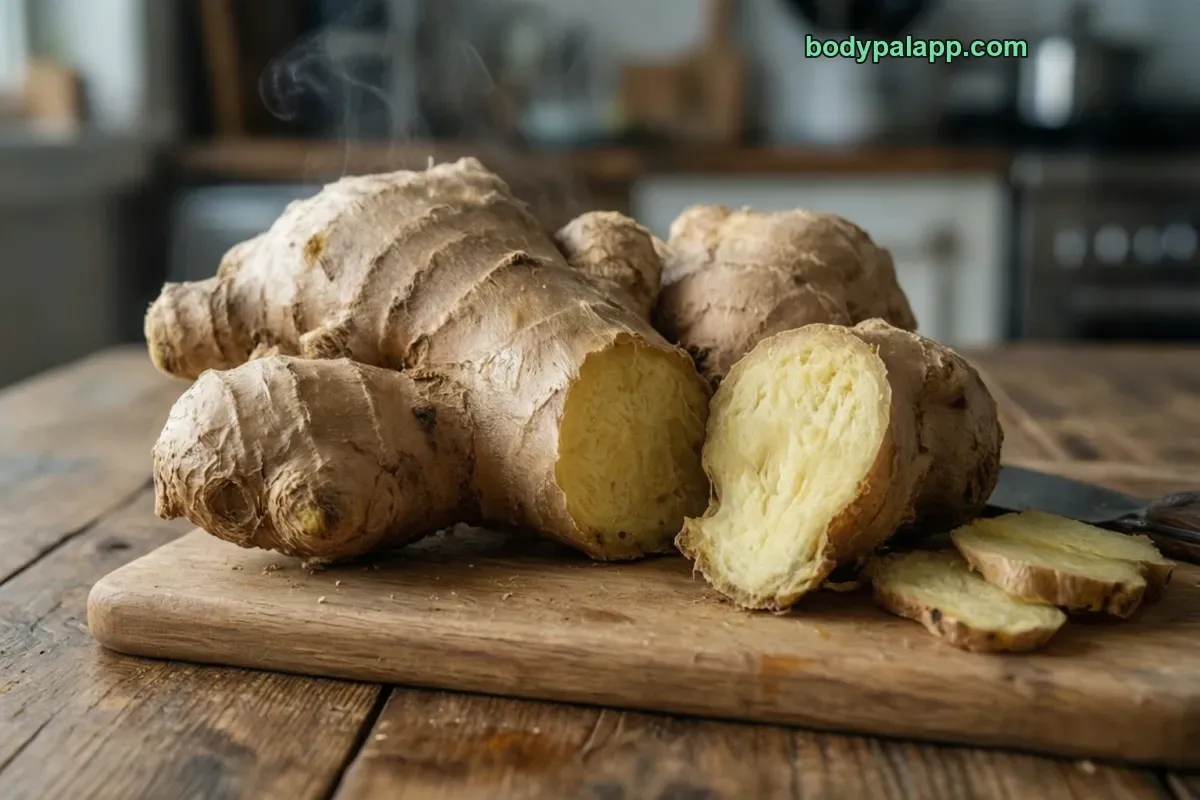
Ginger calories come to 2 for a 1 tsp (2 g) portion of fresh raw root and 80 per 100 g. The number worth noticing is the gap between those two figures. Ginger is mostly carbohydrate, about 84% of its calories, but you use so little of it that it barely moves a day's total.
2kcal
1 teaspoon · 2 g, fresh root, raw
9%protein
0 gProtein
0 gCarbs
0 gFat
How to burn off 2 kcal
—Walking, brisk
—Jogging
—Cycling, moderate
—Swimming
Skip the math. BodyPal counts these calories from your steps and workouts automatically.
Nutrition facts
Fresh root, raw · per 2 g
Calories
2 kcal
Protein
0 g
Carbohydrate
0.4 g
Fat
0 g
Saturated fat
0 g
Cholesterol
0 mg
Sodium
0 mg
Potassium
8 mg
Iron
0 mg
Source: USDA FoodData Central
🛡️
Verified nutrition data
Numbers on this page come from USDA FoodData Central, the U.S. Department of Agriculture’s food composition database, and from manufacturer labels where a branded product is named. Last verified October 2026. How we verify our data →
Ginger: calories, protein and sodium by serving
Percent of daily value uses the FDA reference of 2,000 kcal a day.
Serving
kcal
Protein
Carbs
Fat
Sodium
% DV kcal
1 tsp (2 g)
2
0 g
0.4 g
0 g
0 mg
0%
5 slices (11 g)
9
0.2 g
2 g
0.1 g
1 mg
0%
¼ cup slices (24 g)
19
0.4 g
4.3 g
0.2 g
3 mg
1%
100 g
80
1.8 g
17.8 g
0.8 g
13 mg
4%
3 × 1 tsp (2 g)
5
0.1 g
1 mg
5 × 1 tsp (2 g)
8
0.2 g
1 mg
A teaspoon of ginger barely registers
Grated into a stir-fry or steeped in hot water, ginger is used by the teaspoon. One 1 tsp (2 g) portion carries 2 calories and 0.4 g of carbs, which rounds to 0% of a 2,000-calorie daily value. Even heavy-handed cooks rarely notice it on a tracker.
Scale it up and the total still stays small. Two teaspoons (4 g) come to 3 calories, three teaspoons (6 g) to 5, and five teaspoons (10 g) to 8. Sliced ginger follows the same pattern: 5 slices (11 g) add 9 calories, and a ¼ cup slices (24 g) portion adds 19, or 1% of the daily value.
Only at 100 g does ginger start to look like a vegetable in calorie terms, with 80 calories and 4% of the daily value. Almost nobody eats that much in one sitting. If you juice large amounts of fresh root or blend whole knobs into smoothies, weigh it; otherwise the teaspoon figure is the honest one.
Carbs supply 84% of the calories
Ginger is a root, and its energy profile looks like one. Per 100 g it has 17.8 g of carbohydrate, 1.8 g of protein and 0.8 g of fat. That works out to 84% of calories from carbs, 9% from protein and 8% from fat.
The carbs are not mostly sugar. Of those 17.8 g, only 1.7 g are sugars and 2 g are fiber, so the bulk is starch and other complex carbohydrate. Fat is a minor player, with just 0.2 g of it saturated per 100 g, and cholesterol is 0.
In practical portions these numbers shrink toward zero. A ¼ cup slices (24 g) portion has 4.3 g of carbs, 0.4 g of protein, 0.2 g of fat, 0.5 g of fiber and 0.4 g of sugars. Ginger will not help you hit a protein target, and it will not blow a carb budget either. Its job in a meal is flavor.
Sodium is close to zero, potassium is the standout
Many strong-flavored ingredients lean on salt. Fresh ginger does not. It has 13 mg of sodium per 100 g, which is 1% of the 2,300 mg daily value, and a ¼ cup slices (24 g) portion has 3 mg. A teaspoon rounds to 0.
Potassium is the larger mineral row, at 415 mg per 100 g against a daily value of 4,700 mg. You would need far more than a cooking portion to make a real dent in that, but it is the one row on the label that rises well above the rest.
If you watch sodium, this makes ginger a useful swap. Its heat and sharpness can stand in for some of the salt in marinades, dressings and broths, so the sodium you add comes from soy sauce or stock rather than the ginger itself.
The calories come from what you cook it with
Because ginger adds so little, the dish around it decides the total. Ginger in a vegetable stir-fry stays light; the same ginger in a sweetened glaze, a syrup or a fried dish rides along with far more calories from oil and sugar. Log the other ingredients carefully and treat the ginger as a rounding error.
Drinks are where people get tripped up. The figures on this page are for fresh raw root, not for ginger ale, ginger beer or candied ginger. Those products get most of their calories from added sweetener, so check their own labels instead of using the root's numbers.
Fresh ginger pairs well with garlic, citrus, fish, chicken, carrots and leafy greens, and it brightens plain tea or water without adding meaningful calories. If you cook with it often, BodyPal can log the finished dish from a photo.
How does ginger compare?
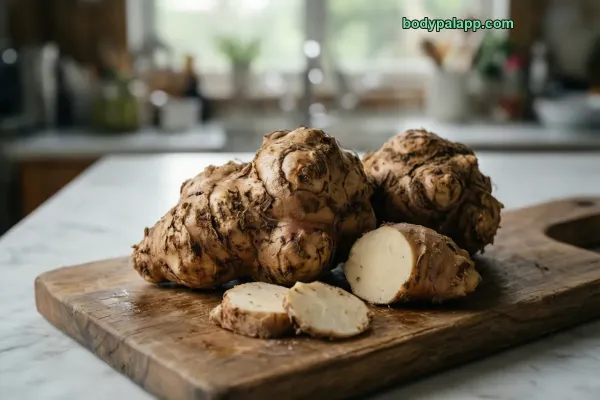
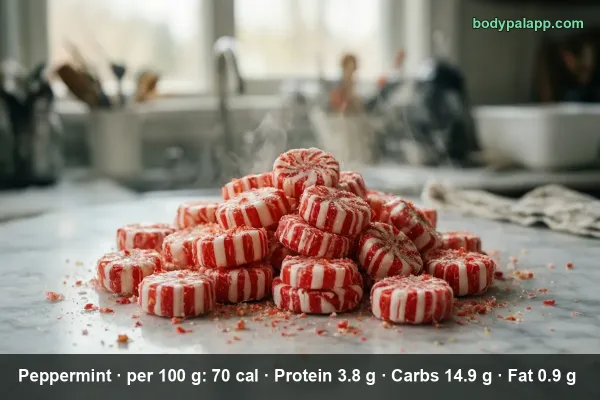
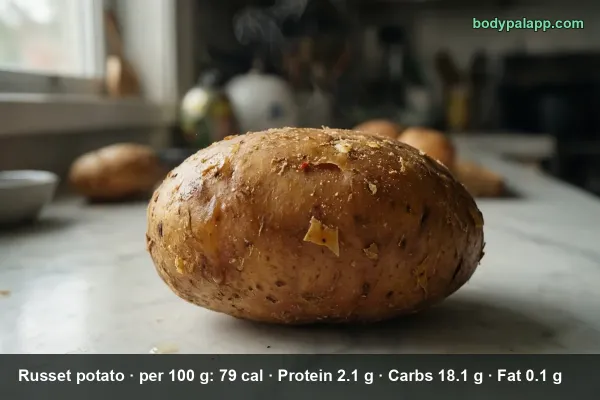
Here is how fresh ginger stacks up against jerusalem artichoke, peppermint and russet potato, per 100 g and per usual serving.
Verdict: Per 100 g these foods sit in a tight band, from 70 calories for peppermint to 80 for ginger, so portion size decides everything: a 1 cup sliced (150 g) serving of jerusalem artichoke is 110 calories, while ginger rarely goes past a teaspoon. For a filling side pick russet potato or jerusalem artichoke; for flavor at almost no calorie cost, ginger and peppermint win.
Ginger FAQs
How many calories are in ginger?
A teaspoon of raw ginger (2 g) has about 2 calories, 5 slices (11 g) have 9, and 100 g has 80.
Is ginger good for weight loss?
Ginger is very low in calories: a quarter cup of slices (24 g) has 19 calories and 0.2 g fat.
Ginger vs Jerusalem artichoke: which has fewer calories?
Per 100 g, raw ginger has 80 calories and Jerusalem artichoke has 73.
How many carbs are in ginger?
Raw ginger has 17.8 g carbs per 100 g, including 2 g fiber and 1.7 g sugar. A teaspoon (2 g) has 0.4 g carbs.
How much sugar is in fresh ginger?
Fresh ginger root has 1.7 g of sugars per 100 g and 0.4 g in a ¼ cup slices (24 g) portion. The sugar in ginger ale is added during production and does not come from the root.
Is ginger fattening?
No. Fresh ginger has 0.8 g of fat and 80 calories per 100 g, and a 1 tsp (2 g) portion adds only 2 calories. The calories in ginger dishes and drinks come mostly from oil and sweeteners.
Does ginger ale have the same calories as ginger root?
No. The 80 calories per 100 g on this page apply to fresh raw ginger root only. Ginger ale gets most of its calories from added sweetener, so use the can's own label for its numbers.
How many calories are in a few slices of ginger, like the ones served with sushi?
Five slices (11 g) of fresh raw ginger have 9 calories. Pickled sushi ginger often has sugar in the brine, so its count can be higher; check the jar's label.
How much protein and fiber does ginger have?
Ginger has 1.8 g of protein and 2 g of fiber per 100 g. A ¼ cup slices (24 g) portion gives 0.4 g of protein and 0.5 g of fiber, so it is not a meaningful source of either.