
How many calories are in a russet potato?
The calories in a russet potato come out at 168 for one medium tuber, 213 g with the skin on and nothing added. Per 100 g, raw russet runs 79 calories, lighter by weight than most people expect from a potato. Bake it and the number per potato barely moves.
On this page
- Russet potato quick facts
- US servings from one ounce to a large baker
- What baking and peeling change
- Potassium is the row that moves
- How does a russet potato compare?
- Most popular russet potato brands
- Russet potato FAQs
Russet potato quick facts
The row on this page is SR Legacy 170027, "Potatoes, russet, flesh and skin, raw". That is the potato you actually pick up: a raw russet with the brown skin still on it, the thing that goes on the kitchen scale before anything happens to it. The baked record is a separate entry and gets its own section further down, because the two are not interchangeable per 100 g.
One medium potato is USDA's own household measure for this record, 213 g, and every number in the right-hand column below is that 100 g figure scaled to 213 g.
| Nutrient | Per 100 g | Per 1 medium potato (213 g) | % Daily Value |
|---|---|---|---|
| Calories | 79 | 168 | — |
| Total fat | 0.08 g | 0.2 g | 0% |
| Saturated fat | 0.03 g | 0.1 g | 0% |
| Carbohydrate | 18.07 g | 38.5 g | 14% |
| Dietary fiber | 1.3 g | 2.8 g | 10% |
| Total sugars | 0.62 g | 1.3 g | — |
| Protein | 2.14 g | 4.6 g | 9% |
| Sodium | 5 mg | 11 mg | 0% |
| Cholesterol | 0 mg | 0 mg | 0% |
| Potassium | 417 mg | 888 mg | 19% |
% Daily Value is based on a 2,000-calorie diet.
Verified nutrition data
Numbers on this page come from USDA FoodData Central, the U.S. Department of Agriculture’s food composition database, and from manufacturer labels where a branded product is named. Last verified September 2026. How we verify our data →
There is no added sugars row here. The SR Legacy edition does not measure added sugars at all, and a plain potato with nothing done to it has none to report anyway. The 1.3 g of sugar in a medium potato is what the tuber grew itself.
Two rows are worth staring at before you scroll. Fat is 0.2 g in a whole medium potato, which rounds to 0% of the Daily Value, and sodium is 11 mg, also 0%. A russet is close to a blank slate. Whatever ends up on your log is mostly a story about the butter, the oil and the cheese, not about the potato.
US servings from one ounce to a large baker
Russets are sold loose and by the 5 lb bag, so the size in your hand varies more than with almost any other vegetable. USDA sizes them by diameter, and the spread is wide: a small potato and a large potato differ by more than 150 calories.
| Serving | Weight | Calories |
|---|---|---|
| 1 oz, raw | 28 g | 22 kcal |
| 1/2 cup diced, raw | 75 g | 59 kcal |
| 1 small potato, 1-3/4 to 2-1/4 in | 170 g | 134 kcal |
| 1 medium potato, 2-1/4 to 3-1/4 in | 213 g | 168 kcal |
| 1 large potato, 3 to 4-1/4 in | 369 g | 292 kcal |
| Per 100 g | 100 g | 79 kcal |
The small, medium and large weights are USDA household measures attached to the record itself, as is the half cup diced. The 1 oz line is our own arithmetic from the USDA 100 g figure, not a USDA serving; it is there because deli and recipe portions are often written in ounces.
One practical warning about the large size. A big baker at 369 g is not "a potato plus a bit" but 1.7 medium potatoes, and at 292 calories it is closer to a sandwich than to a side. If you log by eye rather than by scale, this is the single place a russet quietly costs you a hundred-plus calories.
Store-brand bags label a fixed size rather than a real one. Wegmans lists its russet at 74 calories per 100 g with a 148 g (5.3 oz) serving and 110 calories on the panel, which is a smaller potato than the USDA medium and a slightly lower density. Weigh yours rather than trusting the bag.
What baking and peeling change
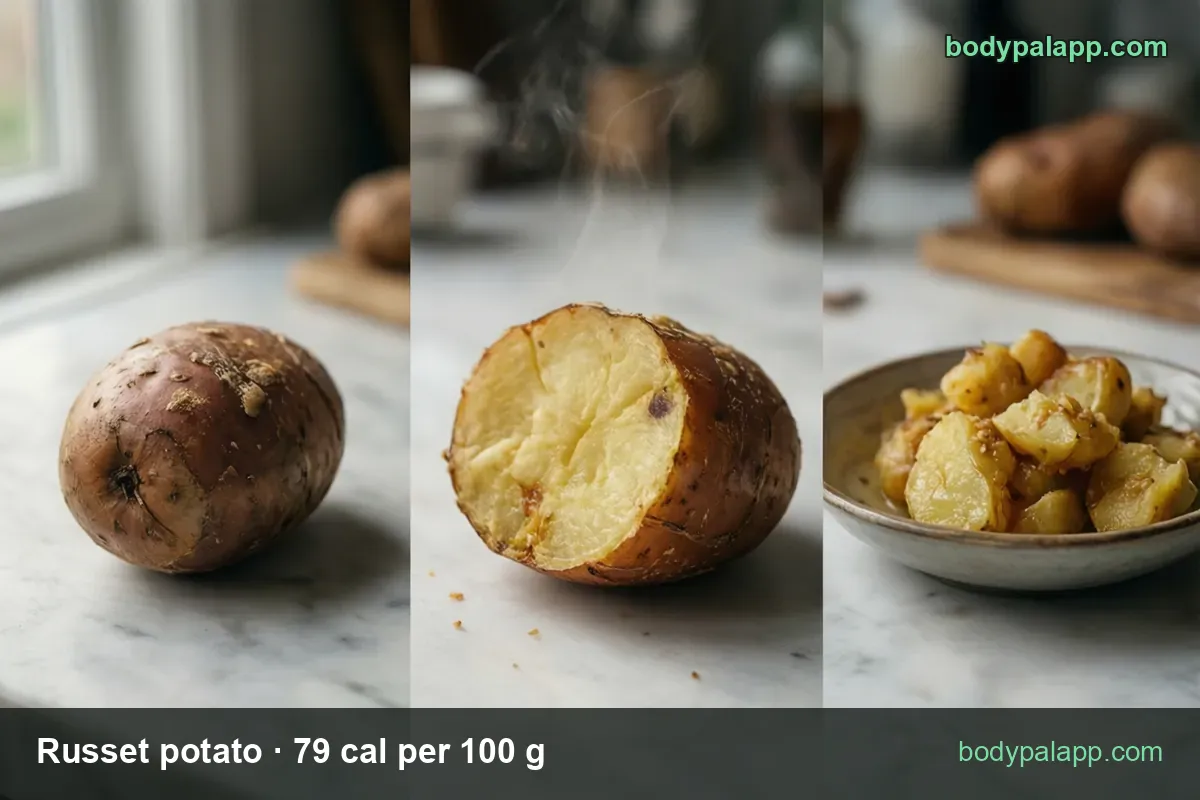
Here is the thing almost every calorie page gets backwards. Baked russet is 95 calories per 100 g against 79 raw, so baking looks like it adds 20%. It does not. The oven drives off water, so the same potato that weighed 213 g raw comes out at roughly 173 g baked. Multiply that through and the baked medium is 164 calories against 168 raw. The energy in the tuber never went anywhere; only the density changed.
| Version | Per 100 g | Typical piece | Calories |
|---|---|---|---|
| Baked, medium, skin on | 95 kcal | 1 medium baked (173 g) | 164 kcal |
| Baked, large, skin on | 95 kcal | 1 large baked (299 g) | 284 kcal |
| Baked, small, skin on | 95 kcal | 1 small baked (138 g) | 131 kcal |
| Raw, large, skin on | 79 kcal | 1 large (369 g) | 292 kcal |
| Raw, diced | 79 kcal | 1/2 cup diced (75 g) | 59 kcal |
| Raw, peeled flesh only | 83 kcal | 100 g | 83 kcal |
The practical rule: if you weigh the potato raw, use 79 per 100 g. If you weigh it after it comes out of the oven, use 95. Using the baked figure on a raw weight is the most common way to overcount a potato by about 20%.
Peeling moves things less than people think, at least for calories. The Foundation record for peeled russet flesh is 83 calories per 100 g against 79 with the skin, since the skin is light and fibrous while the flesh underneath is denser. Those two figures come from different lab batches years apart, so read the gap as small rather than exact. Fiber is where peeling actually costs you, and the peeled record does not report fiber at all, so there is no USDA figure to put on that loss.
Diced is the other trap. Half a cup of raw dice is 75 g and 59 calories, which sounds tiny next to a whole potato, and it is: it is well under half a medium. A cup of dice from the same potato is still only around 118 calories, our own doubling of the USDA half-cup line.
Potassium is the row that moves
Run down the Daily Value column and almost everything is a rounding error. Fat 0%. Saturated fat 0%. Sodium 0%. Then potassium arrives at 888 mg in a medium potato, 19% of the FDA Daily Value of 4,700 mg, from a food most people file under "starch." A large russet gets to about 1,539 mg, roughly a third of the day.
Fiber is the second surprise, and it depends entirely on whether you keep the skin. Raw, a medium potato has 2.8 g, or 10% of the DV. Baked, the same potato has 4.0 g, 14%, because the fiber stays put while the water leaves. That is a real reason to eat the skin rather than a decorative one.
Protein is honest at 4.6 g per medium potato, 9% of the DV. It is not a protein food and nothing here changes that, but it is not zero either. If you are building a plate around a baked potato, MyPlate's vegetable guidance counts starchy vegetables toward the vegetable group, and the potato is the cheapest way most US kitchens hit part of that.
How does a russet potato compare?
Russet lands at exactly 79 calories per 100 g, and so do several other everyday sides. That coincidence is more useful than it looks, because it means you can swap them by weight without touching the total.
| Food (per 100 g) | Calories | Protein | Carbs | Fat |
|---|---|---|---|---|
| Russet potato, raw, skin on | 79 kcal | 2.14 g | 18.07 g | 0.08 g |
| Sweet corn, canned, vacuum pack | 79 kcal | 2.41 g | 19.44 g | 0.5 g |
| Sweet corn, frozen, boiled, salted | 79 kcal | 2.55 g | 18.71 g | 0.67 g |
| Tomatoes, red, cooked, stewed | 79 kcal | 1.96 g | 13.05 g | 2.68 g |
These three neighbors are listed by the cup in USDA, but the gram weight of that cup is not in the records we pulled, so a per-serving column would be a guess and is left out rather than invented.
Our take: for pure calorie control, the four are a wash by weight, and the choice comes down to how much you get for the money and how full it leaves you. The potato is the one you buy whole and weigh whole, which makes it the easiest of the four to log honestly. Stewed tomatoes are the outlier on fat, at 2.68 g per 100 g against essentially none in the potato, because oil goes into the can. If you are watching sodium, the raw russet starts at 5 mg per 100 g, while the canned and the salted frozen corn both take on salt in processing; USDA sodium figures for those two rows are not in the records pulled here.
Most popular russet potato brands in the United States
Ranked by how widely each product appears among foods sold in the United States, from the BodyPal food database of over 3.3 million products. Calories are the figures printed on each Nutrition Facts label, checked against USDA FoodData Central.
| Product | Calories (per 100 g) |
|---|---|
| Wegmans Russet Potato | 74 cal |
Brand popularity: BodyPal food database. Nutrition: manufacturer labels / USDA FoodData Central.
Russet potato FAQs
How many calories are in one medium russet potato?
A medium russet, 2-1/4 to 3-1/4 inches across and 213 g raw with the skin on, carries 168 calories. That is 79 calories per 100 g. Nothing is added yet: no butter, no oil, no sour cream. Bake that same potato and it lands at 164 calories.
How many calories are in a large russet potato?
A large russet, 3 to 4-1/4 inches across, weighs 369 g raw and holds 292 calories. Baked, that same potato weighs about 299 g and comes to 284 calories. It is the biggest single serving USDA lists for this food, and it is roughly 1.7 medium potatoes in one skin.
Is a baked russet potato higher in calories than a raw one?
Per 100 g, yes: baked russet is 95 calories against 79 raw. Per potato, no. A 213 g raw medium bakes down to about 173 g as water leaves, so it lands at 164 calories. Baking concentrates the numbers on the scale; it does not add energy.
How many carbs are in a russet potato?
A medium russet has 38.5 g of carbohydrate, 14% of the Daily Value, of which 2.8 g is fiber and only 1.3 g is sugar. Per 100 g that is 18.07 g. Scale it up and a large potato reaches about 67 g of carbohydrate.
How much fiber is in a russet potato with the skin?
A medium raw russet with the skin gives 2.8 g of fiber, 10% of the Daily Value. Baked, the same potato gives 4.0 g, or 14%, because water leaves while the fiber stays. USDA's peeled russet record does not report fiber, so the cost of peeling cannot be quantified here.
How much potassium is in a russet potato?
A medium russet carries 888 mg of potassium, 19% of the Daily Value, from 417 mg per 100 g. A large one reaches about 1,539 mg, or 33%. Potassium carries the biggest Daily Value share on this page; fat and sodium both round to 0%.
Does peeling a russet potato change the calories?
Only slightly: USDA's peeled russet record runs 83 calories per 100 g against 79 with the skin, because the skin is light and fibrous while the flesh is denser. The two figures come from different lab batches, so treat the gap as small. What peeling really costs you is fiber.
Are russet potatoes good for weight loss?
At 79 calories per 100 g raw and 95 baked, a russet is one of the lighter starches by weight, and a medium one is 168 calories with 2.8 g of fiber. Plain and with the skin on, it is a solid base. What goes on top usually decides the total.
Similar foods
- Idaho Potato — 117 cal per medium potato
- Tofu — 63 cal for 1/4 block
- Caesar Salad — 61 cal per cup
- Corn Kernels — 134 cal per cup
- Peas — 117 cal per cup
- White Sweet Potato — 115 cal per medium sweet potato
Count it without the math
Point the camera at the plate and BodyPal counts the potato for you, skin, butter and all.


How long does it take to burn off russet potato?
One medium potato (213 g) is 168 kcal. Enter your weight and the amount you ate to see how long it takes you to burn that off:
lb
| Activity | Time to burn 168 kcal |
|---|---|
| Walking, brisk | 34 min |
| Cycling, moderate | 21 min |
| Swimming, moderate | 24 min |
| Jogging | 20 min |
| Weight training, moderate | 37 min |
Times are for a 155 lb adult at a steady pace; change the weight to see yours. The amount is set to the portion in the text (213 g); change it to what you actually ate. BodyPal works this out from your steps automatically.
Want the bigger picture? Calculate your daily calorie needs — your maintenance figure, a target for losing or gaining, and the date you get there.