
How many calories are in a Caesar salad?
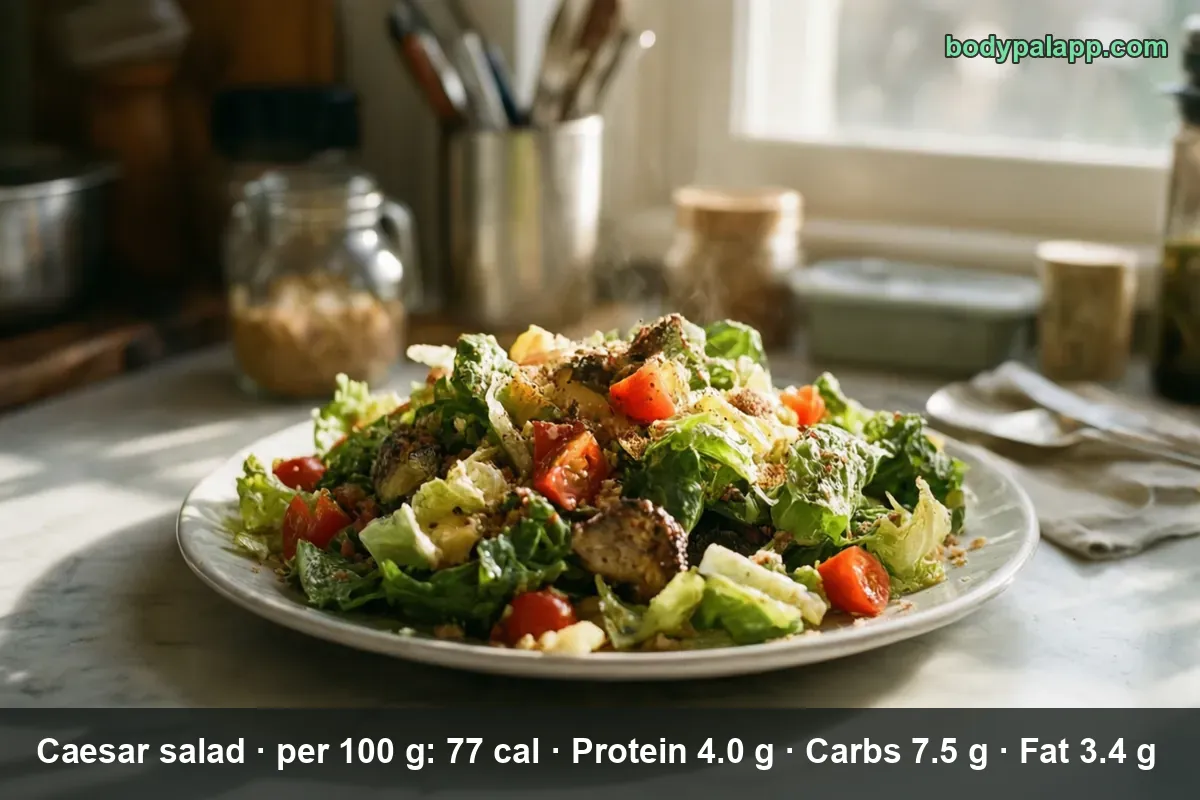
A 1-cup serving weighs 79 g and holds 61 calories before any dressing hits it. Per 100 g the salad runs 77 calories, so a 113 g side salad is 87. The romaine, croutons and Parmesan are all in that number. The dressing is not, and the dressing is where this dish actually gets expensive.
On this page
- Caesar salad quick facts
- US servings, from one ounce to a dinner bowl
- Chicken, crispy chicken and the dressing
- The dressing carries the sodium
- How does Caesar salad compare?
- Most popular caesar salad brands
- Caesar salad FAQs
Caesar salad quick facts
The row below is FNDDS 2709591, "Caesar salad, with romaine, no dressing". It describes the assembled salad — torn romaine, croutons, grated Parmesan — which is the thing on the plate in front of you and the thing people mean when they type the question. The dressing sits in a separate USDA record, and it gets its own section further down, because pouring it on is a choice with a price tag.
If you ordered a chicken Caesar, the numbers here are not yours; skip ahead to the variants. And if you bought a bagged kit, the manufacturer's label counts the dressing packet, so a kit number will always sit above this one.
| Nutrient | Per 100 g | Per 1 cup (79 g) | % Daily Value |
|---|---|---|---|
| Calories | 77 | 61 | — |
| Total fat | 3.41 g | 2.7 g | 3% |
| Saturated fat | 1.67 g | 1.3 g | 7% |
| Carbohydrate | 7.49 g | 5.9 g | 2% |
| Dietary fiber | 1.8 g | 1.4 g | 5% |
| Total sugars | 1.23 g | 1.0 g | — |
| Protein | 4 g | 3.2 g | 6% |
| Sodium | 238 mg | 188 mg | 8% |
% Daily Value is based on a 2,000-calorie diet.
Verified nutrition data
Numbers on this page come from USDA FoodData Central, the U.S. Department of Agriculture’s food composition database, and from manufacturer labels where a branded product is named. Last verified September 2026. How we verify our data →
Two rows you will not find above: added sugars and trans fat. This FNDDS edition does not publish either for the record, so printing a number for them would mean inventing one. Cholesterol comes in at 8 mg per 100 g, which is 6 mg in the cup — 2% of the Daily Value, essentially the Parmesan. Potassium is 250 mg per 100 g, or 198 mg a cup, 4%. The Daily Values used here are the FDA reference amounts printed on every US Nutrition Facts panel.
US servings, from one ounce to a dinner bowl
| Serving | Weight | Calories |
|---|---|---|
| 1 oz | 28 g | 22 kcal |
| 1 cup | 79 g | 61 kcal |
| One side salad | 113 g | 87 kcal |
| Three cups, dinner bowl | 237 g | 182 kcal |
| Per 100 g | 100 g | 77 kcal |
The cup and the side salad are USDA household measures for this record. The ounce and the three-cup bowl are our own arithmetic from the USDA 100 g figure, not USDA servings — 28 g and 237 g scaled off 77 calories per 100 g.
Here is the trap, and it is a cup-versus-ounce trap rather than a raw-versus-cooked one. A cup of Caesar salad weighs 79 g. A cup of most cooked foods weighs two to three times that, so people who log salads by volume out of habit tend to enter far too much weight and then wonder why a bowl of lettuce cost them 250 calories. Loose leaves are mostly air. Weigh the bowl once and the ratio sticks in your head.
The three-cup bowl is the honest size of a restaurant entrée salad base. At 182 calories it is still a light plate — right up to the moment the server ladles dressing over it.
Chicken, crispy chicken and the dressing
| Version | Per 100 g | Typical portion | Calories |
|---|---|---|---|
| Caesar salad, romaine, no dressing | 77 kcal | 1 cup, 79 g | 61 kcal |
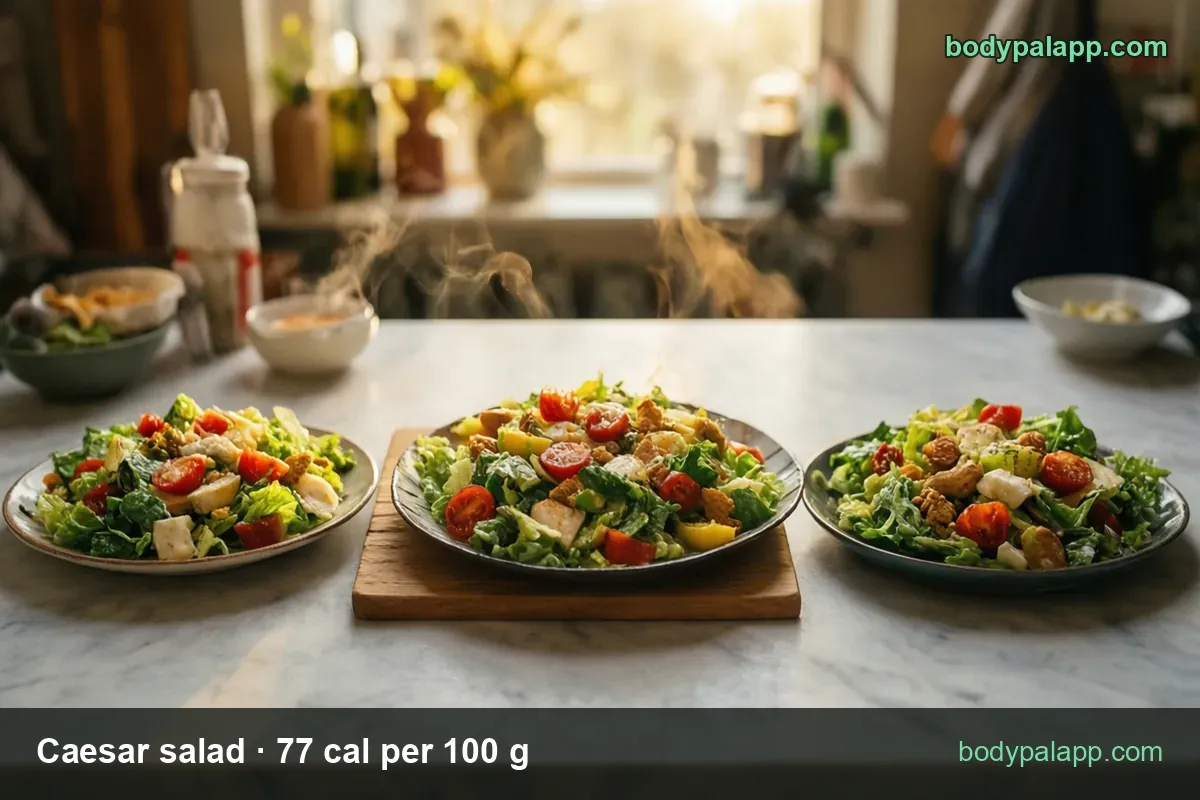
| Chicken Caesar salad, no dressing | 63 kcal | 1 salad, 286 g | 180 kcal |
| Crispy chicken Caesar salad, no dressing | 115 kcal | 1 salad, 314 g | 361 kcal |
| Caesar dressing, regular | 542 kcal | 2 tbsp, 30 g | 163 kcal |
| Caesar dressing, low calorie | 110 kcal | 1 tbsp, 15 g | 17 kcal |
| Caesar dressing, fat-free | 131 kcal | 2 tbsp, 34 g | 45 kcal |
Adding chicken makes the salad less calorie-dense, not more: 63 calories per 100 g against 77 for the plain version. Grilled breast is lean and heavy, so it dilutes the croutons and the cheese. What you gain is protein — about 24 g in that 286 g bowl, roughly 49% of the Daily Value for 180 calories. That is a genuinely good lunch.
Breaded and fried chicken flips it. At 115 calories per 100 g the crispy version nearly doubles the density of the grilled one, and the 314 g bowl lands at 361 calories with about 20 g of protein. Same salad, same lettuce, one different piece of chicken, 181 extra calories.
Store kits land between the two per serving, and above both per gram. USDA's Branded records put the Dole Fresh Caesar Salad Kit at 131 calories per 100 g, or 229 for the 6.2 oz (175 g) label serving, and a Taylor Farms Caesar with chicken and bacon at 196 per 100 g, 319 for the 163 g bowl. Those figures include the dressing packet, which is exactly why they sit so far above the plain FNDDS row.
The dressing carries the sodium
Two tablespoons of regular Caesar dressing weigh 30 g and carry 163 calories. Set that against the 61-calorie cup it is being poured over: the dressed cup is 224 calories, and 73% of that came out of the bottle. Nothing else on this page moves the number that hard.
Sodium moves with it. The undressed cup is 188 mg, 8% of the Daily Value. The same 2 tablespoons add 363 mg, taking the cup to 551 mg — 24% of the day, or about a quarter teaspoon of table salt, in a side dish. The Dietary Guidelines for Americans put the ceiling at 2,300 mg a day, and a 286 g chicken Caesar reaches 758 mg (33%) before anyone opens the dressing at all. If you are watching sodium, the dressing on the side is the single most useful thing you can ask for.
Now the part most people get backwards. "Fat-free" does not mean fewer calories here. Fat-free Caesar dressing is 131 calories per 100 g; the low-calorie version is 110. The fat-free bottle replaces oil with sugar — 30.73 g of carbohydrate per 100 g against 18.6 g — and finishes with more sodium than either alternative, 1,265 mg per 100 g versus 1,209 mg for the regular dressing. At a matched 2 tablespoons the low-calorie version works out to roughly 33 calories by our own arithmetic from its 100 g figure, against 45 for fat-free. Read the panel, not the front of the bottle.
None of this makes the salad a problem food. Romaine is a vegetable, and MyPlate wants half your plate to look like this. The dressing is simply a condiment doing a main-course job.
How does Caesar salad compare?
| Salad, no dressing | Per 100 g | US serving | Calories |
|---|---|---|---|
| Caesar salad, romaine | 77 kcal | 1 cup, 79 g | 61 kcal |
| Lettuce salad with cheese and tomato | 91 kcal | 3 oz, 85 g | 77 kcal |
| Lettuce salad with egg, cheese and tomato | 71 kcal | 3 oz, 85 g | 60 kcal |
| Lettuce salad with assorted vegetables | 24 kcal | 3 oz, 85 g | 20 kcal |
The three neighbors are all scaled to 3 oz by our own arithmetic from their USDA 100 g figures, since USDA does not publish a common household portion across them.
Our take: Caesar sits in the middle of the pack, not at the top. Of these three, the egg-and-cheese salad (71) and the plain vegetable salad (24) are lighter per 100 g, and only the cheese-and-tomato salad (91) is heavier. Caesar's 4 g of protein per 100 g is also mid-pack — both cheese salads beat it, at 4.94 g and 4.24 g. For weight loss, the plain vegetable salad is in a different league at under a third the density, and it is what to build on when you want volume. For a lunch you will not be hungry after, order the Caesar with grilled chicken, keep the dressing on the side, and you get 24 g of protein for under 250 calories. Choose by the pour, not by the lettuce.
Most popular caesar salad brands in the United States
Ranked by how widely each product appears among foods sold in the United States, from the BodyPal food database of over 3.3 million products. Calories are the figures printed on each Nutrition Facts label, checked against USDA FoodData Central.
| Product | Calories (per 100 g) |
|---|---|
| Taylor Farms Caesar Salad with Chicken & Bacon | 196 cal |
| Marketside Caesar Salad with Chicken | 164 cal |
| Marketside Organic Caesar Salad with Chicken | 158 cal |
| Ukrop's Chicken Caesar Salad | 184 cal |
| Dole Fresh Caesar Salad Kit | 131 cal |
| Dole Ultimate Caesar Salad Kit | 180 cal |
Brand popularity: BodyPal food database. Nutrition: manufacturer labels / USDA FoodData Central.
Caesar salad FAQs
How many calories are in a Caesar salad?
A 1-cup serving of Caesar salad without dressing weighs 79 g and holds 61 calories, or 77 calories per 100 g. A restaurant side salad of 113 g comes to 87. Pour 2 tablespoons of regular Caesar dressing over that cup and the total jumps to 224 calories.
How many calories in a Caesar salad without dressing?
Undressed is the figure above: 61 calories a cup, 87 for a 113 g side salad, 182 for a three-cup dinner bowl. The USDA record already counts the croutons and the Parmesan, so lettuce is not the only thing being measured. Dressing is the one component left out.
How many calories in a chicken Caesar salad?
A chicken Caesar salad without dressing runs 63 calories per 100 g, so a 286 g bowl is 180 calories with about 24 g of protein. Breaded fried chicken changes that completely: 115 calories per 100 g, and a 314 g bowl reaches 361 calories.
How many calories are in 2 tbsp of Caesar dressing?
Two tablespoons of regular Caesar dressing weigh 30 g and carry 163 calories, 17.4 g of fat and 363 mg of sodium. That is more calories than the entire cup of salad it lands on. Measure it, or ask for it on the side and use half.
Is Caesar salad healthy?
Undressed, a cup is 61 calories with 1.4 g of fiber and 188 mg of sodium, and it fits the vegetable pattern in the Dietary Guidelines for Americans. Dressed, the same cup is 224 calories and 551 mg of sodium, roughly a quarter of the daily sodium limit.
How much sodium is in a Caesar salad?
A 1-cup serving carries 188 mg of sodium, 8% of the 2,300 mg Daily Value, before any dressing. Two tablespoons of Caesar dressing add 363 mg, taking the cup to 551 mg, or 24%. A 286 g chicken Caesar is already at 758 mg undressed.
How much protein is in a Caesar salad?
A cup of plain Caesar salad has 3.2 g of protein, 6% of the Daily Value, and it comes from the Parmesan more than the lettuce. Add chicken and the picture changes: a 286 g chicken Caesar carries about 24 g, near 49% of the Daily Value, for 180 calories.
Is fat-free Caesar dressing lower in calories?
No: fat-free Caesar dressing is 131 calories per 100 g against 110 for the low-calorie version, because sugar replaces the oil: 30.73 g of carbohydrate versus 18.6 g. Both beat regular dressing at 542. Fat-free also carries the most sodium of the three, 1,265 mg per 100 g.
Similar foods
- Tofu — 63 cal for 1/4 block
- White Sweet Potato — 115 cal per medium sweet potato
- Idaho Potato — 117 cal per medium potato
- Russet Potato — 168 cal per medium potato
- Corn Kernels — 134 cal per cup
- Jerusalem Artichoke (Sunchoke) — 110 cal per cup
Count it without the math
Point the camera at the plate and BodyPal counts the salad and the dressing separately.


How long does it take to burn off Caesar salad?
A 1-cup (79 g) serving is 61 kcal. Enter your weight and the amount you ate to see how long it takes you to burn that off:
lb
| Activity | Time to burn 61 kcal |
|---|---|
| Walking, brisk | 12 min |
| Cycling, moderate | 8 min |
| Swimming, moderate | 9 min |
| Jogging | 7 min |
| Weight training, moderate | 14 min |
Times are for a 155 lb adult at a steady pace; change the weight to see yours. The amount is set to the portion in the text (79 g); change it to what you actually ate. BodyPal works this out from your steps automatically.
One food is easy to picture; a whole day is harder. See how many calories you need a day and what a deficit actually looks like.