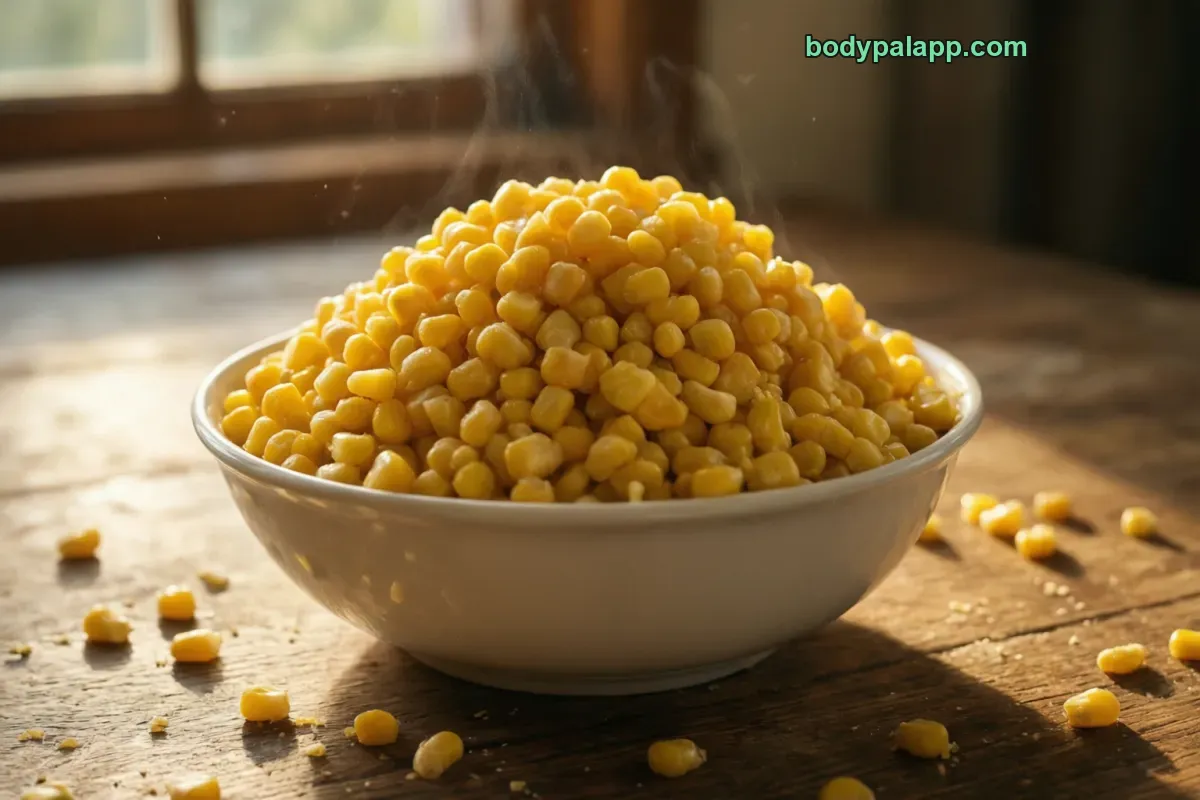
Corn kernel calories come to 134 for 1 cup (165 g) and 81 per 100 g, based on frozen kernels boiled and drained without salt. The thing to notice is the carbs: they supply 83% of the calories. Fat is almost absent, and sodium sits at just 2 mg per cup until you season it.
134kcal
1 cup · 165 g, frozen, boiled, drained
11%protein
4.2 gProtein
32 gCarbs
1.1 gFat
How to burn off 134 kcal
—Walking, brisk
—Jogging
—Cycling, moderate
—Swimming
Skip the math. BodyPal counts these calories from your steps and workouts automatically.
Nutrition facts
Frozen, boiled, drained · per 165 g
Calories
134 kcal
Protein
4.2 g
Carbohydrate
32 g
Fat
1.1 g
Saturated fat
0.2 g
Cholesterol
0 mg
Sodium
2 mg
Potassium
384 mg
Iron
0.8 mg
Source: USDA FoodData Central
🛡️
Verified nutrition data
Numbers on this page come from USDA FoodData Central, the U.S. Department of Agriculture’s food composition database, and from manufacturer labels where a branded product is named. Last verified September 2026. How we verify our data →
Corn kernels: calories, protein and sodium by serving
Percent of daily value uses the FDA reference of 2,000 kcal a day.
Serving
kcal
Protein
Carbs
Fat
Sodium
% DV kcal
1 cup (165 g)
134
4.2 g
31.8 g
1.1 g
2 mg
7%
3 oz portion (85 g)
69
2.2 g
16.4 g
0.6 g
1 mg
3%
100 g
81
2.6 g
19.3 g
0.7 g
1 mg
4%
3 × 1 cup (165 g)
401
12.6 g
5 mg
5 × 1 cup (165 g)
668
21 g
8 mg
A cup of corn is 134 calories, a big bowl is not
A single cup of kernels (165 g) brings 134 calories, about 7% of the daily value for calories. That is a modest side. A smaller 3 oz portion (85 g) drops to 69 calories, or roughly 3% of the daily value, which is closer to what lands on a plate next to a main dish.
The trouble starts with refills. Corn is easy to scoop, and the total climbs in a straight line: 2 cups come to 267 calories, 3 cups to 401, and 5 cups, the kind of amount that disappears at a cookout, reach 668. The protein grows too, from 4.2 g in one cup to 12.6 g in three, but it never catches up with the calories.
If you track food, weigh the first serving once. A level measuring cup and a heaped serving spoon can differ a lot, and the gap shows up fast when corn is a regular side.
Carbs are 83% of every calorie
The calorie split is lopsided: 83% from carbohydrates, 11% from protein and 6% from fat. Per 100 g that means 19.3 g of carbs, 2.6 g of protein and only 0.7 g of fat, with 0.1 g saturated. Corn behaves more like a starch than a green vegetable, and it deserves to be counted that way.
Not all of those carbs are sugar. Per 100 g there are 3.1 g of sugars and 2.4 g of fiber, so most of the carbohydrate is starch. A full cup delivers 31.8 g of carbs, 5.1 g of sugars and 4 g of fiber. The fiber is a real plus for a side dish, and the sweetness you taste comes from a fairly small sugar figure.
Protein is the weak spot. At 4.2 g per cup, about 8% of the daily value, corn will not anchor a meal on its own. Think of it as the carb portion of the plate, not the protein.
Plain kernels are nearly sodium-free
Unsalted frozen kernels carry just 1 mg of sodium per 100 g and 2 mg per cup, which rounds to 0% of the daily value. Even 5 cups only reach 8 mg. Cholesterol is 0, and potassium comes in at 233 mg per 100 g.
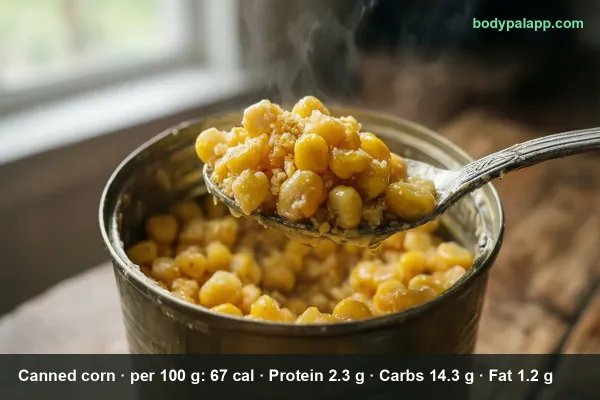
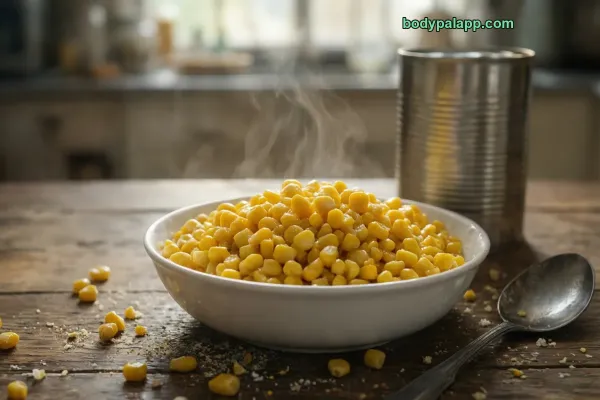
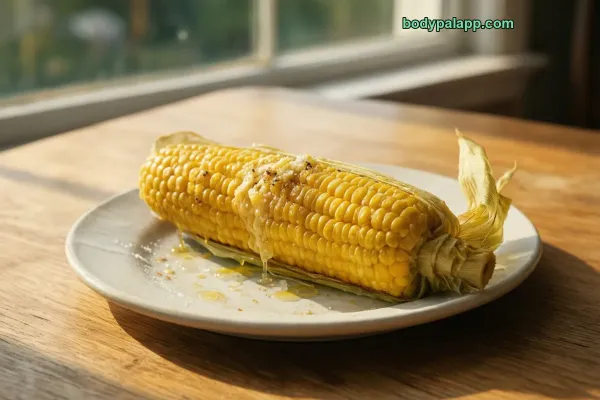
Preparation changes that picture more than anything else. Canned corn on our pages lists 205 mg of sodium per 100 g, and corn on the cob lists 240 mg per 100 g. The kernels themselves are not the source; the salt in the can or the pot is. If you watch sodium, frozen kernels give you the most control, because you decide what goes in.
The same logic applies to butter and cheese. Corn starts low in fat, so the toppings set the final number. A pat of butter or a sprinkle of salty cheese can change the profile of the side more than switching between brands like Birds Eye or Signature Select.
Pair corn with a protein, not another starch
Because corn is mostly carbohydrate, it works best when it fills the starch slot of a meal. Serving it next to rice, potatoes and bread at the same time stacks carbs without adding much protein. Swapping one of those for a cup of corn keeps the plate simpler.
Grilled chicken, beans, fish or eggs cover what corn lacks. Kernels also stretch well in salads, salsas and soups, where a 3 oz portion adds color, sweetness and some fiber for 69 calories. That is an easy way to get the flavor without a full bowl.
If you log meals, BodyPal can record corn kernels from a photo, which helps when the side is mixed into a salad or stir-fry and hard to measure by eye.
How does corn kernels compare?
Here is how frozen corn kernels stack up against canned corn and corn on the cob, per 100 g and per usual serving.
Verdict: For the fewest calories pick canned corn at 67 per 100 g, but expect 205 mg of sodium per 100 g compared with 1 mg in plain kernels. For control over salt and a solid cup at 134 calories, frozen kernels are the better everyday choice, while corn on the cob runs denser at 94 per 100 g.
Most popular corn kernels brands in the United States
Ranked by popularity in the BodyPal database
# Productkcal / 100 g
1Birds Eye White Corn Kernels2/3 cup · 95 g84 kcal
2Signature Select White Corn Kernels2 Tbsp · 30 g400 kcal
3Farmhouse Creek Yellow Corn Kernels2/3 cup · 85 g94 kcal
4Belmont Giant Corn Kernels1 cup · 113 g80 kcal
5Inca's Food White Corn Kernels3 oz · 85 g129 kcal
Labels are per uncooked kernels, frozen or dry, so they read higher than the boiled numbers above. Source: manufacturer labels / USDA FoodData Central.
Corn kernels FAQs
How many calories are in a cup of corn kernels?
A cup of frozen corn kernels boiled and drained (165 g) is 134 calories. A smaller 3 oz portion (85 g) is 69 calories.
Are corn kernels good for weight loss?
A cup is 134 calories with 4.0 g fiber, 4.2 g protein and 1.1 g fat, but it carries 31.8 g carbs, more than most other vegetables in the same volume.
Corn kernels vs canned corn: which has fewer calories?
Canned corn is 67 calories per 100 g, against 81 calories per 100 g for boiled frozen kernels.
How many carbs are in corn kernels?
Per 100 g there are 19.3 g carbs, of which 3.1 g sugars and 2.4 g fiber. A cup (165 g) has 31.8 g carbs.
How many calories are in 100 g of corn kernels?
100 g of corn kernels has 81 calories, based on frozen kernels boiled and drained without salt. That weight also carries 19.3 g of carbs, 2.6 g of protein and 0.7 g of fat.
What are the nutrition facts for corn kernels?
Per 100 g, corn kernels have 81 calories, 19.3 g of carbs, 2.6 g of protein, 0.7 g of fat, 2.4 g of fiber, 3.1 g of sugars and 1 mg of sodium. Cholesterol is 0.
How many calories are in a small serving of corn?
A 3 oz portion (85 g) of corn kernels has 69 calories, about 3% of the daily value. It also gives 2.2 g of protein, 16.4 g of carbs and 2 g of fiber.
How many calories are in 2 cups of corn?
Two cups of corn kernels (330 g) come to 267 calories. Three cups reach 401 calories, so second helpings add up quickly for a side dish.
How much protein is in a cup of corn kernels?
A cup of corn kernels has 4.2 g of protein, about 8% of the daily value. Protein supplies only 11% of corn's calories, so pair it with a protein-rich food.
How much sugar is in corn kernels?
Corn kernels have 3.1 g of sugars per 100 g and 5.1 g per cup. Most of the 31.8 g of carbs in a cup is starch, and the cup also brings 4 g of fiber.