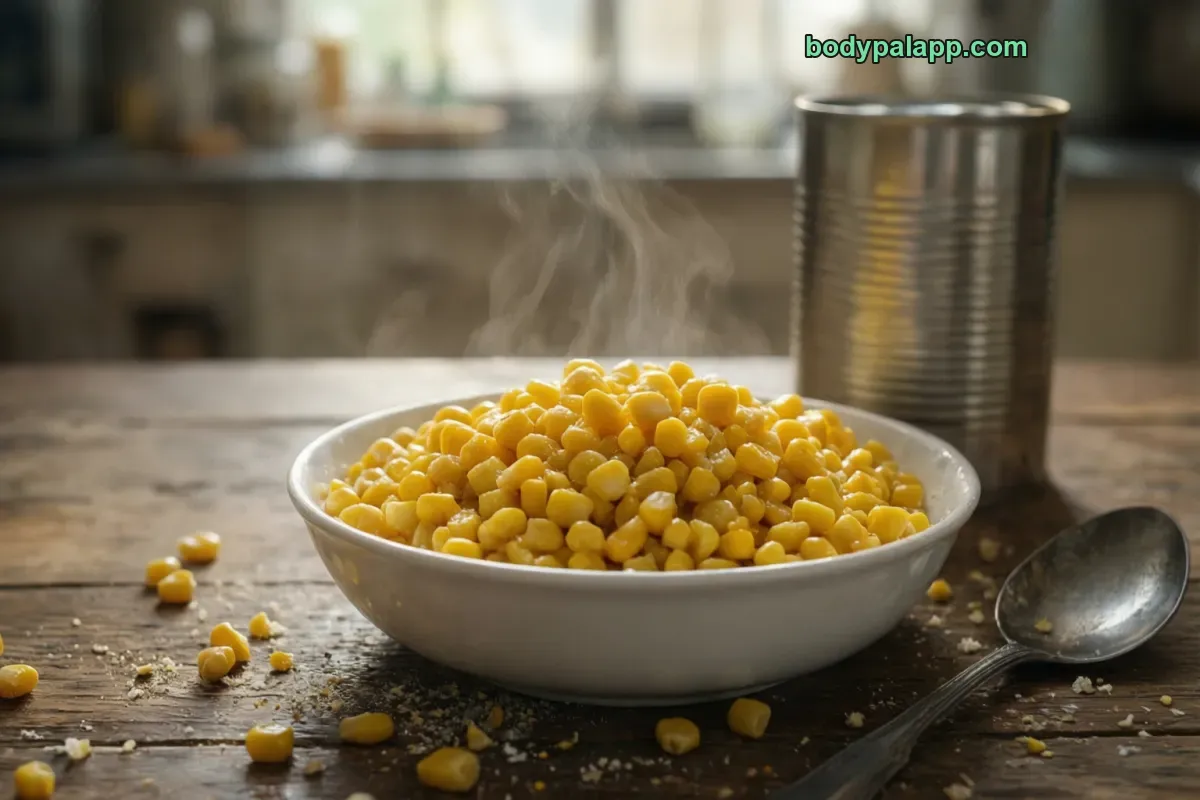
Canned corn calories come to 111 for 1 cup (165 g) and 67 per 100 g, with no added fat. The number to notice is sodium: that cup carries 338 mg, 15% of the daily value, while its calories are only 6%. With canned corn, salt builds up faster than calories.
111kcal
1 cup · 165 g, canned, no added fat
12%protein
3.8 gProtein
24 gCarbs
2 gFat
How to burn off 111 kcal
—Walking, brisk
—Jogging
—Cycling, moderate
—Swimming
Skip the math. BodyPal counts these calories from your steps and workouts automatically.
Nutrition facts
Canned, no added fat · per 165 g
Calories
111 kcal
Protein
3.8 g
Carbohydrate
24 g
Fat
2 g
Saturated fat
0.4 g
Cholesterol
0 mg
Sodium
338 mg
Potassium
218 mg
Iron
0.4 mg
Source: USDA FoodData Central
🛡️
Verified nutrition data
Numbers on this page come from USDA FoodData Central, the U.S. Department of Agriculture’s food composition database, and from manufacturer labels where a branded product is named. Last verified September 2026. How we verify our data →
Canned corn: calories, protein and sodium by serving
Percent of daily value uses the FDA reference of 2,000 kcal a day.
Serving
kcal
Protein
Carbs
Fat
Sodium
% DV kcal
1 cup (165 g)
111
3.8 g
23.7 g
2 g
338 mg
6%
Half cup (83 g)
56
1.9 g
11.9 g
1 g
170 mg
3%
With butter (170 g)
145
3.8 g
23.7 g
5.7 g
367 mg
7%
100 g
67
2.3 g
14.3 g
1.2 g
205 mg
3%
3 × 1 cup (165 g)
332
11.3 g
1,015 mg
5 × 1 cup (165 g)
553
18.9 g
1,691 mg
One cup is a 111-calorie side
The standard serving is 1 cup (165 g), and it lands at 111 calories with 3.8 g of protein and 3.3 g of fiber. A half cup (83 g) halves everything neatly: 56 calories, 1.9 g of protein and 1.7 g of fiber. That smaller scoop is the realistic portion when corn shares the plate with other sides.
Butter is where the total jumps. The USDA row for corn with butter (170 g) reads 145 calories and 5.7 g of fat, against 2 g of fat for the plain cup. Carbs stay at 23.7 g and protein at 3.8 g, so the extra calories come almost entirely from the fat on top.
Portions also climb quickly when corn becomes a main ingredient in a salad, salsa or casserole. Two cups come to 221 calories, three cups to 332 and five cups to 553. If you cook with it often, measure once, because a heaping serving spoon rarely holds exactly 1 cup.
Carbs supply 74% of the calories
Canned corn is a starchy vegetable, and the calorie split shows it: 74% of the energy comes from carbohydrate, 14% from fat and 12% from protein. Per 100 g that works out to 14.3 g of carbs, 1.2 g of fat and 2.3 g of protein. Treat it as the starch on the plate, not as a free vegetable.
Of those 14.3 g of carbs, 4.4 g are sugars, which explains the sweet taste. A full cup carries 7.3 g of sugars and 23.7 g of carbs in total. Fiber reaches 2 g per 100 g, or 3.3 g per cup.
Protein is modest. A cup gives 3.8 g, 8% of the daily value, so corn does not stand in for a protein food. Fat stays low too, with 0.2 g saturated per 100 g and 0 mg cholesterol, as long as nothing gets stirred in. That lean profile is why the butter row looks so different.
Sodium is the row to watch
The calories are modest; the salt is not. One cup carries 338 mg of sodium, 15% of the daily value, while its 111 calories are only 6% of a day's energy. Sodium runs at more than twice the calorie share, the opposite of what most people expect from a vegetable.
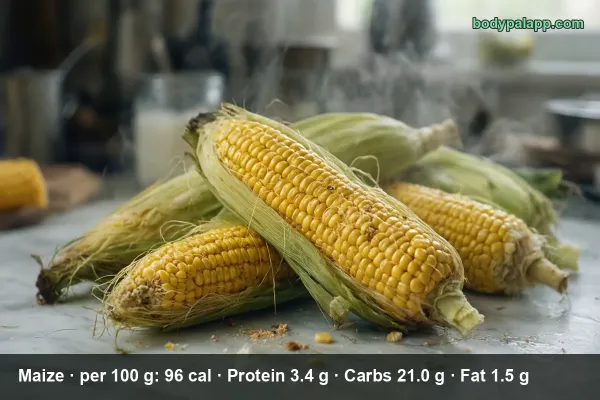
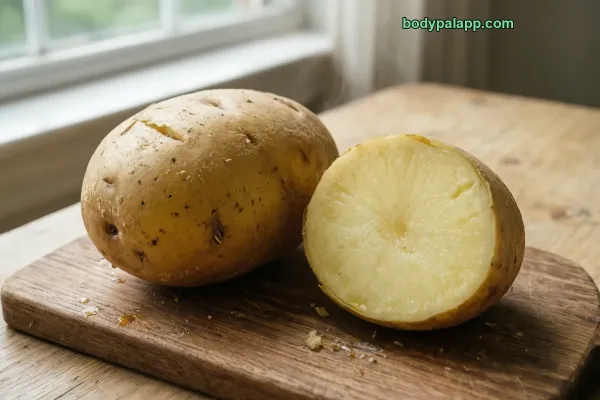
Per 100 g the figure is 205 mg, or 9% of the daily value. The maize row shows just 1 mg per 100 g and golden potato 7 mg, so nearly all of the sodium arrives with the canning, not with the corn itself. That gap is the clearest reason on this page to read the label before you buy.
Bigger servings stack it up fast. Two cups reach 677 mg, three cups 1,015 mg and five cups 1,691 mg. Butter nudges one serving to 367 mg, or 16%. If you watch sodium, compare can labels and keep the scoop to a half cup at 170 mg, 7% of the daily value.
Pair it with protein, not more starch
With 74% of its calories from carbs and only 3.8 g of protein per cup, canned corn works best as the side beside a lean protein, not as the base of the meal. A half cup at 56 calories fits easily next to chicken, fish, eggs or beans and brings color and sweetness without much fat.
If the meal already has rice, bread or potatoes, corn doubles the starch. In that case a smaller scoop keeps the plate balanced. Because it is already cooked, it drops straight into salads, soups, tacos and chili, which is the whole point of the can. Cold corn also works in grain bowls and bean salads with no prep at all.
Logging is simple: measure by the cup or by the gram, or snap a photo and let BodyPal log it. Log butter separately, since it moves the serving from 111 to 145 calories.
How does canned corn compare?
Here is canned corn next to maize and golden potato, per 100 g and per usual serving.
Verdict: For the fewest calories pick canned corn: 67 per 100 g against 96 for maize and 92 for golden potato, each about 1.4 times as much. If sodium is your concern, golden potato at 7 mg and maize at 1 mg per 100 g both beat canned corn's 205 mg by a wide margin.
Canned corn FAQs
How many calories are in a cup of canned corn?
One cup of canned corn, drained and heated without added fat (165 g), is about 111 calories. That cup also has 3.8 g of protein and 2 g of fat.
Is canned corn good for weight loss?
Canned corn is 67 calories per 100 g, so a cup adds 111 calories along with 3.3 g of fiber. Cooking it with butter or margarine raises the same cup to 145 calories.
Canned corn vs corn on the cob: which has fewer calories?
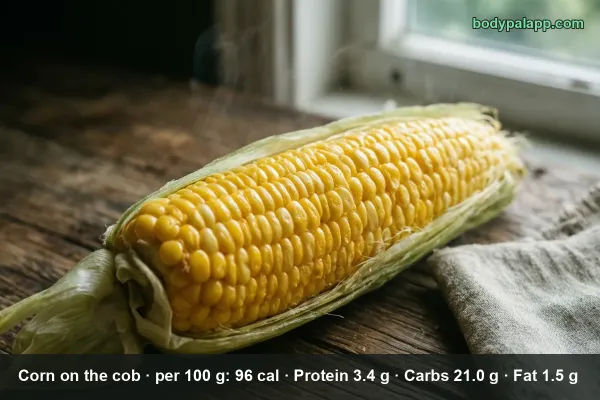
Canned corn has 67 calories per 100 g and an ear of corn has 96 per 100 g, so canned corn is about 29 calories lighter for the same weight.
How many carbs are in canned corn?
A cup (165 g) has 23.7 g of carbohydrate, of which 7.3 g is sugars and 3.3 g is fiber. Per 100 g that is 14.3 g of carbohydrate.
How many calories are in 100 g of canned corn?
Canned corn has 67 calories per 100 g, 3% of the daily value. That weight gives 2.3 g of protein, 14.3 g of carbs, 1.2 g of fat and 2 g of fiber, plus 205 mg of sodium.
Does canned corn have protein?
Yes, but not much: 1 cup holds 3.8 g of protein, 8% of the daily value. Protein supplies 12% of the calories against 74% from carbs, so pair corn with a protein food for a more complete plate.
What are the nutrition facts for 1 cup of canned corn?
One cup (165 g) of canned corn has 111 calories, 3.8 g of protein, 23.7 g of carbs, 2 g of fat, 3.3 g of fiber and 7.3 g of sugars. Sodium comes to 338 mg, 15% of the daily value.
How many calories are in a half cup of canned corn?
A half cup (83 g) of canned corn has 56 calories, 3% of the daily value. It also brings 1.9 g of protein, 11.9 g of carbs, 1.7 g of fiber and 170 mg of sodium.
How much sodium is in canned corn?
Canned corn has 205 mg of sodium per 100 g and 338 mg per cup, which is 15% of the daily value. The maize row shows only 1 mg per 100 g, so the canning adds most of it.