
How many calories are in a can of corn?
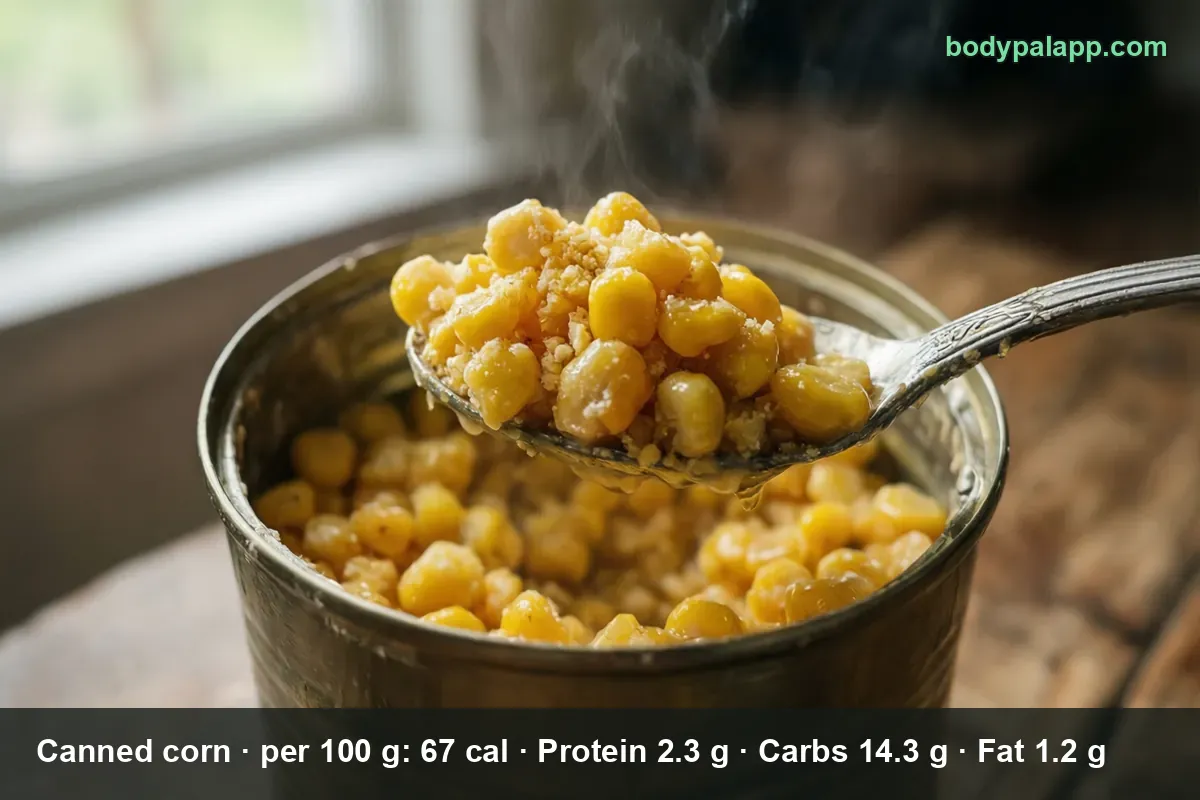
A 1-cup serving of drained canned corn, 165 g, is 111 calories. Per 100 g the kernels run 67 calories, lighter per gram than fresh, frozen or raw corn. The real cost of the can isn't the calories at all — it's the 338 mg of sodium riding along in that same cup.
On this page
- Canned corn quick facts
- US servings, from one ounce to the whole can
- Butter, cream style and vacuum pack
- Sodium is the row to watch, not calories
- How does canned corn compare?
- Most popular canned corn brands
- Canned corn FAQs
Canned corn quick facts
The record that matches what most people actually eat is FNDDS 2709912, "Corn, canned, cooked, no added fat" — kernels poured out of the can, drained, warmed through with nothing added. That's the can on the counter next to the chili pot, and it's the only version that comes with US cup weights attached.
The older SR Legacy entry, 169214 "Corn, sweet, yellow, canned, whole kernel, drained solids", carries identical values because it's the same underlying analysis. Nothing here is averaged between sources.
| Nutrient | Per 100 g | Per 1 cup (165 g) | % Daily Value |
|---|---|---|---|
| Calories | 67 | 111 | — |
| Total fat | 1.22 g | 2.0 g | 3% |
| Saturated fat | 0.24 g | 0.4 g | 2% |
| Carbohydrate | 14.34 g | 23.7 g | 9% |
| Dietary fiber | 2 g | 3.3 g | 12% |
| Total sugars | 4.44 g | 7.3 g | — |
| Protein | 2.29 g | 3.8 g | 8% |
| Sodium | 205 mg | 338 mg | 15% |
% Daily Value is based on a 2,000-calorie diet.
Verified nutrition data
Numbers on this page come from USDA FoodData Central, the U.S. Department of Agriculture’s food composition database, and from manufacturer labels where a branded product is named. Last verified September 2026. How we verify our data →
Two rows you'd expect from a can label are missing: USDA does not publish added sugars or trans fat for this record, so they're left out rather than guessed. Cholesterol is 0 mg, and a cup delivers 218 mg of potassium, 5% of the Daily Value.
One thing worth knowing before you log it: the USDA cup is 165 g, while the label on the can prints a 1/2 cup serving at 125 g. Half a USDA cup is 82.5 g. The can's "half cup" is heavier than half of the USDA cup, which is why store numbers and app numbers rarely line up on the nose.
US servings, from one ounce to the whole can
| Serving | Weight | Calories |
|---|---|---|
| 1 oz | 28 g | 19 kcal |
| 1/3 cup, a side spoonful | 55 g | 37 kcal |
| 1/2 cup | 82.5 g | 55 kcal |
| One cup, drained | 165 g | 111 kcal |
| Two cups, roughly one drained can | 330 g | 222 kcal |
| Per 100 g | 100 g | 67 kcal |
The 1-cup row is the USDA household measure. Everything else in that table is our own arithmetic from the USDA 100 g figure, not a USDA serving — including the whole-can line, because USDA doesn't publish a per-can record and drained weight moves with the brand and with how long the strainer sits in the sink.
That two-cup figure is the one to keep in your head. A can dumped into a casserole is a little over 200 calories for the dish, not per plate. Split four ways it's about 55 calories a person, which is the same as the half-cup row above.
Butter, cream style and vacuum pack
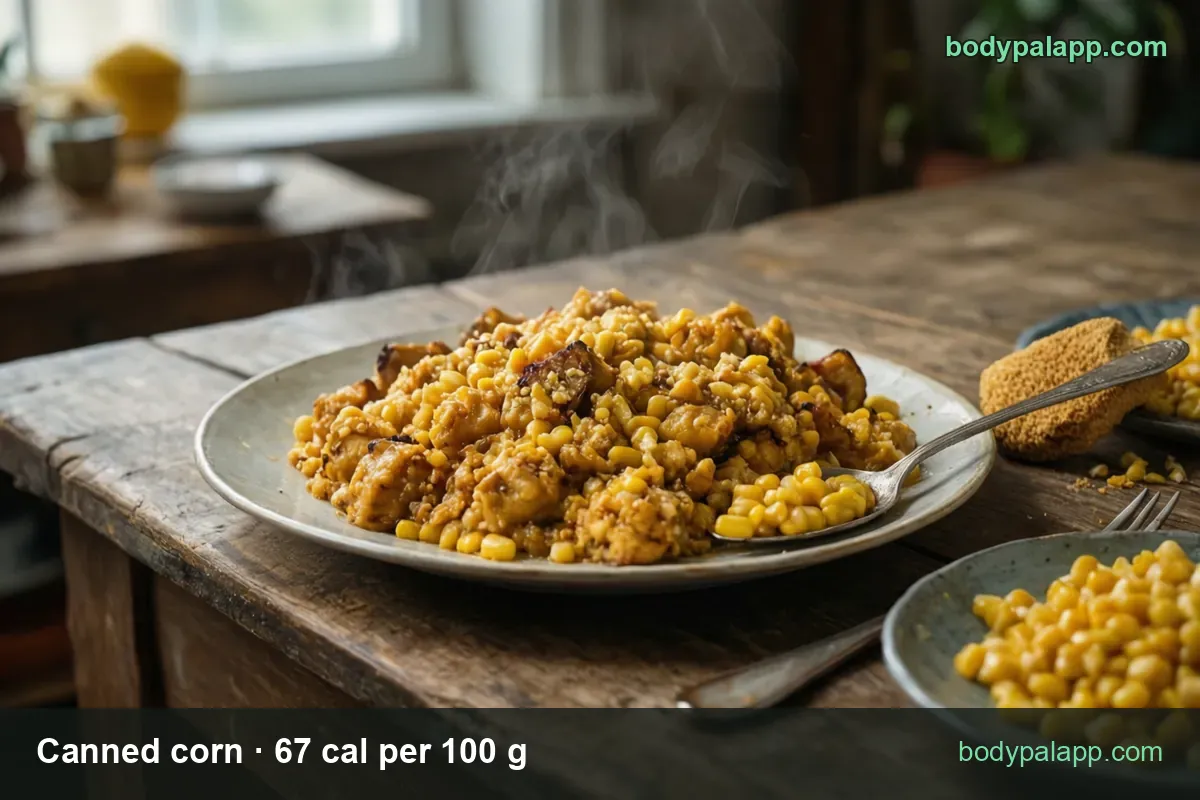
The corn barely changes. What you cook it in, and how it was packed, changes it a lot.
| Version | Per 100 g | Typical serving | Calories |
|---|---|---|---|
| Drained whole kernel, no added fat | 67 kcal | 1 cup (165 g) | 111 kcal |
| Reduced-sodium canned corn | 66 kcal | 1 cup (165 g) | 109 kcal |
| Canned corn with butter | 85 kcal | 1 cup (170 g) | 145 kcal |
| Canned corn cooked with oil | 91 kcal | 1 cup (170 g) | 155 kcal |
| Canned corn, fat added, type not specified | 88 kcal | 1 cup (170 g) | 150 kcal |
| Cream style | 72 kcal | 1 oz (28 g) | 20 kcal |
| Vacuum pack | 79 kcal | 1 oz (28 g) | 22 kcal |
A pat of butter stirred through the pan takes the cup from 111 to 145. Oil takes it to 155. That single spoonful of fat is a bigger swing than any difference between plain whole-kernel brands, and it's the step most people forget to log.
Vacuum pack is the sleeper. With no packing liquid to pour off, the kernels arrive concentrated: 19.44 g of carbohydrate per 100 g against 14.34 g for drained regular pack, with protein almost unchanged at 2.41 g versus 2.29 g. Cream style sits in a starchy sauce, which pushes carbohydrate to 18.13 g per 100 g and drops fiber to 1.2 g.
Store labels use their own 1/2 cup, 125 g serving, and the printed numbers for plain golden kernel cluster tightly: Goya, Topco and ShopRite all list 80 calories, Del Monte's Allens 90, and Weis no-salt-added 60. Roundy's cream style prints 100.
Sodium is the row to watch, not calories
At 111 calories, a cup of corn is not the thing wrecking anyone's day. The sodium is more interesting. Regular pack runs 205 mg per 100 g, so a cup lands at 338 mg — 15% of the FDA Daily Value of 2,300 mg, or roughly a seventh of a teaspoon of table salt hiding in a vegetable side.
Three levers move it, and the USDA has a record for each. Draining alone leaves you at 205 mg per 100 g. Rinsing the drained kernels under the tap takes the rinsed record down to 163 mg per 100 g, and it costs you a little sugar and fiber on the way, 4.11 g and 1.7 g. A no-salt-added can is 12 mg per 100 g — effectively zero — and the vacuum-pack no-salt version is 3 mg. If you're watching sodium, buying the no-salt can beats rinsing the salted one, and it doesn't rinse anything else away.
The upside column is real too. A cup carries 3.3 g of fiber, 12% of the Daily Value, which is more than most people expect from a can. MyPlate files corn under starchy vegetables, so it counts toward the vegetable group while still spending from your carbohydrate budget — worth knowing if corn is riding alongside rice or a tortilla on the same plate.
How does canned corn compare?
| Corn | Per 100 g | US serving | Calories |
|---|---|---|---|
| Canned, drained, no added fat | 67 kcal | 1 oz (28 g) | 19 kcal |
| Frozen, cooked, no added fat | 81 kcal | 1 oz (28 g) | 23 kcal |
| Fresh, cooked, no added fat | 86 kcal | 1 oz (28 g) | 24 kcal |
| Raw corn | 86 kcal | 1 oz (28 g) | 24 kcal |
Our take: canned drained kernels are the lightest per gram of the four, and it isn't a nutrition miracle — the canning process leaves the kernels wetter, so more of each gram is water. Frozen is the middle option at 81 calories per 100 g with 2.54 g of protein, fresh and raw both sit at 86. For calorie counting the differences are small enough to ignore at a side-dish scale: one ounce of each is 19 to 24 calories. Pick canned for the price and the shelf, frozen if you want the kernels to hold their shape, and let the sodium row, not the calorie row, decide which can goes in the cart.
Most popular canned corn brands in the United States
Ranked by how widely each product appears among foods sold in the United States, from the BodyPal food database of over 3.3 million products. Calories are the figures printed on each Nutrition Facts label, checked against USDA FoodData Central.
| Product | Calories (per 100 g) |
|---|---|
| Allens Veg-All Whole Kernel Sweet Corn | 72 cal |
| Goya Premium Whole Kernel Golden Corn | 64 cal |
| Topco Golden Sweet Whole Kernel Corn | 64 cal |
| ShopRite Sweet Whole Kernel Golden Corn | 64 cal |
| Weis Quality No Salt Added Whole Kernel Sweet Corn | 48 cal |
| Roundy's Cream Style Golden Sweet Corn | 80 cal |
Brand popularity: BodyPal food database. Nutrition: manufacturer labels / USDA FoodData Central.
Canned corn FAQs
How many calories are in a whole can of corn?
USDA doesn't publish a whole-can record, so we scale the 100 g figure: two cups of drained kernels, 330 g, comes to 222 calories — our own arithmetic. Drained weight varies by brand and by how long the can sits in the strainer, so treat it as a ballpark for the dish, not a label number.
How many calories in 1 cup of canned corn?
One cup of drained canned corn, 165 g, is 111 calories, at 67 calories per 100 g. That cup also brings 23.7 g of carbohydrate, 3.3 g of fiber and 3.8 g of protein. Note that the USDA cup is heavier than the 1/2 cup, 125 g serving printed on most cans.
Does draining canned corn reduce calories?
Draining removes liquid, not calories: drained solids run 67 calories per 100 g. The USDA record measured with the packing liquid runs 61 calories per 100 g, because the water poured off weighed something and carried almost nothing. Per kernel actually eaten, nothing changed — but the sodium in that liquid does go down the sink.
How much sodium is in canned corn?
A 165 g cup of regular canned corn carries 338 mg of sodium, 15% of the FDA Daily Value. Rinsing the drained kernels under the tap takes the record down to 163 mg per 100 g from 205 mg, and a no-salt-added can is 12 mg per 100 g, with the vacuum-pack no-salt version at 3 mg.
Is canned corn healthy?
A cup is 111 calories with 3.3 g of fiber, 3.8 g of protein, no cholesterol and 218 mg of potassium, so it earns its place. The caveat is sodium at 338 mg a cup. MyPlate counts corn as a starchy vegetable, so it fills the vegetable group while still spending carbohydrate.
Is canned corn better than frozen corn?
Frozen corn cooked without fat is 81 calories per 100 g against 67 for drained canned kernels, so canned is lighter per gram simply because it holds more water. Frozen carries more protein, 2.54 g against 2.29 g. If sodium is the concern, the no-salt-added can at 12 mg per 100 g settles it.
How many carbs are in canned corn?
One cup of drained canned corn holds 23.7 g of carbohydrate, 9% of the Daily Value, of which 3.3 g is fiber and 7.3 g is total sugars. Vacuum-pack corn is denser at 19.44 g per 100 g against 14.34 g for drained regular pack, because there's no packing liquid to pour off.
Is cream style corn higher in calories?
Cream style is 72 calories per 100 g against 67 for drained whole kernel, so per gram it's only slightly higher. The real gap is in the carbohydrate: 18.13 g per 100 g against 14.34 g, with fiber down to 1.2 g from 2 g, because the kernels sit in a starchy sauce rather than water.
Similar foods
- Corn Canned — 111 cal per cup
- Yukon Gold Potato — 147 cal per medium potato
- Peppermint — 2 cal for 2 tbsp chopped
- Garden Salad — 180 cal per salad
- Fruit Salad — 89 cal per cup
- White Sweet Potato — 115 cal per medium sweet potato
Count it without the math
Point the camera at the plate and BodyPal counts the corn for you, butter and all.


How long does it take to burn off canned corn?
A 1-cup (165 g) serving is 111 kcal. Enter your weight and the amount you ate to see how long it takes you to burn that off:
lb
| Activity | Time to burn 111 kcal |
|---|---|
| Walking, brisk | 22 min |
| Cycling, moderate | 14 min |
| Swimming, moderate | 16 min |
| Jogging | 13 min |
| Weight training, moderate | 25 min |
Times are for a 155 lb adult at a steady pace; change the weight to see yours. The amount is set to the portion in the text (165 g); change it to what you actually ate. BodyPal works this out from your steps automatically.
Burning it off is one side of it. The other is knowing your number: work out how many calories you need a day, with macros and a goal date.