
How Many Calories Are in Fruit Salad?
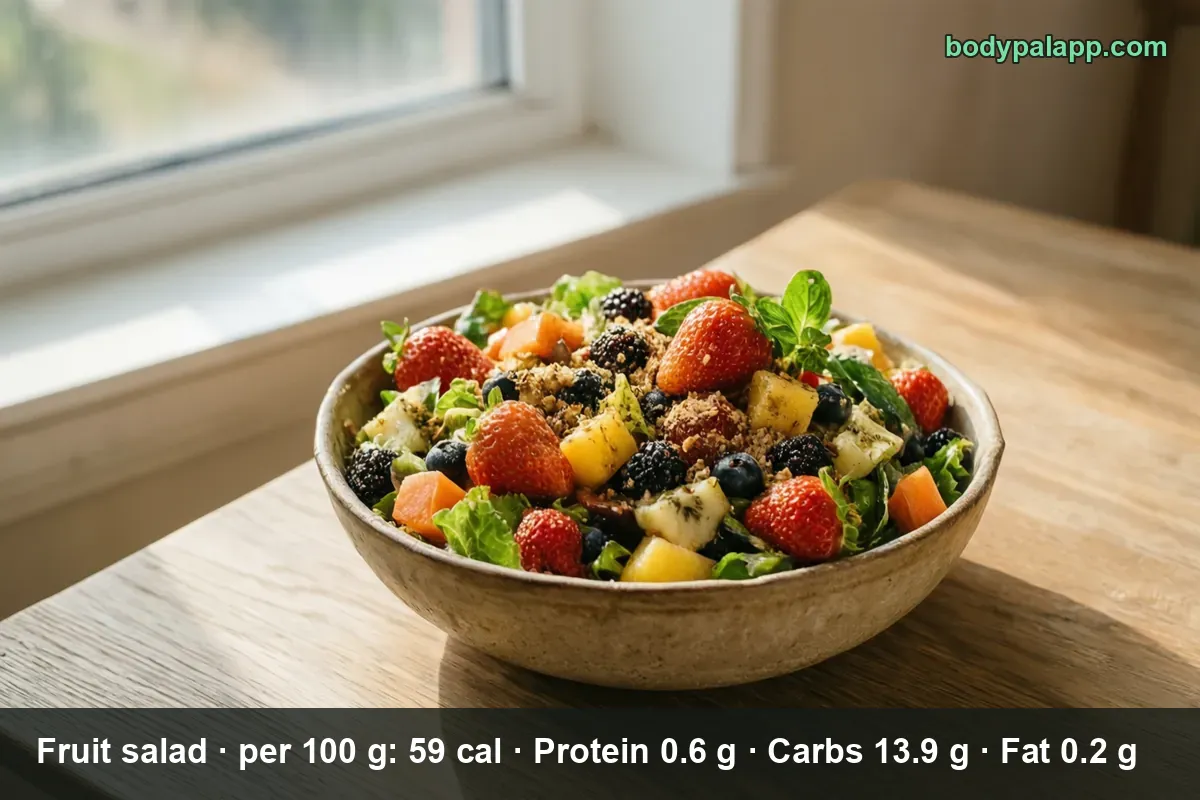
A 1-cup (150 g) serving of fresh fruit salad, no dressing, is 89 calories, and per 100 g it runs 59 calories. The cup is fruit and nothing else: 15.7 g of sugar, all of it the fruit's own, 2.3 g of fiber and 6 mg of sodium. Toppings change the answer completely.
On this page
- Fruit salad quick facts
- US servings from an ounce to two cups
- What the toppings do to the number
- Canned fruit salad in juice and in water
- Sugar and fiber in a cup of fruit
- How does fruit salad compare?
- Most popular fruit salad brands
- FAQ
Fruit salad quick facts
The row used here is FNDDS 2709287, "Fruit salad, fresh or raw, excluding citrus fruits, no dressing". It matches the bowl most people are actually holding when they look this up: cut berries, melon, mango and pineapple, spooned out and eaten plain. Nothing poured over it, nothing folded through it.
USDA keeps a separate record for the same salad with citrus in the mix, and several more for the topped versions. Those are further down. Pick this one when the fruit is the whole dish.
| Nutrient | Per 100 g | Per 1 cup (150 g) | % Daily Value |
|---|---|---|---|
| Calories | 59 | 89 | — |
| Total fat | 0.21 g | 0.3 g | 0% |
| Saturated fat | 0.04 g | 0.1 g | 0% |
| Carbohydrate | 13.94 g | 20.9 g | 8% |
| Dietary fiber | 1.5 g | 2.3 g | 8% |
| Total sugars | 10.45 g | 15.7 g | — |
| Protein | 0.64 g | 1.0 g | 2% |
| Sodium | 4 mg | 6 mg | 0% |
% Daily Value is based on a 2,000-calorie diet.
Verified nutrition data
Numbers on this page come from USDA FoodData Central, the U.S. Department of Agriculture’s food composition database, and from manufacturer labels where a branded product is named. Last verified September 2026. How we verify our data →
Two rows you would see on a packaged label are missing here. USDA does not publish added sugars or trans fat for this FNDDS record, so neither line appears above. The cup also carries 285 mg of potassium, 6% of the Daily Value, and no cholesterol at all. Daily Values come from the FDA nutrition label reference.
US servings from an ounce to two cups
| Serving | Weight | Calories |
|---|---|---|
| 1 oz | 28 g | 17 kcal |
| Half a cup | 75 g | 44 kcal |
| One cup | 150 g | 89 kcal |
| Two cups, a full lunch bowl | 300 g | 177 kcal |
| Per 100 g | 100 g | 59 kcal |
The 1-cup, 150 g line is USDA's own household measure. The ounce, the half cup and the two-cup bowl are our own arithmetic from the USDA 100 g figure, not USDA servings, which is why they scale so cleanly.
Here is the trap in that table. A cup of fruit salad is a cup of solid cut fruit, not a cup of loose berries, and how tightly the fruit is packed swings the weight before it swings the calories. Weigh the bowl once on a kitchen scale and you will know for good whether your cup is closer to 130 g or 170 g. Even at the top of that range you are still right around 100 calories.
What the toppings do to the number
| Version | Per 100 g | Typical cup | Calories |
|---|---|---|---|
| Fresh, no citrus | 59 kcal | 1 cup (150 g) | 89 kcal |
| Fresh, with citrus | 56 kcal | 1 cup (150 g) | 84 kcal |
| With pudding | 133 kcal | 1 cup (182 g) | 242 kcal |
| With whipped cream, with citrus | 158 kcal | 1 cup (182 g) | 288 kcal |
| With whipped cream, no citrus | 164 kcal | 1 cup (182 g) | 298 kcal |
| With marshmallows, with citrus | 244 kcal | 1 cup (171 g) | 417 kcal |
| With marshmallows, no citrus | 251 kcal | 1 cup (171 g) | 429 kcal |
Adding citrus takes the plain salad down a little, from 59 to 56 calories per 100 g, or 89 to 84 a cup. Oranges and grapefruit are more water than mango or banana, so the bowl gets slightly cheaper. That is the smallest move on this page.
Everything else on the list is the topping talking. Whipped cream more than triples the plain cup, 288 against 89. Marshmallows, the holiday-table bowl, land at 417 a cup with citrus and 429 without. A fruit salad bound with mayonnaise or salad dressing sits at 240 calories per 100 g, in the same territory as the marshmallow bowl.
There is a second, quieter effect in that table, and it flatters the topped versions. USDA weighs a cup of the fresh salad at 150 g but a cup of the creamed and pudding versions at 182 g, because the topping fills the gaps between the fruit. Comparing cup to cup already loads 21% more food onto the topped side before a single gram of fat is counted. Per 100 g, whipped cream is not tripling the salad, it is roughly two and a half times it.
Canned fruit salad in juice and in water
Canned is the one place where the calorie count actually falls. Fruit salad canned in juice is 50 calories per 100 g with solids and liquid together, and the water pack is 30. Scale both to the same 150 g cup as the fresh salad, our own arithmetic from those 100 g figures, and you get 75 calories for the juice pack and 45 for the water pack, against 89 fresh.
Lighter, though, is not the same as better here. Fiber drops to 1 g per 100 g in both canned records, against 1.5 g fresh, and USDA does not publish total sugars for either canned row, so there is no honest way to compare the sweetness of a juice pack against fresh fruit. Syrup-packed cans are a different product again and are not the rows quoted above.
Retail tubs of cut fruit sit close to the fresh number. Across six US branded records the range is 40 to 93 calories per 100 g: Fresh & Easy's cut fruit at 40, Fiesta at 43, Del Monte's tropical fruit salad at 63 and Great Value's blend at 93. Del Monte's labeled half cup (126 g) is 79 calories, and Great Value's labeled cup (140 g) is 130.
Sugar and fiber in a cup of fruit
The sugar line is the one that makes people nervous. A cup holds 15.7 g of total sugars, which sounds like a lot next to the 50 g Daily Value for added sugars until you notice that they are not the same thing. Total sugars have no Daily Value on the US label, and USDA publishes no added sugars figure for plain cut fruit, because there is nothing to add. The 15.7 g arrives packed with 2.3 g of fiber and 285 mg of potassium.
Fiber is where a cup of fruit salad quietly does well: 2.3 g is 8% of the 28 g Daily Value, the same percentage as its carbohydrate. Very few things sweet enough to eat for dessert return fiber at the same rate as their calories. MyPlate puts most adults at 1½ to 2 cups of fruit a day, so one bowl of this covers a large slice of it.
Sodium is a non-event at 6 mg a cup, 0% of the Daily Value. That changes the moment a topping goes on: the marshmallow version runs 122 mg per 100 g and the mayonnaise-dressed version 124 mg, roughly thirty times the 4 mg of the plain fruit.
How does fruit salad compare?
| Dish | Per 100 g | US serving | Calories |
|---|---|---|---|
| Fruit salad, fresh, no dressing | 59 kcal | 1 cup (150 g) | 89 kcal |
| Ambrosia | 75 kcal | 1 cup (193 g) | 145 kcal |
| Pineapple salad with dressing | 105 kcal | 1 serving (184 g) | 193 kcal |
| Apple salad with dressing | 180 kcal | 1 cup (137 g) | 247 kcal |
Our take: plain fruit salad is the lightest of these four both per 100 g and per serving, and it is not close. Apple salad with dressing is 180 calories per 100 g, just over three times the plain salad's 59, and its smaller 137 g cup still comes to 247 calories. If you are counting, the decision is not which fruit goes in the bowl, it is whether anything creamy goes on top. Keep it plain and a generous two-cup bowl is 177 calories; dress the same fruit and one cup can cost more than double that.
Most popular fruit salad brands in the United States
Ranked by how widely each product appears among foods sold in the United States, from the BodyPal food database of over 3.3 million products. Calories are the figures printed on each Nutrition Facts label, checked against USDA FoodData Central.
| Product | Calories (per 100 g) |
|---|---|
| Del Monte Tropical Fruit Salad | 63 cal |
| Roland Tropical Fruit Salad | 64 cal |
| Roland Tropical Fruit Salad (lighter pack) | 50 cal |
| Great Value Fruit Salad Blend | 93 cal |
| Fiesta Fruit Salad | 43 cal |
| Fresh & Easy Fruit Salad | 40 cal |
Brand popularity: BodyPal food database. Nutrition: manufacturer labels / USDA FoodData Central.
Fruit salad FAQs
How many calories are in a cup of fruit salad?
A 1-cup (150 g) serving of fresh fruit salad with no dressing is 89 calories, from the USDA record at 59 calories per 100 g. The same cup carries 20.9 g of carbohydrate, 2.3 g of fiber and 15.7 g of sugar, all of it from the fruit itself.
How many calories in fruit salad with whipped cream?
A cup of fruit salad with whipped cream is 288 calories, more than three times the 89 in a plain cup. USDA also weighs that cup heavier, 182 g against 150 g, so part of the jump is volume of topping rather than the fruit underneath it.
How many calories in half a cup of fruit salad?
Half a cup, 75 g, is 44 calories. That is our own arithmetic from the USDA figure of 59 calories per 100 g, not a USDA serving. It brings about 10.5 g of carbohydrate, 1.1 g of fiber and 7.8 g of sugar with it.
How many carbs are in fruit salad?
A 1-cup (150 g) serving has 20.9 g of carbohydrate, 8% of the Daily Value, and 2.3 g of that is fiber. Per 100 g the figure is 13.94 g. Adding pudding pushes it to 17.49 g per 100 g, because the starch and sugar in the pudding count too.
How much sugar is in fruit salad?
A 1-cup (150 g) serving has 15.7 g of total sugars, or 10.45 g per 100 g. USDA does not publish an added sugars figure for this record, but it is plain fruit with no dressing, so the sugar is the fruit's own. Total sugars have no Daily Value.
Does fruit salad have fiber?
Yes, 2.3 g in a 1-cup (150 g) serving, which is 8% of the 28 g Daily Value, from 1.5 g per 100 g. The citrus version is slightly higher at 1.7 g per 100 g. Canned fruit salad in juice gives 1 g per 100 g instead.
Is canned fruit salad healthier than fresh?
Canned fruit salad in juice is 50 calories per 100 g and the water pack 30, both below fresh at 59. Lighter is not automatically better: the canned records lose fiber, 1 g per 100 g against 1.5 g, and USDA does not publish total sugars for either canned row.
Is fruit salad good for weight loss?
At 89 calories a cup, plain fruit salad is one of the cheapest bowls you can put on a plate, and 2.3 g of fiber helps it feel like food. The version to watch is the topped one: the same cup with marshmallows is 417 calories, more than four times as much.
Similar foods
- Acorn Squash — 115 cal per cup
- Garden Salad — 180 cal per salad
- Artichoke — 66 cal per whole artichoke
- Corn — 111 cal per cup
- Corn Canned — 111 cal per cup
- Yukon Gold Potato — 147 cal per medium potato
Count it without the math
Point the camera at the bowl and BodyPal counts the fruit salad for you, topping and all.


How long does it take to burn off fruit salad?
A 1-cup (150 g) serving is 89 kcal. Enter your weight and the amount you ate to see how long it takes you to burn that off:
lb
| Activity | Time to burn 89 kcal |
|---|---|
| Walking, brisk | 18 min |
| Cycling, moderate | 11 min |
| Swimming, moderate | 13 min |
| Jogging | 10 min |
| Weight training, moderate | 20 min |
Times are for a 155 lb adult at a steady pace; change the weight to see yours. The amount is set to the portion in the text (150 g); change it to what you actually ate. BodyPal works this out from your steps automatically.
Want the bigger picture? Calculate your daily calorie needs — your maintenance figure, a target for losing or gaining, and the date you get there.