Acorn squash calories come to 115 for 1 cup of baked cubes (205 g) and 56 per 100 g. The number to notice is fiber: that same cup carries 9 g, while carbohydrate supplies 91% of the calories and fat barely registers. Portions are easy to scale, and toppings move the total far more than the squash does.
115kcal
1 cup of baked cubes · 205 g, baked, unsalted
7%protein
2.3 gProtein
30 gCarbs
0.3 gFat
How to burn off 115 kcal
—Walking, brisk
—Jogging
—Cycling, moderate
—Swimming
Skip the math. BodyPal counts these calories from your steps and workouts automatically.
Nutrition facts
Baked, unsalted · per 205 g
Calories
115 kcal
Protein
2.3 g
Carbohydrate
30 g
Fat
0.3 g
Saturated fat
0.1 g
Cholesterol
0 mg
Sodium
8 mg
Potassium
896 mg
Iron
1.9 mg
Source: USDA FoodData Central
🛡️
Verified nutrition data
Numbers on this page come from USDA FoodData Central, the U.S. Department of Agriculture’s food composition database, and from manufacturer labels where a branded product is named. Last verified September 2026. How we verify our data →
Acorn squash: calories, protein and sodium by serving
Percent of daily value uses the FDA reference of 2,000 kcal a day.
Serving
kcal
Protein
Carbs
Fat
Sodium
% DV kcal
1 cup cubes (205 g)
115
2.3 g
29.9 g
0.3 g
8 mg
6%
Mashed cup (245 g)
83
1.6 g
21.5 g
0.2 g
7 mg
4%
Whole squash, raw (431 g)
172
3.4 g
44.9 g
0.4 g
13 mg
9%
100 g
56
1.1 g
14.6 g
0.1 g
4 mg
3%
3 × 1 cup cubes (205 g)
344
6.9 g
25 mg
5 × 1 cup cubes (205 g)
574
11.5 g
41 mg
One cup of cubes is a 115-calorie side
A cup of baked, unsalted cubes weighs 205 g and lands at 115 calories, about 6% of the daily value. That is a modest side dish by any measure. It also scales cleanly: 2 cups (410 g) come to 230 calories, and 3 cups (615 g) reach 344.
Even a big batch stays reasonable. Five cups, 1,025 g of squash, total 574 calories, which is roughly what a single rich restaurant entree can carry. If you roast a tray for the week and portion it out, the cup measure is the one to track.
Two other rows on the servings table need context. A mashed cup (245 g) is listed at 83 calories because it comes from a different USDA entry than the baked cubes, so the heavier cup reads lower. A whole raw squash of 431 g comes to 172 calories, weighed before cooking and before you scoop out the seeds and skin, so treat it as a shopping reference rather than a plate portion.
Carbs supply 91% of the calories
Per 100 g, baked acorn squash has 14.6 g of carbohydrate, 1.1 g of protein and 0.1 g of fat. Run that through the calorie split and carbs account for 91% of the energy, protein for 7% and fat for just 2%. This is a starchy vegetable, closer in role to a sweet potato than to a leafy green.
Protein is thin. A full cup gives 2.3 g, about 5% of the daily value, so the squash will not anchor a meal on its own. Fat is close to zero at 0.3 g per cup, with 0 g saturated fat and 0 mg cholesterol.
That near-zero fat line is exactly why preparation matters. Butter, maple syrup, brown sugar or a cheese crust are where the extra calories show up, not in the squash itself. If you log a stuffed or glazed half, log the toppings separately and you will see where the total really comes from.
Fiber is the standout row
Acorn squash delivers 4.4 g of fiber per 100 g, and a cup of cubes reaches 9 g. Against a daily value of 28 g, that is a meaningful share from a side that costs only 115 calories. Few vegetables at this calorie level carry that much.
Potassium is the other strong number, at 437 mg per 100 g. If you track potassium, this squash pulls more weight than its mild flavor suggests.
Sodium is close to nothing. The plain squash has 4 mg per 100 g and 8 mg per cup, which rounds to 0% of the daily value. Whatever sodium ends up on your plate comes from the salt, butter or seasoning blend you add, so if you watch sodium, the shaker is the only row to manage.
Pair it with protein to round out the plate
Because acorn squash is mostly carbohydrate with little protein or fat, it works best as the starch on a plate rather than the whole meal. Roast chicken, turkey, pork, eggs, lentils or beans fill the protein gap that 2.3 g per cup leaves open.
A small amount of fat helps flavor without wrecking the numbers. A drizzle of olive oil or a sprinkle of toasted seeds keeps the dish satisfying while the squash itself stays light. Stuffing a halved squash with grains, ground meat or cheese turns it into a full dinner, but that dinner should be counted as one, not as a vegetable side.
If you want to skip the measuring cup, BodyPal can log acorn squash from a photo of your plate, which makes the topping-heavy versions easier to track honestly.
How does acorn squash compare?
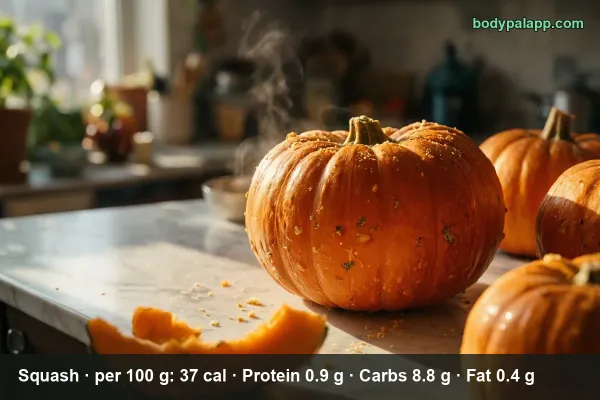
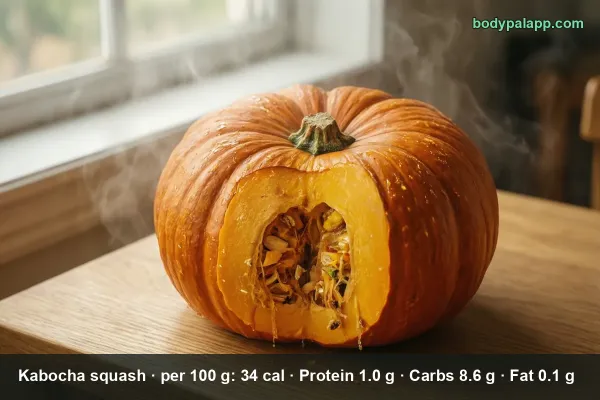
Here is how baked acorn squash stacks up against other squash on our pages, per 100 g and per usual serving.
Verdict: For the fewest calories pick spaghetti squash at 27 per 100 g, about half of acorn's 56, with kabocha at 34 as the next lightest option. Choose acorn when you want a heartier, more filling side, since it carries 14.6 g of carbs per 100 g against 6.5 g in spaghetti squash.
Most popular acorn squash brands in the United States
Ranked by popularity in the BodyPal database
# Productkcal / 100 g
1Wegmans Acorn Squash1/2 cup · 85 g47 kcal
Store packs are labeled for the fresh, uncooked squash, so they read lower than the baked numbers above. Source: manufacturer labels / USDA FoodData Central.
Acorn squash FAQs
How many calories are in acorn squash?
A cup of baked acorn squash cubes (205 g) has 115 calories, and 100 g has 56 calories.
Is acorn squash good for weight loss?
A cup baked is 115 calories with 9.0 g of fiber and only 0.3 g of fat, so it fills a plate for few calories.
Acorn squash vs spaghetti squash: which has fewer calories?
Spaghetti squash has 27 calories per 100 g against 56 in baked acorn squash, so acorn squash has about twice as many.
How many carbs are in acorn squash?
Baked acorn squash has 14.6 g of carbs per 100 g, of which 4.4 g is fiber. A cup of cubes (205 g) has 29.9 g of carbs.
How many calories are in a whole acorn squash?
A whole raw acorn squash of 431 g has 172 calories. That weight includes the skin and seeds you usually discard, so the edible portion you eat will come in lower than the whole-squash figure.
How much fiber is in a cup of acorn squash?
A cup of baked acorn squash cubes (205 g) has 9 g of fiber, or 4.4 g per 100 g. Against a daily value of 28 g, that is a strong contribution for a 115-calorie side.
How much protein does acorn squash have?
Acorn squash has 2.3 g of protein per cup of baked cubes, about 5% of the daily value, and 1.1 g per 100 g. Protein supplies only 7% of its calories, so pair it with a protein food.
Is acorn squash high in sodium?
No. Plain baked acorn squash has 4 mg of sodium per 100 g and 8 mg per cup, which is 0% of the daily value. Nearly all the sodium in a finished dish comes from added salt or butter.
How many calories are in mashed acorn squash?
A mashed cup of acorn squash (245 g) lists 83 calories, based on a separate USDA entry. Butter, cream or sugar stirred into the mash will add to that total, so count them separately.