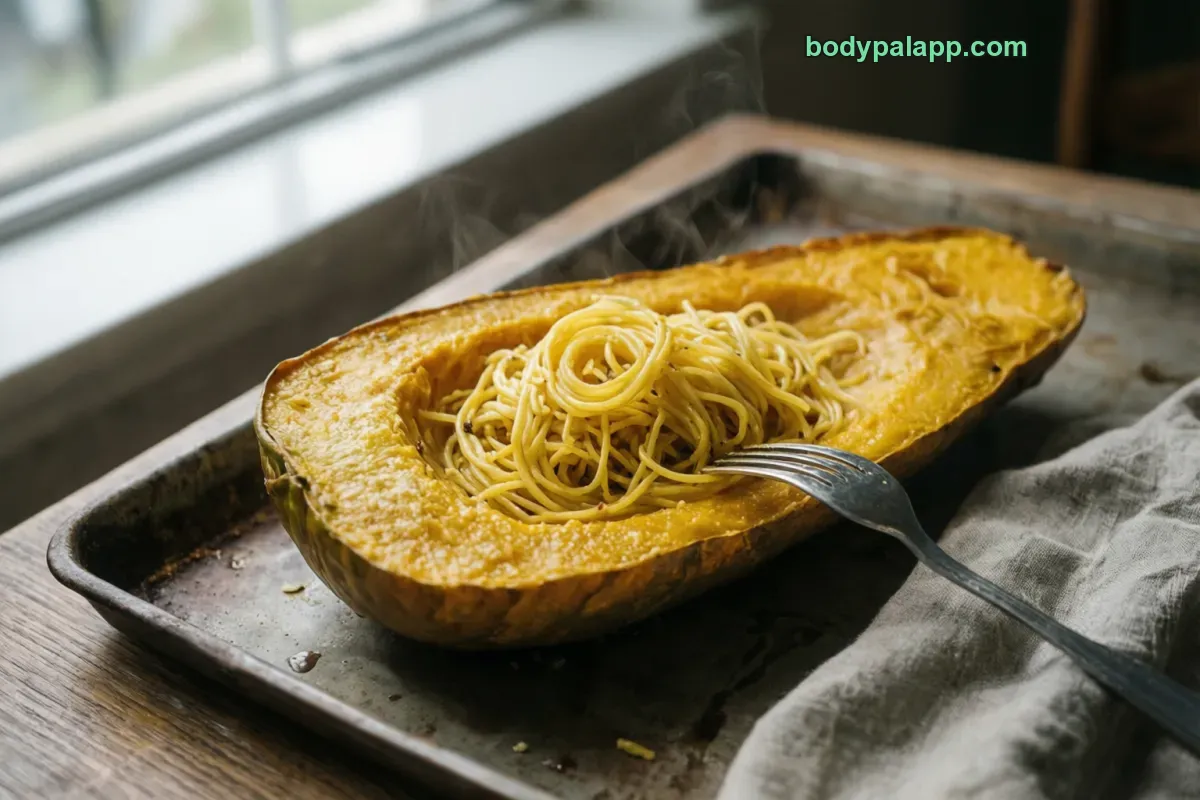
Spaghetti squash calories come to 42 for 1 cup (155 g) of cooked, unsalted squash and 27 per 100 g. Carbs supply 84% of those calories, yet a full cup holds only 10 g of them. The real story is volume: you can eat a big plate before the total moves much.
42kcal
1 cup · 155 g, cooked, unsalted
9%protein
1 gProtein
10 gCarbs
0.4 gFat
How to burn off 42 kcal
—Walking, brisk
—Jogging
—Cycling, moderate
—Swimming
Skip the math. BodyPal counts these calories from your steps and workouts automatically.
Nutrition facts
Cooked, unsalted · per 155 g
Calories
42 kcal
Protein
1 g
Carbohydrate
10 g
Fat
0.4 g
Saturated fat
0.1 g
Cholesterol
0 mg
Sodium
28 mg
Potassium
181 mg
Iron
0.5 mg
Source: USDA FoodData Central
🛡️
Verified nutrition data
Numbers on this page come from USDA FoodData Central, the U.S. Department of Agriculture’s food composition database, and from manufacturer labels where a branded product is named. Last verified September 2026. How we verify our data →
Spaghetti squash: calories, protein and sodium by serving
Percent of daily value uses the FDA reference of 2,000 kcal a day.
Serving
kcal
Protein
Carbs
Fat
Sodium
% DV kcal
1 cup (155 g)
42
1 g
10 g
0.4 g
28 mg
2%
100 g
27
0.7 g
6.5 g
0.3 g
18 mg
1%
Raw, cubed (101 g)
31
0.6 g
7 g
0.6 g
17 mg
2%
3 × 1 cup (155 g)
126
3.1 g
84 mg
5 × 1 cup (155 g)
209
5.1 g
140 mg
Even five cups stay near 209 calories
One cup (155 g) of cooked spaghetti squash is 42 calories, about 2% of a 2000-calorie daily value. Two cups (310 g) come to 84. Three cups (465 g) reach 126. Five cups, a heavy 775 g that few people finish in one sitting, still land at only 209 calories.
That flat curve is why the squash works as a base for a pasta-style bowl. The strands themselves rarely decide the total. The oil, butter, cheese and sauce you add almost always outweigh the squash, so if you track calories, log the toppings with the same care as the main ingredient.
Raw squash reads a little differently. A raw, cubed portion (101 g) lists 31 calories and 7 g of carbs, because it has not lost water or gained any from cooking. A whole squash varies so much in size that the scale beats any guess: weigh the cooked strands and use the cup or 100 g figures.
Carbs make up 84% of every calorie
The calorie split is lopsided: 84% from carbs, 9% from protein and 8% from fat. Per 100 g that works out to 6.5 g of carbs, 0.7 g of protein and 0.3 g of fat. Fat is close to nothing, with 0.1 g saturated and 0 mg cholesterol.
Within those carbs, 2.5 g per 100 g are sugars and 1.4 g are fiber. Per cup that becomes 3.9 g of sugars and 2.2 g of fiber out of 10 g total carbs. The squash tastes mildly sweet, but the sugar load is small because the whole serving is mostly water.
Protein is the weak spot. A cup gives 1 g, which is 2% of the 50 g daily value. Even five cups only add up to 5.1 g. If you want the plate to keep you full, the protein has to come from somewhere else.
Sodium stays low until you salt it
These numbers are for squash cooked without salt. Per 100 g it carries 18 mg of sodium, and a cup has 28 mg, about 1% of the 2300 mg daily value. Five cups still total only 140 mg.
That leaves you in charge of the sodium. Salted cooking water, jarred marinara and grated hard cheese can push a bowl far past what the squash brings. If you watch sodium, season at the table, where you can see how much goes on.
Potassium shows up at 117 mg per 100 g, a modest share of the 4700 mg daily value. Fiber at 2.2 g per cup is a small step toward the 28 g daily value. Neither is a headline number, but both come with very few calories attached, which is the squash's main strength.
It needs protein and fat to become a meal
On its own, a cup of spaghetti squash is a side dish, not dinner. With 1 g of protein and 0.4 g of fat per cup, it has little to slow digestion or keep hunger away for long. Treat it as the bulk of the plate and build the rest around it.
Good partners are the ones that fill the gaps: chicken, turkey meatballs, shrimp, beans, eggs or a spoon of ricotta for protein, and a measured drizzle of olive oil or a sprinkle of parmesan for fat and flavor. Roasted vegetables and a tomato sauce add volume without many extra calories.
The easy trap is treating the low base as permission for a heavy sauce. Keep the squash generous and the rich toppings measured, and the bowl stays light. If weighing strands feels tedious, BodyPal can log spaghetti squash from a photo of your plate.
How does spaghetti squash compare?
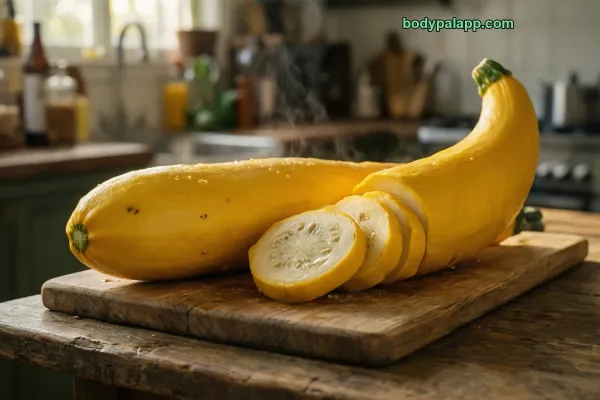
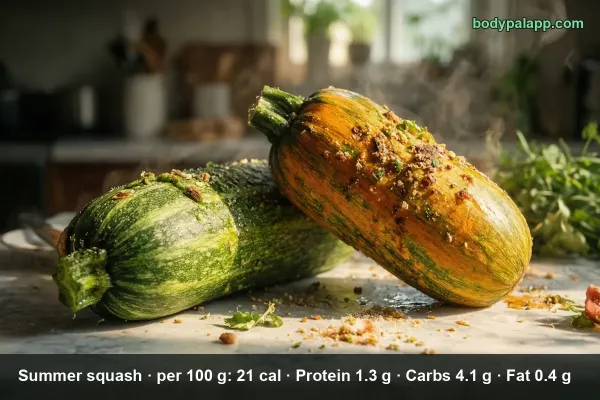
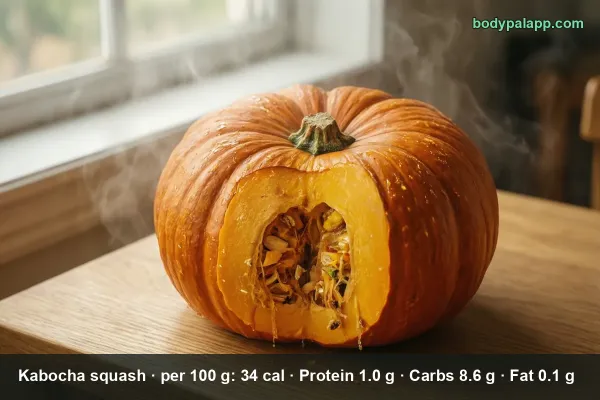
Here is how cooked spaghetti squash stacks up against yellow, summer and kabocha squash, per 100 g and per usual serving.
Verdict: For the fewest calories, summer and yellow squash win at 21 per 100 g versus 27 here, though they list 142 mg of sodium against just 18 for spaghetti squash. For a pasta-like base you can pile high, spaghetti squash is the pick, while kabocha at 34 per 100 g is the denser, sweeter option.
Most popular spaghetti squash brands in the United States
3L&M Family Farms Spaghetti Squash1 cup · 155 g27 kcal
Store labels are measured on raw or frozen squash, so they sit close to but not exactly on the cooked and drained numbers above. Source: manufacturer labels / USDA FoodData Central.
Spaghetti squash FAQs
How many calories are in a cup of spaghetti squash?
About 42 calories in one cup cooked and drained (155 g), which works out to 27 calories per 100 g.
Is spaghetti squash good for weight loss?
A cooked cup is 42 calories with 10.0 g of carbs, 2.2 g of fiber, 1.0 g of protein and 0.4 g of fat.
Spaghetti squash vs summer squash: which has fewer calories?
Summer squash is 21 calories per 100 g and spaghetti squash is 27, so a cooked cup of spaghetti squash comes to 42 calories.
How many carbs are in spaghetti squash?
6.5 g of carbs per 100 g, or about 10.0 g per cooked cup (155 g), including 2.2 g of fiber and 3.9 g of sugars.
How many calories are in 100 g of spaghetti squash?
100 g of cooked, unsalted spaghetti squash has 27 calories. That portion also carries 6.5 g of carbs, 0.7 g of protein, 0.3 g of fat and 18 mg of sodium.
What are the macros of spaghetti squash?
Carbs supply 84% of the calories in spaghetti squash, protein 9% and fat 8%. Per cup (155 g) that is 10 g of carbs, 1 g of protein and 0.4 g of fat for 42 calories.
What is the lowest calorie squash?
Among the squashes compared on this page, summer and yellow squash are lowest at 21 calories per 100 g. Spaghetti squash follows at 27, and kabocha squash is higher at 34 per 100 g.
What are the key nutrition facts for spaghetti squash?
A cup (155 g) of cooked spaghetti squash has 42 calories, 2.2 g of fiber, 3.9 g of sugars and 28 mg of sodium. It has 0 mg of cholesterol and 0.1 g of saturated fat per 100 g.