
How many calories are in kabocha squash?
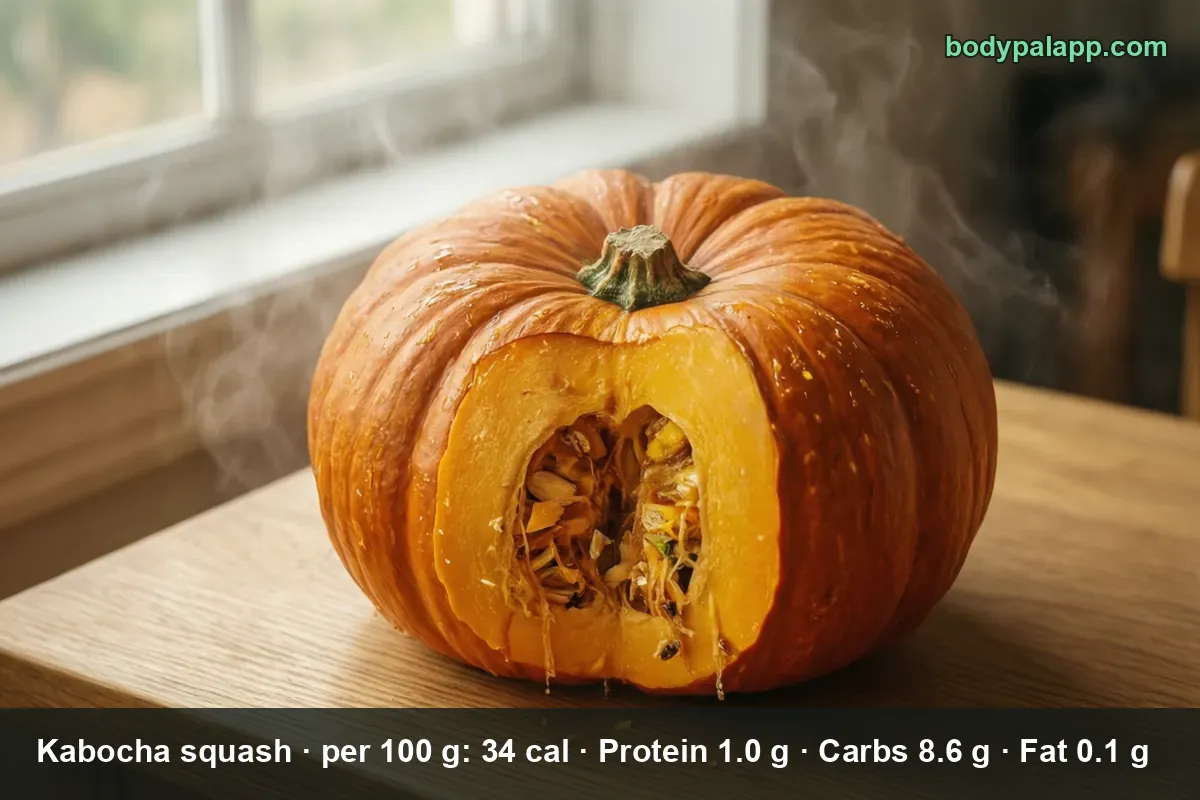
A 1-cup serving of raw kabocha squash cubes weighs 116 g and carries 39 calories. Per 100 g the flesh runs 34 calories. That is the number to hold on to, because roasting concentrates it, the cup gets heavier, and the same measuring cup can hand you almost twice the calories.
On this page
- Kabocha squash quick facts
- US servings, from one ounce to a whole pound
- Raw, roasted, salted and buttered
- Fiber and potassium are the rows that pay
- How does kabocha squash compare?
- Most popular kabocha squash brands
- Kabocha squash FAQs
Kabocha squash quick facts
There is no separate USDA record called "kabocha." The database groups it with its relatives in SR Legacy 170489, "Squash, winter, all varieties, raw", and that is the row used here, because the shopper weighing a kabocha is holding it raw: a whole globe, a halved one, or a bag of wedges. The one USDA entry that spells out kabocha by name is a produce label at 35 calories per 100 g, one calorie away from the grouped row, so the two agree.
The skin can be dark green with pale mottling or a deep orange-red, depending on the type in the bin. Neither changes the number. What changes it is water: the moment that flesh hits a hot oven, the math on this page shifts, and the section below has those figures.
| Nutrient | Per 100 g | Per 1 cup, cubes (116 g) | % Daily Value |
|---|---|---|---|
| Calories | 34 | 39 | — |
| Total fat | 0.13 g | 0.2 g | 0% |
| Saturated fat | 0.03 g | 0.0 g | 0% |
| Carbohydrate | 8.59 g | 10.0 g | 4% |
| Dietary fiber | 1.5 g | 1.7 g | 6% |
| Total sugars | 2.2 g | 2.6 g | — |
| Protein | 0.95 g | 1.1 g | 2% |
| Sodium | 4 mg | 5 mg | 0% |
% Daily Value is based on a 2,000-calorie diet.
Verified nutrition data
Numbers on this page come from USDA FoodData Central, the U.S. Department of Agriculture’s food composition database, and from manufacturer labels where a branded product is named. Last verified September 2026. How we verify our data →
There is no added sugars row here, because the SR Legacy edition of this record does not carry the field, and raw squash with nothing done to it has none to declare. Cholesterol is 0 mg, as it is in every plant food. Potassium is the standout: 350 mg per 100 g, or 406 mg in the cup, which is 9% of the FDA Daily Value of 4,700 mg.
US servings, from one ounce to a whole pound
| Serving | Weight | Calories |
|---|---|---|
| 1 oz | 28 g | 10 kcal |
| 1/2 cup, cubes | 58 g | 20 kcal |
| 1 cup, cubes | 116 g | 39 kcal |
| 2 cups, cubes | 232 g | 79 kcal |
| 1 lb, edible part | 454 g | 154 kcal |
| Per 100 g | 100 g | 34 kcal |
Only the 1-cup line is a USDA household measure. The half cup, the two cups, the ounce and the pound are our own arithmetic from the USDA 100 g figure, not USDA servings, and they are the ones people actually log: half a cup next to a protein, two cups as the base of a bowl, a pound because that is roughly what a wedge weighs at the register.
The pound line is the useful one when you buy a whole squash. Weigh what you cut, subtract nothing for the seeds you throw away, and every 100 g of flesh on the scale is 34 calories. A full pound of edible raw kabocha, seeds and stem already gone, is 154 calories.
Raw, roasted, salted and buttered
| Version | fdc_id | Per 100 g | Typical cup | Calories |
|---|---|---|---|---|
| Raw cubes | 170489 | 34 kcal | 1 cup, 116 g | 39 kcal |
| Baked, no salt | 170490 | 37 kcal | 1 cup, 205 g | 76 kcal |
| Baked, with salt | 170127 | 37 kcal | 1 cup, 205 g | 76 kcal |
| Cooked, no added fat | 2709694 | 37 kcal | 1 cup, 225 g | 83 kcal |
| Cooked, fat added | 2709695 | 59 kcal | 1 cup, 230 g | 136 kcal |
| Raw, survey record | 2709693 | 26 kcal | 1 cup, 140 g | 36 kcal |
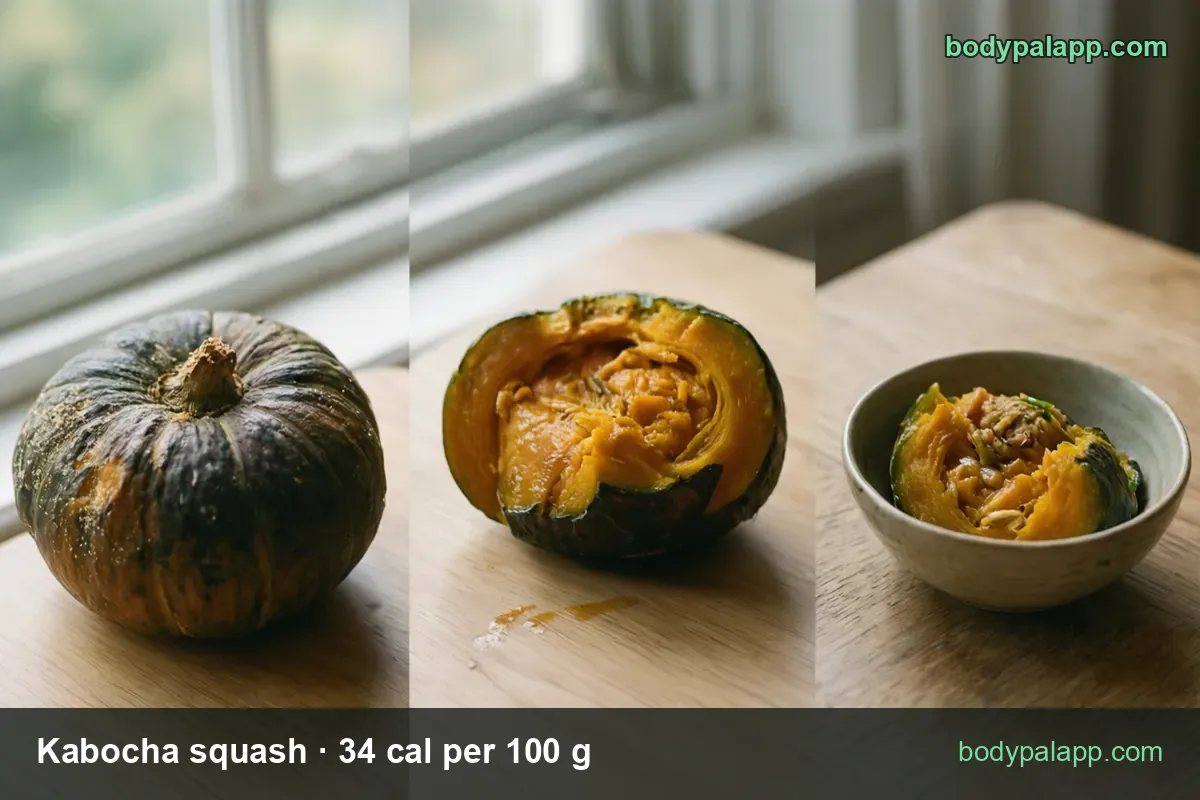
Here is the trap, and it is not the oven. Per 100 g, roasting takes kabocha from 34 to 37 calories — a rounding error on a dinner plate. But a cup of roasted cubes weighs 205 g, while a cup of raw cubes weighs 116 g, because the pieces soften and pack. Same cup, same squash, 39 calories against 76. The measuring cup lied, not the recipe.
Salt is the other thing worth separating. Records 170490 and 170127 are the same baked squash and carry identical calories, fat, carbs and fiber. The only line that moves is sodium: 1 mg per 100 g without salt, 237 mg with it. Everything in that jump came out of a shaker, not out of the vegetable.
Then there is the pan. The survey record cooked with fat added runs 59 calories per 100 g against 37 cooked plain, and per cup that is 136 against 83. The roughly 53-calorie gap — the two cup weights differ a little, 230 g versus 225 g — is larger than an entire cup of raw kabocha at 39 calories. The oil is the meal here; the squash is the excuse.
Store-brand frozen and packaged squash lands in the same neighborhood. A produce label for Earthbound Farm kabocha reads 35 calories per 100 g, with a 2/3-cup (85 g) serving at 30. Cascadian Farm's organic winter squash reads 36 per 100 g and Birds Eye's cooked winter squash 38, both at 45 calories for their half-cup serving — the differences are packing weight and cooking, not a different vegetable.
Fiber and potassium are the rows that pay
Fiber is where roasting quietly works in your favor. A cup of raw cubes gives 1.7 g, 6% of the 28 g Daily Value. A cup of roasted cubes, at 2.8 g per 100 g and 205 g to the cup, gives 5.7 g — 20% of the day's fiber for 76 calories. That is more than triple, and it comes from the same squash concentrating rather than from anything you added.
Sodium is the row to keep an eye on if you salt as you roast. A cup of the salted baked record carries about 486 mg of sodium, 21% of the 2,300 mg Daily Value, against 2 mg unsalted. That is roughly a fifth of a teaspoon of table salt on one cup of vegetable. If you are watching sodium, roast plain and salt at the table, where a smaller pinch does the same job on the tongue.
Potassium runs the other way, and it is the reason winter squash keeps showing up in the vegetable guidance at MyPlate. At 406 mg a cup raw, kabocha carries more potassium per calorie than most things you would put beside it — a nutrient the Dietary Guidelines for Americans flags as under-consumed in the US diet.
How does kabocha squash compare?
| Vegetable | Per 100 g | Protein | Carbs | Fat |
|---|---|---|---|---|
| Kabocha squash, raw | 34 kcal | 0.95 g | 8.59 g | 0.13 g |
| Pumpkin, canned, no salt | 34 kcal | 1.1 g | 8.09 g | 0.28 g |
| Broccoli, raw | 34 kcal | 2.82 g | 6.64 g | 0.37 g |
| Shiitake mushrooms, raw | 34 kcal | 2.24 g | 6.79 g | 0.49 g |
The USDA records for these three neighbors do not publish a gram weight for their household portions, so this table compares them per 100 g only — no per-serving column, rather than a guessed one.
Our take: all four land on exactly 34 calories per 100 g, which makes the choice a texture and macro question, not a calorie one. For weight loss, kabocha is the pick when you want something that eats like a starch — it carries the most carbohydrate of the four at 8.59 g and tastes sweet enough to stand in for potato at a fraction of the calories. For fullness at the same calorie count, broccoli wins on protein, close to three times kabocha's, and shiitake is not far behind. Put the kabocha where the starch would have gone and the broccoli beside it, and the plate does both jobs.
Most popular kabocha squash brands in the United States
Ranked by how widely each product appears among foods sold in the United States, from the BodyPal food database of over 3.3 million products. Calories are the figures printed on each Nutrition Facts label, checked against USDA FoodData Central.
| Product | Calories (per 100 g) |
|---|---|
| Earthbound Farm Kabocha Squash | 35 cal |
| Cascadian Farm Premium Organic Winter Squash | 36 cal |
| Birds Eye Cooked Winter Squash | 38 cal |
Brand popularity: BodyPal food database. Nutrition: manufacturer labels / USDA FoodData Central.
Kabocha squash FAQs
How many calories are in kabocha squash?
Raw kabocha squash is 34 calories per 100 g, and a 1-cup serving of cubes weighing 116 g comes to 39 calories. USDA groups it under Squash, winter, all varieties, raw. A kabocha-branded produce label reads 35 per 100 g, so the grouped figure holds up well.
How many calories are in 1 cup of kabocha squash?
39 calories for a cup of raw cubes, which USDA weighs at 116 g. A cup of roasted cubes is a different story: the softened pieces pack to 205 g, so the same cup carries 76 calories. Half a cup of raw cubes, 58 g, is 20 calories.
How many carbs are in kabocha squash?
10.0 g of carbohydrate in a 1-cup serving of raw cubes, which is 8.59 g per 100 g and 4% of the Daily Value. Of that cup, 1.7 g is fiber and 2.6 g is naturally occurring sugar. It is the most carb-dense of the vegetables compared on this page.
Does roasting kabocha squash add calories?
Barely, on its own: 37 calories per 100 g baked against 34 raw, the difference being water lost in the oven. What adds calories is the pan. The USDA record for winter squash cooked with fat added runs 59 calories per 100 g, or 136 for a 230 g cup.
How much fiber is in kabocha squash?
1.7 g in a cup of raw cubes, 6% of the 28 g Daily Value. Roasted, the number climbs to 5.7 g a cup, or 20%, because baked squash runs 2.8 g of fiber per 100 g and a cup of roasted cubes weighs 205 g instead of 116 g.
How many calories are in half a kabocha squash?
USDA does not publish a weight for a whole kabocha, so weigh the half instead: every 100 g of raw flesh is 34 calories, and a full pound of edible raw flesh is 154 calories by our own arithmetic from that figure. Seeds and stem do not count.
Is kabocha squash good for weight loss?
At 34 calories per 100 g it is one of the cheapest ways to make a plate look and eat like it has a starch on it. A 1-cup serving is 39 calories with 1.7 g of fiber. Roast it plain: the oil in a fat-added record costs more than the squash.
Is kabocha squash keto-friendly?
A cup of raw cubes holds 10.0 g of carbohydrate and 1.7 g of fiber, which is about 8.3 g of net carbs by our own subtraction. On a plan capped near 20 g a day that single cup is a large share of the budget, though half a cup at roughly 4 g fits more easily.
Similar foods
- Broccoli Crown — 50 cal per crown
- Broccoli Floret — 31 cal per cup
- Broccoli Head — 207 cal per head
- Pumpkin Puree — 42 cal for 1/2 cup
- Broccoli — 55 cal per cup chopped
- Cooked Broccoli — 27 cal per half cup
Count it without the math
Point the camera at the plate and BodyPal counts the squash for you, raw cubes or roasted wedges.


How long does it take to burn off kabocha squash?
A 1-cup (116 g) serving is 39 kcal. Enter your weight and the amount you ate to see how long it takes you to burn that off:
lb
| Activity | Time to burn 39 kcal |
|---|---|
| Walking, brisk | 8 min |
| Cycling, moderate | 5 min |
| Swimming, moderate | 6 min |
| Jogging | 5 min |
| Weight training, moderate | 9 min |
Times are for a 155 lb adult at a steady pace; change the weight to see yours. The amount is set to the portion in the text (116 g); change it to what you actually ate. BodyPal works this out from your steps automatically.
This table assumes you know your daily total. If you do not, the daily calorie calculator works it out from five numbers.