
How many calories are in pumpkin puree?
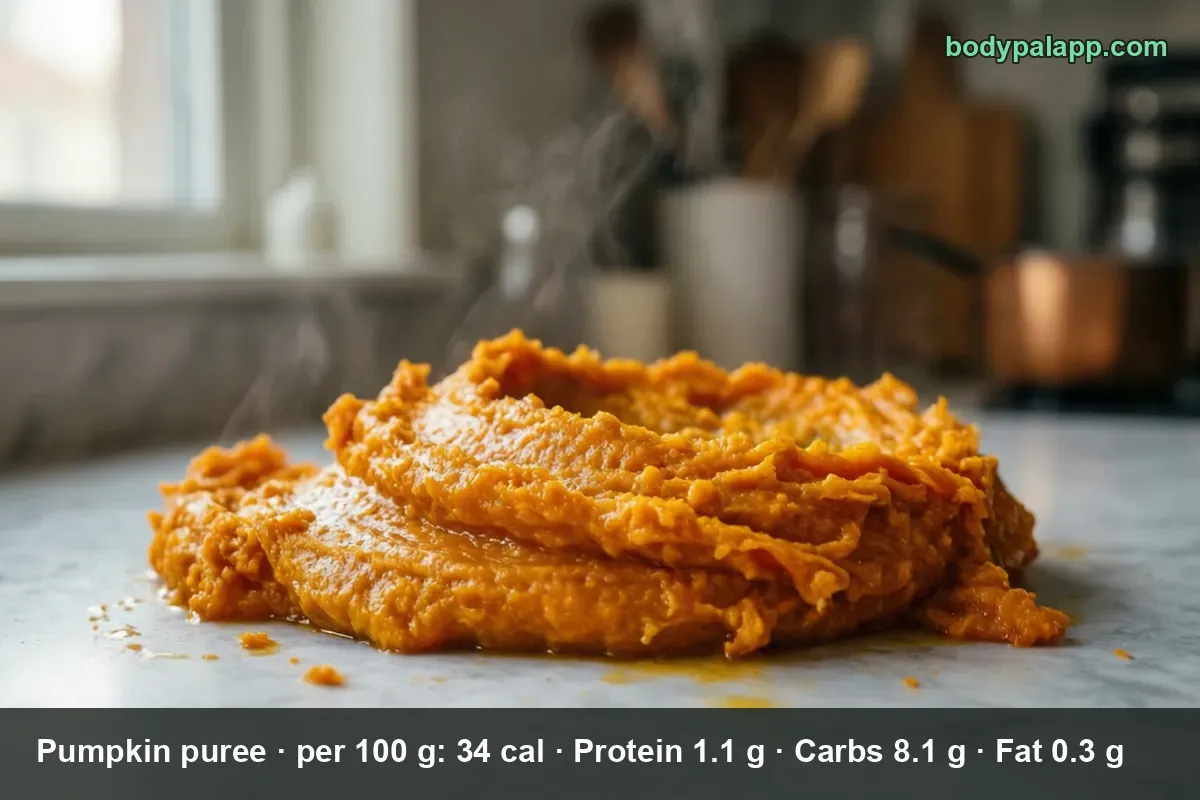
Half a cup of canned pumpkin puree — the serving printed on the can — is 42 calories. Per 100 g plain pumpkin puree runs 34 calories, one of the lowest numbers in the canned-goods aisle, and 3.6 g of that half cup is fiber. Nothing but pumpkin goes into the can.
On this page
- Pumpkin puree quick facts
- US servings from a tablespoon to the whole can
- Four other ways pumpkin lands in the bowl
- Fiber is the row that earns its place
- How does pumpkin puree compare?
- Most popular pumpkin puree brands
- FAQ
Pumpkin puree quick facts
The record that matches what you actually open is SR Legacy 168450, "Pumpkin, canned, without salt". That is the can labeled 100% pure pumpkin, with nothing stirred in. USDA also carries a salted canned row and two rows for fresh pumpkin that was boiled and mashed at home, and those come further down the page — same vegetable, different water content and different sodium.
The column below is scaled to the 1/2 cup (123 g) that the label uses, so the numbers should line up with the panel on the can in your hand.
| Nutrient | Per 100 g | Per 1/2 cup (123 g) | % Daily Value |
|---|---|---|---|
| Calories | 34 | 42 | — |
| Total fat | 0.28 g | 0.3 g | 0% |
| Saturated fat | 0.15 g | 0.2 g | 1% |
| Carbohydrate | 8.09 g | 10.0 g | 4% |
| Dietary fiber | 2.9 g | 3.6 g | 13% |
| Total sugars | 3.3 g | 4.1 g | — |
| Protein | 1.1 g | 1.4 g | 3% |
| Sodium | 5 mg | 6 mg | 0% |
% Daily Value is based on a 2,000-calorie diet.
Verified nutrition data
Numbers on this page come from USDA FoodData Central, the U.S. Department of Agriculture’s food composition database, and from manufacturer labels where a branded product is named. Last verified September 2026. How we verify our data →
There is no added sugars row here because the SR Legacy edition of this record does not publish that field at all. A can of plain pumpkin has none anyway — the 3.3 g of total sugars per 100 g is the vegetable's own. Cholesterol is 0 mg, and potassium comes in at 206 mg per 100 g, which works out to 253 mg per half cup, or 5% of the Daily Value.
US servings from a tablespoon to the whole can
Pumpkin puree gets measured two ways: by the spoon, when it goes into oatmeal or a smoothie, and by the can, when it goes into a pie or a pot of soup. Both are cheap.
| Serving | Weight | Calories |
|---|---|---|
| 1 tbsp | 15 g | 5 kcal |
| 1 oz | 28 g | 10 kcal |
| 1/4 cup | 61 g | 21 kcal |
| 1/2 cup, the label serving | 123 g | 42 kcal |
| 1 cup | 245 g | 83 kcal |
| One 15 oz can | 425 g | 145 kcal |
The 1 cup is the household measure USDA publishes for this food. The half cup on the label, the tablespoon, the ounce, the quarter cup and the whole can are our own arithmetic from the USDA 100 g figure, not USDA servings. The can matters most: 425 g of puree for 145 calories means a whole 15 oz can costs less than most single cookies, which is why it disappears into chili, pancake batter and dog bowls without moving anyone's daily total much.
Watch the spoon count, though. Four tablespoons stirred into oatmeal is only about 20 calories, but people rarely stop at four when the can is open.
Four other ways pumpkin lands in the bowl
| Version | Per 100 g | Typical serving | Calories |
|---|---|---|---|
| Canned, no salt added | 34 kcal | 1/2 cup (123 g) | 42 kcal |
| Canned, with salt | 34 kcal | 1/2 cup (123 g) | 42 kcal |
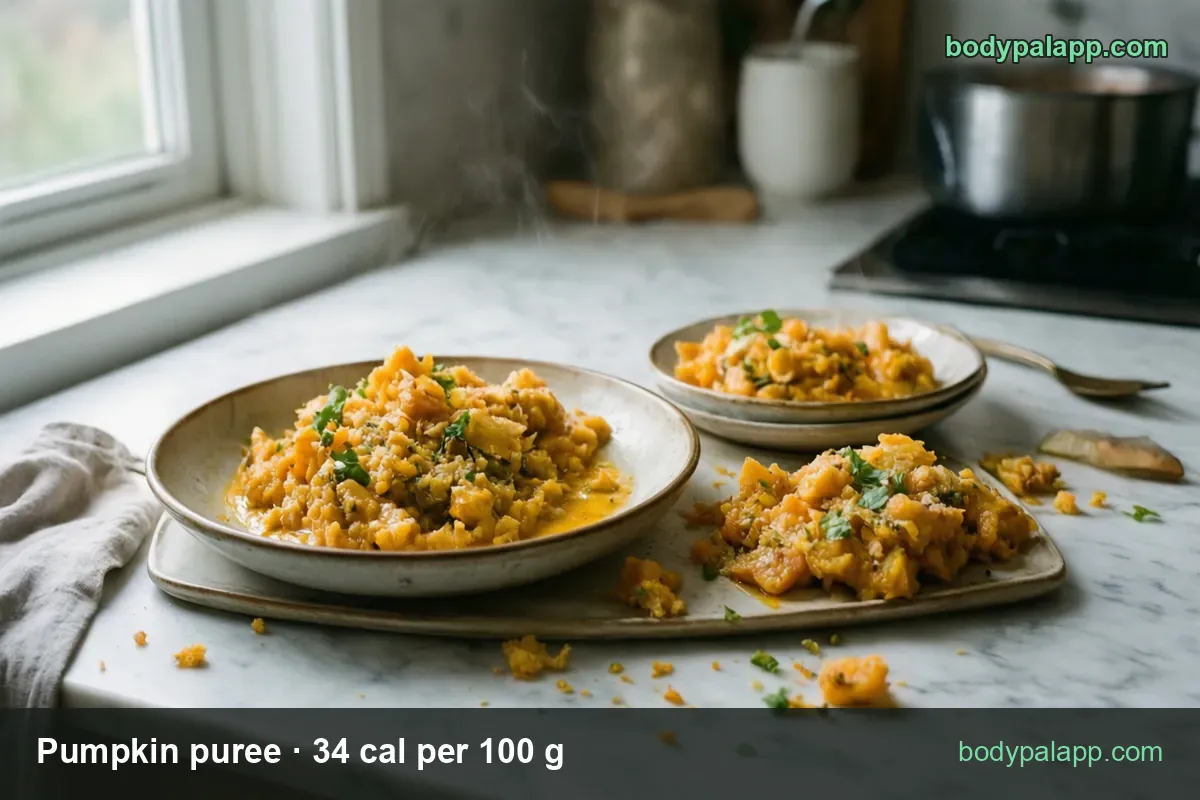
| Fresh, boiled and mashed, no salt | 20 kcal | 1 cup mashed (245 g) | 49 kcal |
| Fresh, boiled and mashed, with salt | 18 kcal | 1 cup mashed (245 g) | 44 kcal |
| Canned pumpkin cooked with fat | 56 kcal | 1 cup (245 g) | 137 kcal |
The salted can is the same food as the plain one, calorie for calorie. The only line that moves is sodium: 241 mg per 100 g against 5 mg, which is 296 mg in a half cup — 13% of the Daily Value, or roughly an eighth of a teaspoon of table salt — versus 6 mg and 0% for the no-salt-added can. If you are watching sodium, buy the plain can and salt the recipe yourself.
Fresh pumpkin that you roast or boil and mash yourself is the lighter option per spoon, 20 calories per 100 g against 34, because canning drives off water and concentrates everything. The canned puree is about 70% denser per 100 g as a result. USDA's salted fresh row lands slightly lower again at 18 calories per 100 g, a difference in its carbohydrate figure (4.31 g against 4.9 g) rather than anything the salt does.
The last row is the trap. Once pumpkin is cooked with butter or oil, USDA's FNDDS prepared record puts it at 56 calories per 100 g and 2.82 g of fat — 137 calories a cup, more than three times the plain half-cup serving. The fat in the pan, not the pumpkin, does all of that.
Store brands sit right on the USDA number. Pacific Foods Organic, 365 Everyday Value and Farmer's Market Organic all label 33 calories per 100 g, which is 41 calories for a 123 g half cup, while Goya lists 38 per 100 g, or 46 per 120 g label serving. The spread across the shelf is about five calories a serving.
Fiber is the row that earns its place
Calories are not the interesting number on this label — fiber is. A 1/2-cup serving delivers 3.6 g, which is 13% of the FDA Daily Value of 28 g, for 42 calories. That ratio is unusual. To get the same 3.6 g from fresh pumpkin you boiled and mashed yourself, you would need about 1 1/3 cups, roughly 65 calories, because fresh pumpkin carries only 1.1 g of fiber per 100 g against 2.9 g in the can.
The whole 15 oz can holds about 12.3 g of fiber, 44% of the Daily Value, for 145 calories. Very little else in the pantry does that.
Potassium is the quieter win. 253 mg per half cup is 5% of the Daily Value, and the NIH Office of Dietary Supplements notes that most American adults fall short of the recommended intake. Pumpkin will not fix that on its own, but a cup in a soup contributes about 505 mg. It also counts as a red and orange vegetable under MyPlate, which is a category most people underfill.
How does pumpkin puree compare?
| Food | Per 100 g | US serving | Calories |
|---|---|---|---|
| Canned pumpkin puree | 34 kcal | 1/2 cup (123 g) | 42 kcal |
| Winter squash, raw | 34 kcal | 1 oz (28 g) | 10 kcal |
| Acorn squash, boiled and mashed | 34 kcal | 1 oz (28 g) | 10 kcal |
| Broccoli, raw | 34 kcal | 1 oz (28 g) | 10 kcal |
All four land on exactly 34 calories per 100 g, and all four cost 10 calories an ounce. That is a genuinely rare tie, and it means calories are not the thing that separates them.
Our take: pick pumpkin puree for convenience and fiber, not because it is lighter — it is not. Raw broccoli beats it on protein, 2.82 g per 100 g against 1.1 g, and winter squash matches it spoon for spoon. What the can gives you is a cooked, smooth, shelf-stable vegetable you can add to anything at 42 calories a half cup, with no prep and no pan. For weight loss, the plain no-salt can is the version to keep; for a side dish, mashed acorn squash costs the same and tastes like more.
Most popular pumpkin puree brands in the United States
Ranked by how widely each product appears among foods sold in the United States, from the BodyPal food database of over 3.3 million products. Calories are the figures printed on each Nutrition Facts label, checked against USDA FoodData Central.
| Product | Calories (per 100 g) |
|---|---|
| Pacific Foods Organic Pumpkin Puree | 33 cal |
| 365 Everyday Value Pumpkin Puree | 33 cal |
| Goya Pumpkin Puree | 38 cal |
| 365 Whole Foods Market Pumpkin Puree | 33 cal |
| Farmer's Market Organic Pumpkin Puree | 33 cal |
Brand popularity: BodyPal food database. Nutrition: manufacturer labels / USDA FoodData Central.
Pumpkin puree FAQs
How many calories are in 1/2 cup of pumpkin puree?
A 1/2-cup serving weighs 123 g and comes to 42 calories, using the USDA figure of 34 calories per 100 g. That half cup carries 10.0 g of carbohydrate, 3.6 g of fiber and 1.4 g of protein. It is the serving size printed on most cans of pure pumpkin.
How many calories are in a whole can of pumpkin puree?
A 15 oz can holds 425 g, which works out to 145 calories - our own arithmetic from the USDA 100 g figure, not a USDA serving. The whole can also delivers about 12.3 g of fiber, or 44% of the Daily Value, which is more than most people get from a full meal.
Is pumpkin puree the same as pumpkin pie filling?
Pure canned pumpkin is 34 calories per 100 g with 3.3 g of total sugars and no added sugar. Pumpkin pie filling is a different product, sweetened and spiced, and USDA lists it under its own record, so none of the numbers on this page apply to it. Check the can says 100% pumpkin.
How many carbs are in pumpkin puree?
Canned pumpkin puree has 8.09 g of carbohydrate per 100 g, so a 1/2-cup serving carries 10.0 g, which is 4% of the Daily Value. Of that, 3.6 g is fiber and 4.1 g is naturally occurring sugar, leaving about 6.4 g of net carbohydrate in the half cup.
How much fiber is in canned pumpkin?
Canned pumpkin has 2.9 g of fiber per 100 g, which makes 3.6 g in a 1/2-cup serving, or 13% of the 28 g Daily Value, for only 42 calories. Very few pantry foods put that much fiber behind so few calories, which is why the can turns up in oatmeal and smoothies.
Is canned pumpkin healthier than fresh pumpkin?
Canned is denser: 34 calories per 100 g against 20 for fresh pumpkin boiled and mashed, because canning drives off water. Fiber follows the same pattern, 2.9 g against 1.1 g per 100 g. Neither is healthier as such - canned is more concentrated per spoon, fresh is more filling per calorie.
Does pumpkin puree have added sugar?
Plain canned pumpkin has 3.3 g of total sugars per 100 g, or 4.1 g per 1/2 cup, and all of it comes from the vegetable itself. The USDA SR Legacy record does not publish an added sugars figure at all, and a can labeled 100% pumpkin has none by definition.
Is pumpkin puree good for weight loss?
At 42 calories per 1/2 cup with 3.6 g of fiber, pumpkin puree is one of the cheapest ways to add bulk to a meal. Stirred into oatmeal or yogurt it adds volume for very little. If you are watching calories, the plain can beats pie filling, which is sweetened.
Similar foods
- Broccoli Crown — 50 cal per crown
- Broccoli Floret — 31 cal per cup
- Broccoli Head — 207 cal per head
- Kabocha Squash — 39 cal per cup cubes
- Broccoli — 55 cal per cup chopped
- Cooked Broccoli — 27 cal per half cup
Count it without the math
Point the camera at the bowl and BodyPal counts the pumpkin for you, spoon by spoon.


How long does it take to burn off pumpkin puree?
A 1/2-cup (123 g) serving is 42 kcal. Enter your weight and the amount you ate to see how long it takes you to burn that off:
lb
| Activity | Time to burn 42 kcal |
|---|---|
| Walking, brisk | 8 min |
| Cycling, moderate | 5 min |
| Swimming, moderate | 6 min |
| Jogging | 5 min |
| Weight training, moderate | 9 min |
Times are for a 155 lb adult at a steady pace; change the weight to see yours. The amount is set to the portion in the text (123 g); change it to what you actually ate. BodyPal works this out from your steps automatically.
Want the bigger picture? Calculate your daily calorie needs — your maintenance figure, a target for losing or gaining, and the date you get there.