
How many calories are in summer squash?
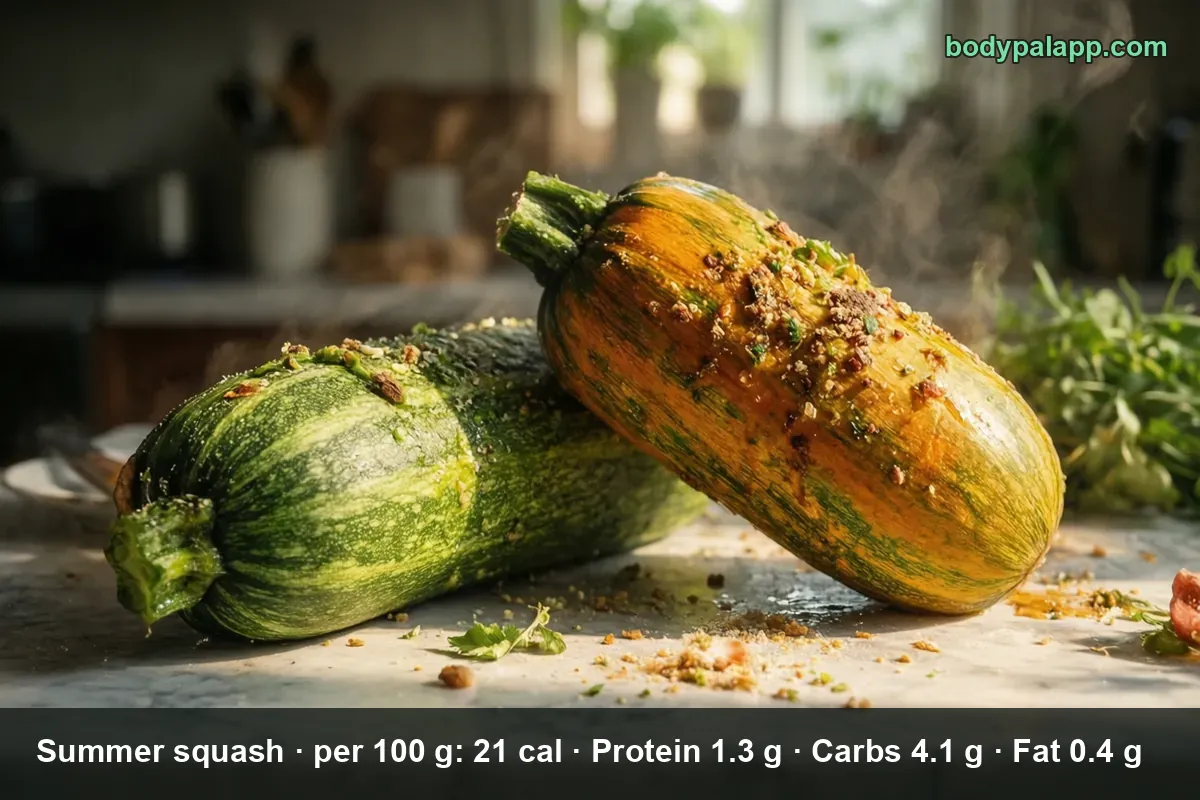
A cup of cooked summer squash, 180 g of it, is 38 calories. Per 100 g the plain cooked vegetable is 21 calories, one of the lowest numbers in the produce aisle. A whole squash of 200 g comes to 42 calories. What changes the total is the pan, not the squash.
On this page
- Summer squash quick facts
- US servings from one slice to a cup of mash
- From raw to deep fried
- Sodium is the row that surprises people
- How does summer squash compare?
- Most popular summer squash brands
- Summer squash FAQs
Summer squash quick facts
The record on this page is FNDDS 2709991, "Summer squash, yellow or green, fresh, cooked, no added fat". That is the squash most people actually eat: sliced or halved, steamed or roasted or thrown in a skillet dry, with the fat added at the table rather than in the pan. USDA keeps yellow crookneck and green zucchini in one entry here, because once they are cooked their numbers sit within a rounding error of each other.
Raw squash and the versions cooked in oil or butter are separate USDA records, and they are all in the tables further down. They differ by preparation, not by source, so nothing here is averaged between databases.
| Nutrient | Per 100 g | Per 1 cup (180 g) | % Daily Value |
|---|---|---|---|
| Calories | 21 | 38 | — |
| Total fat | 0.35 g | 0.6 g | 1% |
| Saturated fat | 0.1 g | 0.2 g | 1% |
| Carbohydrate | 4.1 g | 7.4 g | 3% |
| Dietary fiber | 1.2 g | 2.2 g | 8% |
| Total sugars | 3.16 g | 5.7 g | — |
| Protein | 1.3 g | 2.3 g | 5% |
| Sodium | 142 mg | 256 mg | 11% |
% Daily Value is based on a 2,000-calorie diet.
Verified nutrition data
Numbers on this page come from USDA FoodData Central, the U.S. Department of Agriculture’s food composition database, and from manufacturer labels where a branded product is named. Last verified September 2026. How we verify our data →
Two rows you would see on a package are missing here: added sugars and trans fat. USDA does not publish either nutrient for the FNDDS vegetable records, so listing them would mean inventing them. Cholesterol is a clean zero, as it is for every plain vegetable, and potassium is the quiet win at 509 mg a cup, 11% of the Daily Value.
Look at the fiber row against the calorie row. A cup delivers 8% of a day's fiber for under 2% of a 2,000-calorie day. Very few foods trade that well.
US servings from one slice to a cup of mash
| Serving | Weight | Calories |
|---|---|---|
| 1 slice | 10 g | 2 kcal |
| 1 oz | 28 g | 6 kcal |
| 1 cup, sliced | 180 g | 38 kcal |
| 1 whole squash | 200 g | 42 kcal |
| 1 cup, mashed | 240 g | 50 kcal |
| Per 100 g | 100 g | 21 kcal |
The cup, the whole squash, the slice and the mashed cup are USDA household measures attached to that FNDDS record. The ounce is our own arithmetic from the USDA 100 g figure, not a USDA serving, because nobody weighs squash in ounces but recipes still call for them.
The mashed cup is the trap. Mashing packs 240 g into the same cup that held 180 g of slices, so the cup goes from 38 to 50 calories without a single extra piece of squash. Same food, denser packing, a third more calories. If you log by cup rather than by scale, note which one you had.
From raw to deep fried
| Version | Per 100 g | Typical serving | Calories |
|---|---|---|---|
| Raw green summer squash | 17 kcal | 1 cup sliced, 115 g | 20 kcal |
| Raw yellow summer squash | 19 kcal | 100 g | 19 kcal |
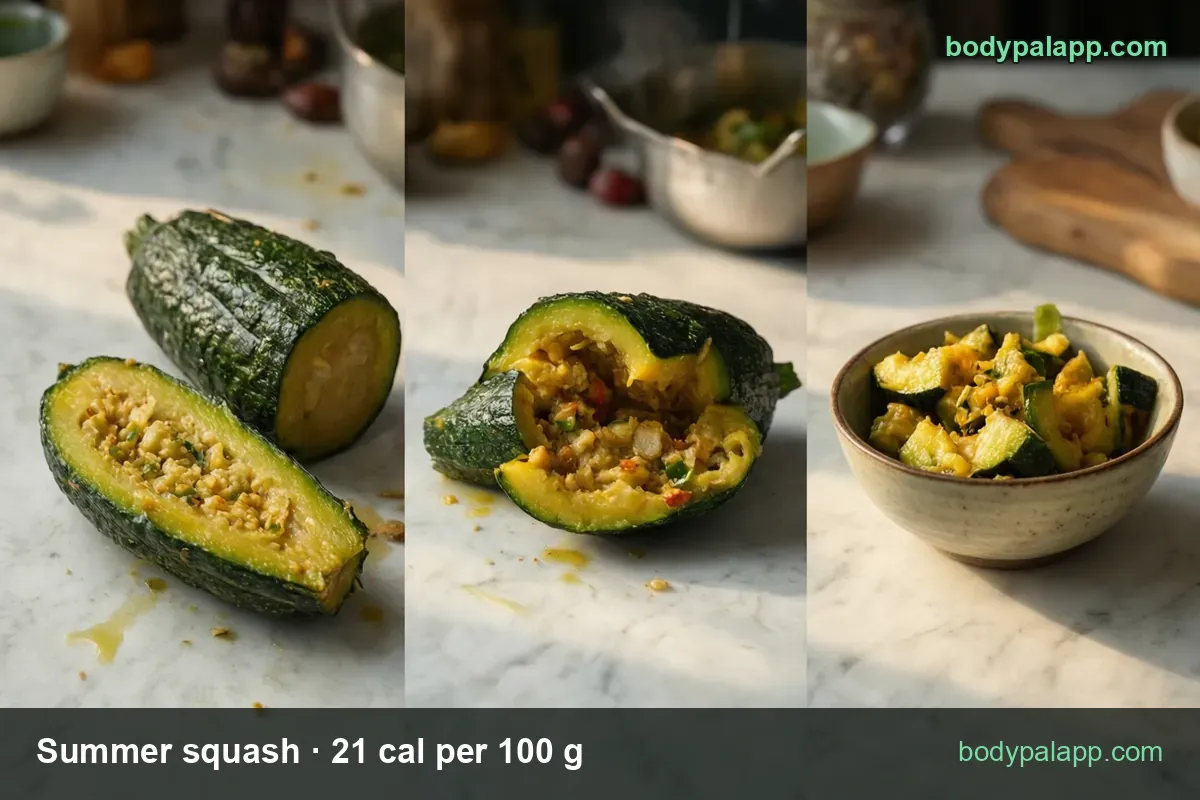
| Cooked plain, no added fat | 21 kcal | 1 cup, 180 g | 38 kcal |
| Frozen, cooked, no added fat | 21 kcal | 100 g | 21 kcal |
| Cooked with butter or margarine | 44 kcal | 1 cup, 185 g | 81 kcal |
| Sauteed in oil | 51 kcal | 1 cup, 185 g | 94 kcal |
| Fried, breaded | 216 kcal | 100 g | 216 kcal |
Raw is lower than cooked, which surprises people who expect cooking to burn something off. Water leaves the flesh in the pan, so what remains is slightly more concentrated: 17 calories per 100 g raw green becomes 21 cooked. It is the same squash, weighed drier.
The oil is where the real money goes. A skillet cup sauteed in oil is 94 calories against 38 for the plain cup, roughly two and a half times, and the squash contributed none of the difference. Butter lands a little softer at 81 calories a cup, though it brings saturated fat, 1.21 g per 100 g against 0.1 g for the plain record.
Breaded and deep fried, summer squash stops behaving like a vegetable at all: 216 calories per 100 g, more than ten times the plain figure, with fat at 12.88 g and carbohydrate at 21.5 g from the coating. The fiber barely moves, 1.2 g, which tells you exactly what got added.
Frozen squash is worth a line. Cooked with no added fat it matches fresh at 21 calories per 100 g, with a touch more fiber, 1.3 g, and fewer sugars, 2 g, because blanching before freezing costs it some of them. It is not a compromise ingredient.
Pre-cut supermarket squash reads even lower than the cooked record, since it is sold raw: spiralized noodles and coins from Whole Foods Market, The Pick and Created Fresh all label 18 calories per 100 g, which is 15 calories for an 85 g serving. The seasoned exception is Open Acres Summer Squash and Onion Griller at 53 calories per 100 g, or 60 for a 4 oz (113 g) pack serving, since the oil is already in the tray.
Sodium is the row that surprises people
Plain raw green summer squash carries 8 mg of sodium per 100 g. Cooked, the same USDA family reads 142 mg. Nothing in the vegetable changed. The salted cooking water did. A cup therefore lands at 256 mg, 11% of the FDA Daily Value of 2,300 mg, which is more of your day's sodium than the same cup gives you of fiber.
In kitchen terms 256 mg is roughly a tenth of a teaspoon of table salt, our own conversion from the sodium figure. That is not alarming on its own, and the FDA Daily Value reference exists precisely so a single side dish can be read in context. But if you are watching sodium, steaming or roasting unsalted brings the row back near the raw figure, and the fried version runs the other way at 317 mg per 100 g.
The nicer number in the same column is potassium: 509 mg a cup, also 11% of the Daily Value, which is the sort of trade MyPlate's vegetable guidance is built around.
How does summer squash compare?
| Vegetable, cooked | Per 100 g | Protein | Carbohydrate | Fat |
|---|---|---|---|---|
| Summer squash, no added fat | 21 kcal | 1.3 g | 4.1 g | 0.35 g |
| Cucumber, cooked | 45 kcal | 0.72 g | 3.37 g | 3.2 g |
| Green peppers, cooked | 47 kcal | 0.74 g | 4.83 g | 2.76 g |
| Broccoli and cauliflower, fat added | 46 kcal | 2.29 g | 4.41 g | 2.71 g |
USDA's index does not attach gram weights to the household servings for those three neighbors, so there is no honest per-serving calorie column to publish for them. Per 100 g is the fair comparison anyway.
Our take: summer squash at 21 calories per 100 g is less than half of any of the three, and the reason is visible in the fat column, where it sits at 0.35 g while the others run near 3 g. Those records assume a cooking fat; ours does not. For volume on a plate while cutting, plain summer squash is close to unbeatable, and the cup of mash is the cheapest way to make a bowl look full. For staying full, take the broccoli and cauliflower instead, since 2.29 g of protein per 100 g nearly doubles what squash gives you. The honest summary is that summer squash is a carrier, not a meal, and what you cook it in decides everything.
Most popular summer squash brands in the United States
Ranked by how widely each product appears among foods sold in the United States, from the BodyPal food database of over 3.3 million products. Calories are the figures printed on each Nutrition Facts label, checked against USDA FoodData Central.
| Product | Calories (per 100 g) |
|---|---|
| Whole Foods Market Summer Squash Noodles | 18 cal |
| Whole Foods Market Sliced Zucchini and Summer Squash | 18 cal |
| Whole Foods Market Zucchini & Summer Squash Noodles | 18 cal |
| Open Acres Summer Squash & Onion Griller Fresh Vegetables | 53 cal |
| The Pick Summer Squash Noodles | 18 cal |
| Created Fresh Summer Squash Coins | 18 cal |
Brand popularity: BodyPal food database. Nutrition: manufacturer labels / USDA FoodData Central.
Summer squash FAQs
How many calories are in 1 cup of cooked summer squash?
One cup of cooked summer squash, 180 g with no added fat, is 38 calories. That works out to 21 calories per 100 g. The same cup carries 7.4 g of carbohydrate, 2.2 g of fiber and 2.3 g of protein, so it fills a plate without moving a calorie target much.
How many calories are in a whole summer squash?
A whole summer squash of about 200 g comes to 42 calories cooked plain, four more than a cup of slices. Squash sold loose ranges widely in size, so weigh yours if it looks big; every extra 100 g adds only 21 calories anyway.
How many calories are in raw summer squash?
Raw green summer squash is 17 calories per 100 g, and a cup of raw slices at 115 g is 20 calories. Raw yellow squash is 19 per 100 g. Cooking without fat concentrates the flesh slightly, which is why the cooked record reads 21 rather than 17.
Is yellow squash lower in calories than green summer squash?
Green is the lighter one, but barely: 17 calories per 100 g raw against 19 for yellow. The gap is two calories per 100 g, which no kitchen decision really hinges on. Yellow carries slightly more carbohydrate, 3.88 g against 3.11 g, and slightly less protein. Cooked side by side, nobody could tell them apart.
Does sauteing summer squash in oil add many calories?
Yes, a cup sauteed in oil, 185 g, is 94 calories, against 38 for a 180 g cup cooked plain, because oil pushes the record from 21 to 51 calories per 100 g. Butter sits between them at 44 per 100 g, or 81 calories for that same 185 g cup.
How many calories are in fried summer squash?
Breaded and deep fried, summer squash is 216 calories per 100 g, more than ten times the 21 of the plain cooked vegetable. The fat goes from 0.35 g to 12.88 g and the carbohydrate from 4.1 g to 21.5 g, because the coating is flour, not squash.
How many carbs are in summer squash?
A cup of cooked summer squash holds 7.4 g of carbohydrate, 3% of the Daily Value, with 2.2 g of that as fiber. Per 100 g it is 4.1 g. Subtract the fiber, our own arithmetic, and about 5.2 g of net carbohydrate is left in a cup.
Is summer squash the same as zucchini?
Zucchini is one kind of summer squash, so the USDA record used here, 21 calories per 100 g cooked, covers both green zucchini and yellow crookneck. The agency lists them together as yellow or green. Raw, the green runs 17 calories per 100 g and the yellow 19.
Similar foods
- Yellow Squash — 42 cal per squash
- Asparagus — 20 cal per half cup
- Bok Choy — 23 cal per head
- Mushrooms — 15 cal per cup sliced
- Portobello Mushroom — 18 cal per whole cap
- Shishito Peppers — 18 cal for 12 peppers
Count it without the math
Point the camera at the plate and BodyPal counts the squash for you, oil and all.


How long does it take to burn off summer squash?
A 1-cup (180 g) serving is 38 kcal. Enter your weight and the amount you ate to see how long it takes you to burn that off:
lb
| Activity | Time to burn 38 kcal |
|---|---|
| Walking, brisk | 8 min |
| Cycling, moderate | 5 min |
| Swimming, moderate | 5 min |
| Jogging | 4 min |
| Weight training, moderate | 8 min |
Times are for a 155 lb adult at a steady pace; change the weight to see yours. The amount is set to the portion in the text (180 g); change it to what you actually ate. BodyPal works this out from your steps automatically.
Want the bigger picture? Calculate your daily calorie needs — your maintenance figure, a target for losing or gaining, and the date you get there.